Pink Granite


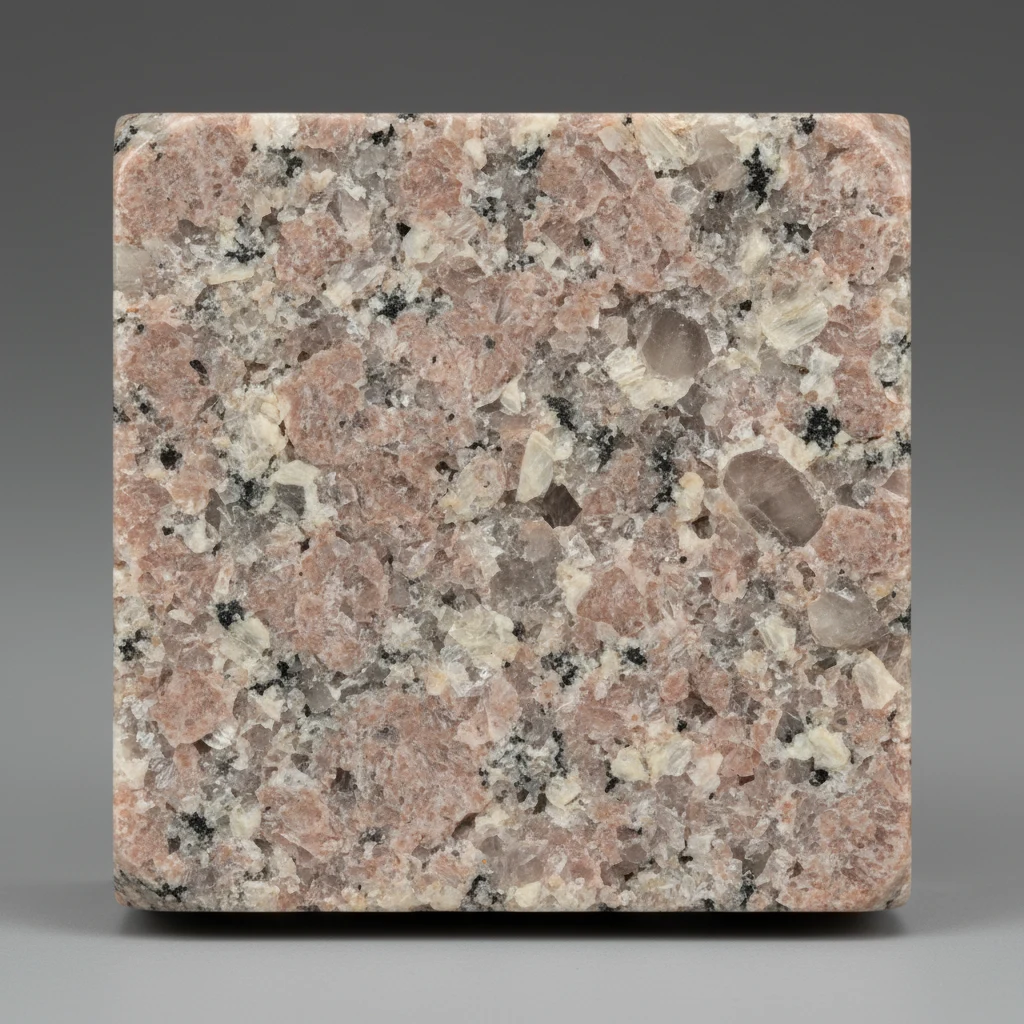
Quick answer: Pink granite is an intrusive igneous rock with visible quartz, feldspar, and mica grains. Its pink color usually comes from potassium feldspar, while quartz appears glassy gray to clear and dark minerals may appear as black or green specks.
AI Rock ID can help screen a pink granite photo by checking visible grain texture, color distribution, and likely mineral mix. RockIdentifier.io provides visual identification support, but a hand lens, hardness check, and geologic context can improve confidence for granite and similar rocks.
Good fit
- Collectors who want a durable, common igneous rock with visible mineral grains
- Students learning to identify quartz, feldspar, and mica in hand samples
- Decorative stone users who prefer a pink, speckled natural rock
- Beginner rockhounds looking for a recognizable continental crust rock
Not a good fit
- Anyone seeking a single-mineral crystal rather than a multi-mineral rock
- Collectors who require rare or gem-grade mineral specimens
- Projects where acid sensitivity testing is the main identification method
- Situations where exact quarry origin must be proven without documentation
Most commonly confused with
- Rhyolite: Rhyolite can be pink but is usually fine-grained or flow-banded, unlike coarse-grained granite.
- Pegmatite: Pegmatite has much larger interlocking crystals and may contain unusual accessory minerals.
- Granite Gneiss: Granite gneiss often shows banding or foliation from metamorphism, while granite is generally massive and granular.
- Syenite: Syenite can look pink and feldspar-rich but contains little or no quartz compared with true granite.
Pink Granite Lookalike Comparison
| Material | Typical Texture | Key Difference | Quartz Content |
|---|---|---|---|
| Pink Granite | Coarse, interlocking grains | Pink feldspar with glassy quartz and dark mica/amphibole specks | Common |
| Rhyolite | Fine-grained or porphyritic | Volcanic equivalent of granite, often less visibly granular | Common but often microscopic |
| Pegmatite | Very coarse crystals | Individual crystals can be centimeters or larger | Common |
| Granite Gneiss | Banded or foliated | Minerals aligned by metamorphic pressure | Common |
| Syenite | Coarse, feldspar-rich | Usually lacks obvious quartz grains | Low to absent |
AI identification confidence
AI identification confidence is often moderate to high when the photo clearly shows coarse, interlocking pink feldspar, gray quartz, and dark mineral grains. Confidence drops when the sample is polished, wet, strongly weathered, or photographed too close for grain relationships to be visible.
When AI gets it wrong
- A polished countertop sample may resemble natural granite but could be engineered stone or a granite trade-name material.
- Fine-grained pink volcanic rocks can be mislabeled as granite if scale is not visible.
- Granite gneiss may be mistaken for granite when banding is subtle or the photo shows only a small area.
- Lighting can make tan, orange, or red feldspar appear pink and change the apparent rock type.
Final recommendation
For buying a specimen, choose pieces with visible interlocking grains and a natural mix of pink feldspar, glassy quartz, and dark minerals. Ask for locality information if provenance matters, because many commercial pink granites are sold by trade name rather than precise geologic source.
How to Check Pink Granite Authenticity
Real pink granite should show interlocking mineral grains rather than a printed, painted, or perfectly repeating pattern. A hand lens may reveal glassy quartz, blocky pink feldspar, and small dark mica or amphibole grains. Natural granite is hard enough to resist scratching by a steel nail in many cases, though individual minerals and weathered surfaces can vary.
Buying Pink Granite Specimens
Small collector pieces are usually inexpensive because pink granite is common in many continental regions. Price is more affected by size, polish quality, locality documentation, and unusual texture than by the pink color alone. For educational use, an unpolished or lightly cut surface is often more useful than a highly polished slab.
Field Clues for Identifying Pink Granite
Pink granite commonly forms large, massive outcrops, boulders, or quarry blocks rather than thin layers. Look for a granular texture where differently colored minerals are locked together like a mosaic. The presence of visible quartz helps separate granite from feldspar-rich rocks that contain little quartz.
What Is Pink Granite?
Pink Granite is a common, light-colored igneous rock made mainly of quartz and feldspar. In the hand, it feels solid and granular rather than glassy-smooth, with pink to reddish feldspar grains set among gray and white mineral areas. Its Mohs hardness is 6-7, so a fresh piece usually feels tough, durable, and resistant to casual scratching.
Collectors value Pink Granite more for texture, color, and cultural familiarity than for rarity. It is an opaque, feldspar-rich igneous rock with vitreous luster, uneven fracture, white streak, and a density of 2.63-2.75 g/cm3. Typical colors include pink, gray, and white, with the pink tone coming from the feldspar content.
Origin & History
Pink Granite gets its name from granite, a word derived from the Latin “granum,” meaning grain. That name fits the specimen immediately: look closely and you see a coarse, grain-by-grain fabric rather than a single crystal face. The rock’s visible crystals give it the sturdy, speckled appearance collectors expect from granite.
Granite has been used in construction for thousands of years, and Pink Granite carries that same long association with strength and permanence. When documenting a specimen, collectors can compare locality names and geological context with mindat.org, especially for labels tied to well-known granite regions or historic building-stone sources.
Where Is Pink Granite Found?
Pink Granite is commonly found in continental crust regions. Reported countries include the United States, Brazil, and India, and notable United States localities include Mount Rushmore in South Dakota, the Sierra Nevada in California, and the Granite Mountains in Wyoming.
Formation
Pink Granite forms by the slow crystallization of magma beneath the Earth’s surface. That slow cooling is the reason the rock is coarse-grained: minerals have enough time to grow into visible crystals instead of freezing into a fine, uniform mass.
The main chemical components are listed as SiO2, Al2O3, K2O, Na2O, and CaO, with silicon, oxygen, aluminum, potassium, sodium, and calcium present. Common impurities include iron and manganese. In practical terms, the result is a hard, stable, feldspar-rich igneous rock with a pink cast and excellent durability in varied environments.
How to Identify Pink Granite
Identify Pink Granite by its pink to reddish feldspar color and coarse-grained texture. A good hand specimen should show visible mineral grains rather than a uniform surface, often mixing pink, gray, and white areas. Its luster ranges from glassy to dull, and it is opaque, with a generally vitreous appearance on fresh mineral surfaces.
Pink Granite is not assigned to a crystal system because it is an aggregate of minerals, not a single crystal species. Useful checks include its Mohs hardness of 6-7, white streak, non-magnetic behavior, uneven fracture, and excellent scratch resistance. Scratch tests can support identification, especially when paired with color and texture observations.
Properties of Pink Granite
Physical Properties
| Crystal System | Granite is not classified into a crystal system as it is an aggregate of minerals. |
| Hardness (Mohs) | 6-7 (Medium) |
| Density | 2.63-2.75 g/cm3 |
| Luster | Vitreous |
| Diaphaneity | Opaque |
| Fracture | Uneven |
| Streak | White |
| Magnetism | Non-magnetic |
| Colors | Pink, Gray, White |
Chemical Properties
| Classification | Feldspar-rich igneous rock |
| Formula | Mainly SiO2, Al2O3, K2O, Na2O, CaO |
| Elements | Si, O, Al, K, Na, Ca |
| Common Impurities | Fe, Mn |
Optical Properties
| Refractive Index | N/A |
| Birefringence | None |
| Pleochroism | None |
| Optical Character | Isotropic |
Pink Granite Health & Safety
There are no significant health risks associated with handling pink granite.
Pink Granite Value & Price
Price Range
Rough/Tumbled: $50 - $150 per specimen
Cut/Polished:
Price is affected by quality, color, and origin.
Durability
Very Durable — Scratch resistance: Excellent, Toughness: Excellent
Pink granite is stable in various environments.
How to Care for Pink Granite
Use & Storage
Store in a dry place to avoid moisture.
Cleaning
Clean with mild soap and water using a soft cloth. Avoid harsh chemicals.
Cleanse & Charge
Cleanse by rinsing in water and placing in sunlight for a few hours.
Placement
Place in living spaces for aesthetic and grounding purposes.
Caution
Avoid exposing to extreme temperature changes.
Works Well With
Pink Granite Meaning & Healing Properties
In crystal healing traditions, Pink Granite is used as a grounding and stability stone. Its weight, durability, and feldspar-pink color make it feel steady in the palm, so practitioners often choose it for emotional strength, inner peace, protection, trust, meditation, and self-discovery work.
Pink Granite is associated with the Root and Heart chakras, the Earth element, and the planet Earth. Zodiac links include Capricorn and Taurus. For care, clean it with mild soap and water using a soft cloth, avoid harsh chemicals and extreme temperature changes, and store it in a dry place after rinsing or cleansing.
Identify Pink Granite from a photo
Compare Pink Granite traits, care tips, value clues, and common lookalikes with a clear photo.
Common mistakes
- Calling any pink, speckled decorative stone true granite without checking mineral content
- Ignoring grain size and confusing fine-grained rhyolite with coarse-grained granite
- Assuming all commercial stones sold as granite meet the strict geologic definition
- Mistaking banded granite gneiss for unmodified granite
- Using color alone instead of checking quartz, feldspar, dark minerals, and texture