Red Beryl


Quick answer: Red beryl is a rare beryllium aluminum silicate colored by trace manganese, most famously from Utah. For identification, the strongest clues are its hexagonal crystal habit, high hardness, red to purplish-red color, and the need to separate it from red corundum, garnet, spinel, and treated stones.
AI Rock ID can help screen a red crystal by comparing visible color, habit, luster, and surface features against known minerals. RockIdentifier.io should be used as a first-pass identification aid, while valuable or rare red beryl should be confirmed by a qualified gemologist or mineral laboratory.
Good fit
- Collectors interested in rare beryl-group minerals
- People comparing red stones that may be ruby, spinel, garnet, or red beryl
- Specimen buyers who want to check crystal habit and matrix clues before purchase
- Gem enthusiasts researching rare American mineral localities
Not a good fit
- Anyone seeking a low-cost red gemstone for frequent wear
- Buyers unwilling to request documentation for expensive specimens
- Situations where visual identification alone is being treated as proof of authenticity
Most commonly confused with
- Ruby: Ruby is red corundum with Mohs 9 hardness and no beryl-family hexagonal prism chemistry.
- Red Spinel: Red spinel is singly refractive and commonly occurs as octahedral crystals rather than beryl prisms.
- Garnet: Many red garnets have a deeper wine-red tone, different crystal forms, and lower typical refractive behavior than red beryl.
- Pezzottaite: Pezzottaite is a separate cesium-rich beryl-related mineral that is usually raspberry pink to reddish pink.
Red Beryl vs Common Red Lookalikes
| Material | Typical Clue | Key Difference |
|---|---|---|
| Red Beryl | Hexagonal prisms; red to purplish red | Beryl-group mineral with Mohs 7.5-8 |
| Ruby | Bright red corundum; often fluorescent | Harder at Mohs 9 and different mineral species |
| Red Spinel | Octahedral crystals; high luster | Cubic mineral, not beryl |
| Garnet | Dodecahedral or granular crystals | Usually lacks beryl’s hexagonal prism habit |
| Red Glass | Bubbles or overly even color | Amorphous material, not a natural crystal |
AI identification confidence
AI identification confidence for red beryl is usually moderate at best from photos because several red gems share similar color and luster. Confidence improves when the image shows crystal shape, matrix, locality information, scale, and multiple angles in natural light.
When AI gets it wrong
- The photo shows only a polished red stone with no crystal habit or inclusions visible
- Strong lighting, filters, or saturation make ruby, garnet, spinel, and glass appear similar
- A specimen is mounted in jewelry and key diagnostic areas are hidden
- The seller label or claimed locality is accepted without independent evidence
Final recommendation
Treat any high-value red beryl claim as provisional until supported by gemological testing or reliable provenance. For purchases, prioritize clear photos, locality details, return terms, and documentation over color alone.
How to Check Red Beryl Authenticity
Authentic red beryl should be evaluated using more than color, because many red gemstones can appear similar in photos. Useful checks include crystal habit, refractive index, specific gravity, inclusions, and spectroscopy when available. For valuable pieces, a report from a reputable gemological laboratory or a trusted mineral dealer is the most reliable support.
Red Beryl Locality Clues
The best-known gem red beryl has come from Utah, especially the Wah Wah Mountains and related rhyolite-hosted deposits. Locality information is not proof by itself, but it can support identification when paired with matching crystal habit, matrix, and documentation. Vague labels such as “red emerald” without a specific source should be treated cautiously.
Buying Red Beryl Online
Online listings should show sharp, unfiltered images from multiple angles, size measurements, weight, and any visible matrix or crystal termination. Be cautious with unusually large, flawless, or inexpensive red beryl, because natural material is rare and often small. Ask whether the item is natural, treated, synthetic, assembled, or simply a red lookalike sold under a confusing trade name.
What Is Red Beryl?
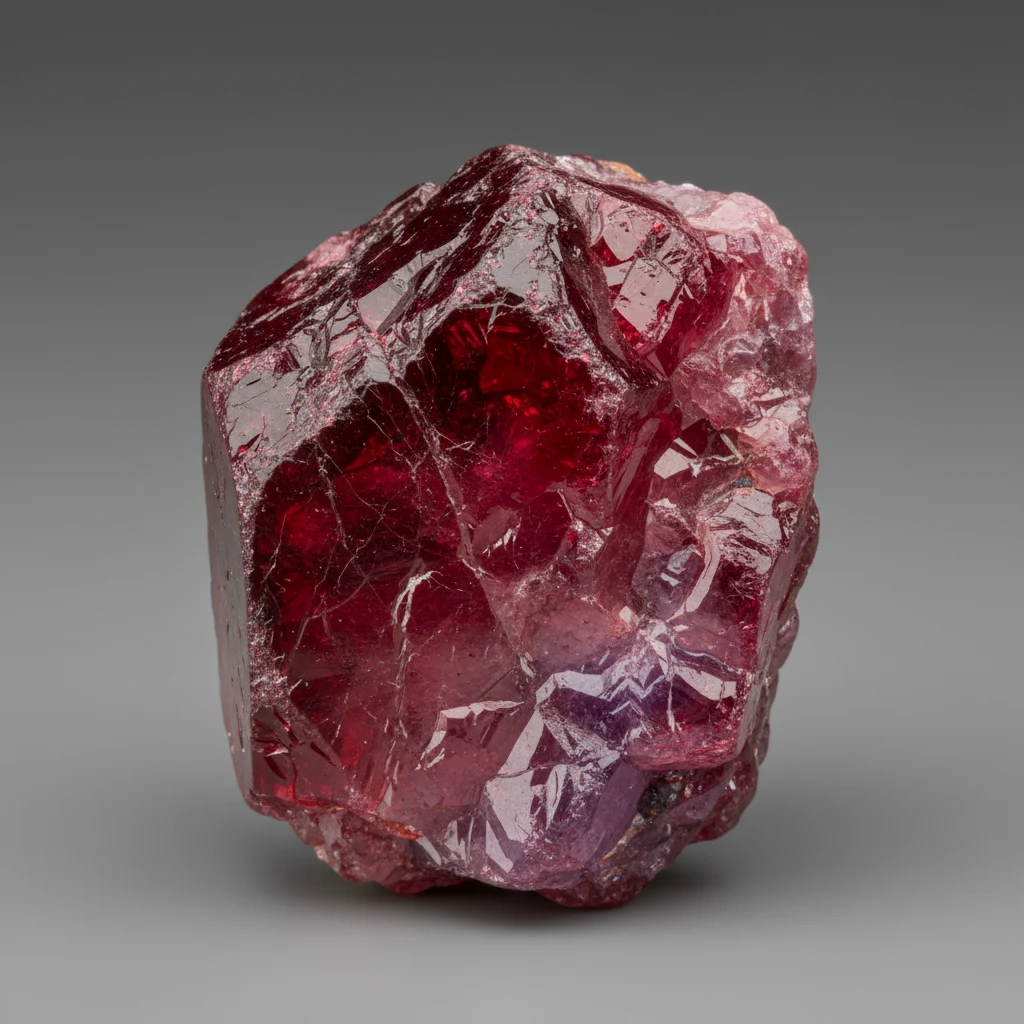
Red Beryl is a very rare red variety of beryl, prized as a precious gemstone for its vivid red to purplish-red color. In the hand, a good specimen reads as glassy and intense rather than dull: the luster is vitreous, the streak is colorless, and transparent pieces can show a clean red, pink, or purple body color.
Mineralogically, Red Beryl is a cyclosilicate with the formula Be3Al2Si6O18. It belongs to the hexagonal crystal system, is non-magnetic, and has a Mohs hardness of 7.5 to 8, giving it good scratch resistance. Its toughness is listed as fair, so collectors should treat crystal edges and cut stones with care.
Origin & History
Red Beryl is also known as bixbite, a name taken from the American geologist Maynard Bixby, who first described the mineral in 1904. For collectors, the historical name is often encountered on older labels, while “Red Beryl” is the clearer mineral name because it identifies the stone as a red variety of beryl.
Its rarity is part of its identity: Red Beryl is not just a red-colored gemstone, but a scarce member of the same beryl mineral family as emerald, aquamarine, and heliodor. Locality records and mineral references such as mindat.org commonly treat Red Beryl as a notable collector mineral because verified origin matters strongly for value and identification.
Where Is Red Beryl Found?
Red Beryl is found in the USA, Mexico, and Afghanistan, with the best-known listed localities including the Wah Wah Mountains in Utah, Ruby Hill in Nevada, and Chihuahua, Mexico. It is most commonly found in volcanic rocks, so a Red Beryl specimen with a strong locality label is especially important to collectors.
Formation
Red Beryl forms in volcanic environments through hydrothermal processes. In practical terms, collectors should think of it as a mineral tied to hot fluid activity in volcanic rock, rather than as a common pegmatite beryl occurrence.
This formation setting helps explain why Red Beryl is so limited in occurrence. The right chemistry for beryl, the right volcanic environment, and the conditions that produce vivid red to purplish-red color must come together. Its common listed impurities include chromium and iron, while the base composition remains Be3Al2Si6O18.
How to Identify Red Beryl
Identify Red Beryl first by its vivid red to purplish-red color, vitreous luster, transparency, and hexagonal crystal habit. A genuine specimen should fit beryl’s hardness range of 7.5 to 8 on the Mohs scale, show a colorless streak, and remain non-magnetic.
For closer confirmation, use the listed physical and optical properties together rather than relying on color alone. Red Beryl has a density of 2.63 to 2.74 g/cm3, conchoidal fracture, refractive index of 1.577 to 1.590, weak pleochroism, uniaxial optical character, and no listed birefringence. Color, crystal system, hardness, and provenance are the strongest field clues.
Properties of Red Beryl
Physical Properties
| Crystal System | Hexagonal |
| Hardness (Mohs) | 7.5 - 8 (Hard (6-7.5)) |
| Density | 2.63 - 2.74 g/cm3 |
| Luster | Vitreous |
| Diaphaneity | Transparent |
| Fracture | Conchoidal |
| Streak | Colorless |
| Magnetism | Non-magnetic |
| Colors | Red, Pink, Purple |
Chemical Properties
| Classification | Cyclosilicate |
| Formula | Be3Al2Si6O18 |
| Elements | Be, Al, Si, O |
| Common Impurities | Cr, Fe |
Optical Properties
| Refractive Index | 1.577 - 1.590 |
| Birefringence | None |
| Pleochroism | Weak |
| Optical Character | Uniaxial |
Red Beryl Health & Safety
Red Beryl is safe to handle and poses no health risks.
Red Beryl Value & Price
Price Range
Rough/Tumbled: $500 - $3,000 per specimen
Cut/Polished: $2,000 - $10,000 per carat
Price is influenced by color, clarity, and size.
Durability
Durable — Scratch resistance: Good, Toughness: Fair
It is stable under normal conditions.
How to Care for Red Beryl
Use & Storage
Store in a soft cloth or padded box to avoid scratches.
Cleaning
Clean with warm, soapy water and a soft cloth. Avoid harsh chemicals.
Cleanse & Charge
Cleanse with sage or under moonlight for charging.
Placement
Place in a location that receives natural light for energy.
Caution
Avoid exposing to extreme heat or chemicals.
Works Well With
Red Beryl Meaning & Healing Properties
In crystal healing traditions, Red Beryl is believed to enhance vitality, passion, and strength. Its cultural associations include courage, love, growth, transformation, energy, confidence, protection, and focus, making it a stone many people choose when they want a bold, energizing presence rather than a quiet neutral crystal.
Red Beryl is associated with the Root and Heart chakras, Aries and Leo, the planet Mars, and the Fire and Earth elements. These meanings are spiritual and symbolic, not medical advice, and Red Beryl is not a substitute for professional treatment. It is safe to handle and safe in water, but avoid harsh chemicals, extreme heat, and careless storage.
Identify Red Beryl from a photo
Compare Red Beryl traits, care tips, value clues, and common lookalikes with a clear photo.
Common mistakes
- Identifying any vivid red transparent stone as red beryl based on color alone
- Using the trade phrase “red emerald” as proof that a specimen is red beryl
- Ignoring crystal habit when a specimen is rough and visible under magnification
- Assuming a seller’s locality claim is accurate without supporting documentation
- Confusing pezzottaite or red spinel with red beryl in polished gems
- Relying on a single photo instead of checking multiple angles and lighting conditions