Emerald


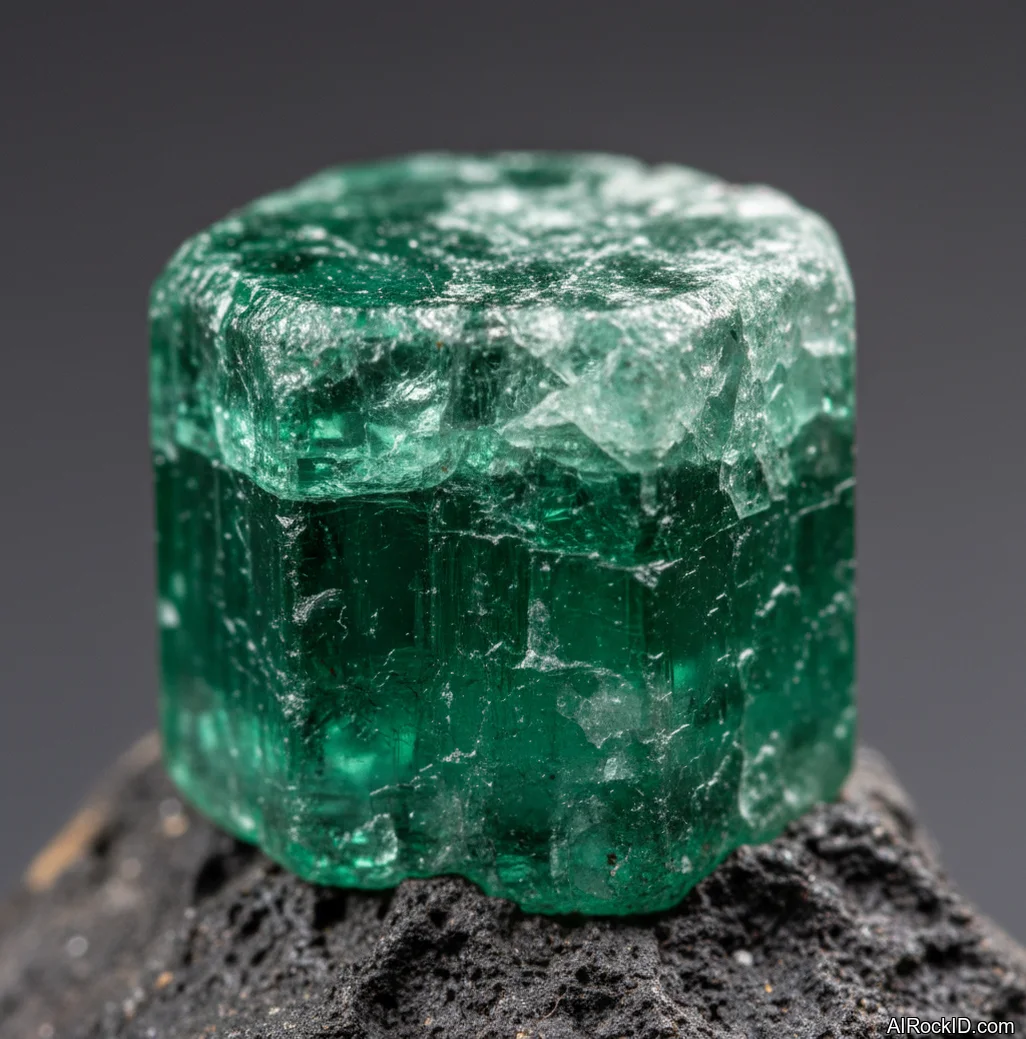
Quick answer: Emerald is a green beryl gemstone that is commonly identified by its color, hexagonal crystal habit, vitreous luster, and frequent natural inclusions. Because several green gems and treated stones can look similar, visual identification should be treated as preliminary unless supported by gemological testing.
AI Rock ID can help screen an emerald candidate by comparing visible features such as color, crystal shape, transparency, and matrix context. RockIdentifier.io provides educational crystal information, but high-value emeralds should be confirmed by a qualified gemologist or gem lab.
Good fit
- Collectors comparing green beryl, emerald, and common emerald lookalikes
- Buyers checking whether a stone needs lab verification before purchase
- Users photographing green crystals for preliminary AI-assisted identification
- Beginners learning why inclusions are common in natural emerald
Not a good fit
- Confirming treatment status or origin from a photo alone
- Pricing a faceted emerald without carat weight, clarity, cut, and lab details
- Replacing professional gemological testing for expensive stones
- Assuming every vivid green transparent stone is emerald
Why people search for this
People often search for emerald to distinguish natural emerald from green glass, dyed stones, synthetic emerald, or other green gems. Buyers also look for clues about inclusions, treatments, and documentation before making a purchase.
Most commonly confused with
- Green Beryl: Green beryl is usually lighter or less saturated; emerald is the chromium- and/or vanadium-colored green variety of beryl.
- Peridot: Peridot is an olivine mineral with a yellow-green to olive tone and lower hardness than emerald.
- Green Tourmaline: Green tourmaline commonly forms striated prismatic crystals and has different optical properties from beryl.
- Green Fluorite: Green fluorite is much softer and often shows cubic cleavage or crystal forms rather than beryl’s hexagonal habit.
Emerald vs. Common Green Lookalikes
| Material | Typical Clue | Key Difference |
|---|---|---|
| Emerald | Rich green beryl, often included | Mohs 7.5–8 with hexagonal beryl structure |
| Green beryl | Paler green to blue-green | Same mineral group but generally not saturated enough to be called emerald |
| Peridot | Olive to yellow-green tone | Softer olivine, not beryl |
| Green tourmaline | Long striated crystals | Different mineral group and crystal habit |
| Green glass | Bubbles or very uniform color | Man-made material without natural mineral structure |
AI identification confidence
AI identification of emerald is usually moderate when the photo shows crystal shape, surface texture, color zoning, and surrounding rock. Confidence is lower for polished, faceted, heavily treated, or loose green stones because many materials share similar color and luster.
When AI gets it wrong
- The stone is faceted or cabochon-cut with no visible crystal habit.
- Lighting makes a pale green stone appear more saturated than it is.
- The image does not show scale, matrix, inclusions, or multiple angles.
- The sample is synthetic emerald, dyed beryl, glass, or another treated green material.
Final recommendation
Use visual identification as a first screening step, especially for rough crystals or specimens with visible hexagonal beryl features. For purchases, request disclosure of treatments and consider a gemological report for any emerald with significant value.
Emerald Authenticity Checks
Natural emerald commonly contains inclusions, fractures, or growth features, so a completely clean-looking stone is not automatically more authentic. Common treatments include oiling or resin filling to improve apparent clarity, and these should be disclosed by sellers. A loupe can reveal surface-reaching fractures, bubbles in glass imitations, or unnatural color concentration, but lab testing is needed for reliable confirmation.
Natural, Synthetic, and Treated Emerald
Synthetic emerald has the same basic mineral identity as natural emerald but is grown in a laboratory rather than formed geologically. Treated natural emerald remains natural material, but clarity enhancement can affect value, durability, and care needs. Seller descriptions should clearly separate natural origin, synthetic origin, and treatment status.
Photo Tips for Emerald Identification
Photograph emerald candidates in daylight or neutral white light to reduce color distortion. Include close-up and full-stone images, show any crystal faces or matrix, and add a size reference. Avoid strong filters, backlighting, or green backgrounds because they can make non-emerald materials appear more emerald-like.
What Is Emerald?
Emerald is the green gem variety of the mineral beryl, and it gets that color mostly from chromium, with vanadium showing up sometimes too.
Hold a decent crystal for a second and you feel it right away: it stays cool in your palm, even when you’ve got it under those warm show lights that make everything else feel a little toasty. The green can look almost fake at first. But real emerald usually isn’t “clean” like green glass. It’s got that classic jardin thing going on, with tiny internal feathers, misty threads, little mossy-looking bits (you’ll see them the moment you tilt it) that chop up the light and make the stone feel like it’s got movement.
Thing is, emerald can be hard and still kind of brittle. Weird combo, right? I’ve handled plenty that had killer color, then you turn the piece a few degrees and there it is: a healed fracture line cutting right through the middle. That’s normal for emerald. Not a dealbreaker. But it does change how you store it, and it changes how you look at the price.
Origin & History
“Emerald” traces back to the Greek *smaragdos*, then it filtered through Latin *smaragdus* and Old French *esmeraude*, and it basically just means “green stone.” Beryl as a mineral species shows up in early mineralogy descriptions, but “emerald” as a named gem material pops up much earlier in trade records and classical writing.
Most collectors don’t learn this stuff from a textbook. They pick it up by chasing localities. Cleopatra’s mines in Egypt get brought up constantly, and Colombian emeralds became the benchmark in the gem trade after Spanish contact in the 1500s. On the science side, the chemistry story only really snapped into focus once chromium and vanadium were understood as the main green-makers, and once lab-grown emerald became a real market factor in the 20th century.
Where Is Emerald Found?
You’ll see emerald from Colombia and Zambia most often in the trade, but good collector crystals also come out of Brazil, Pakistan, Afghanistan, and a few classic European and US localities.
Formation
Emerald shows up when beryllium-bearing fluids run into chromium or vanadium in the right geologic setup. And that “right setup” is the tricky part. Beryllium tends to hang around granitic and pegmatitic environments, while chromium feels more at home in mafic and ultramafic rocks. So, yeah, emerald is basically a chemistry meetup that doesn’t happen all that often.
Compared to aquamarine, emerald comes off like it had a rougher upbringing. A lot of it forms in veins and shear zones where fluids are on the move, rocks are getting squeezed, and the crystals are basically growing under stress. That’s why even high-end emerald usually has internal breaks and those garden-like inclusions (you can kind of “see” the messiness when you tilt it under a light). If you’ve ever held a clean aqua crystal and then a similar-sized emerald, the emerald almost always looks way more busy inside. Why wouldn’t it?
How to Identify Emerald
Color: Emerald ranges from medium to deep green, often with a slightly bluish or yellowish secondary tone depending on chemistry. True emerald color is usually tied to chromium and/or vanadium, not just any green beryl.
Luster: Polished emerald has a vitreous luster, like glass with a softer glow when inclusions scatter the light.
Look closely at the interior: natural emerald commonly shows jardin inclusions, healed fractures, and uneven color zoning rather than perfectly uniform green. The real test is a loupe, because a lot of green stones are sold as “emerald” when they’re dyed quartz, glass, or other green beryl that doesn’t hit emerald color. Pick up a few at a show and you’ll feel it too: emerald crystals often have sharp hexagonal edges, but the faces can be slightly frosted or etched instead of mirror-smooth like some quartz.
Common Look-Alikes
Emerald is sometimes confused with these materials:
- Green glass
- Dyed green beryl
- Green cubic zirconia
- Chrome diopside
- Green tourmaline (verdelite)
- Synthetic hydrothermal emerald
Market Cautions & Treatments
When AI Can Get This Wrong
Photo ID tools get tripped up by green glass and synthetic emerald, especially if the photo hides inclusions or surface luster. AI can't feel the stone's coolness or spot that oily look in cracks. A loupe check for mossy inclusions and a simple 'touch test' for temperature help confirm real emerald versus fakes.
Properties of Emerald
Physical Properties
| Crystal System | Hexagonal |
| Hardness (Mohs) | 7.5-8 (Very Hard (7.5-10)) |
| Density | 2.67-2.78 g/cm3 |
| Luster | Vitreous |
| Diaphaneity | Transparent to translucent |
| Fracture | Conchoidal |
| Streak | White |
| Magnetism | Non-magnetic |
| Colors | Green, Bluish green, Yellowish green |
Chemical Properties
| Classification | Silicates (cyclosilicate) |
| Formula | Be3Al2Si6O18 |
| Elements | Be, Al, Si, O |
| Common Impurities | Cr, V, Fe |
Optical Properties
| Refractive Index | 1.577-1.583 |
| Birefringence | 0.005-0.009 |
| Pleochroism | Moderate |
| Optical Character | Uniaxial |
Emerald Health & Safety
Normal handling is pretty low risk. But when you’re doing lapidary work, don’t kick up dust. Keep it out of the air, and definitely don’t breathe it in.
Safety Tips
If you’re grinding or polishing, do it wet and wear the right respirator. And once you’re done, rinse off the slurry, then wash your hands (don’t skip that).
Emerald Value & Price
Price Range
Rough/Tumbled: $20 - $2,000+ per specimen
Cut/Polished: $50 - $20,000+ per carat
Color and how see-through the stone looks can swing the price in a hurry, but where it came from and what’s been done to it matters a ton, too. Thing is, emerald shopping gets weird because two stones can look basically the same from the top, yet one is packed with fractures (you’ll spot those little threadlike lines when you tilt it under a lamp) or has been heavily treated, and the other hasn’t.
Durability
Moderate — Scratch resistance: Excellent, Toughness: Fair
Emerald resists scratches well, but it can chip or crack along existing fractures if it gets knocked or squeezed.
How to Care for Emerald
Use & Storage
Store emerald separately from harder, sharp-edged stones so it doesn’t get chipped on a corner. I keep mine in small boxes or gem jars with a bit of padding because a single clack against quartz can leave a tiny bite.
Cleaning
1) Rinse with lukewarm water and a drop of mild soap. 2) Use a soft brush around crevices, especially on crystal faces with matrix. 3) Rinse well and pat dry; skip ultrasonic and steam cleaners.
Cleanse & Charge
If you do energetic cleansing, gentle methods are the safest: smoke, sound, or a short rest on dry selenite. Avoid salt soaks if you don’t know whether your piece has fractures filled with oils or resins.
Placement
Keep it out of direct sun on a windowsill if you care about long-term appearance; I’ve seen some stones look tired after months of bright light. A shelf with indirect light shows the green without cooking it.
Caution
Don’t use ultrasonic or steam cleaners on emeralds, especially in jewelry. A lot of emeralds have tiny fractures, and plenty have common clarity treatments, and those can get weird fast under heat or vibration. Thing is, “hard” doesn’t mean “unbreakable.” You can still crack one.
Works Well With
Emerald Meaning & Healing Properties
A lot of people grab emerald when they want something heart-centered but don’t want that sweet, bubblegum feel some pink stones give off. For me, emerald reads steady. Adult. Quiet. It’s the stone I’ll leave on my desk when I’m trying to say what I mean and not get yanked into other people’s drama (you know the kind).
But look, emerald isn’t a magic fix, and it’s not replacing therapy, sleep, or real medical care. What it *can* do, if you’re someone who responds to objects and little rituals, is work like a physical anchor. I’ve literally seen customers in the shop start to settle just by holding a cool emerald cab in their palm, noticing the weight, the slick polished face, and just staring into that green until their shoulders drop.
Compared to rose quartz, emerald tends to lean harder into the “truth” side of the whole heart conversation. It’s good alongside journaling, tough talks, and boundaries. And thing is, if you’re sensitive to stone energy, start small, because a strong emerald can hit kind of intense, which catches people off guard when they only think of it as a jewelry gem.
Common mistakes
- Calling any bright green transparent stone emerald without checking mineral properties.
- Assuming inclusions mean a stone is fake; many natural emeralds are visibly included.
- Ignoring treatment disclosure when comparing emerald prices.
- Using color alone to separate emerald from green beryl, tourmaline, peridot, or glass.
- Relying on a single photo for high-value buying decisions.
Identify Emerald from a photo
Compare Emerald traits, care tips, value clues, and common lookalikes with a clear photo.