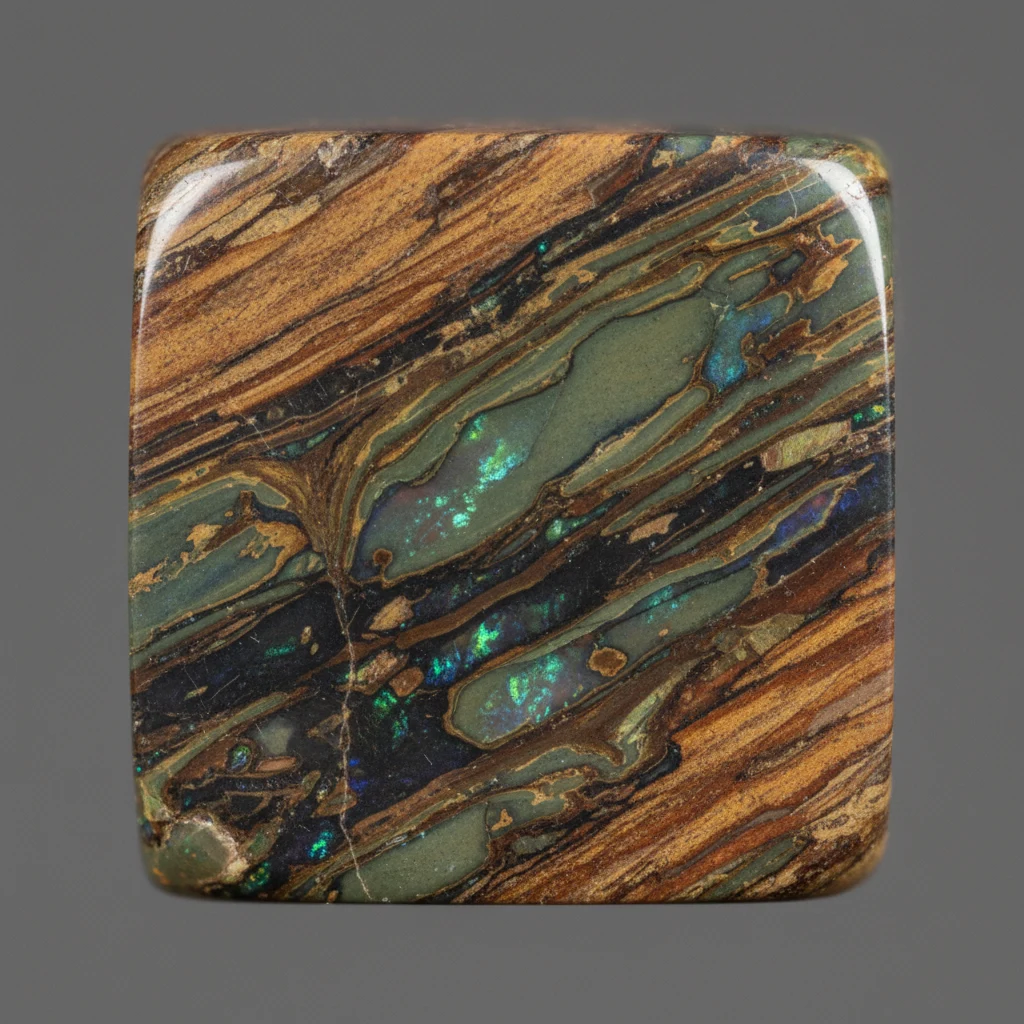
Wood Opal


Quick answer: Wood Opal is petrified wood in which original wood spaces have been replaced or filled by opal-rich silica. It is usually identified by preserved wood grain, growth-ring textures, earthy brown to green colors, and a hardness around Mohs 5.5–6.5.
AI Rock ID can help screen Wood Opal by checking visible grain, silica texture, color zoning, and fracture patterns from a clear photo. RockIdentifier.io provides identification support, but uncertain specimens may still require hardness testing, magnification, or a lapidary opinion.
Good fit
- Collectors who like fossils, petrified wood, and silica minerals
- People looking for earthy brown, tan, cream, or green patterned stones
- Lapidary hobbyists who want cabochon material with natural wood-grain texture
- Beginners comparing opalized wood with jasper, agate, or common opal
Not a good fit
- Anyone expecting transparent precious opal with strong play-of-color
- Jewelry uses that involve frequent impact, soaking, or harsh cleaning
- Buyers who need a guaranteed fossil origin without seller documentation
- Collectors who prefer highly uniform color and pattern
Most commonly confused with
- Petrified Wood: Petrified wood may be chalcedony, jasper, or agate rather than opal-rich silica.
- Common Opal: Common opal lacks the preserved wood grain and fossil structure typical of Wood Opal.
- Jasper: Jasper is usually denser microcrystalline quartz and may show earthy colors without true wood-cell texture.
- Agate: Agate commonly shows banding or translucent chalcedony layers rather than cellular wood replacement.
Wood Opal vs. Common Lookalikes
| Material | Key Visual Clue | Typical Difference |
|---|---|---|
| Wood Opal | Wood grain, knots, or ring-like fossil texture | Opal-rich silica replacement or infill |
| Petrified Wood | Woody structure with earthy colors | May be chalcedony, jasper, agate, or opal |
| Common Opal | Waxy to glassy surface, often massive | Usually lacks preserved wood anatomy |
| Jasper | Opaque, dense, patterned surface | No true fossil wood-cell structure |
| Agate | Translucent zones or curved banding | Banding is usually more important than wood grain |
AI identification confidence
AI identification is usually more reliable when a Wood Opal photo shows sharp wood grain, cut-and-polished surfaces, and natural color variation. Confidence is lower for rough, weathered, dark, or heavily polished pieces where fossil texture is hidden.
When AI gets it wrong
- A jasper or agate piece has wood-like banding but no preserved wood structure.
- A common opal specimen is photographed without scale or context.
- A dyed or resin-stabilized stone shows unnatural color saturation.
- A rough specimen is coated with dust, iron staining, or weathered rind.
Final recommendation
Choose Wood Opal when visible fossil wood texture is more important than bright precious-opal color play. For buying, prioritize clear photos of multiple sides, natural-looking color, and disclosure of any stabilization, dye, or resin treatment.
How to Photograph Wood Opal for Identification
Use bright indirect light and photograph the stone from the top, side, and broken or cut surface if available. Include a ruler or coin for scale, and avoid heavy filters because color balance can affect identification. Close-up photos should focus on grain, pores, ring patterns, and any translucent opal-filled areas.
Buying and Authenticity Checks
Authentic Wood Opal should show natural variation rather than perfectly repeated printed or molded patterns. Ask whether the piece is natural, stabilized, dyed, resin-filled, or reconstructed, especially for cabochons and decorative carvings. Strong neon colors, plastic-like luster, bubbles, or unusually low weight can be warning signs.
Where Wood Opal Forms
Wood Opal forms when buried wood is mineralized by silica-rich water, preserving woody structures while replacing organic material. Deposits can occur in volcanic ash beds, sedimentary layers, and fossil forests where silica was available during fossilization. The final appearance depends on silica chemistry, impurities, and later weathering.
What Is Wood Opal?
Wood Opal is opal formed from silicified wood, recognized by a wood-like internal structure and earthy color patterns. In the hand, a good piece can look less like a conventional crystal and more like a preserved fragment of old timber, with browns, blacks, and greens held under a vitreous surface.
Mineralogically, Wood Opal is a variety of opal with the formula SiO2·nH2O. It is amorphous, translucent, non-magnetic, and has a white streak, with a Mohs hardness of 5.5-6.5 and density of 1.98-2.20 g/cm3.
Origin & History
Wood Opal takes its name from its resemblance to wood, and it has been known since the early 20th century. The name is practical and visual: collectors use it for opal that still carries the look of wood grain or internal wood structure after silicification.
For labeling and locality checking, collectors often compare specimen information with locality databases such as mindat.org. That is especially useful with Wood Opal because the material can be valued not only for opal color play, but also for how clearly it preserves the original wood-like pattern.
Where Is Wood Opal Found?
Wood Opal is found in the USA, Australia, and Brazil, most commonly in sedimentary deposits. Notable localities include Opal Butte in Oregon, USA; Lightning Ridge in New South Wales, Australia; and Cachoeira do Sul, Brazil.
Formation
Wood Opal forms when silica-rich water permeates wood and replaces the organic material with opal over time. The result is a mineral specimen that keeps a wood-like appearance while becoming opal, rather than remaining ordinary organic wood.
That replacement process explains why identification is so tactile and visual: the specimen may carry internal structure resembling wood, but its luster is usually vitreous and its fracture is conchoidal. Common impurities include iron and manganese, which may contribute to the natural character of the piece.
How to Identify Wood Opal
Identify Wood Opal by looking for wood-like internal structure combined with opal features. Typical colors are brown, black, and green, the luster is usually vitreous, and better pieces may show color play typical of opals.
A practical check starts with the basics: Wood Opal is amorphous, translucent, non-magnetic, and leaves a white streak. It has no birefringence or pleochroism, is isotropic, and has a refractive index of 1.44-1.46, with Mohs hardness of 5.5-6.5.
Properties of Wood Opal
Physical Properties
| Crystal System | Amorphous |
| Hardness (Mohs) | 5.5-6.5 (Medium) |
| Density | 1.98-2.20 g/cm3 |
| Luster | Vitreous |
| Diaphaneity | Translucent |
| Fracture | Conchoidal |
| Streak | White |
| Magnetism | Non-magnetic |
| Colors | Brown, Black, Green |
Chemical Properties
| Classification | Tectosilicate |
| Formula | SiO2·nH2O |
| Elements | Si, O |
| Common Impurities | Fe, Mn |
Optical Properties
| Refractive Index | 1.44-1.46 |
| Birefringence | None |
| Pleochroism | None |
| Optical Character | Isotropic |
Wood Opal Health & Safety
There are no known health risks associated with handling wood opal.
Wood Opal Value & Price
Price Range
Rough/Tumbled: $10 - $50 per specimen
Cut/Polished: $20 - $100 per carat
Price is affected by color intensity and patterns.
Durability
Moderate — Scratch resistance: Fair, Toughness: Good
It can be sensitive to heat and sudden changes in temperature.
How to Care for Wood Opal
Use & Storage
Store in a cool, dry place away from direct sunlight.
Cleaning
Clean with a soft cloth and mild soap. Avoid abrasive cleaners.
Cleanse & Charge
Leave it under moonlight for cleansing.
Placement
Ideal for display in a cabinet or as part of jewelry.
Caution
Avoid prolonged exposure to moisture to maintain quality.
Works Well With
Wood Opal Meaning & Healing Properties
In crystal healing traditions, Wood Opal is believed to support emotional healing and grounding. Its listed qualities are grounding, healing, and stability, which suits the feel of the stone: earthy, calm, and visually rooted in the look of preserved wood.
Wood Opal is associated with the Root and Heart chakras, Taurus and Libra, Venus, and the Earth element. Use it as a meditation, relaxation, or inner-peace stone if that symbolism resonates, but do not use it as a substitute for medical treatment.
Identify Wood Opal from a photo
Compare Wood Opal traits, care tips, value clues, and common lookalikes with a clear photo.
Common mistakes
- Assuming all petrified wood is Wood Opal; many specimens are chalcedony, jasper, or agate.
- Identifying a stone from brown color alone without checking for preserved wood texture.
- Confusing curved agate bands with fossil growth rings or wood grain.
- Expecting Wood Opal to always show precious-opal play-of-color.
- Ignoring treatment disclosures such as dye, resin filling, or stabilization.
- Using vinegar or harsh cleaners to test a specimen, which can damage surfaces or finishes.