Biotite


Quick answer: Biotite is a dark mica mineral best recognized by its thin, flexible sheets, pearly to vitreous luster, and perfect basal cleavage. It is commonly confused with other black, shiny minerals, so flake flexibility and easy splitting are key identification clues.
AI Rock ID can help screen a dark, flaky specimen by comparing visible traits such as luster, sheet structure, and cleavage. RockIdentifier.io is useful for narrowing possibilities, but physical checks like hardness, cleavage, and flexibility are important for confirming biotite.
Good fit
- Collectors who want a classic black mica specimen
- Students learning cleavage, luster, and sheet silicate structure
- People comparing dark minerals found in granite, schist, or pegmatite
- Collectors who prefer inexpensive mineral specimens over faceted gems
Not a good fit
- Jewelry that needs durability or daily wear resistance
- Specimens that will be handled frequently without protection
- Anyone seeking a transparent black gemstone
- Displays in damp or dusty locations where thin flakes may degrade
Most commonly confused with
- Muscovite: Muscovite is usually colorless, silvery, or pale brown, while biotite is dark brown to black.
- Phlogopite: Phlogopite is typically amber, bronze, or golden brown and is richer in magnesium than most biotite.
- Hornblende: Hornblende is dark but forms prismatic crystals with splintery cleavage rather than flexible sheets.
- Hematite: Hematite may look black and shiny, but it is harder, denser, and often leaves a reddish-brown streak.
Biotite vs Similar Dark Minerals
| Feature | Biotite | Common Lookalikes |
|---|---|---|
| Cleavage | Perfect one-direction cleavage into thin sheets | Hornblende has two cleavages; hematite has no mica-like sheets |
| Flexibility | Thin flakes bend and may spring slightly | Hematite and hornblende break rather than flex |
| Color | Black, dark brown, or brownish black | Muscovite is usually pale; phlogopite is bronze to golden brown |
| Hardness | Mohs 2.5–3 | Hematite is harder; chlorite is often softer |
| Typical habit | Platy books, flakes, or sheet-like masses | Hornblende is prismatic; hematite is massive, botryoidal, or metallic |
AI identification confidence
AI identification confidence is usually moderate for biotite when photos clearly show stacked sheets, dark color, and reflective cleavage surfaces. Confidence drops when the specimen is a small black grain, a weathered flake, or embedded in a mixed rock.
When AI gets it wrong
- The photo shows only a shiny black surface without visible sheet cleavage
- The specimen is part of a coarse rock with several dark minerals present
- Lighting makes muscovite, phlogopite, or chlorite appear darker than they are
- The sample is too small to test flexibility or observe flake edges
How to Check Biotite Authenticity
Authentic biotite should split easily into thin, shiny sheets with perfect basal cleavage. A small flake should be flexible rather than brittle like glass, although older or weathered flakes may crumble. Specimens sold as biotite should not look like opaque black glass, polished plastic, or a dense metallic stone with no visible layers.
Buying Tips for Biotite Specimens
Choose specimens with visible mica books, clean cleavage surfaces, and minimal crumbling if the piece is intended for display. Matrix specimens from granite, schist, or pegmatite can be more stable than loose flakes. Ask for locality information when possible, because biotite is common and provenance is often more useful than rarity for collector interest.
Biotite in Rocks and Field Identification
Biotite commonly occurs in igneous and metamorphic rocks, including granite, diorite, gneiss, schist, and some pegmatites. In the field, it often appears as shiny black flakes scattered through lighter minerals such as quartz and feldspar. A hand lens can reveal the layered mica structure that separates it from dark amphiboles or pyroxenes.
What Is Biotite?
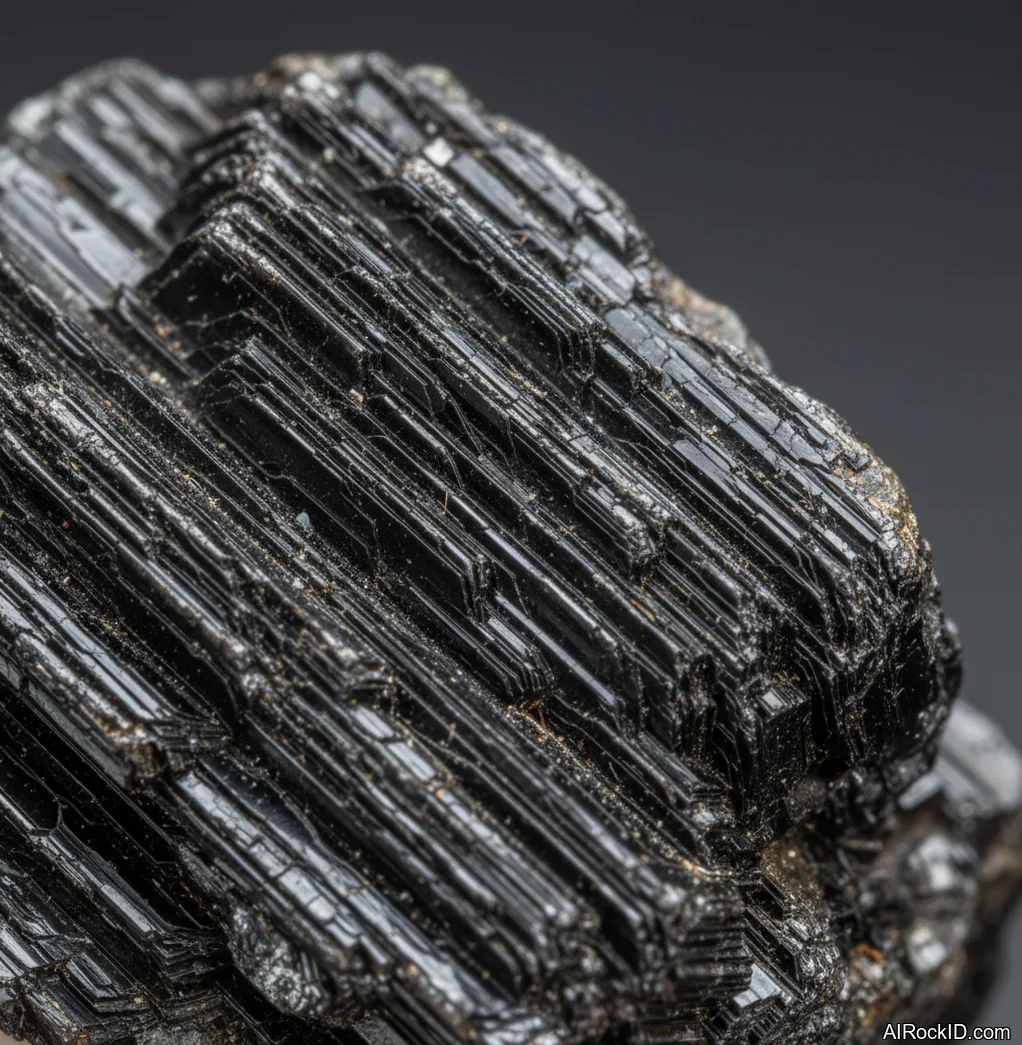
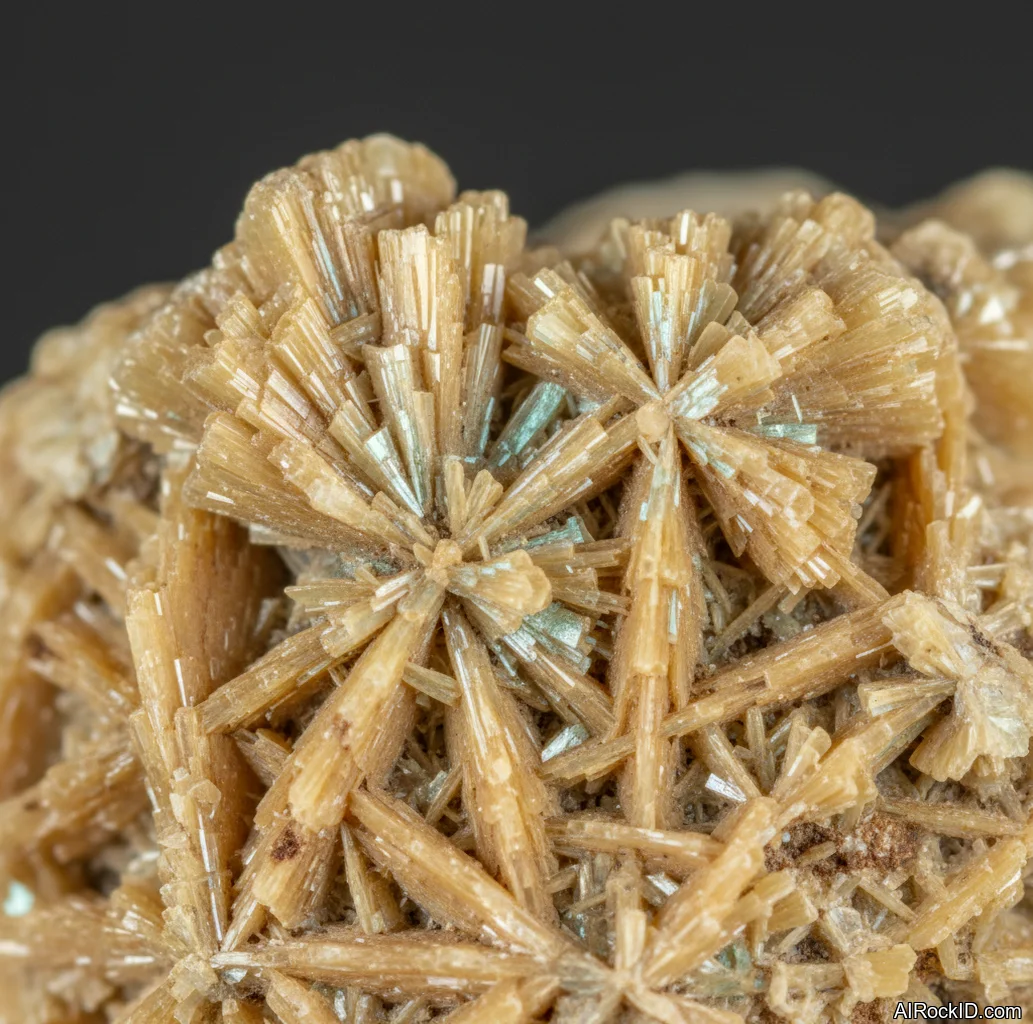
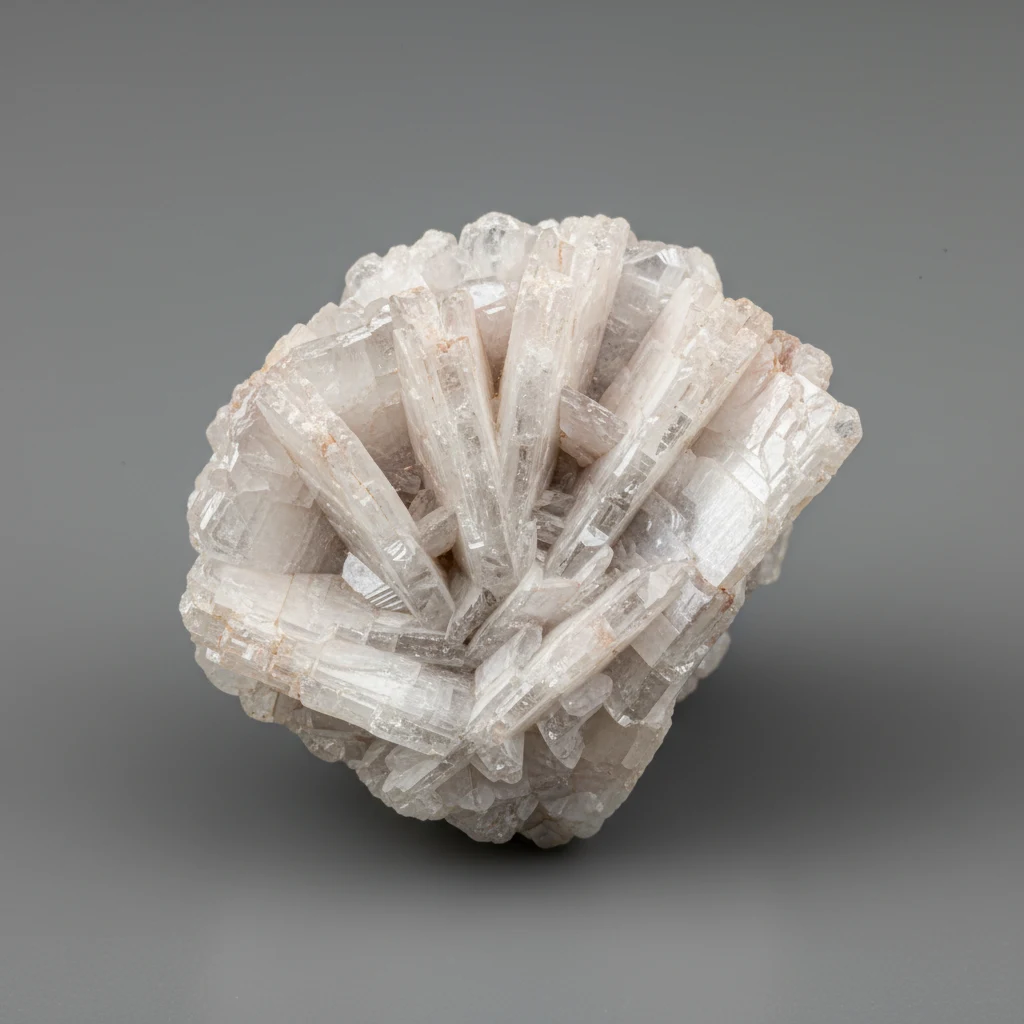
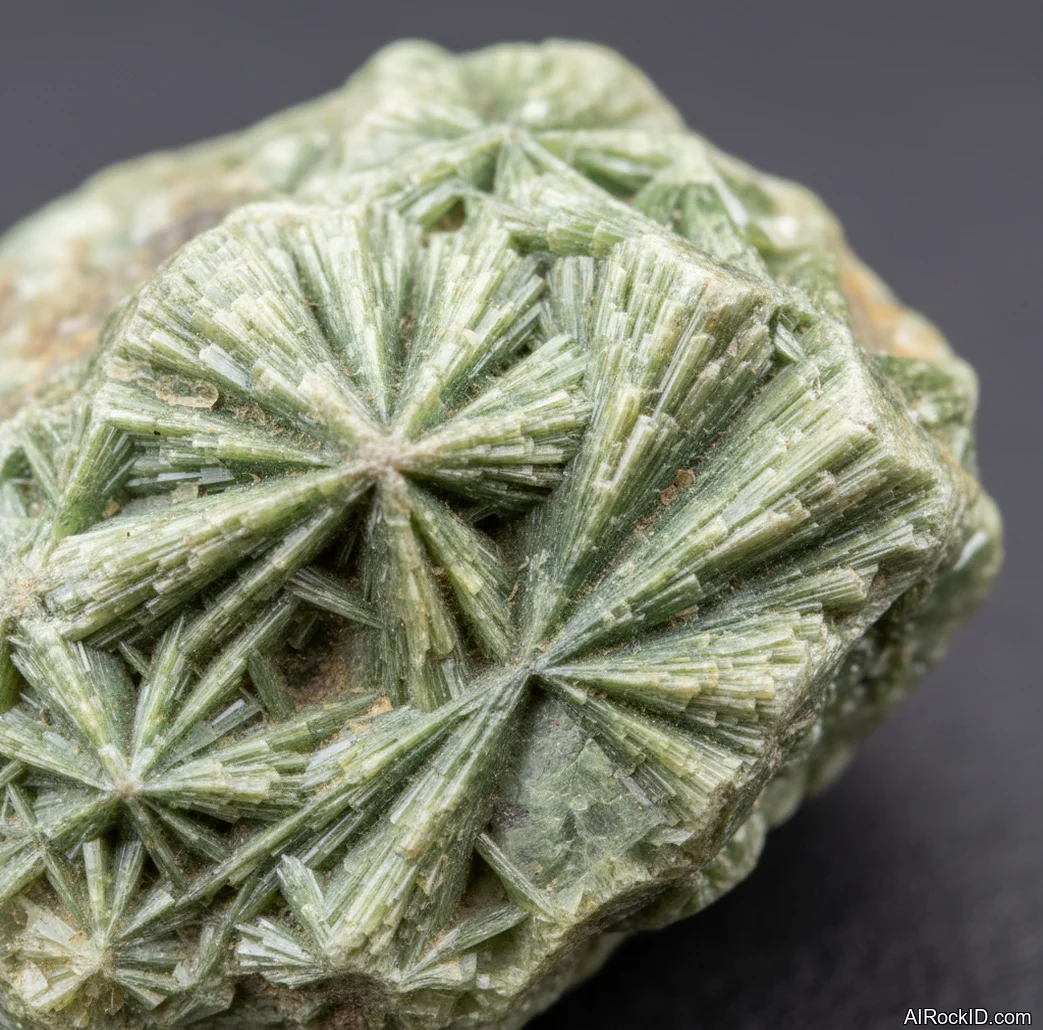
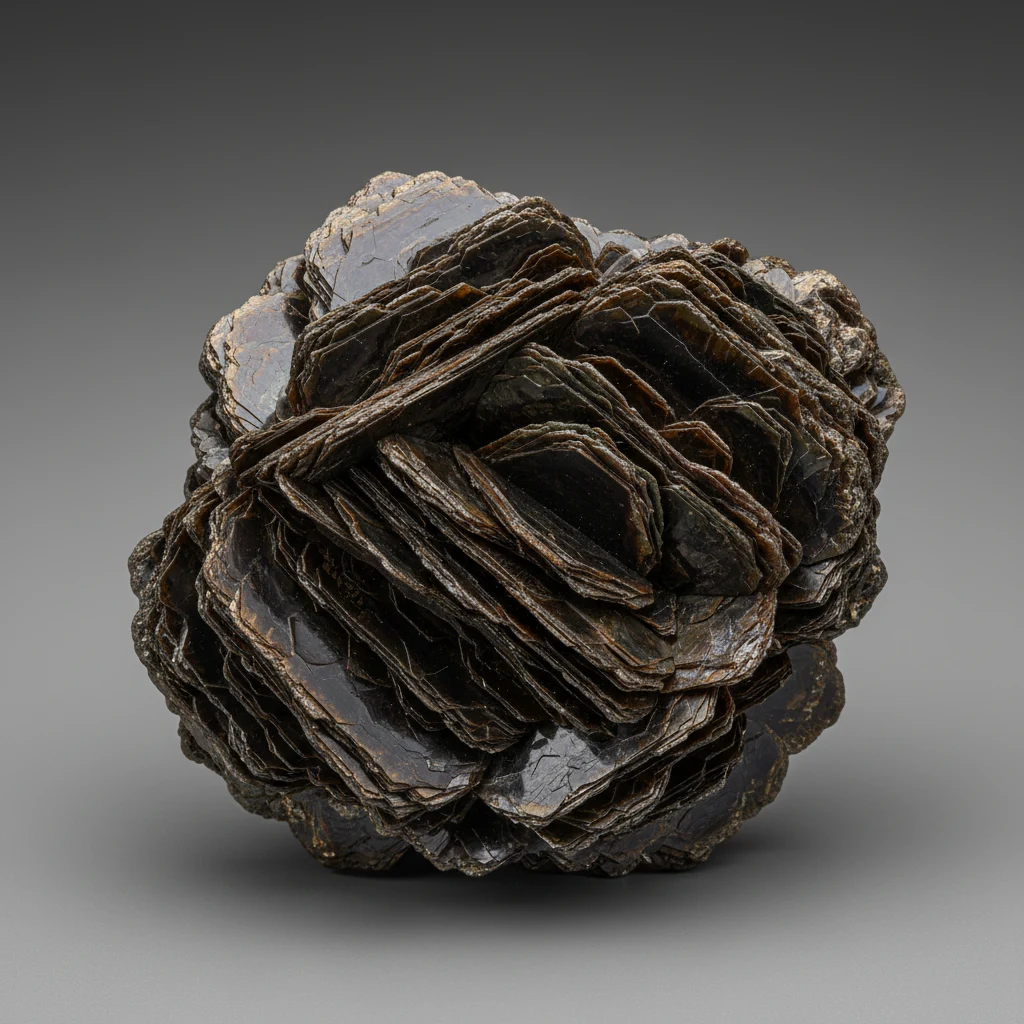
Biotite is the common dark mica seen as black to dark brown flakes in many igneous and metamorphic rocks. In the hand, it feels soft, platy, and layered: a fresh edge can split into thin elastic sheets that flash vitreous to pearly light. Collectors often call it black mica, iron mica, or magnesium iron mica.
Mineralogically, biotite is a mica-group phyllosilicate and a dark mica series name rather than a single IMA-approved species. Its listed formula is K(Mg,Fe)3(AlSi3O10)(OH,F)2, reflecting potassium, magnesium, iron, aluminum, silicon, oxygen, hydrogen, and fluorine. Its Mohs hardness is only 2.5–3, so biotite is better kept as a specimen, teaching piece, or rock-forming clue than as daily jewelry.
Origin & History
The name biotite was introduced in the 19th century by Johann Friedrich Ludwig Hausmann in honor of French physicist Jean-Baptiste Biot. Biot studied the optical properties of mica, a fitting connection for a mineral whose thin sheets can show strong color changes in transmitted light and strong pleochroism in thin section.
Modern mineralogy treats biotite as a compositional series within the mica group, mainly between iron-rich annite and magnesium-rich phlogopite. A collector checking old labels can compare locality wording with mindat.org, but the key idea is simple: biotite is the dark mica name used for many Fe-Mg mica compositions, not one narrowly defined species.
Where Is Biotite Found?
Biotite is found worldwide because it is a major rock-forming mica. It occurs in granites, granodiorites, diorites, pegmatites, schists, gneisses, hornfels, and many volcanic rocks. In a granite hand sample, it is often the black flake that contrasts sharply with lighter feldspar and quartz.
Formation
Biotite forms from potassium-, aluminum-, magnesium-, iron-, and silica-rich melts or metamorphic fluids. It crystallizes in igneous rocks such as granite and granodiorite, where it may appear as dark mica books or scattered flakes locked between feldspar, quartz, and other minerals.
Biotite also grows during regional and contact metamorphism as clay minerals and other silicates recrystallize under heat and pressure. Over time, weathering or hydrothermal activity can alter it to chlorite, vermiculite, iron oxides, and clay minerals. That is why older flakes may look dull, rusty, bronzy, or softened compared with fresh pearly cleavage faces.
How to Identify Biotite
Identify biotite by looking for dark brown to black mica flakes or books that peel into very thin, flexible, elastic sheets. The best field clues are one perfect basal cleavage direction, a pearly sheen on cleavage faces, a white to pale gray streak, and soft Mohs hardness of 2.5–3.
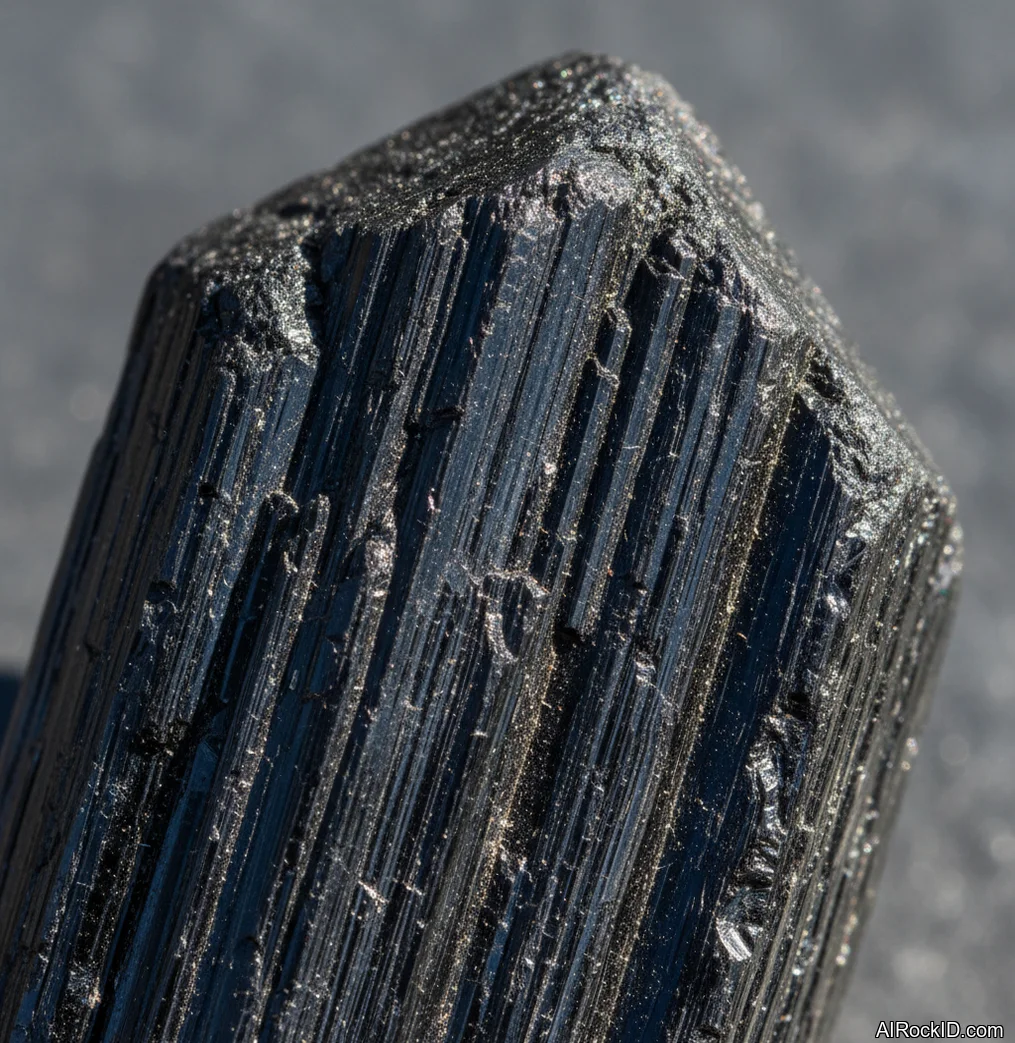
Fresh biotite is usually vitreous to pearly, while weathered flakes may appear dull, rusty, or bronzy. Thin sheets can look smoky brown or translucent at the edges, but thick books are usually opaque. Compared with black tourmaline, hornblende, or pyroxene, biotite is much softer and splits into flat mica sheets rather than breaking into tougher prismatic pieces.
Properties of Biotite
Physical Properties
| Crystal System | Monoclinic |
| Hardness (Mohs) | 2.5–3 on the Mohs scale (Soft) |
| Density | About 2.7–3.3 g/cm³, increasing with iron content |
| Luster | Vitreous to pearly |
| Diaphaneity | Transparent to translucent in thin sheets; opaque in thick books or masses |
| Fracture | Uneven to splintery across cleavage; perfect basal cleavage dominates |
| Streak | White to pale gray |
| Magnetism | Usually non-magnetic; iron-rich material may show very weak attraction only in some cases |
| Colors | black, dark brown, brownish black, greenish black, bronze-brown, reddish brown |
Chemical Properties
| Classification | Potassium iron magnesium aluminum phyllosilicate, mica group |
| Formula | K(Mg,Fe)3(AlSi3O10)(OH,F)2 |
| Elements | potassium, magnesium, iron, aluminum, silicon, oxygen, hydrogen, fluorine |
| Common Impurities | titanium, manganese, sodium, calcium, barium, lithium, chlorine, water |
Optical Properties
| Refractive Index | Approximately nα 1.52–1.63, nβ 1.55–1.69, nγ 1.56–1.70 depending on Fe-Mg composition |
| Birefringence | Moderate to high, commonly about 0.03–0.07 |
| Pleochroism | Strong; typically pale yellow-brown to dark brown, green-brown, reddish brown, or nearly opaque brown in thin section |
| Optical Character | Biaxial negative, with variable 2V |
Biotite Health & Safety
Biotite is not considered toxic for normal handling. The main risk is nuisance mineral dust from crushing, grinding, or cutting; avoid inhaling fine particles. Some specimens may be attached to other minerals, so unknown matrix material should be treated cautiously.
Biotite Value & Price
Price Range
Rough/Tumbled: Common small biotite flakes or rock specimens are often under $1–$10; attractive mica books, pegmatite specimens, or educational lots may range from about $10–$50+, depending on size, locality, and associated minerals.
Cut/Polished:
Biotite is abundant and not normally faceted as a gem. Value is mainly influenced by well-formed mica books, large flexible sheets, association with attractive minerals such as feldspar or quartz, locality, freshness, and usefulness as an educational or petrology specimen.
Durability
Low for jewelry, good for display if protected — Scratch resistance: Poor; biotite is soft and scratches easily., Toughness: Thin sheets are flexible and elastic, but books can split, bend, or flake along perfect cleavage.
Generally stable indoors, but prolonged weathering, moisture, abrasion, or chemical alteration can cause flaking, dulling, oxidation stains, or alteration to chlorite and clay minerals.
How to Care for Biotite
Use & Storage
Store in a box, tray, or padded display area where the flaky edges will not be rubbed. Keep mica books away from heavier specimens that could split or crush them.
Cleaning
Clean with a soft dry brush or a brief rinse if needed, then dry thoroughly. Avoid ultrasonic cleaners, acids, harsh detergents, and aggressive scrubbing because the sheets can separate.
Cleanse & Charge
For spiritual use, cleanse gently with smoke, sound, moonlight, or by placing near clear quartz. Avoid salt scrubs or rough handling, which can damage the mica layers.
Placement
Best kept as a display, teaching, or meditation specimen rather than daily jewelry. Place where its reflective cleavage faces can catch light without being handled constantly.
Caution
Do not tumble biotite and avoid using thin flakes in rings or bracelets. It cleaves perfectly and can peel apart easily.
Works Well With
Biotite Meaning & Healing Properties
In modern crystal healing traditions, biotite is used as a grounding and protective stone. Its dark, reflective sheets are associated with the root chakra and earth star chakra, making it a popular choice for meditation, shadow work, study focus, and steady practical intention. These meanings are cultural and spiritual beliefs, not medical claims.
For spiritual care, cleanse biotite gently with smoke, sound, moonlight, or by placing it near clear quartz. Avoid salt scrubs, tumbling, ultrasonic cleaners, harsh detergents, acids, and rough handling because the mica layers can separate. Keep it in a padded tray or display box where its flaky edges will not be rubbed or crushed.
Identify Biotite from a photo
Compare Biotite traits, care tips, value clues, and common lookalikes with a clear photo.
Common mistakes
- Calling every shiny black mineral biotite without checking for flexible sheet cleavage
- Confusing dark muscovite or phlogopite with biotite based on color alone
- Using a knife or heavy pressure on thin flakes, which can permanently split or crumble the specimen
- Assuming biotite is suitable for rings or bracelets because it has an attractive luster
- Mistaking weathered, dull biotite for a different mineral when fresh cleavage surfaces are still shiny