Alurgite


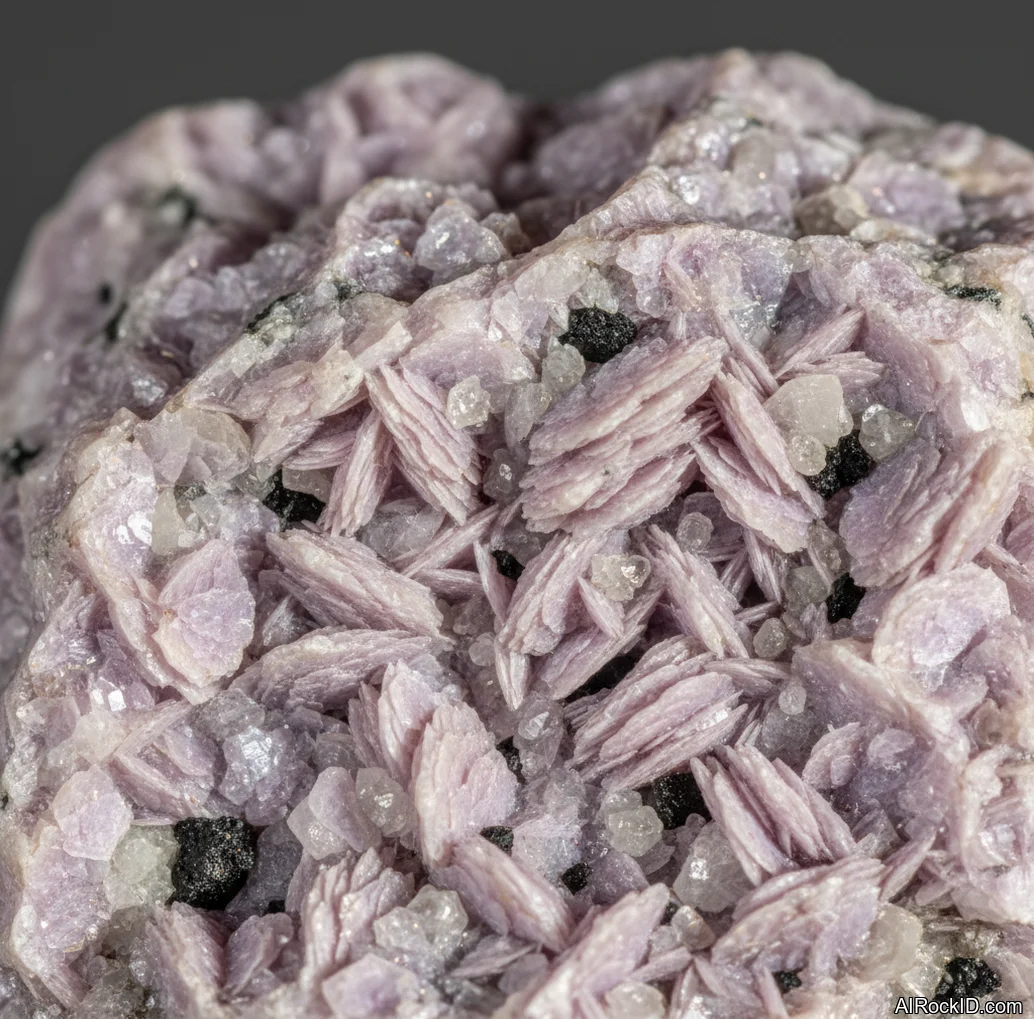
Quick answer: Alurgite is a historical trade and field name applied to purple to reddish manganese-bearing mica, most often a variety of muscovite rather than a separate IMA-approved mineral species. Identification should focus on mica habits, perfect basal cleavage, manganese-related color, and the possibility of labels such as lepidolite, purpurite, or sugilite being used incorrectly.
AI Rock ID can help compare a purple mica-like specimen with likely visual matches, but color alone is not enough for a firm mineral name. RockIdentifier.io is useful for narrowing possibilities before confirming with hardness, cleavage, locality, and, when needed, laboratory testing.
Good fit
- Collectors documenting historical or locality-based mineral names
- People verifying purple mica specimens sold as rare or unusual material
- Students comparing mica-group minerals and manganese-bearing look-alikes
- Buyers who want to distinguish descriptive trade names from approved species
Not a good fit
- Anyone seeking a currently approved IMA mineral species named alurgite
- Identification based only on purple color in a photo
- Buyers who need a guaranteed species name without test data or provenance
Why people search for this
People often search for alurgite after finding the name on an old label, dealer listing, or purple mica specimen. The main question is whether the name refers to a valid species or a descriptive manganese-rich mica variety.
Most commonly confused with
- Lepidolite: A lithium mica that is commonly lilac to purple; alurgite is generally a manganese-bearing muscovite-related material.
- Purpurite: A purple manganese phosphate that lacks the flexible sheet cleavage typical of mica.
- Sugilite: A massive purple cyclosilicate that is usually denser-looking and does not split into thin elastic flakes.
- Muscovite: The closest mineral-group comparison; alurgite is commonly treated as a purple manganese-bearing variety of muscovite.
Alurgite Look-Alike Comparison
| Material | Key visual clue | Practical check | Main caution |
|---|---|---|---|
| Alurgite | Purple to reddish mica with platy flakes | Splits into thin sheets with perfect basal cleavage | Name is not an IMA-approved species |
| Lepidolite | Lilac mica, often scaly or granular | May be associated with lithium pegmatite minerals | Can be mislabeled when any purple mica is present |
| Purpurite | Dull to silky purple masses | Does not peel into flexible mica sheets | Color can closely mimic purple mica in photos |
| Sugilite | Massive violet material, often opaque | No mica-like sheet cleavage | Gem rough may be sold under broad purple-stone labels |
| Muscovite | Silvery, pale, greenish, or tinted mica | Elastic thin sheets and pearly cleavage faces | Purple varieties may be given historical varietal names |
AI identification confidence
AI identification confidence is usually moderate for recognizing a mica habit, but lower for confirming the historical name alurgite. A reliable result needs supporting details such as locality, cleavage, streak, hardness, associated minerals, and whether the label is using a varietal name.
When AI gets it wrong
- A photo shows only purple color without a clear view of cleavage or crystal habit
- The specimen is polished, tumbled, or coated, hiding mica sheets
- Lighting makes brown, pink, or gray mica appear purple
- The listing uses alurgite as a trade name rather than a mineralogical description
Final recommendation
Treat alurgite labels as historical or varietal information unless a seller provides clear mineralogical context. For purchasing, prioritize specimens with locality data, visible mica cleavage, and transparent wording such as manganese-bearing muscovite rather than claims of a separate rare species.
How to Verify an Alurgite Label
Start by checking whether the specimen behaves like mica: it should show perfect basal cleavage and may separate into thin, flexible sheets. Compare the label with locality records, because historical alurgite use is often tied to specific occurrences rather than a modern species definition. If the specimen is valuable or scientifically important, XRD, Raman spectroscopy, or chemical analysis can confirm whether it is muscovite-group mica and whether manganese is present.
Buying and Authenticity Checks
A trustworthy listing should explain that alurgite is not an IMA-approved species name and should describe the material as a purple manganese-bearing mica or muscovite variety when appropriate. Be cautious with listings that price the specimen mainly on the word “alurgite” without locality, matrix, or test information. Photos should show cleavage surfaces, crystal habit, scale, and any associated minerals rather than only a saturated purple close-up.
Label Language to Watch For
Terms such as “rare alurgite crystal,” “purple mica,” and “manganese muscovite” may refer to similar-looking material but do not carry the same level of mineralogical precision. Older collection labels can be historically useful even when the name is outdated. A modern catalog entry can preserve the historical name while listing the current interpretation separately.
What Is Alurgite?
Alurgite isn’t a formally recognized mineral species. Most of the time, the name shows up out in the market as a mislabel, or just a loose trade name, for other reddish, micaceous, manganese-bearing silicates.
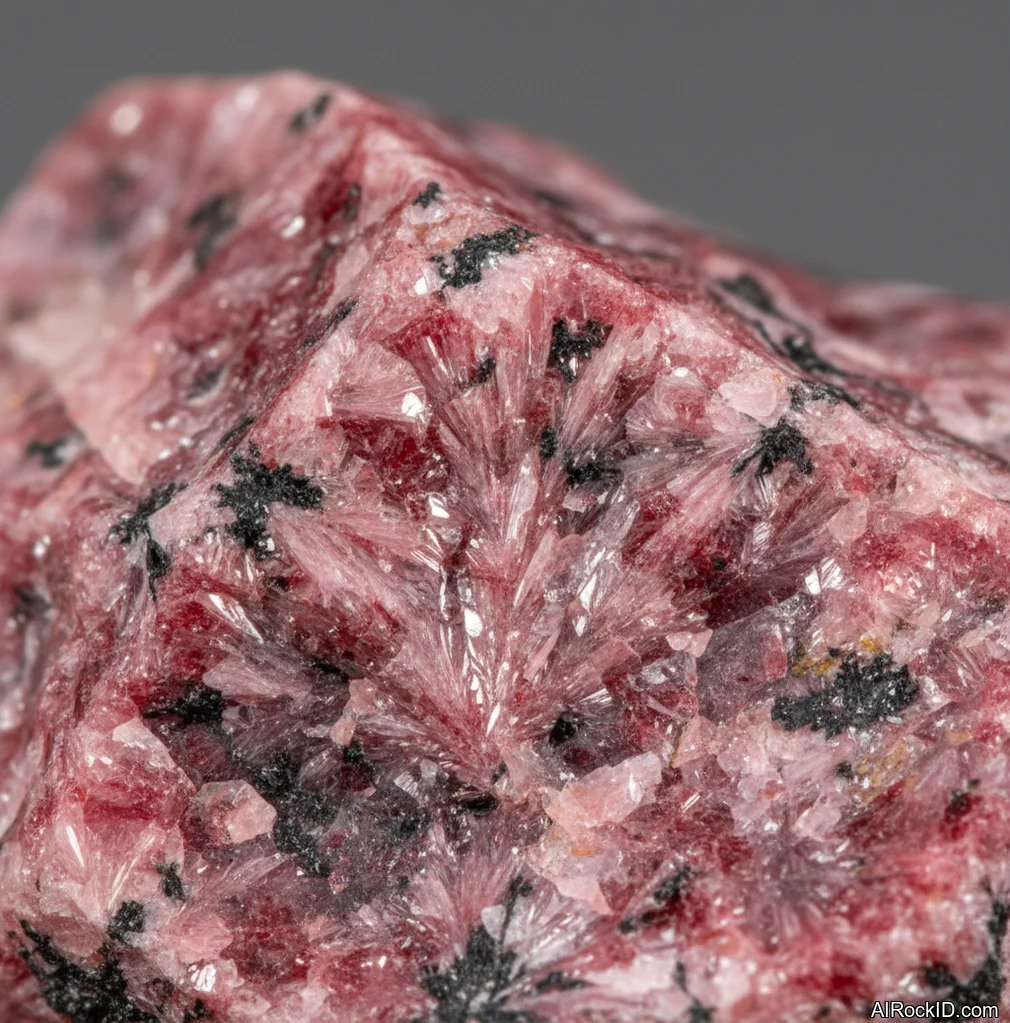
Pick up something being sold as “alurgite” and you’ll usually notice the mica vibe immediately. It wants to flake. The surface has that slightly greasy slip you get when tiny plates are sliding under your fingers, and the color sits in thin layers instead of running solid all the way through. I’ve handled a few at shows that were basically rosy to brick-red, platy pieces that looked like they belonged in the mica family, and honestly the label was doing more heavy lifting than the specimen.
But here’s the catch: without a verified species definition, you can’t pin down one set of physical constants and pretend it’s accurate. So when you see hardness, density, or refractive index printed like it’s settled fact, take that as a red flag. The only straight way to talk about “alurgite” is as a name that still needs ID work, not a mineral you can lock in with a single chart.
Origin & History
Most dealers who toss around the word “alurgite” are usually leaning on old, inconsistent usage and shop-to-shop folklore, not a modern, accepted species description. It shows up on handwritten tags the same way “green onyx” does. Handy label. Not a guarantee.
Look at the spelling, and watch how it moves. You’ll spot it in mixed lots, estate trays, online listings, the kind where the stone’s already polished or tumbled and the surface has that slick, rounded feel that makes real ID a pain. In my experience, the name gets slapped on anything reddish and micaceous (you can see the little sparkly flakes catch the light when you tilt it) because the seller doesn’t want to say “just mica” at the table. Who does, honestly?
Where Is Alurgite Found?
Because “alurgite” isn’t a standardized species name, there isn’t a reliable, citable locality list. Any location claims should be treated as unverified until the specimen is properly identified.
Formation
Look, at first glance a lot of “alurgite” chunks really do look like they came out of a metamorphic setup, the kind where micas and manganese-bearing silicates tend to show up, especially in schists and other foliated rocks. You see that platy habit and then it starts splitting into thin little sheets (the way mica does), and it’s basically a neon sign saying “mica-like.”
But the real test is the context. If it’s actually coming out of a manganese-rich metamorphic zone, then sure, you might be looking at a Mn-bearing mica or some related silicate. If it’s sitting in a grab bag with dyed material and reconstituted chips, though, that’s a different story. Then you might be dealing with something man-made or altered that just got a fancy label stuck on it.
And no, you can’t sort that out from one glam photo. Not really.
How to Identify Alurgite
Color: Most material sold as alurgite is red-brown to wine-red, often with a rusty or brick tone that sits in thin layers. The color can look patchy because the stone is built from flakes and plates.
Luster: It’s usually pearly to vitreous on cleavage faces, with a mica-like sheen when you tilt it under a lamp.
Pick up the piece and roll it in your fingers. If it sheds tiny flakes or shows perfect sheet-like cleavage, you’re probably in mica territory, not some rare standalone gem. If you scratch it with a steel pin and it marks easily, don’t let anyone sell it to you as a “hard” stone. The problem with buying it by name is that you can’t verify it by name. Ask the seller what it was identified as originally, and whether there’s any lab note, locality info, or at least a consistent association matrix in the host rock.
Common Look-Alikes
Alurgite is sometimes confused with these materials:
- Rhodonite
- Manganese-rich muscovite (roscoelite or fuchsite with Mn)
- Lepidolite (especially when pinkish)
- Dyed mica sheets
- Thulite
- Glass fakes with mica powder
Market Cautions & Treatments
When AI Can Get This Wrong
AI photo tools usually confuse alurgite with rhodonite or lepidolite, especially if they're just seeing a pink or reddish flakey surface. In-hand, the flaking and greasy feel are dead giveaways—no real rhodonite does that. The real test is to try splitting a thin flake with a pin; alurgite-labeled mica will split, while genuine massive silicates won't budge.
Properties of Alurgite
Physical Properties
| Crystal System | invalid |
| Hardness (Mohs) | invalid (invalid) |
| Density | invalid |
| Luster | invalid |
| Diaphaneity | invalid |
| Fracture | invalid |
| Streak | invalid |
| Magnetism | invalid |
| Colors | invalid |
Chemical Properties
| Classification | invalid |
| Formula | invalid |
| Elements | |
| Common Impurities |
Optical Properties
| Refractive Index | invalid |
| Birefringence | invalid |
| Pleochroism | invalid |
| Optical Character | invalid |
Alurgite Health & Safety
Handling it is usually pretty low risk. But if you’re cutting or sanding some micaceous material you haven’t ID’d yet, don’t breathe the dust. That fine powder hangs in the air longer than you think, and you’ll notice it gritty on your fingers (and sometimes in your nose) right after. So treat any unverified stones as unknowns until they’re identified.
Safety Tips
If you’re grinding or drilling it, don’t do it dry. Use water to keep the dust down, keep a fan or decent ventilation going, and wear a real respirator that seals to your face (the kind where you can feel it tug when you inhale). But if you’re just keeping it as a specimen, stick it in a closed box or a display case with a tight-fitting lid so any little flakes stay trapped inside. Why make a mess if you don’t have to?
Alurgite Value & Price
Price Range
Rough/Tumbled: $5 - $40 per specimen (as-labeled, unverified)
Value mostly comes down to what it looks like, how big it is, and if the seller can actually prove what it is. A verified, well-documented specimen of a specific mineral is always going to be easier to price than some mystery trade name with nothing behind it.
Durability
Nondurable — Scratch resistance: Poor, Toughness: Poor
As a mica-like material, it tends to cleave and flake, so it doesn’t handle knocks or abrasion well.
How to Care for Alurgite
Use & Storage
Store it in a perky box or a small jar so the flaky bits don’t end up all over your shelf. If it’s platy and delicate, keep harder specimens from rubbing against it.
Cleaning
1) Use a soft paintbrush to lift dust and loose flakes. 2) If needed, rinse quickly in cool water and pat dry. 3) Let it air-dry fully before putting it back in a box.
Cleanse & Charge
If you do energy-style cleansing, smoke, sound, or a quick rinse are the gentlest options for flaky material. Skip salt bowls if the piece has fragile layers.
Placement
I keep anything sold as alurgite out of sunny windows because the look can change when the surface dries out or sheds. A shaded shelf with stable humidity is easier on micaceous stuff.
Caution
Don’t treat it like it’s some single, well-identified mineral with a neat little list of guaranteed properties. And skip the aggressive stuff: ultrasonic cleaners, long soaks, or scrubbing it hard with a stiff brush. Thing is, if it’s got that sheet-like cleavage, it can flake or even pop off in thin bits when you stress it. Why risk it?
Works Well With
Alurgite Meaning & Healing Properties
Compared to something nailed down like quartz or garnet, “alurgite” sits in a weird spot in metaphysical talk because that name doesn’t point to one specific mineral. So I treat it like a vibe you can work with, not a science claim. If your piece is that red-brown, micaceous stuff, people tend to read it as grounding and steady, kind of like they do with earthy micas and manganese-leaning stones.
Thing is, when you pick up a flaky, reddish mica, you get this quiet, weighty feeling in your hand even when the specimen isn’t actually heavy. I’ve kept similar material on my desk while I’m trying to slow down and grind through paperwork, mostly because that little sheen flashes when I move and it snaps my attention back to what I’m doing (like a tiny visual tap on the shoulder). Not medicine. Just a physical object doing what physical objects do, giving you a small sensory anchor.
But don’t let anyone sell you certainty where there isn’t any. If somebody promises the exact same results from every “alurgite” piece, they’re pretending the label can’t cover different minerals. So if you still want to work with it, keep it simple: pair it with a grounding stone, set a clear intention, then watch what you actually feel over a week, not what some listing tells you you’re supposed to feel. Why make it more complicated than that?
Common mistakes
- Assuming alurgite is a separate IMA-approved mineral species
- Identifying any purple mica as alurgite without checking composition or locality
- Confusing massive purple minerals with mica because of color alone
- Ignoring perfect basal cleavage, which is one of the most useful field clues
- Paying a premium for the name without documentation or provenance
- Treating a historical label as a modern mineral classification
Identify Alurgite from a photo
Compare Alurgite traits, care tips, value clues, and common lookalikes with a clear photo.