Blue Chalcedony


Quick answer: Blue chalcedony is a translucent to opaque variety of microcrystalline quartz known for its soft blue, gray-blue, or lavender-blue appearance. It is commonly confused with dyed agate, blue lace agate, angelite, and some glass imitations, so color pattern, translucency, hardness, and seller disclosure are useful checks.
AI Rock ID can help compare a blue chalcedony photo against visually similar stones by evaluating color, luster, translucency, and texture. RockIdentifier.io provides crystal identification support, but final confirmation may require hardness testing, magnification, or gemological review for valuable pieces.
Good fit
- Collectors who like soft blue translucent quartz varieties
- Jewelry wearers who want a durable stone for pendants, beads, or earrings
- Beginners learning to compare chalcedony, agate, and dyed quartz materials
- Buyers who prefer subtle color over bright or heavily banded stones
Not a good fit
- Anyone needing a certified natural-color gemstone without lab documentation
- Buyers expecting strong blue color in every natural specimen
- People looking for a very soft, fragile display mineral
- Collectors who want sharp crystal faces rather than massive or nodular material
Most commonly confused with
- Blue Lace Agate: Usually shows visible pale blue and white banding, while blue chalcedony is often more uniform.
- Angelite: Softer and more opaque with a chalkier look; it can be scratched more easily than chalcedony.
- Dyed Agate: May show unusually saturated blue color concentrated in cracks, pores, or banded zones.
- Blue Quartz: May appear more granular or crystalline, while chalcedony has a waxy microcrystalline texture.
Blue Chalcedony vs Similar Blue Stones
| Material | Typical Look | Key Difference |
|---|---|---|
| Blue Chalcedony | Soft blue to gray-blue, waxy, translucent to opaque | Microcrystalline quartz with Mohs 6.5–7 |
| Blue Lace Agate | Pale blue with white or lighter bands | Distinct banding is usually visible |
| Angelite | Opaque powdery blue, dull to pearly | Much softer, about Mohs 3–3.5 |
| Dyed Agate | Bright or uneven blue, often banded | Dye may collect in fractures or pores |
| Blue Glass | Even blue, glassy shine | May show bubbles, mold marks, or flow lines |
AI identification confidence
AI identification is often moderately confident for blue chalcedony when the photo shows a waxy luster, soft blue color, and translucency at edges. Confidence is lower for polished beads, cabochons, dyed stones, or images taken under strong blue lighting.
When AI gets it wrong
- The specimen is a polished bead or cabochon with no visible texture or natural surface.
- Lighting makes gray, white, or colorless chalcedony appear blue.
- Dyed agate has an even bright blue color that masks natural banding or fractures.
- Angelite or glass is photographed without scale, hardness context, or edge translucency.
Final recommendation
Choose blue chalcedony with seller disclosure about treatment status, origin when available, and clear photos in neutral lighting. For higher-priced jewelry or collector stones, ask whether the color is natural, dyed, coated, or stabilized.
How to Check Blue Chalcedony Authenticity
Natural blue chalcedony usually has a soft, slightly gray or lavender-blue color rather than an intense neon blue. Examine the stone under magnification for dye concentrated in cracks, pits, drill holes, or banded zones. A waxy luster, slight edge translucency, and hardness consistent with quartz support identification, while bubbles or mold seams may indicate glass.
Buying Blue Chalcedony Online
Useful listings show photos in daylight or neutral lighting, include close-ups, and state whether the stone is natural, dyed, heated, coated, or stabilized. Be cautious with very saturated blue beads or slabs sold without treatment disclosure. For expensive pieces, request a return policy or an independent gemological report.
Photo Tips for Identifying Blue Chalcedony
Photograph blue chalcedony on a white or neutral background in indirect daylight to reduce color distortion. Include one close-up, one edge-lit image showing translucency, and one photo with a ruler or coin for scale. Avoid heavy filters, colored lights, and overly warm indoor lighting because they can change gray-blue tones.
What Is Blue Chalcedony?
Blue chalcedony is the blue to gray-blue, translucent kind of chalcedony, and chalcedony itself is microcrystalline quartz (SiO2). On a dealer’s tray it can look almost plain. But tip it under a desk lamp and that soft, watery glow shows up, the kind that makes you pause mid-reach.
Thing is, you notice the texture before anything else. It’s smooth, yeah, but it doesn’t have that hard glassy slickness, and it hangs onto that cool-to-the-touch feel longer than dyed glass usually does. Most of what’s out there is tumbled, cabbed, or carved, since chalcedony typically doesn’t form big, pointy quartz crystals. And when the color stays even and the translucency hits just right, even a simple oval cab looks like a tiny window into fog (how is that even possible?).
Origin & History
“Chalcedony” comes from Chalcedon (ancient Khalkedon), an old port district across from Byzantium. The word’s been used forever as a catch-all name for the cryptocrystalline quartz family. Blue chalcedony, though, is really more of a trade and collector label than a formal species name, since it’s basically color plus texture, not a separate mineral.
On the science side, quartz was described and formalized ages ago, but chalcedony’s microstructure took way longer to pin down. It’s essentially tightly packed fibers of quartz and moganite. And in the shop world, “blue chalcedony” turned into the polite, accurate way to say “that soft blue quartz that isn’t dyed agate,” because, honestly, people mix those up all the time (I’ve seen the same milky, waxy sheen get mislabeled right in the tray).
Where Is Blue Chalcedony Found?
Blue chalcedony shows up in silica-rich volcanic and sedimentary settings worldwide, with steady commercial material coming from places like Brazil, Namibia, Turkey, and parts of the western USA.
Formation
Most blue chalcedony shows up when silica-loaded fluids snake through little cavities, hairline fractures, or porous rock, then turn into a gel and harden up. Think gas bubbles trapped in basalt (those rounded pockets you see when you crack a piece open), old hydrothermal veins, or spots where silica straight-up replaces whatever was there first. It doesn’t build itself into a clear quartz point with big flat faces. It just packs the space with tight fibers and microscopic crystals you won’t even notice without a microscope.
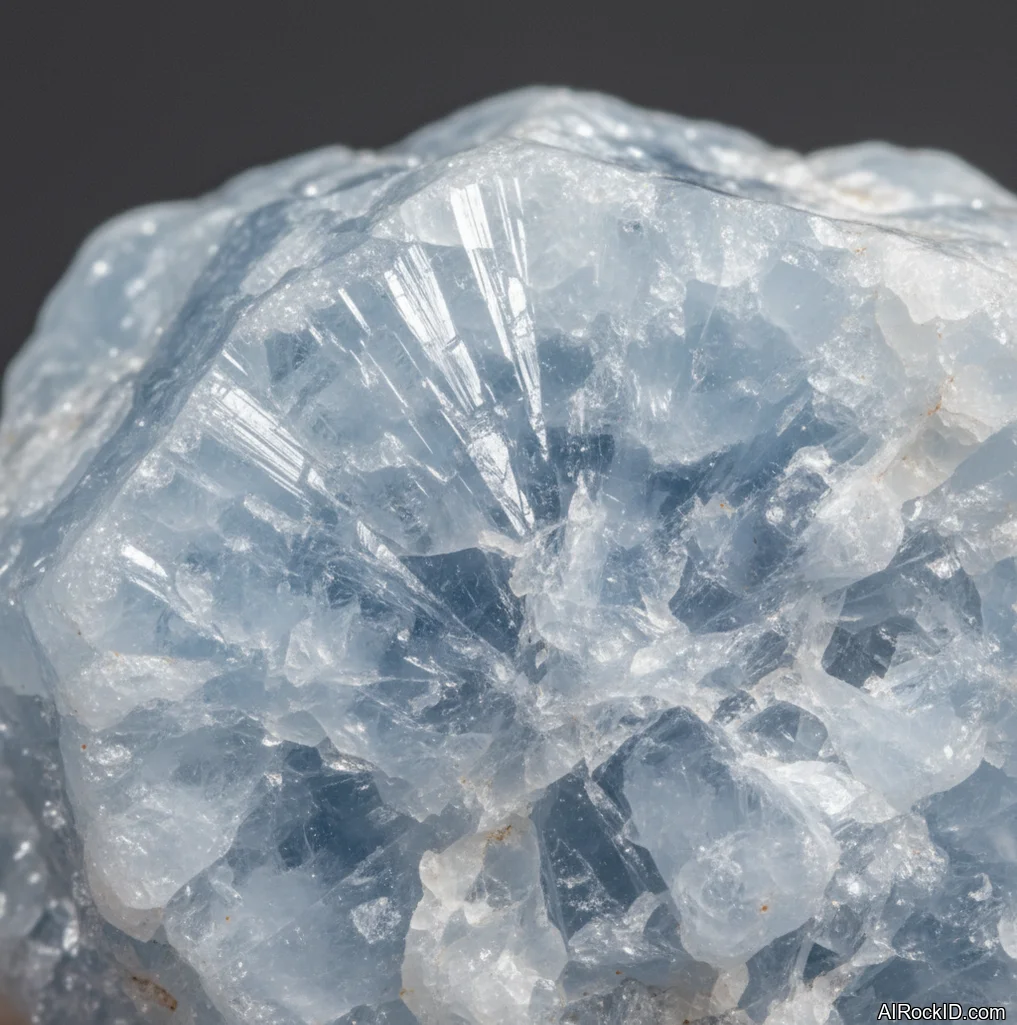
Look, if you snap it and stare at the fresh break, you’ll usually see that classic conchoidal fracture, like chipped bottle glass, just with a softer, waxier vibe. And the blue? That’s mostly light scattering through the microstructure, plus tiny trace impurities. So in daylight a lot of “blue” chalcedony reads more blue-gray, then under warm indoor bulbs it slides into a milkier, easier blue. Funny how lighting messes with it, right?
How to Identify Blue Chalcedony
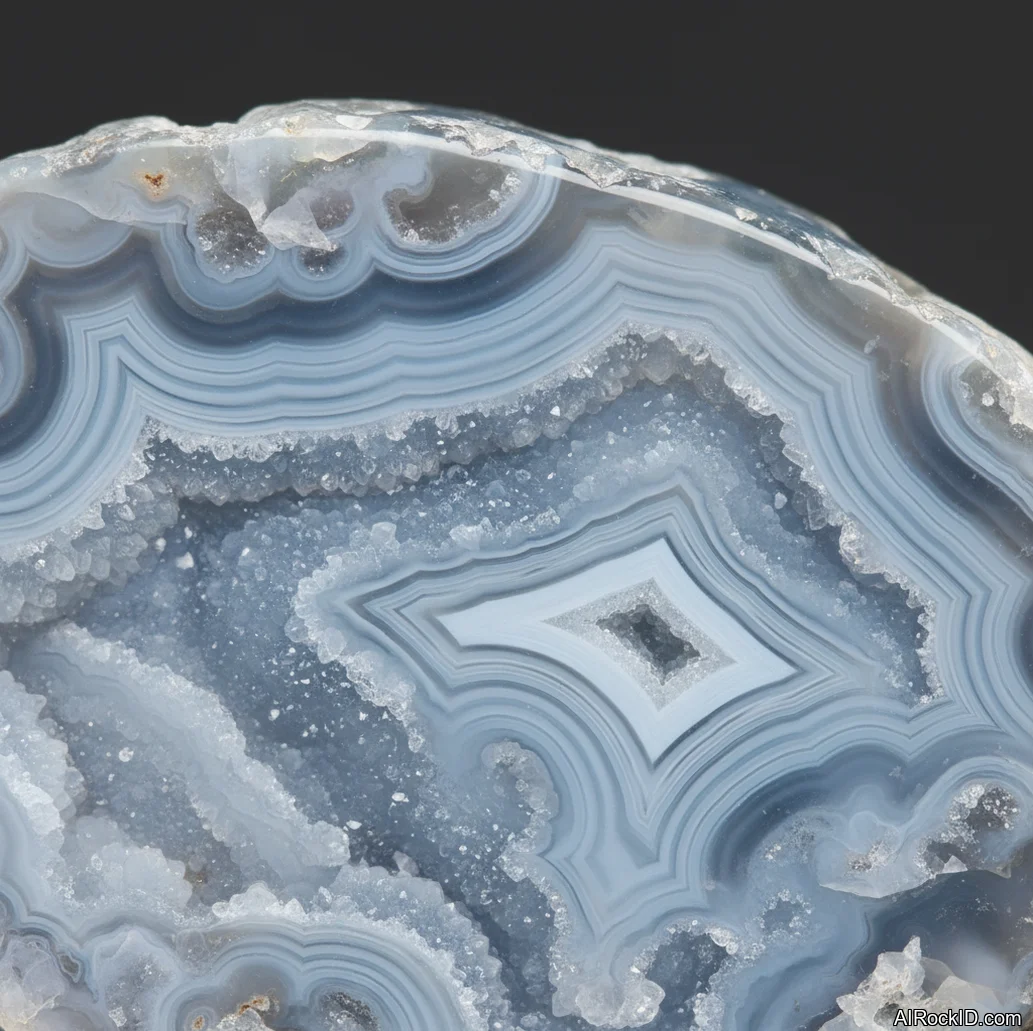
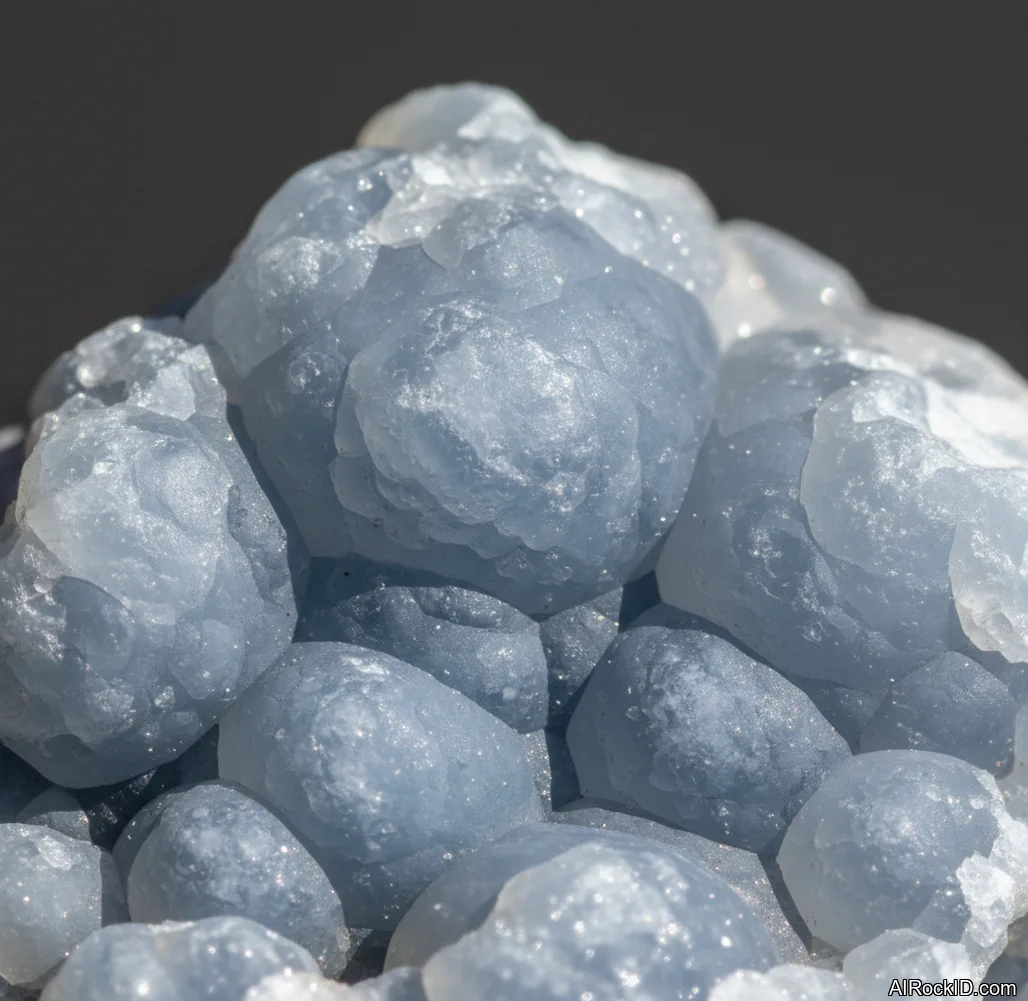
Color: Soft blue to gray-blue, often with a cloudy or misty look rather than sharp banding. Color is usually even, but you can get faint zoning or white patches.
Luster: Waxy to vitreous luster, especially obvious on a fresh break or a good polish.
At first glance, separate it from dyed agate by hunting for banding. Real blue chalcedony is usually more uniform and foggy, while dyed material loves to show concentrated color along cracks and bands. If you scratch it with a steel knife, you shouldn’t get a deep cut, but you can leave a faint metal mark that wipes off. And when you hold a cab up to a phone flashlight, good chalcedony glows through the edges in a soft, even way, not in blotchy patches.
Common Look-Alikes
Blue Chalcedony is sometimes confused with these materials:
- Dyed blue agate
- Blue lace agate
- Blue glass (especially tumbled or cabochon)
- Blue opal (Peruvian or Andean)
- Blue aventurine
- Synthetic quartz dyed blue
Market Cautions & Treatments
When AI Can Get This Wrong
AI photo ID often mistakes blue chalcedony for dyed agate or blue lace agate, especially when the photo is overexposed or the polish is high. In hand, run a steel blade over an inconspicuous spot—real chalcedony will scratch glass, glass fakes won’t. Look for subtle, cloudy zoning inside; dyed stones show color pooling along cracks and edges, but natural blue chalcedony glows evenly throughout.
Properties of Blue Chalcedony
Physical Properties
| Crystal System | Trigonal |
| Hardness (Mohs) | 6.5-7 (Hard (6-7.5)) |
| Density | 2.58-2.64 |
| Luster | Waxy |
| Diaphaneity | Translucent |
| Fracture | Conchoidal |
| Streak | White |
| Magnetism | Non-magnetic |
| Colors | Blue, Gray-blue, Whitish blue, Blue-green (rare) |
Chemical Properties
| Classification | Silicates |
| Formula | SiO2 |
| Elements | Si, O |
| Common Impurities | Fe, Mn, Ti, Ni, Al |
Optical Properties
| Refractive Index | 1.530-1.540 |
| Birefringence | 0.009 |
| Pleochroism | None |
| Optical Character | Uniaxial |
Blue Chalcedony Health & Safety
Blue chalcedony is usually fine to touch and keep out on a shelf. The one real issue comes up if you start cutting, grinding, or drilling it, because that can kick up silica dust into the air.
Safety Tips
If you have to shape it, do it with wet cutting and wear the right respirator. And when you’re done, wipe up the slurry while it’s still wet, don’t sweep up dry dust (that stuff gets airborne fast).
Blue Chalcedony Value & Price
Price Range
Rough/Tumbled: $5 - $60 per piece
Cut/Polished: $2 - $15 per carat
Price mostly tracks how even the color is, how translucent it looks when you hold it up to a lamp, and how big the piece is. And the market will pay more for clean cab material with very few fractures, since chalcedony loves to hide tiny internal stress lines that don’t show up until you’ve got it on the wheel and polished.
Durability
Durable — Scratch resistance: Good, Toughness: Good
It handles daily wear well, but it can chip on sharp edges if it takes a hard knock against tile or concrete.
How to Care for Blue Chalcedony
Use & Storage
Store it in a soft pouch or a compartmented box so harder stones don’t scuff the polish. I’ve seen chalcedony come out of a mixed tumble bag looking hazy from tiny surface rubs.
Cleaning
1) Rinse with lukewarm water and a drop of mild soap. 2) Gently scrub with a soft toothbrush, especially around drill holes or carvings. 3) Rinse well and dry with a microfiber cloth.
Cleanse & Charge
If you do energy-style care, running water or a short rest on a windowsill at indirect light is usually fine. Skip harsh sun for long stretches if you’re picky about keeping the color looking soft and even.
Placement
Looks best where light can pass through an edge, like on a shelf near a lamp, not shoved flat against a dark backdrop. And keep it away from places it’ll get knocked, since polished edges can chip.
Caution
Skip strong acids and gritty, abrasive cleaners, and don’t toss carved or already-fractured pieces into an ultrasonic cleaner. If you think it’s been dye-treated, don’t leave it soaking for hours, because some treated material will bleed color into the water (and you’ll see that tint creep out pretty fast).
Works Well With
Blue Chalcedony Meaning & Healing Properties
Compared to the flashier stones, blue chalcedony’s the quiet one. And that’s exactly why people go for it. In my own stash, it’s the piece I keep grabbing when I want something calming on the desk that doesn’t yell for attention.
Most folks tie it to communication and a smoother emotional tone, like a “say it without heat” kind of vibe. I’ve found it’s easier to wear than those harder, high-contrast blues like lapis when you’re in a setting where subtle matters. But look, I’m going to be straight about it: that’s personal experience and traditional belief, not medicine, and it doesn’t replace real help when you need it.
Thing is, buying it for metaphysical reasons can get messy because the label gets abused. Dyed agate and dyed quartz get sold as “blue chalcedony” all the time, especially in bead strands (the kind that arrive looking almost too perfectly sky-blue, like they came out of a paint bath). So if you care about how the stone feels as much as the story attached to it, learn the natural look: even, cloudy color. And don’t be shy about asking a seller point-blank if it’s been treated. Why not?
Common mistakes
- Assuming every bright blue chalcedony or agate is naturally colored.
- Confusing blue lace agate with blue chalcedony when banding is visible.
- Identifying angelite as chalcedony without checking relative softness.
- Relying only on color instead of checking luster, translucency, and texture.
- Ignoring dye concentration around drill holes in beads.
- Calling all blue microcrystalline quartz agate even when no banding is present.
Identify Blue Chalcedony from a photo
Compare Blue Chalcedony traits, care tips, value clues, and common lookalikes with a clear photo.