Cultured Pearl


Quick answer: Cultured pearl is an organic gem made when a mollusk deposits nacre around a human-introduced nucleus or tissue piece. It can be confused with natural pearl, shell pearl, glass imitation pearl, and plastic imitation pearl, so surface, drill-hole, luster, and X-ray evidence may matter for identification.
AI Rock ID can help screen a photographed pearl by comparing visible traits such as shape, luster, surface blemishes, and drill-hole appearance. RockIdentifier.io provides crystal and gem references that can support visual checks, but laboratory testing is needed for high-value pearl origin reports.
Good fit
- People comparing pearl jewelry before purchase
- Beginners learning differences between cultured, natural, and imitation pearls
- Collectors documenting organic gems with visible surface features
- Owners checking whether a strand may need professional appraisal
Not a good fit
- Situations requiring proof that a pearl is natural rather than cultured
- Confirming saltwater versus freshwater origin from photos alone
- Valuing fine pearls without measurements, matching, luster grading, and condition inspection
Most commonly confused with
- Natural Pearl: Natural pearls form without human nucleation, while cultured pearls form after human assistance; X-ray testing is often needed to confirm the difference.
- Mother of Pearl: Mother of pearl is nacreous shell material cut from the mollusk shell, not a whole pearl formed inside the mollusk.
- Glass Imitation Pearl: Glass imitation pearls usually have a coated surface and may show flaking or a uniform drill-hole coating rather than layered nacre.
- Plastic Imitation Pearl: Plastic imitation pearls are typically lighter, warmer to the touch, and less dense than cultured pearls.
Cultured Pearl vs Common Lookalikes
| Material | Typical origin | Visual clue | Confirming test |
|---|---|---|---|
| Cultured pearl | Mollusk-grown with human assistance | Nacre luster with natural surface variations | X-ray or expert gem testing |
| Natural pearl | Mollusk-grown without human assistance | Can look identical to cultured pearl | X-ray structure analysis |
| Glass imitation pearl | Coated glass bead | Coating may chip near drill holes | Magnification and density check |
| Plastic imitation pearl | Coated plastic bead | Very light weight and often uniform surface | Weight, magnification, and hot-needle testing by a professional |
| Mother of pearl | Cut nacreous shell | Flat or carved shell pieces rather than spherical growth | Shape and layered shell structure |
AI identification confidence
AI identification confidence for cultured pearl is usually moderate when the image is sharp, well lit, and includes drill holes, surface texture, and scale. Confidence drops when the object is a round white bead, because cultured pearls and imitation pearls can look similar in ordinary photos.
When AI gets it wrong
- A coated glass or plastic bead has strong luster and is photographed without a visible drill hole.
- A high-quality freshwater cultured pearl is mistaken for a natural pearl from appearance alone.
- A shell pearl or mother-of-pearl bead shows nacre-like shine but was manufactured from shell material.
- Heavy filters, low resolution, or overexposure hide surface blemishes and nacre texture.
Final recommendation
For casual identification, compare luster, surface irregularities, weight, and drill-hole details before assuming a bead is cultured pearl. For expensive strands, antique jewelry, or natural-pearl claims, request documentation from a qualified gemological laboratory or pearl specialist.
How to Check Pearl Authenticity Before Buying
Ask whether the pearl is freshwater cultured, saltwater cultured, natural, or imitation, because these categories affect price and documentation. Examine drill holes with magnification for peeling coatings, uneven nacre, or exposed bead nuclei. Request measurements, matching notes, luster description, surface grade, and any available lab report for higher-value purchases.
Freshwater vs Saltwater Cultured Pearl
Freshwater cultured pearls are commonly grown in mussels and often appear in a wide range of shapes, sizes, and natural colors. Saltwater cultured pearls include Akoya, Tahitian, and South Sea types and are often bead-nucleated. Visual appearance can suggest a type, but origin should not be treated as certain from photos alone.
Photo Tips for Identifying Cultured Pearl
Use soft natural light and avoid flash glare, which can hide surface texture. Photograph the pearl beside a ruler, include the drill hole if present, and capture both close-up and full-strand views. A white background helps show body color, while a dark background can reveal luster and surface blemishes.
What Is Cultured Pearl?
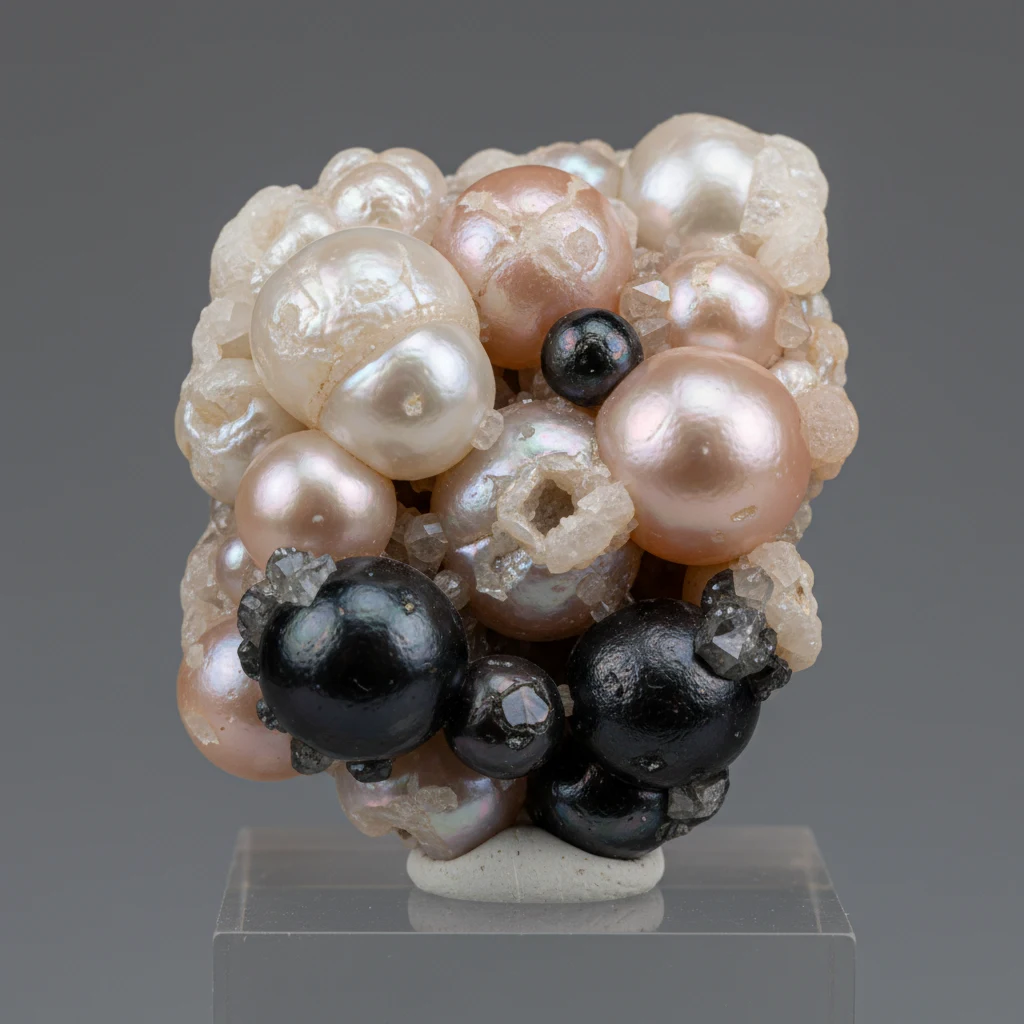
Cultured Pearl is a common organic gem formed by mollusks, valued for its smooth body and high pearly luster. In hand, a good cultured pearl reads as soft, rounded, and quietly reflective rather than glassy; its surface can appear white, cream, pink, or black depending on the pearl.
Mineralogically, it is an organic compound with a CaCO3 composition in an organic matrix. It is amorphous, opaque, non-magnetic, and very soft to moderately soft at Mohs 2.5-4.5, so collectors treat it more like a delicate gem than a hard crystal specimen.
Origin & History
The word pearl comes from the Latin perla, and cultured pearls have been produced since the early 20th century. That history matters to collectors because a cultured pearl is not simply found by chance; it forms through mollusk activity with human intervention.
Practically, this gives cultured pearls their familiar jewelry presence: smooth, lustrous surfaces, often more uniform than natural pearls. For catalog-style comparison and mineral-reference checking, mindat.org is a useful plain-text reference alongside specimen notes and seller documentation.
Where Is Cultured Pearl Found?
Cultured pearls are most commonly found in marine environments and are produced in countries including Japan, China, and Australia. Notable names collectors see in the market include Akoya, Japan; South Sea, Australia; and Tahitian, French Polynesia.
Formation
Cultured Pearl forms when a mollusk is irritated and secretes layers of nacre around an irritant. The result is a compact organic gem with a pearly luster and an opaque body, rather than a crystal with visible faces or cleavage.
Because the gem grows by layered secretion, the surface is central to its identity. A fine cultured pearl should show a smooth, luminous skin, while blemishes or unevenness can be visible under close inspection and may influence value.
How to Identify Cultured Pearl
Identify Cultured Pearl by its pearly luster, smooth rounded surface, and colors such as white, cream, pink, or black. It is opaque, non-magnetic, has a white streak, and has a density range of 2.60-2.85.
For practical sorting, check uniformity and surface blemishes. Cultured pearls are often more regular than natural pearls, while natural pearls are usually less perfect; a careful look at matching, color consistency, and surface condition is essential.
Properties of Cultured Pearl
Physical Properties
| Crystal System | Amorphous |
| Hardness (Mohs) | 2.5-4.5 (Very Soft (1-2)) |
| Density | 2.60-2.85 |
| Luster | Pearly |
| Diaphaneity | Opaque |
| Fracture | Conchoidal |
| Streak | White |
| Magnetism | Non-magnetic |
| Colors | White, Pink, Black |
Chemical Properties
| Classification | Organic compound |
| Formula | CaCO3 (with organic matrix) |
| Elements | Ca, C, O |
| Common Impurities |
Optical Properties
| Refractive Index | 1.53-1.68 |
| Birefringence | None |
| Pleochroism | None |
| Optical Character | Isotropic |
Cultured Pearl Health & Safety
There are no significant health risks associated with handling cultured pearls.
Cultured Pearl Value & Price
Price Range
Rough/Tumbled: $200 - $1,000 per specimen
Cut/Polished: $100 - $5,000 per carat
Price is affected by size, luster, and color.
Durability
Moderate — Scratch resistance: Fair, Toughness: Good
They can be damaged by harsh chemicals and should be handled carefully.
How to Care for Cultured Pearl
Use & Storage
Store in a soft pouch to avoid scratches.
Cleaning
Clean with a soft cloth after wearing. Avoid harsh chemicals.
Cleanse & Charge
Soak in cool water to cleanse occasionally.
Placement
Keep away from direct sunlight to prevent fading.
Caution
Avoid exposing to perfumes or cosmetics.
Works Well With
Cultured Pearl Meaning & Healing Properties
In crystal healing traditions, Cultured Pearl is associated with calming, nurturing, and emotional healing. It is traditionally believed to support emotional balance and personal integrity, though it is not a substitute for medical treatment.
Energetically, it is linked with the Heart and Crown chakras, the zodiac signs Cancer and Taurus, the Moon, and the Water element. Many practitioners pair it with rose quartz for love, amethyst for insight, or clear quartz for a clean, bright supporting presence.
Identify Cultured Pearl from a photo
Compare Cultured Pearl traits, care tips, value clues, and common lookalikes with a clear photo.
Common mistakes
- Calling every pearl natural when most pearls in modern jewelry are cultured.
- Assuming perfectly round shape proves a pearl is valuable; luster, surface, size, nacre quality, and matching also matter.
- Using the tooth test as a final answer; it can damage surfaces and does not reliably separate all imitations.
- Ignoring drill holes, where coating chips or exposed nuclei may reveal imitation materials.
- Buying expensive pearls without a return policy, grading details, or independent documentation.
- Assuming color alone proves origin; dyed and treated pearls are common in the market.