Dzi Bead


Quick answer: A Dzi bead is usually an etched agate or chalcedony bead associated with Tibetan and Himalayan cultural traditions. Its identity depends on the bead material, surface patterning, wear, drilling, and provenance rather than mineral species alone.
AI Rock ID can help compare a Dzi bead’s visible material, banding, polish, and etched pattern against common agate and glass lookalikes. RockIdentifier.io provides visual identification support, but authentication of age, origin, and cultural provenance should be confirmed by a qualified appraiser or experienced dealer.
Good fit
- Collectors interested in Tibetan and Himalayan bead traditions
- People comparing etched agate beads with glass, resin, or ceramic imitations
- Jewelry wearers who want a durable bead material with Mohs hardness around 6.5–7
- Buyers who can request provenance, close-up photos, and seller documentation
Not a good fit
- Anyone needing a bead’s age verified from photos alone
- Buyers expecting every patterned agate bead to be an antique Dzi bead
- People seeking guaranteed medical or protective effects
- Collectors who cannot inspect drill holes, surface wear, and pattern quality
Most commonly confused with
- Agate: Dzi beads are commonly made from agate, but ordinary agate lacks the specific etched eye, stripe, or symbolic bead patterns.
- Onyx: Onyx may have dark banding, but Dzi beads typically show intentional etched motifs rather than natural parallel bands alone.
- Glass: Glass imitations can copy Dzi patterns but may show bubbles, mold marks, lower hardness, or a different surface feel.
- Carnelian: Carnelian beads may share warm brown to orange tones, but they do not automatically have Dzi cultural patterning or age.
Dzi Bead vs. Common Lookalikes
| Item | Typical Material | Key Difference | ID Clue |
|---|---|---|---|
| Dzi bead | Etched agate or chalcedony | Intentional symbolic patterns on a hard stone bead | Check drill wear, surface etching, and provenance |
| Modern agate bead | Agate | May be similar stone without traditional Dzi motifs or age | Natural banding is often more important than etched symbols |
| Glass imitation | Glass | Can copy the pattern but not the same mineral hardness | Look for bubbles, mold seams, and softer surface wear |
| Ceramic copy | Fired clay or porcelain | Pattern may be painted, printed, or glazed | Edges of designs may sit on the surface rather than within etched stone |
| Dyed bead | Agate, chalcedony, or other porous material | Color may be enhanced to imitate aged Dzi tones | Inspect holes and cracks for concentrated dye |
AI identification confidence
AI identification can usually suggest whether a bead resembles agate, glass, ceramic, or another common material from clear photos. AI cannot reliably confirm antique status, ritual use, geographic origin, or market value without provenance and physical examination.
When AI gets it wrong
- Photos are blurry, overexposed, or taken through a plastic bag or display case
- The bead has heavy polish, oil, wax, or surface coatings that hide texture
- Printed or painted patterns imitate etched agate too closely in a single image
- Only one angle is shown, with no view of drill holes, ends, or side wear
Final recommendation
For buying, treat material identification and authenticity as separate questions: a bead may be real agate but still modern or artificially aged. Ask for multiple photos, measurements, weight, provenance, and a clear return policy before paying antique-level prices.
How to Photograph a Dzi Bead for Identification
Use bright indirect light and photograph the bead from the front, back, both ends, and through the drill hole. Include a ruler or coin for scale and avoid beauty filters, flash glare, or color-changing backgrounds. Close-up images of chips, worn edges, and pattern boundaries are especially useful for separating etched stone from printed or painted copies.
Authentication Clues Buyers Check
Experienced buyers look at drill-hole shape, edge rounding, surface wear, pattern depth, mineral translucency, and whether aging appears consistent across the bead. Antique claims should be supported by provenance or expert evaluation because modern etching and artificial wear can be convincing. A high price should not be used as proof of age or authenticity.
Cultural Context and Respectful Use
Dzi beads are strongly associated with Tibetan, Himalayan, and Central Asian bead traditions, where patterns may carry symbolic meanings. Wearing or collecting them is common, but sellers and buyers should avoid presenting uncertain pieces as sacred antiques without evidence. Metaphysical meanings are best described as cultural or spiritual traditions, not guaranteed effects.
What Is Dzi Bead?
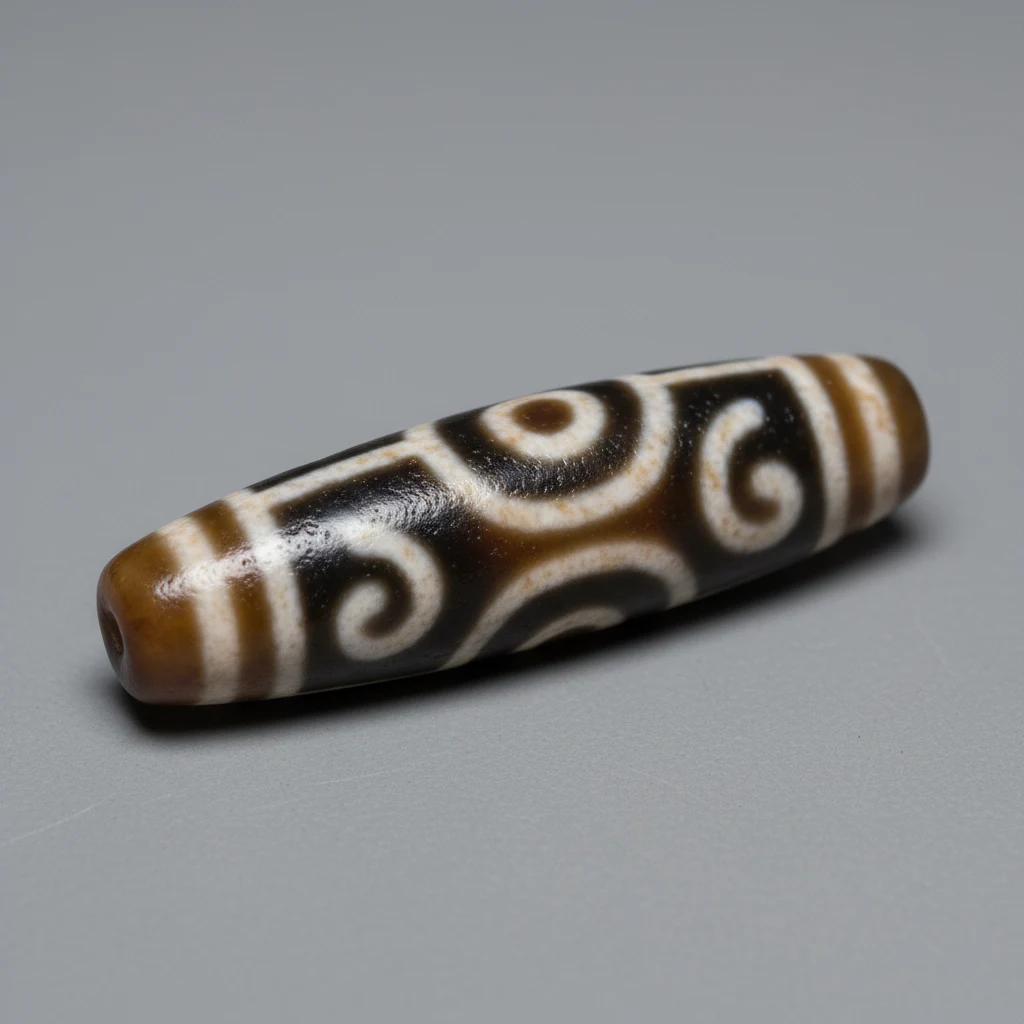
A Dzi Bead is a decorative agate bead, valued for its carved, polished form and distinctive brown, black, and white patterning. In the hand, it feels like a compact piece of durable agate: smooth, cool at first touch, and firm enough for regular jewelry wear. Its Mohs hardness is 6.5-7, with good scratch resistance, good toughness, and a stable nature suited to everyday handling.
Collector interest comes from the bead’s look, age, craftsmanship, and rarity of pattern. Dzi Beads are classed as uncommon semi-precious gemstones, with each bead carrying its own markings rather than a single uniform appearance. Mineralogically, the material is agate, a silicate with formula SiO2, trigonal crystal system, white streak, conchoidal fracture, and vitreous to waxy luster.
Origin & History
The name “Dzi” comes from Tibetan and means “to shine” or “brightness.” Dzi Beads have been used for centuries in Tibetan culture, where their patterned agate bodies are associated with symbolism, protection, fortune, and spiritual practice. That cultural history is a major reason collectors treat them differently from ordinary agate beads.
When examining one, the history is read through the bead’s workmanship and pattern, not just its mineral identity. Age, craftsmanship, and rarity of design strongly influence value. For broader mineral-reference context on agate as the bead material, collectors may consult mindat.org while still judging a Dzi Bead by its authenticity, surface, polish, and markings.
Where Is Dzi Bead Found?
Dzi Beads are most commonly found in Tibet and surrounding regions, with listed countries and regions including China, Tibet, and India. Notable localities include Amdo, Tibet; Lhasa, Tibet; and Yunnan, China. In collecting practice, origin matters because Dzi Beads are cultural objects as well as agate objects, so a bead’s stated source is usually considered alongside its pattern, workmanship, and condition.
Formation
Dzi Beads begin with natural agate, then become beads through carving and polishing. The mineral base is SiO2 agate, a silicate with density of about 2.65 g/cm3, translucent diaphaneity, non-magnetic behavior, and a white streak. The finished bead’s identity is therefore both geological and worked: natural agate shaped into a symbolic wearable form.
The final surface should feel smoothly polished rather than grainy, with a vitreous to waxy luster. Conchoidal fracture is consistent with agate, but a complete bead is normally judged by intact polish, visible pattern, and overall craftsmanship. Avoid harsh chemicals and extreme temperatures during care, since the value of a Dzi Bead depends heavily on preserving the carved, polished surface.
How to Identify Dzi Bead
Identify a Dzi Bead by its agate body, polished bead form, and distinct brown, black, and white markings. The luster is vitreous to waxy, and the material is hard enough to resist casual scratching at Mohs 6.5-7. A typical specimen should feel dense and smooth in the fingers, with a clean polish rather than a soft or chalky surface.
The most important field tip is to study the pattern and authenticity. Each Dzi Bead is distinct, and imitations are common enough that checking authenticity is important before purchase. Supporting properties include trigonal crystal system, SiO2 composition, non-magnetic response, white streak, refractive index of 1.54-1.55, no birefringence, and no pleochroism.
Properties of Dzi Bead
Physical Properties
| Crystal System | Trigonal |
| Hardness (Mohs) | 6.5-7 (Hard (6-7.5)) |
| Density | 2.65 g/cm3 |
| Luster | Vitreous |
| Diaphaneity | Translucent |
| Fracture | Conchoidal |
| Streak | White |
| Magnetism | Non-magnetic |
| Colors | Brown, Black, White |
Chemical Properties
| Classification | Silicate |
| Formula | SiO2 |
| Elements | Si, O |
| Common Impurities | Fe |
Optical Properties
| Refractive Index | 1.54-1.55 |
| Birefringence | None |
| Pleochroism | None |
| Optical Character | Isotropic |
Dzi Bead Health & Safety
Dzi beads pose no significant health risks when handled properly.
Dzi Bead Value & Price
Price Range
Rough/Tumbled: $10 - $100 per specimen
Cut/Polished: $50 - $300 per carat
Price is influenced by age, craftsmanship, and rarity of patterns.
Durability
Durable — Scratch resistance: Good, Toughness: Good
Dzi beads are stable and suitable for everyday wear.
How to Care for Dzi Bead
Use & Storage
Store in a soft pouch or box to avoid scratches.
Cleaning
Clean with a soft, damp cloth. Avoid harsh chemicals.
Cleanse & Charge
Place under moonlight or bury in salt for cleansing.
Placement
Keep in a space that promotes positive energy.
Caution
Avoid exposing to extreme temperatures.
Works Well With
Dzi Bead Meaning & Healing Properties
In crystal healing traditions, Dzi Beads are believed to promote protection, good fortune, grounding, clarity, focus, intuition, and spiritual awareness. They are associated with the Root and Crown chakras, linking practical steadiness with higher spiritual intention. These meanings are cultural and spiritual uses, not a substitute for medical treatment.
For daily practice, many collectors wear or place a Dzi Bead where they want positive energy and a sense of protection. It is linked with Capricorn and Aquarius, the planets Saturn and Jupiter, and the Earth element. It also pairs well with quartz, amethyst, and carnelian, especially when used for meditation, grounding, emotional healing, joy, abundance, or transformation.
Identify Dzi Bead from a photo
Compare Dzi Bead traits, care tips, value clues, and common lookalikes with a clear photo.
Common mistakes
- Assuming every eye-pattern bead is antique
- Confusing real agate material with verified Dzi authenticity
- Relying only on the number of eyes or symbols to determine value
- Ignoring drill holes, chips, and side wear during inspection
- Buying high-priced beads without provenance, return terms, or independent opinions
- Using harsh chemical cleaners that may affect surface treatments or stringing materials