Spiral Shell


Quick answer: Spiral Shell is an organic calcium carbonate material recognized by its coiled shell shape, smooth to pearly surface, and light weight compared with most mineral gemstones. It is best identified by combining visual structure, hardness, and signs of natural shell growth rather than color alone.
AI Rock ID can help screen a Spiral Shell by checking its coiled form, surface texture, and resemblance to common shell lookalikes. RockIdentifier.io provides reference information for comparing Spiral Shell with similar organic gems and beach-found materials.
Good fit
- Collectors who want an easily recognized organic gem with a natural spiral form
- Beachcombing finds that need a basic material check before labeling
- Jewelry or decor pieces that will not be exposed to heavy abrasion
- Beginners learning the difference between shells, corals, and mineral lookalikes
Not a good fit
- Rings or daily-wear jewelry that may be scratched or knocked often
- Acid testing or harsh cleaning methods, because calcium carbonate reacts with acids
- Situations where a precise species-level shell identification is required from appearance alone
Most commonly confused with
- Mother of Pearl: Mother of Pearl is nacreous shell lining and usually appears as flat or curved iridescent pieces, not a whole coiled shell.
- Pearl: Pearl is rounded nacre formed inside mollusks, while Spiral Shell keeps the external coiled shell structure.
- Coral: Coral commonly shows branching, porous, or skeletal textures rather than a continuous spiral coil.
- Calcite: Calcite can share calcium carbonate chemistry but forms mineral crystals or massive pieces instead of biological shell whorls.
Spiral Shell vs. Common Lookalikes
| Material | Main clue | Typical difference |
|---|---|---|
| Spiral Shell | Visible coiled whorls | Whole or partial shell form with organic growth lines |
| Mother of Pearl | Iridescent nacre layers | Usually sheet-like, inlaid, or cut rather than naturally coiled |
| Pearl | Rounded bead shape | Lacks shell whorls and external aperture structure |
| Coral | Branching or porous skeleton | No spiral chambered shell form |
| Calcite | Crystal cleavage or massive mineral habit | Mineral texture without biological shell features |
AI identification confidence
AI identification is usually more confident when the photo clearly shows the spiral whorls, opening, growth lines, and both front and side views. Confidence is lower for polished cabochons, broken fragments, dyed pieces, or close-up photos that show only color and luster.
When AI gets it wrong
- A polished shell piece may be labeled as Mother of Pearl if the spiral structure is not visible.
- White or cream fragments may be mistaken for calcite, limestone, or bone without scale and texture clues.
- Dyed shells can be confused with unrelated colored gemstones when the surface pattern is hidden.
- Single-angle photos may miss the aperture, whorls, or thickness needed for a reliable shell identification.
Final recommendation
Choose Spiral Shell specimens with visible natural whorls, intact edges, and clear growth texture if identification matters. For jewelry, favor protected settings and ask whether the shell has been dyed, stabilized, or coated.
How to Check Spiral Shell Authenticity
Authentic Spiral Shell usually shows natural growth lines, small surface irregularities, and a continuous coiled structure rather than a molded seam. Plastic imitations may feel unusually warm and light, show uniform coloring, or display casting lines. Coated or dyed shells can still be real shell material, but the treatment should be disclosed when sold as a collectible or jewelry component.
Photo Tips for Identifying Spiral Shell
Use bright, indirect light and photograph the shell from the top, side, and opening. Include a coin or ruler for scale, because size helps separate shell fragments from beads, pearls, and mineral pieces. A close-up of the surface can show growth lines, nacre, chips, or coating that may affect identification.
Buying Notes for Spiral Shell
When buying Spiral Shell, check for chips at the aperture, repaired breaks, artificial dye, and surface coatings. Ask whether the item is a natural beach-found shell, a cut shell component, or a manufactured imitation. For ethical sourcing, verify that the seller follows local collection rules and does not offer protected or restricted species.
What Is Spiral Shell?
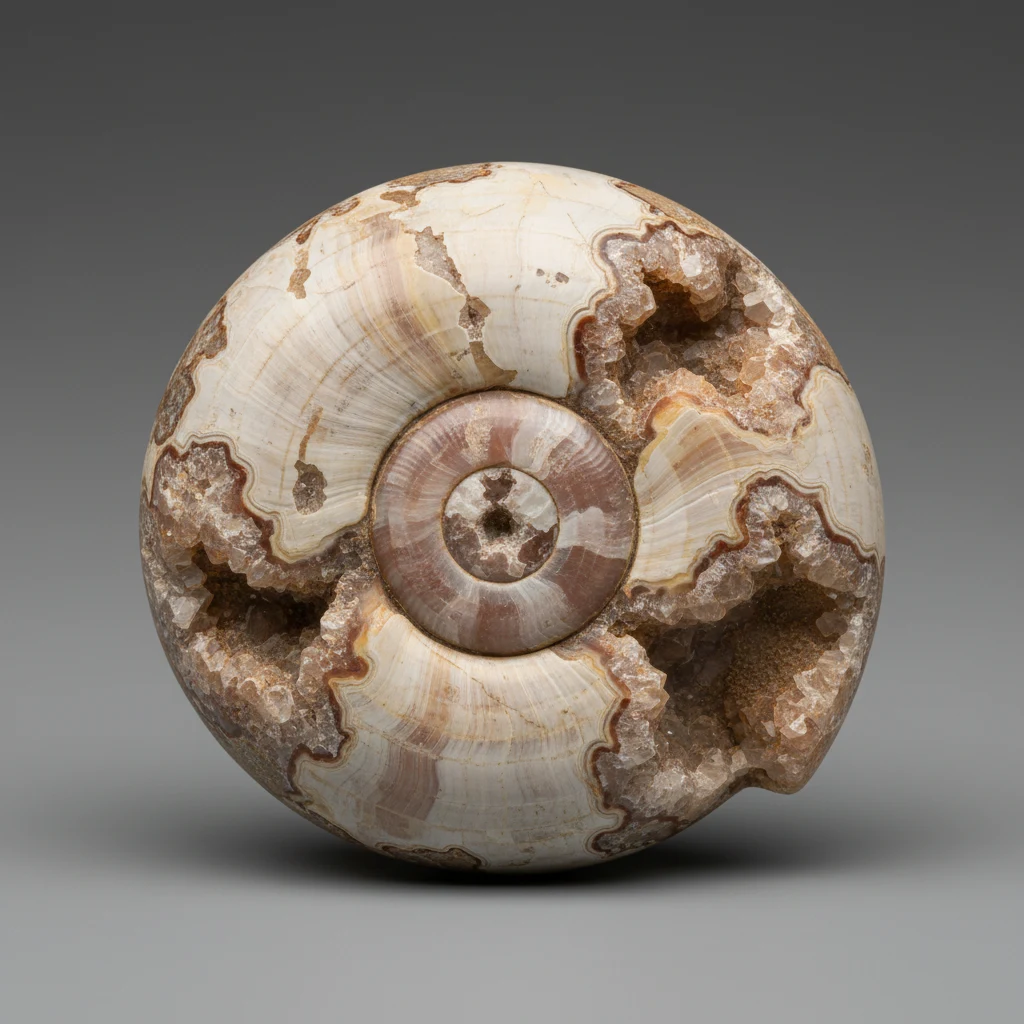
Spiral Shell is a common organic gem: the hard, protective outer covering of a mollusk, built mainly from calcium carbonate, CaCO3. In the hand, the first thing to notice is the coil. The shape guides your eye inward, while the surface usually feels smooth and firm rather than glassy-sharp.
Collectors value Spiral Shell for its beach-found character, gentle color range, and natural growth lines. Specimens may be white, brown, pink, or more vibrant in tone, with an opaque body and a shiny to vitreous luster. With a Mohs hardness of 3-4 and moderate durability, it is best treated as a display, meditation, or decorative specimen rather than a hard-wearing stone.
Origin & History
Spiral Shell has a long natural history as a mollusk-made covering, and the word “shell” traces to the Old English “sceoll.” These forms have been observed as fossils for millions of years, so a spiral shell can feel like a small record of growth, protection, and time held in the palm.
As a carbonate organic gem, Spiral Shell belongs to the calcium carbonate material family rather than a single mined crystal species. For carbonate mineral context and terminology, collectors commonly consult mindat.org. In practical collecting, its appeal comes from the visible coil, the growth lines, and the direct connection to marine environments and coastal areas.
Where Is Spiral Shell Found?
Spiral Shell is commonly found in marine environments and coastal areas. Listed countries include the USA, Italy, and Japan, with notable localities including California, USA; Sicily, Italy; and Okinawa, Japan. Beach specimens are often selected for complete coiling, pleasing color, and an intact glossy surface.
Formation
Spiral Shell forms as mollusks secrete calcium carbonate while they grow. Layer by layer, that material becomes a hard protective covering, and the coiled outline records the animal’s growth pattern. The finished shell is amorphous in structure, opaque, non-magnetic, and typically shows a smooth, shiny surface.
This formation process gives Spiral Shell its collector-friendly details: growth lines, curved geometry, and color variation from white and brown to pink or more vivid hues. Its carbonate composition is expressed by the formula CaCO3, with calcium, carbon, and oxygen listed as the elements. The material is relatively stable, but strong impacts and extreme temperatures can damage it.
How to Identify Spiral Shell
Identify Spiral Shell first by its distinctive spiral shape and visible growth lines. A typical piece feels hard and smooth, has a shiny to vitreous luster, and appears opaque rather than transparent. Color can range from white to brown and pink, sometimes with brighter natural tones.
For physical checks, Spiral Shell has a Mohs hardness of 3-4, a white streak, and a density of 2.5-2.8 g/cm3. It is non-magnetic, isotropic, and listed with a refractive index of 1.65, with no birefringence or pleochroism. If broken, the fracture may appear conchoidal, so handle display pieces carefully.
Properties of Spiral Shell
Physical Properties
| Crystal System | Amorphous |
| Hardness (Mohs) | 3-4 (Medium) |
| Density | 2.5-2.8 g/cm3 |
| Luster | Vitreous |
| Diaphaneity | Opaque |
| Fracture | Conchoidal |
| Streak | white |
| Magnetism | Non-magnetic |
| Colors | white, brown, pink |
Chemical Properties
| Classification | Carbonate |
| Formula | CaCO3 |
| Elements | Ca, C, O |
| Common Impurities |
Optical Properties
| Refractive Index | 1.65 |
| Birefringence | None |
| Pleochroism | None |
| Optical Character | Isotropic |
Spiral Shell Health & Safety
Spiral shells are generally safe to handle and use.
Spiral Shell Value & Price
Price Range
Rough/Tumbled: $1 - $15 per specimen
Cut/Polished:
Price is influenced by size, color, and condition.
Durability
Moderate — Scratch resistance: Fair, Toughness: Good
They are relatively stable but can be damaged by strong impacts.
How to Care for Spiral Shell
Use & Storage
Store in a cool, dry place to prevent damage.
Cleaning
Clean with mild soap and water, avoiding harsh chemicals. Rinse thoroughly afterward.
Cleanse & Charge
Place under moonlight to cleanse and charge.
Placement
Display in a location where they won't be knocked over.
Caution
Avoid exposing them to extreme temperatures.
Works Well With
Spiral Shell Meaning & Healing Properties
In crystal-healing practice, Spiral Shell is used as a calming, protective, and growth-focused object. It is associated with peace, tranquility, emotional healing, meditation, intuition, relaxation, trust, love, inner peace, compassion, and soothing energy. These meanings are traditional and spiritual, not a substitute for medical advice.
Spiral Shell is linked with the Root and Sacral chakras, Cancer and Pisces, the Moon, and the Water element. Many practitioners pair it with rose quartz, amethyst, or clear quartz, especially for quiet display or reflective work. To care for it, clean with mild soap and water, rinse thoroughly, avoid harsh chemicals, and place it under moonlight to cleanse and charge.
Identify Spiral Shell from a photo
Compare Spiral Shell traits, care tips, value clues, and common lookalikes with a clear photo.
Common mistakes
- Identifying a shell only by color instead of checking the coiled structure and growth lines
- Assuming every iridescent shell piece is Mother of Pearl
- Using vinegar or other acids for testing, which can damage calcium carbonate shell material
- Buying dyed shells without realizing the color may not be natural
- Confusing polished shell fragments with calcite or other pale minerals
- Wearing Spiral Shell in high-impact jewelry settings where it can scratch or chip