Striped Agate


Quick answer: Striped Agate is best identified by its parallel or curved bands of chalcedony, which may appear white, gray, brown, red, black, or translucent. The banding pattern, waxy luster, and hardness help separate it from softer dyed stones, glass, and other banded lookalikes.
AI Rock ID can help screen a Striped Agate photo by checking visible banding, translucency, surface luster, and color distribution. RockIdentifier.io provides visual identification support, but final confirmation may require hardness testing, magnification, or gemological review.
Good fit
- Collectors who want a durable banded chalcedony specimen
- Jewelry wearers looking for a stone that resists everyday scratching better than softer minerals
- Beginners learning to recognize natural banding in agate
- Buyers comparing natural, dyed, and imitation banded stones
Not a good fit
- Anyone needing a transparent gemstone with high brilliance
- Buyers who want guaranteed untreated material without seller documentation
- People expecting metaphysical traditions to replace medical care
Most commonly confused with
- Onyx: Onyx is also banded chalcedony, but it usually has straighter, more even bands and is often black-and-white or artificially dyed.
- Sardonyx: Sardonyx has bands that include sard-like reddish brown layers, while Striped Agate may show a wider range of band colors.
- Jasper: Jasper is typically opaque and more granular-looking, while Striped Agate often has translucent chalcedony bands.
- Banded Calcite: Banded Calcite is much softer, reacts to acid, and can be scratched more easily than agate.
Striped Agate vs. Common Lookalikes
| Material | Key Visual Clue | Simple Check |
|---|---|---|
| Striped Agate | Natural curved or parallel chalcedony bands | Hardness about 6.5-7; usually no acid reaction |
| Onyx | Straighter, more uniform bands, often black and white | May be dyed; inspect color concentration in cracks |
| Jasper | Opaque, earthy, less translucent | Light usually does not pass through thin edges |
| Banded Calcite | Soft banded layers with glassy to pearly look | Scratches more easily and can fizz with acid |
| Glass Imitation | Bubbles or overly perfect color patterns | May feel smoother and lack natural band depth |
AI identification confidence
AI identification confidence is usually moderate to high when a photo clearly shows banding, translucency at the edges, and a polished or freshly broken surface. Confidence drops when the stone is heavily dyed, photographed under colored light, or shown only as a small bead or cabochon.
When AI gets it wrong
- Dyed onyx or dyed agate can appear similar to natural Striped Agate in photos.
- Banded calcite may be mistaken for agate if hardness and acid reaction are not tested.
- Small jewelry pieces may hide natural texture, fractures, and translucency.
- Strong filters or warm indoor lighting can distort the true band colors.
Final recommendation
Choose Striped Agate based on clear banding, good polish, stable surface condition, and seller transparency about dyeing or treatments. For higher-value pieces, request natural-light photos and close-ups of edges, cracks, and drill holes.
How to Tell If Striped Agate Is Dyed
Dyed Striped Agate may show unusually intense colors, color pooling in fractures, or darker pigment around drill holes and surface pits. Natural agate colors are often softer or more uneven, though some natural specimens can still be vivid. A seller should clearly state whether a piece is natural, dyed, heat-treated, or stabilized.
Best Photos for Identifying Striped Agate
Use sharp photos taken in natural light with the stone shown from multiple angles. Include a close-up of the banding, an edge where translucency may be visible, and any broken or unpolished area if present. A scale reference, such as a coin or ruler, helps distinguish beads, slabs, nodules, and tumbled stones.
Buying Checklist for Striped Agate
Check whether the listing identifies the stone as natural, dyed, or treated. Look for continuous banding that follows the stone rather than printed-looking surface patterns. Avoid pieces with undisclosed cracks, filled cavities, or overly uniform color if authenticity is important.
What Is Striped Agate?
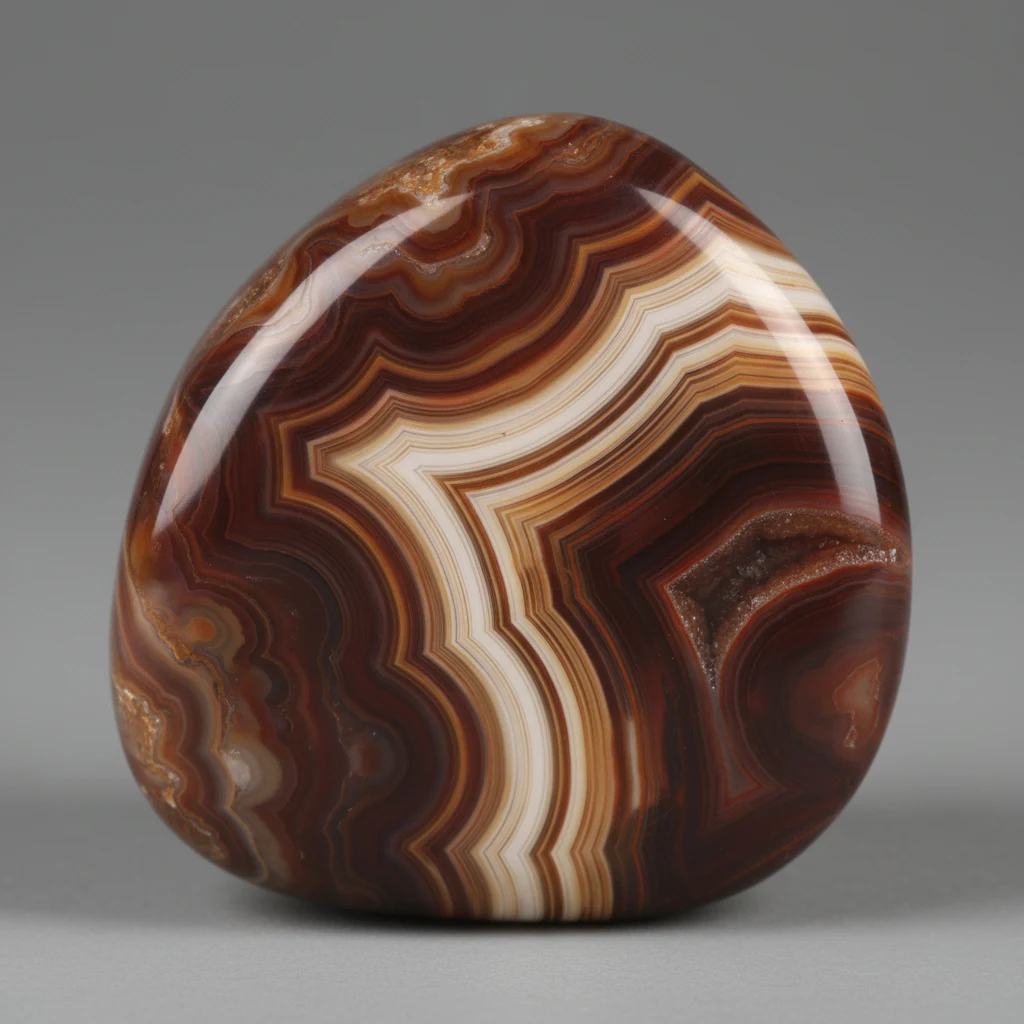
Striped Agate is a banded variety of chalcedony, a silicate gemstone made of SiO2. In the hand, a good piece is all about rhythm: brown, red, and white bands running in clean layers, often with a smooth polish and a waxy to vitreous flash when turned under light.
Collectors like Striped Agate because it is durable, attractive, and usually accessible. It has a Mohs hardness of 6.5-7, good scratch resistance, good toughness, and a stable nature under normal conditions, making it practical for jewelry, palm stones, and decorative objects. Prices commonly reflect color, pattern, and size.
Origin & History
Striped Agate belongs to the long-known agate family, and the name “agate” comes from the Achates River in Sicily, where agate was first described in ancient times. For a collector, that history shows up in the stone’s classic appeal: layered color, polishable surfaces, and a pattern that feels both geological and ornamental.
As a variety of chalcedony, Striped Agate is best understood through its banding rather than a single body color. When checking locality or variety information, collectors commonly compare agate records with mineral databases such as mindat.org, while still judging the individual specimen by its color bands, translucency, luster, and finish.
Where Is Striped Agate Found?
Striped Agate is found in Brazil, India, and Uruguay, with notable localities including Santa Catarina, Brazil; Agate Creek, Australia; and Maharashtra, India. It is considered common, so the collector’s eye usually turns from rarity to pattern quality, contrast, size, and how well the stone has been cut or polished.
Formation
Striped Agate forms when silica is deposited in layers within volcanic rocks. It often develops inside cavities as the material crystallizes, building up bands over time. That layered growth is the reason a cut face can look like a tiny landscape of repeating lines, soft curves, and color changes.
Its mineral variety is chalcedony, with a trigonal crystal system listed for the material and a density of about 2.65 g/cm3. Common impurities include iron and manganese, and the finished stone is typically translucent with vitreous luster. The result is a durable banded gemstone that rewards close inspection.
How to Identify Striped Agate
Identify Striped Agate first by its banding. Typical colors include brown, red, and white, and the best visual clue is a distinctive striped or layered pattern across a smooth surface. When polished, it should feel glassy-smooth under the thumb and show waxy to vitreous luster in shifting light.
Useful checks include its Mohs hardness of 6.5-7, white streak, non-magnetic response, translucent diaphaneity, and conchoidal fracture. Its refractive index is listed as 1.54-1.55, with no birefringence and no pleochroism. For finished stones, avoid damaging tests; rely on banding, polish, luster, and reliable source information.
Properties of Striped Agate
Physical Properties
| Crystal System | Trigonal |
| Hardness (Mohs) | 6.5-7 (Medium) |
| Density | 2.65 g/cm3 |
| Luster | Vitreous |
| Diaphaneity | Translucent |
| Fracture | Conchoidal |
| Streak | White |
| Magnetism | Non-magnetic |
| Colors | Brown, Red, White |
Chemical Properties
| Classification | Silicate |
| Formula | SiO2 |
| Elements | Si, O |
| Common Impurities | Fe, Mn |
Optical Properties
| Refractive Index | 1.54-1.55 |
| Birefringence | None |
| Pleochroism | None |
| Optical Character | Isotropic |
Striped Agate Health & Safety
There are no significant health risks associated with handling striped agate.
Striped Agate Value & Price
Price Range
Rough/Tumbled: $5 - $15 per specimen
Cut/Polished: $10 - $30 per carat
Price is influenced by color, pattern, and size.
Durability
Durable — Scratch resistance: Good, Toughness: Good
It is stable under normal conditions.
How to Care for Striped Agate
Use & Storage
Store in a soft pouch or box to prevent scratches.
Cleaning
Clean with mild soap and water. Avoid harsh chemicals.
Cleanse & Charge
Place under moonlight or use sound to cleanse.
Placement
Can be placed anywhere in your home for decorative purposes.
Caution
Avoid exposing to extreme heat or chemicals.
Works Well With
Striped Agate Meaning & Healing Properties
Striped Agate is used in crystal healing as a stone of balance, stability, grounding, emotional healing, focus, calming, trust, inner peace, and self-discovery. This is a spiritual or symbolic use only, not a medical treatment. Many practitioners place it near the body during meditation because its steady bands give the eye a calm point of focus.
It is associated with the Root and Sacral chakras, the zodiac signs Gemini and Leo, the Earth element, and the planet Earth. It pairs well with rose quartz, amethyst, and citrine. For care, clean it with mild soap and water, store it in a soft pouch or box, cleanse with moonlight or sound, and avoid harsh chemicals or extreme heat.
Identify Striped Agate from a photo
Compare Striped Agate traits, care tips, value clues, and common lookalikes with a clear photo.
Common mistakes
- Assuming all bright blue, pink, or purple Striped Agate is naturally colored
- Calling every black-and-white banded chalcedony onyx without checking band style and treatment
- Identifying banded calcite as agate without testing hardness
- Judging authenticity from color alone instead of band structure, translucency, and surface features
- Using only one photo of a polished bead or cabochon for identification