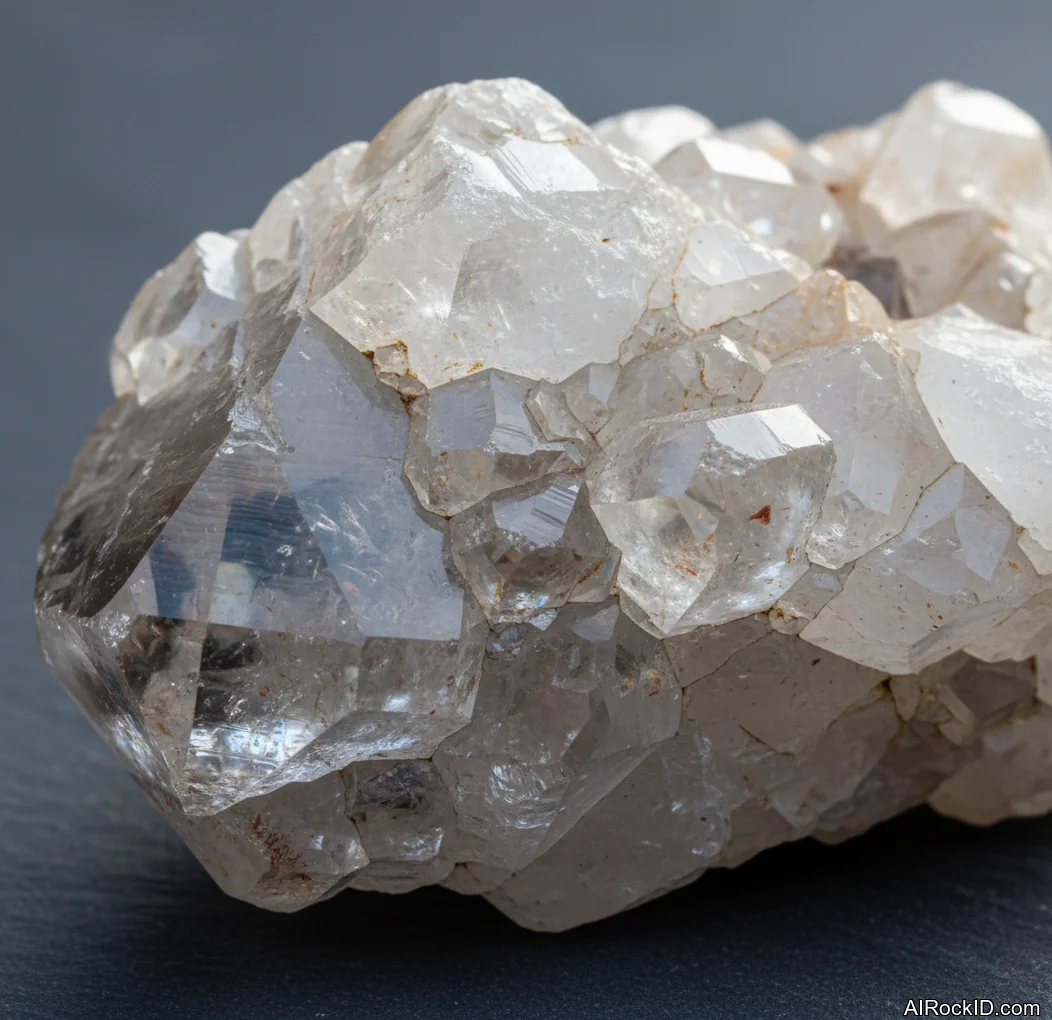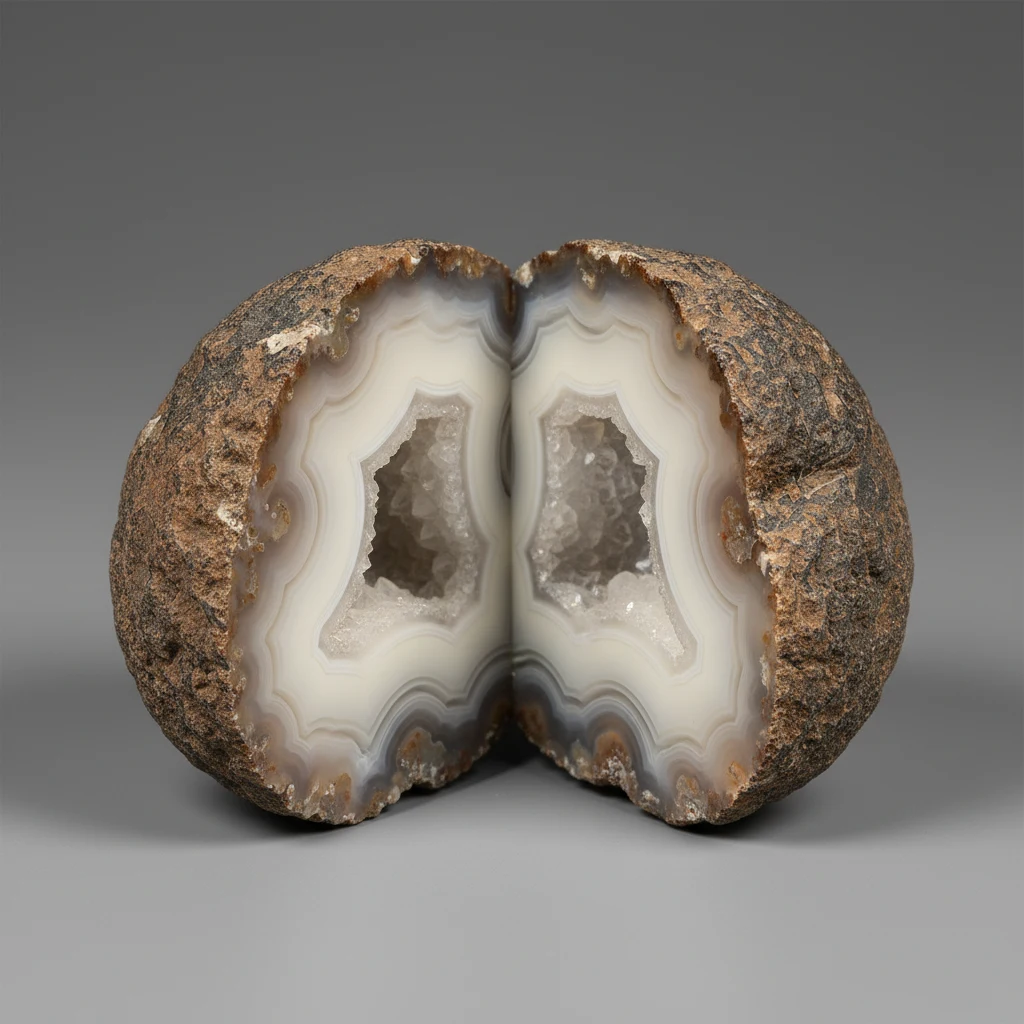
Thunder Egg


Quick answer: Thunder egg is a rounded volcanic nodule that often contains agate, chalcedony, quartz, or opal-like silica in its center. It is commonly identified by its rough, rhyolite-like exterior and a cut face showing star-shaped cavities, fortification banding, or quartz-filled pockets.
AI Rock ID can help screen a suspected thunder egg by comparing visible texture, shape, banding, and quartz-filled cavities from a photo. RockIdentifier.io provides visual identification support, but a cut surface, locality information, and hardness checks are often needed for stronger confirmation.
Good fit
- Collectors who like cut-and-polished nodules with hidden interiors
- Beginners learning to compare agate, chalcedony, and quartz textures
- Lapidary hobbyists interested in slicing, polishing, or displaying nodules
- Collectors who value locality-based specimens from volcanic regions
Not a good fit
- Anyone needing a transparent faceted gemstone
- Buyers who want the interior pattern guaranteed before cutting an uncut nodule
- Collectors avoiding heavy, rough, or saw-cut display stones
- People looking for a single mineral rather than a rock-like nodule with mixed silica fillings
Most commonly confused with
- Agate: Agate is the banded silica filling often found inside a thunder egg, while thunder egg refers to the whole volcanic nodule.
- Geode: Geodes usually have hollow crystal-lined cavities, while thunder eggs are commonly solid or partly filled with agate, chalcedony, and quartz.
- Chalcedony: Chalcedony is a microcrystalline quartz material that may fill a thunder egg, not the outer nodule itself.
- Quartz: Quartz may appear as clear or milky crystalline areas inside thunder eggs, but quartz alone lacks the volcanic nodule structure.
Thunder Egg Lookalike Comparison
| Specimen | Typical Interior | Key Difference |
|---|---|---|
| Thunder egg | Agate, chalcedony, quartz, or silica-filled cavity | Rounded volcanic nodule with a rough outer rind |
| Geode | Open hollow cavity with crystals | More likely to be hollow and lined with visible crystal points |
| Agate nodule | Banded chalcedony | May lack the rhyolitic outer shell typical of thunder eggs |
| Jasper nodule | Opaque silica-rich mass | Usually lacks translucent banding or quartz-filled pockets |
| Septarian nodule | Calcite or aragonite-filled cracks | Shows polygonal crack patterns rather than agate fortification banding |
AI identification confidence
AI identification is usually more reliable from a clean, cut face than from an uncut brown or gray nodule, because the interior pattern provides the strongest visual clues. Confidence is lower when the specimen is weathered, poorly lit, dyed, or shown without scale and locality context.
When AI gets it wrong
- An uncut thunder egg may be labeled as an ordinary volcanic rock or rounded river stone.
- A hollow geode may be mistaken for a thunder egg if only the polished face is shown.
- Dyed agate slices can be misidentified as natural thunder egg material when color saturation is the main visible feature.
- Septarian nodules may be confused with thunder eggs because both can be rounded and cut for display.
Final recommendation
Choose a thunder egg based on the cut face, structural pattern, polish quality, and documented source rather than color alone. For uncut nodules, expect uncertainty because the internal pattern cannot be confirmed until the specimen is opened.
How to Identify an Uncut Thunder Egg
An uncut thunder egg is usually rounded to oval, with a dull, rough, gray, tan, brown, or reddish volcanic exterior. Identification is uncertain before cutting because many volcanic nodules and weathered rocks have similar outer surfaces. Locality information from known thunder egg beds can improve confidence, especially when paired with size, shape, and rind texture.
Buying Authentic Thunder Eggs
Authentic thunder eggs are often sold as whole nodules, paired halves, polished faces, or slabs. Ask whether the piece is natural, dyed, stabilized, or repaired, especially when the colors are unusually bright or the surface appears resin-coated. A reputable listing should state the locality when known and distinguish a thunder egg from a generic agate slice or geode.
Natural Color, Dye, and Enhancement Clues
Natural thunder egg interiors commonly show earthy reds, browns, grays, whites, creams, yellows, and muted translucent agate tones. Very intense blue, neon pink, purple, or evenly saturated colors can indicate dye, especially if color concentrates along cracks or porous edges. Enhancement does not make a specimen unusable for display, but it should be disclosed for accurate collecting value.
What Is Thunder Egg?
Thunder Egg is a rounded nodule, usually filled with agate, quartz, or related silicate minerals. In the hand it often feels plain and earthy on the outside, but a cut face can reveal vitreous bands, pockets, and concentric patterns in brown, gray, and white.
As a collector material, Thunder Egg sits between rock and gemstone: durable enough for display, interesting enough for lapidary work, and common enough to be approachable. Its Mohs hardness range is 5.5 to 7, with good toughness, fair scratch resistance, white streak, conchoidal fracture, and opaque to translucent areas when sliced thin or polished.
Origin & History
The name Thunder Egg comes from Native American folklore, and written descriptions date back to the 19th century. The name suits the specimen well: an uncut nodule can look like a quiet stone egg, while the opened interior shows the hidden agate or quartz structure that makes collectors keep searching.
Thunder Eggs are best understood as agate-bearing nodular rocks rather than single, perfect crystals. For locality checking and mineral occurrence context, mindat.org is a useful plain-text reference alongside specimen labels, especially when comparing Oregon, Central Australian, or Brazilian material.
Where Is Thunder Egg Found?
Thunder Egg is found in the USA, Australia, and Brazil, with notable localities including Oregon in the USA, Central Australia, and Rio Grande do Sul in Brazil. These are the names most worth watching for on specimen labels, because locality can help explain differences in color, size, and internal pattern.
Formation
Thunder Eggs form through volcanic activity, when minerals crystallize in gas bubbles over time. Those cavities become filled with agate, quartz, or other minerals, producing the rounded nodular structure and the internal banding that makes each cut piece different.
The chemistry is silicate-based, with the listed formula SiO2 and common impurities including iron and manganese. Those impurities can influence the earthy visual range collectors expect: browns, grays, whites, and subtle transitions under a vitreous polish.
How to Identify Thunder Egg
Identify Thunder Egg by its smooth, rounded nodule shape and by cutting or viewing an opened face for internal agate or quartz patterns. The strongest visual clue is distinctive concentric banding, often in brown, gray, and white, with a glassy to vitreous luster on polished surfaces.
Its physical profile supports the ID: amorphous structure, Mohs hardness 5.5 to 7, density of 2.5 to 2.7 g/cm3, white streak, non-magnetic behavior, and conchoidal fracture. It is opaque to translucent, isotropic, with refractive index listed at 1.54 to 1.55 and no birefringence or pleochroism.
Properties of Thunder Egg
Physical Properties
| Crystal System | Amorphous |
| Hardness (Mohs) | 5.5 - 7 (Medium) |
| Density | 2.5 - 2.7 g/cm3 |
| Luster | Vitreous |
| Diaphaneity | Opaque to translucent |
| Fracture | Conchoidal |
| Streak | White |
| Magnetism | Non-magnetic |
| Colors | Brown, Gray, White |
Chemical Properties
| Classification | Silicate |
| Formula | SiO2 |
| Elements | Si, O |
| Common Impurities | Fe, Mn |
Optical Properties
| Refractive Index | 1.54 - 1.55 |
| Birefringence | None |
| Pleochroism | None |
| Optical Character | Isotropic |
Thunder Egg Health & Safety
There are no significant health risks associated with handling thunder eggs.
Thunder Egg Value & Price
Price Range
Rough/Tumbled: $10 - $50 per specimen
Cut/Polished: $20 - $100 per carat
Price is influenced by size, color, and pattern quality.
Durability
Moderate — Scratch resistance: Fair, Toughness: Good
Thunder eggs are generally stable but can be damaged by extreme force.
How to Care for Thunder Egg
Use & Storage
Store in a cool, dry place away from direct sunlight.
Cleaning
Clean with warm soapy water and a soft cloth. Avoid harsh chemicals.
Cleanse & Charge
Place under running water or in sunlight to cleanse.
Placement
Display in a prominent location to showcase its beauty.
Caution
Avoid dropping to prevent breaking.
Works Well With
Thunder Egg Meaning & Healing Properties
In crystal healing traditions, Thunder Egg is used for protection, grounding, emotional healing, and self-discovery. Its Root and Sacral chakra associations match the feel of the stone well: dense, steady, earthy, and quietly patterned, with a visual contrast between the rough exterior and the revealed interior.
It is also associated with Aries and Leo, the Earth planet listing, and Earth and Fire elements. These meanings are cultural and spiritual rather than medical; Thunder Egg is not a substitute for medical treatment. For care, clean it with warm soapy water and a soft cloth, avoid harsh chemicals, and avoid dropping it.
Identify Thunder Egg from a photo
Compare Thunder Egg traits, care tips, value clues, and common lookalikes with a clear photo.
Common mistakes
- Calling every agate slice a thunder egg without evidence of a volcanic nodule rind
- Assuming a whole nodule will contain strong banding before it has been cut
- Confusing a hollow geode with a solid or partly filled thunder egg
- Judging authenticity only by bright color instead of structure, rind, and source
- Ignoring dye or resin treatment when evaluating price and collectibility
- Using a single photo of the exterior as definitive proof of identification