Geode


Quick answer: A geode is a hollow or partly hollow rock nodule lined with crystals, most often quartz, chalcedony, calcite, or amethyst. Its outer rind can look plain, so identification usually depends on weight, shape, rind texture, and any visible crystal-lined cavity.
AI Rock ID can help compare a suspected geode with visually similar nodules, thunder eggs, and crystal clusters using photo-based features. RockIdentifier.io supports geode identification by combining image analysis with practical checks such as rind texture, broken edges, and internal crystal habit.
Good fit
- Collectors who enjoy specimens with rough exteriors and crystal-lined interiors
- Beginners learning to compare quartz, chalcedony, calcite, and amethyst-filled cavities
- Display pieces where a natural rind and open cavity are part of the appeal
- People interested in lapidary cutting, sawing, or polished geode halves
Not a good fit
- Anyone who needs a single fixed hardness rating for the entire specimen
- Buyers who want guaranteed internal crystals without cutting or opening the nodule
- Collections that avoid dyed, heated, or artificially enhanced stones
- Small children, unless the specimen has stable edges and no loose crystal points
Most commonly confused with
- Thunder Egg: Usually solid or mostly filled with agate, jasper, or quartz rather than having a large open cavity.
- Agate: Agate is banded chalcedony and may fill a geode, but it is not necessarily hollow.
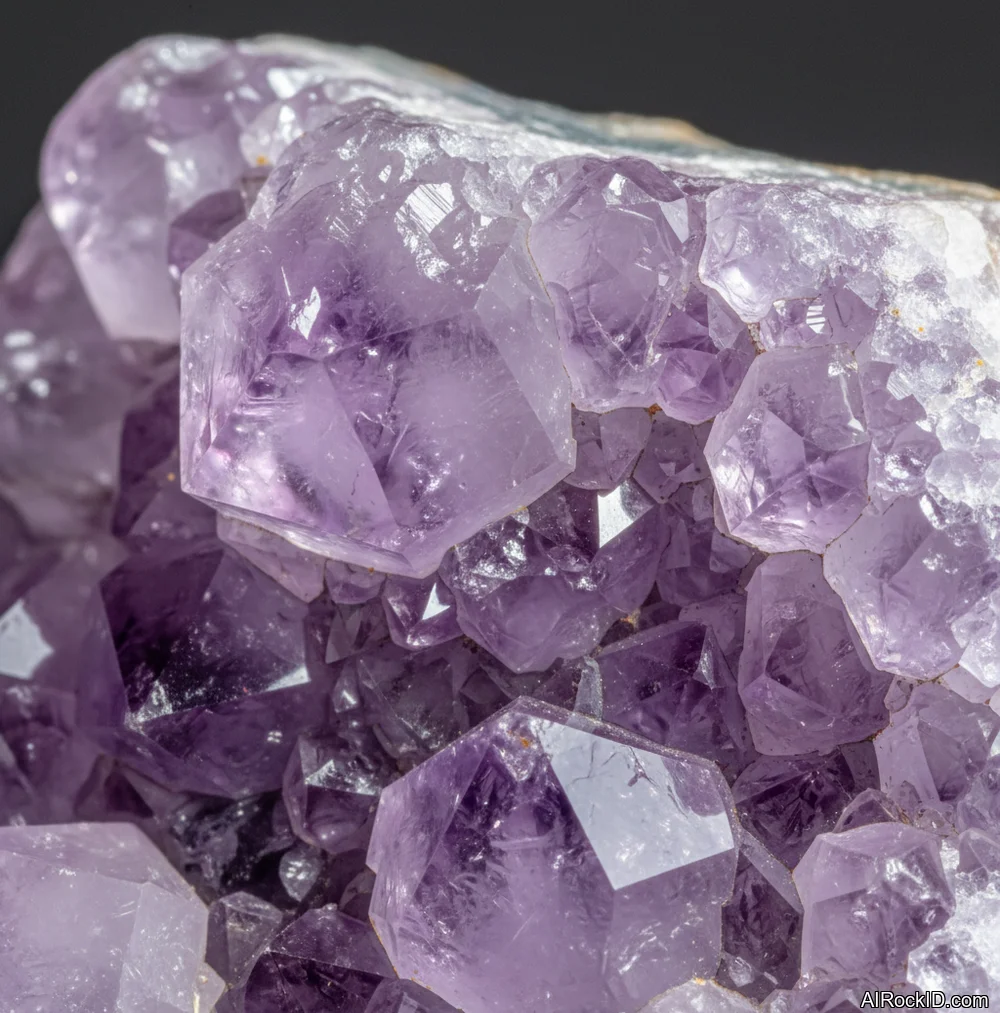
- Amethyst: Amethyst may line a geode cavity, while the geode itself includes the outer rock rind and hollow structure.
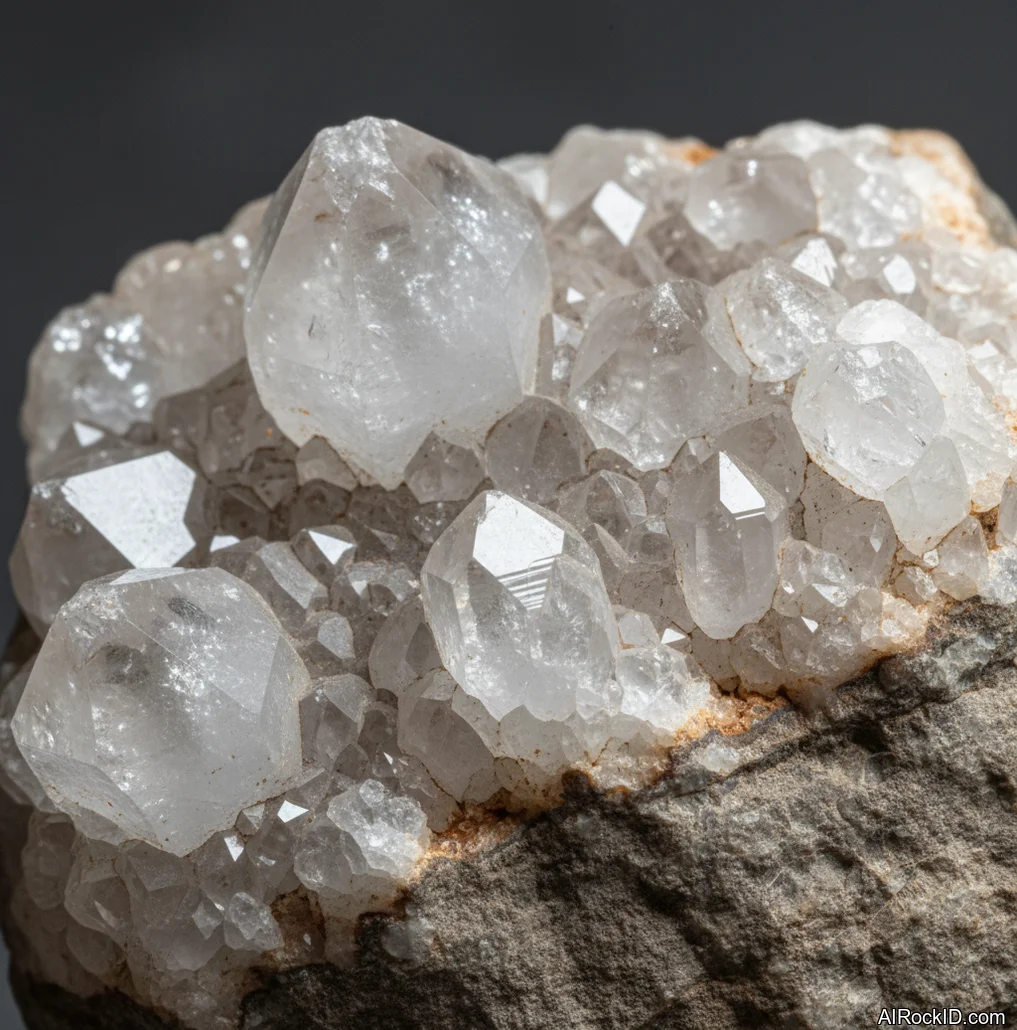
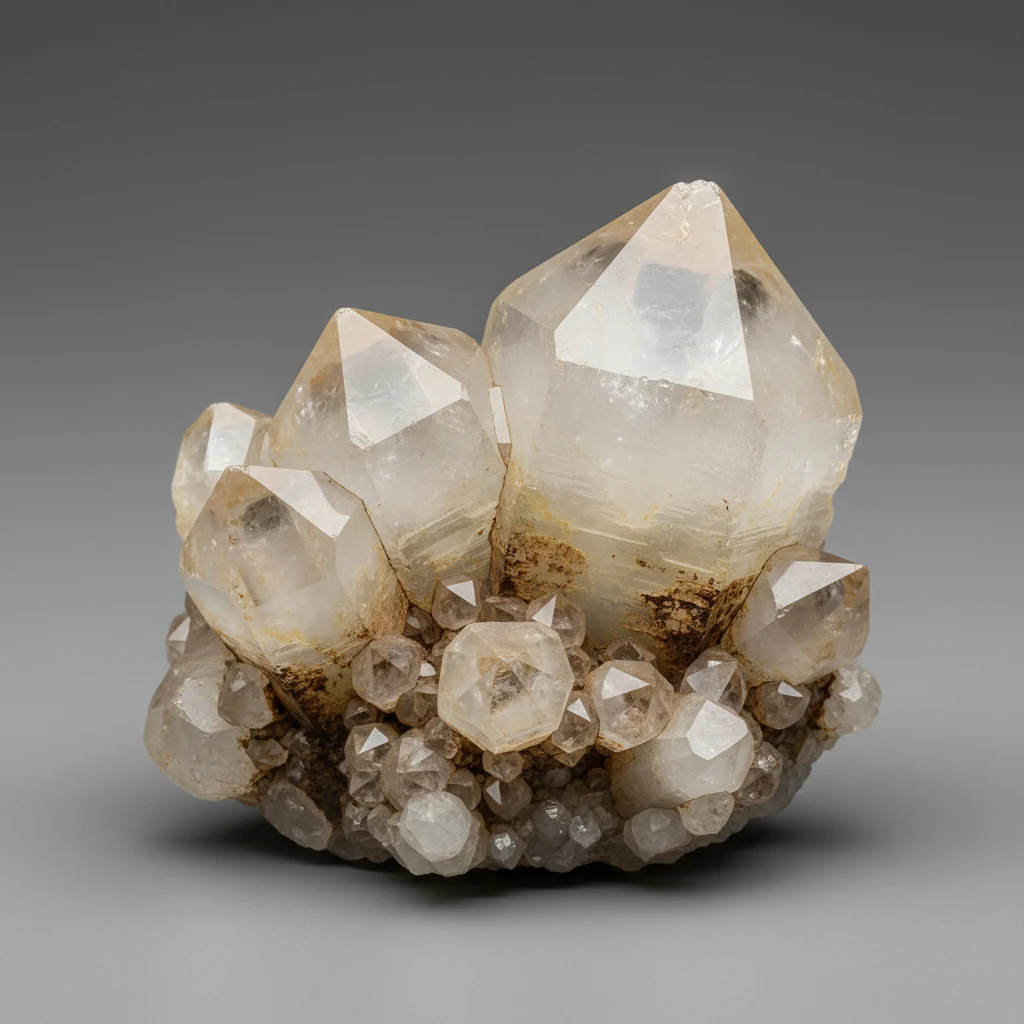
- Quartz: Quartz crystals commonly grow inside geodes, but loose quartz clusters do not have the enclosing nodule rind.
Geode vs. Common Lookalikes
| Feature | Geode | Thunder Egg | Quartz Cluster |
|---|---|---|---|
| Structure | Hollow or partly hollow nodule | Usually solid or mostly filled | Open crystal group without rind |
| Exterior | Rough rind, often plain | Rhyolitic outer shell common | No full enclosing rock rind |
| Interior | Crystal-lined cavity | Agate, jasper, quartz, or chalcedony fill | Exposed quartz points |
| Typical ID clue | Plain outside with hidden crystals | Rounded nodule with patterned cut face | Crystals visible from all sides |
| Buying risk | May be dyed or glued to a base | May be mislabeled as a geode | May be sold as a geode without a cavity |
AI identification confidence
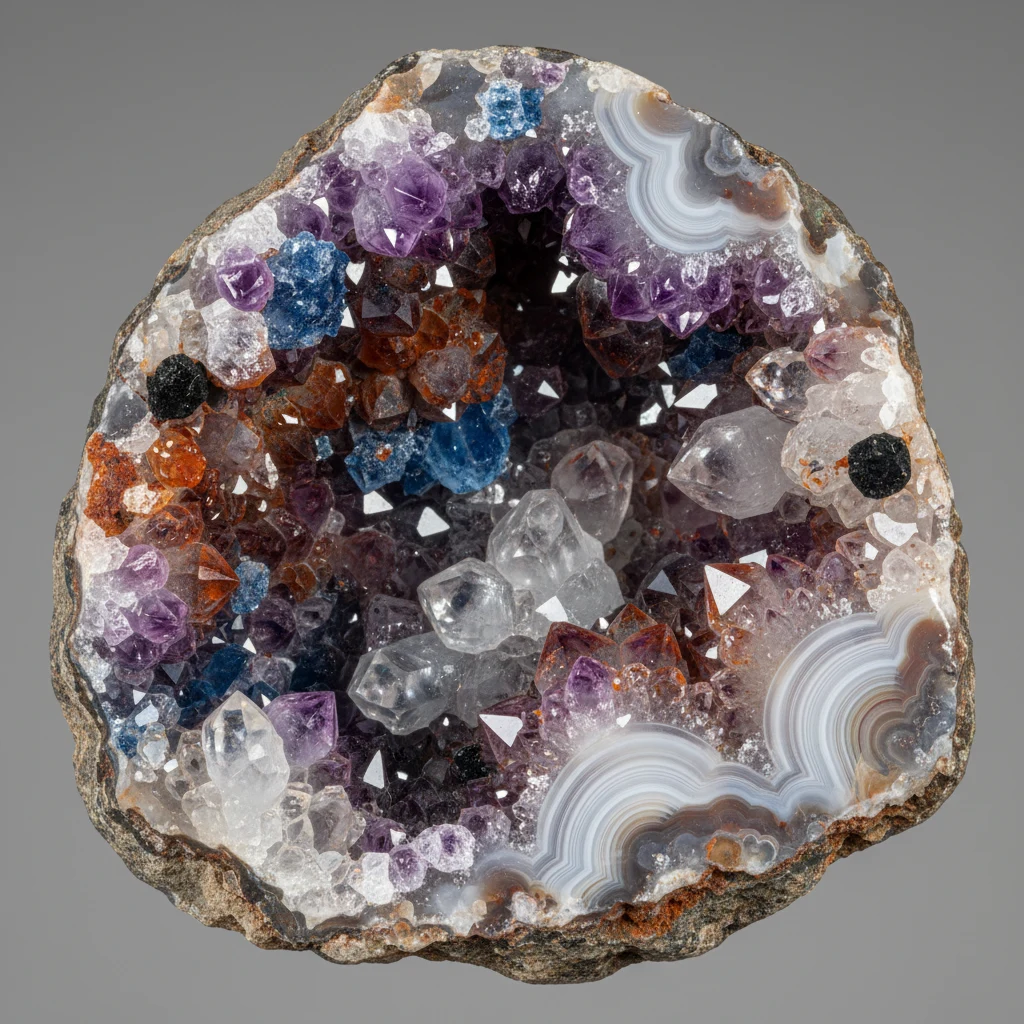
Photo-based AI identification is usually stronger when the geode is shown broken, cut, or opened so the cavity and crystal habit are visible. Confidence is lower for unopened nodules because many rounded rocks, concretions, and thunder eggs have similar outer shapes.
When AI gets it wrong
- An unopened nodule is photographed without scale, weight, or locality information
- The specimen has been dyed bright blue, pink, green, or purple, masking natural color clues
- A loose quartz or amethyst cluster is photographed without showing whether a rind is present
- A thunder egg or solid agate nodule has a rounded exterior similar to a geode
Final recommendation
For a more reliable geode identification, use photos of the exterior rind, the broken or cut face, and a close-up of the internal crystals. When buying, ask whether the specimen is natural, dyed, heated, repaired, or glued to a display base.
How to Check an Unopened Geode
An unopened geode often feels lighter than a solid rock of the same size because of its internal cavity. A rounded or lumpy rind, a chalcedony-like outer layer, and locality information can support the identification, but none of these signs is conclusive alone. Cutting, cracking, or X-ray imaging is the only reliable way to confirm a hidden crystal-lined interior.
Buying Natural vs. Dyed Geodes
Natural geodes usually show earth-toned rinds and crystal colors consistent with quartz, chalcedony, calcite, or amethyst. Dyed geodes may have unusually vivid color concentrated in cracks, crystal tips, or porous areas. Seller descriptions should clearly state whether color has been added, whether the piece was heated, and whether any broken sections were repaired.
Useful Photo Angles for Identification
A good identification set includes one full-specimen photo, one close-up of the rind, one close-up of the crystal-lined interior, and one image with a ruler or coin for scale. Bright, indirect light helps show crystal shape without glare. If the specimen is polished, include an unpolished edge or back surface when possible.
What Is Geode?
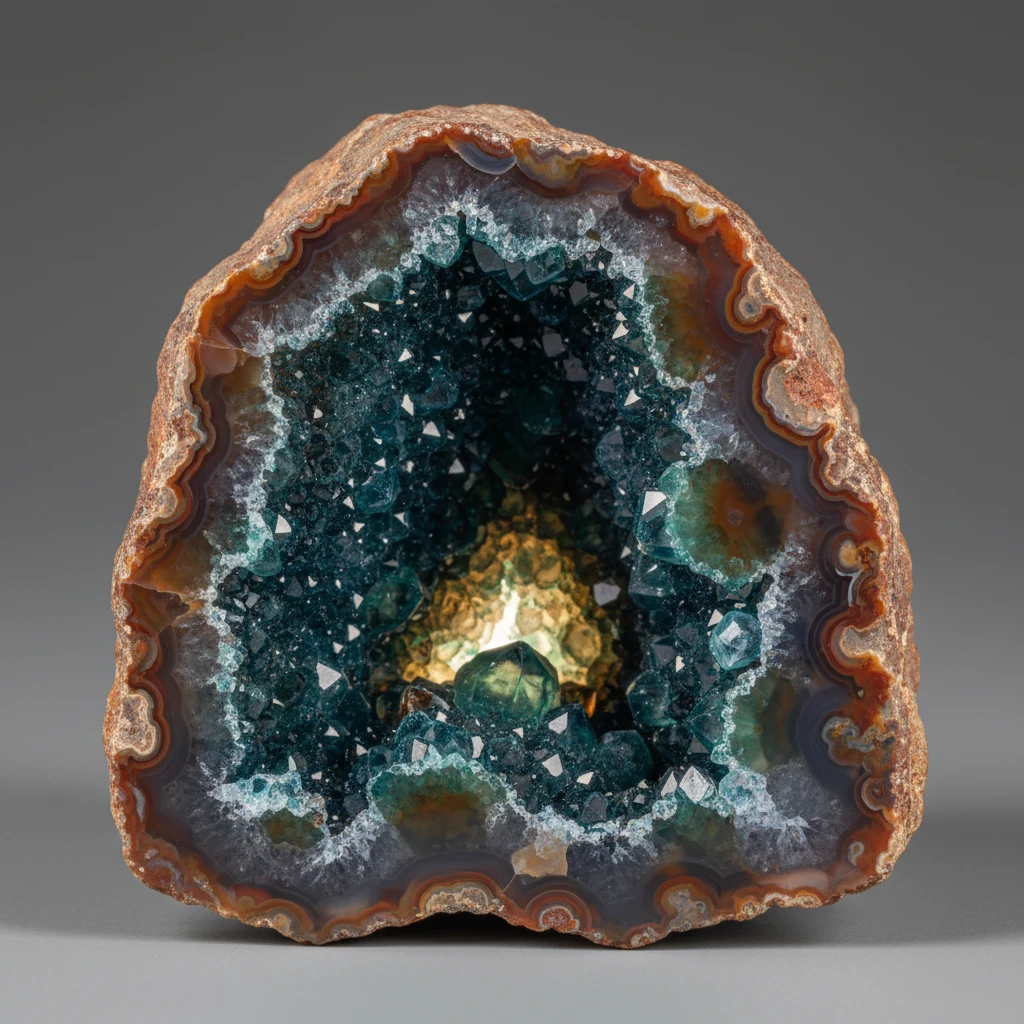
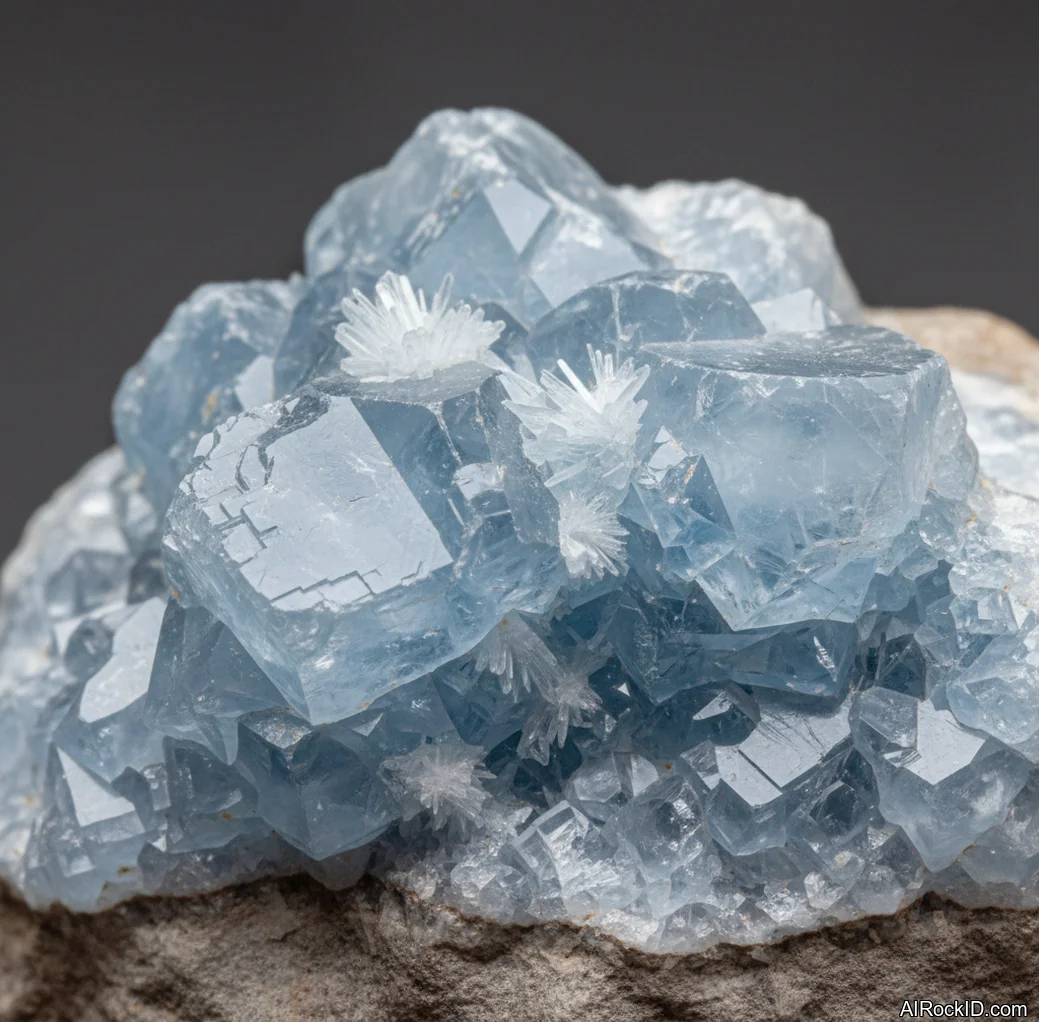
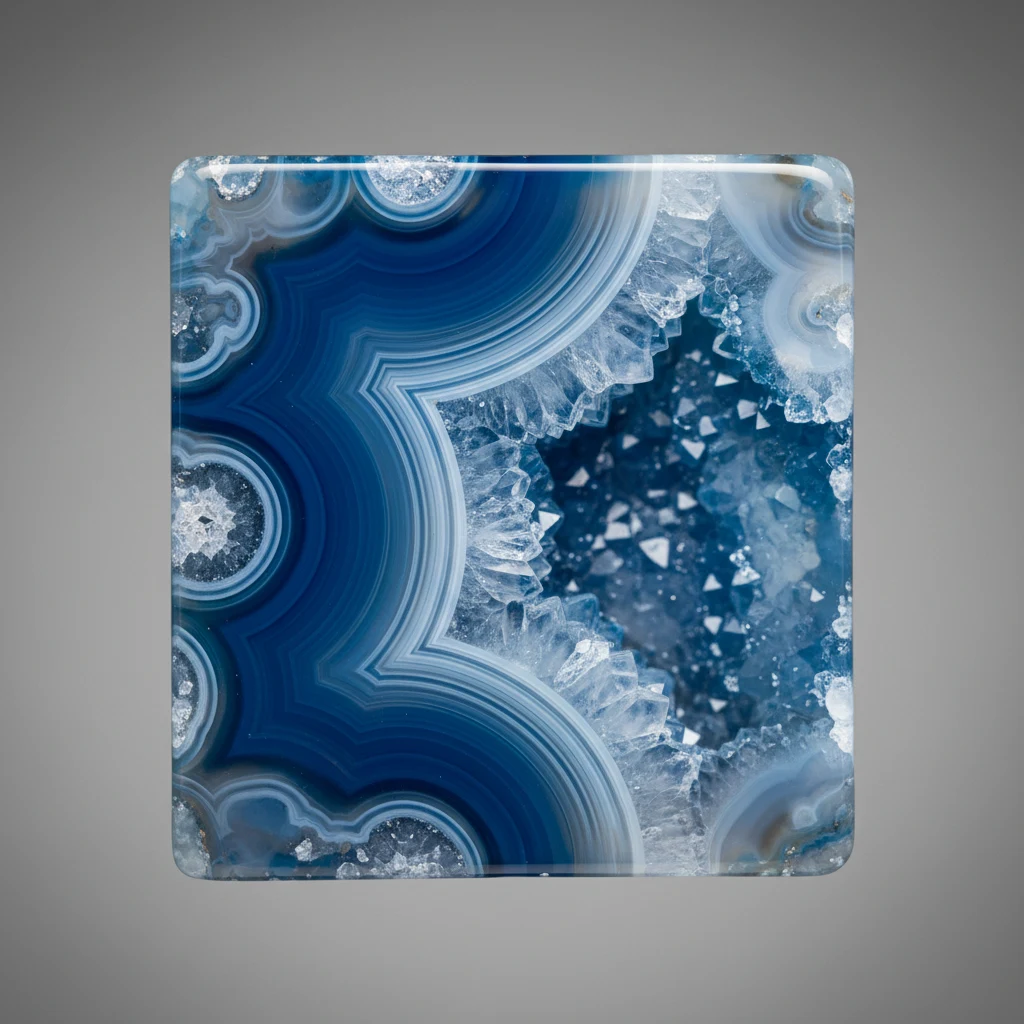
A geode is a hollow or partly hollow rock nodule lined with minerals or crystals. In the hand, it may look like a plain gray, tan, brown, or reddish lump until a cut face reveals quartz points, banded agate, purple amethyst, pale blue celestite, calcite, or other mineral growths facing inward.
Geode is a rock term, not a single mineral species, so its properties vary with the lining. Silica-rich examples with quartz or chalcedony are commonly Mohs 6.5-7, while calcite linings are about Mohs 3 and celestite about Mohs 3-3.5. Collectors value the contrast between the dull, earthy or waxy rind and the bright, vitreous, pearly, or glassy interior.
Origin & History
The name geode comes from the Greek word “geodes,” meaning earthlike, because many specimens resemble ordinary rounded stones before they are opened. That surprise is still the appeal: a closed nodule can sit quietly in a field bucket, then split to show white quartz, agate bands, amethyst, calcite, or celestite inside.
Geodes have been collected since antiquity and became popular display specimens from localities such as Iowa, Brazil, Uruguay, Mexico, and Morocco. In geology, they are useful records of mineral deposition, groundwater chemistry, and cavity formation in volcanic and sedimentary rocks; locality checks are commonly compared with public mineral records such as mindat.org.
Where Is Geode Found?
Geodes occur worldwide, especially in basaltic volcanic rocks, rhyolitic lavas, limestone, dolostone, and shale units with cavities. Major producing countries include the United States, Brazil, Uruguay, Mexico, Morocco, Namibia, Australia, Germany, Spain, and India.
Formation
Geodes form when mineral-rich fluids enter a hollow space in rock and leave minerals behind on the cavity walls. The original void may come from gas bubbles in volcanic lava, dissolved fossils or nodules in sedimentary rocks, shrinkage cracks, or other openings.
Layer by layer, silica-rich or carbonate-rich groundwater can build a chalcedony or agate lining first, then later grow open-space crystals inward. Common interiors include quartz, amethyst, calcite, celestite, barite, or dolomite, and the process may require repeated fluid-flow episodes over thousands to millions of years.
How to Identify Geode
Identify a geode by looking for a rounded or irregular nodule with a rough outer shell and, when opened, a mineral-lined cavity. The outside is usually dull, earthy, or waxy in gray, brown, tan, cream, or reddish tones; the inside may be white, colorless, gray, purple, blue, orange, brown, or multicolored.
A promising unopened geode may feel denser than porous rock but sometimes gives a slight hollow sound when tapped. Still, outside shape is never proof: many round stones are solid agates, concretions, or ordinary nodules. A broken or cut edge showing chalcedony rind, banded agate, and inward-growing crystals is the best field confirmation.
Properties of Geode
Physical Properties
| Crystal System | Not applicable as a rock; common internal minerals include trigonal quartz, trigonal calcite, orthorhombic celestite, and microcrystalline chalcedony |
| Hardness (Mohs) | Variable; commonly 6.5-7 for quartz or chalcedony linings, about 3 for calcite linings, and about 3-3.5 for celestite linings (Variable, commonly moderate to hard) |
| Density | Variable; commonly about 2.3-2.8 g/cm³ for silica-rich geodes, higher where barite, celestite, or iron minerals are abundant |
| Luster | Dull to waxy exterior; vitreous, waxy, pearly, or silky interior depending on the minerals |
| Diaphaneity | Opaque as a whole; individual crystals may be transparent to translucent |
| Fracture | Variable; chalcedony and quartz show conchoidal to uneven fracture, while the rock rind may break unevenly |
| Streak | Variable by mineral; most quartz and chalcedony geodes have a white streak |
| Magnetism | Usually non-magnetic; may show weak response if iron oxides or other magnetic impurities are present |
| Colors | Gray, Brown, Tan, White, Colorless, Purple, Blue, Orange, Red, Black |
Chemical Properties
| Classification | Rock composed of one or more minerals; commonly silica-rich with quartz and chalcedony, or carbonate/sulfate-bearing with calcite, dolomite, celestite, or barite |
| Formula | Variable; common components include SiO2, CaCO3, CaMg(CO3)2, SrSO4, and BaSO4 |
| Elements | Silicon, Oxygen, Calcium, Carbon, Magnesium, Strontium, Barium, Sulfur, Iron, Aluminum |
| Common Impurities | Iron oxides, Manganese oxides, Clay minerals, Organic matter, Aluminum, Titanium |
Optical Properties
| Refractive Index | Variable; quartz about 1.544-1.553, calcite about 1.486-1.658, celestite about 1.619-1.632 |
| Birefringence | Variable; quartz about 0.009, calcite very high about 0.172, celestite about 0.009-0.011 |
| Pleochroism | Variable; usually none in colorless quartz, chalcedony, and calcite, weak to absent in many common geode minerals |
| Optical Character | Not applicable to the rock as a whole; depends on the lining mineral |
Geode Health & Safety
Most natural geodes are safe to handle, but cutting, grinding, or breaking silica-rich geodes can create respirable crystalline silica dust, which is hazardous if inhaled. Some geodes may also contain iron oxides, clay, or uncommon accessory minerals, so dust control is important.
Geode Value & Price
Price Range
Rough/Tumbled: Small common quartz or agate geodes often sell for about $2-$25 each; attractive cut pairs commonly range from $20-$150; large amethyst, celestite, or high-quality display geodes can range from hundreds to many thousands of dollars depending on size and quality.
Cut/Polished:
Value depends on size, completeness, crystal quality, color, symmetry, locality, rarity of the lining mineral, polish quality, and whether the geode is a matching pair. Deep purple amethyst, bright blue celestite, well-formed quartz points, strong agate banding, unusual minerals, and undamaged interiors increase value.
Durability
Variable — Scratch resistance: Silica-rich geodes with quartz or chalcedony interiors resist scratching well, but calcite, celestite, and gypsum-lined geodes are much softer and scratch easily., Toughness: Generally fair as a display specimen; crystals can chip or detach, and thin rinds may crack if dropped.
Quartz and agate geodes are generally stable in normal indoor conditions. Calcite and celestite geodes should be kept away from acids, prolonged soaking, and rough handling. Dyed geodes may fade or bleed color if exposed to water, sunlight, or solvents.
How to Care for Geode
Use & Storage
Store geodes as display specimens on a stable shelf or stand, ideally with padding under cut halves to prevent edge chips. Keep fragile crystal interiors from rubbing against harder stones.
Cleaning
Dust gently with a soft brush or air blower. For quartz and agate geodes, brief rinsing with clean water is usually safe, but avoid soaking specimens with calcite, celestite, fragile clay matrix, or unknown dyed color. Do not use acids unless the mineral content is known and the treatment is appropriate.
Cleanse & Charge
For metaphysical use, cleanse by dry methods such as moonlight, sound, incense smoke, or placing near clear quartz. Avoid saltwater or prolonged water cleansing for soft, dyed, calcite-rich, or celestite-rich geodes.
Placement
Place geodes where their interior is visible and protected from impact. Avoid direct, long-term sunlight for dyed geodes or specimens with light-sensitive minerals, and keep heavy geodes on strong, level surfaces.
Caution
Edges of broken geodes can be sharp, and crystal points can chip. Do not assume a closed nodule is hollow without cutting it. Avoid using acid tests on carbonate-bearing geodes unless you accept possible damage.
Works Well With
Geode Meaning & Healing Properties
In modern crystal-healing traditions, geodes are used as symbols of inner growth, hidden potential, protection, grounding, calm, amplification, and patience. These meanings are cultural and spiritual beliefs rather than scientifically verified effects, but many collectors enjoy placing a geode where its interior can be seen during meditation or quiet reflection.
Geodes are commonly associated with the Crown, Third Eye, and Root chakras, with Aquarius, Pisces, Virgo, and Capricorn, and with Earth, Moon, Earth element, and Air element symbolism. For metaphysical care, use dry cleansing methods such as moonlight, sound, incense smoke, or placement near clear quartz, especially when the lining is soft, dyed, calcite-rich, celestite-rich, or unknown.
Identify Geode from a photo
Compare Geode traits, care tips, value clues, and common lookalikes with a clear photo.
Common mistakes
- Calling every crystal-lined rock a geode, even when it lacks a hollow nodule structure
- Assuming bright color is natural without checking for dye disclosure
- Identifying an unopened rounded rock as a geode based only on shape
- Confusing thunder eggs with geodes because both can have rounded exteriors and patterned interiors
- Using one hardness value for the whole specimen instead of considering the specific minerals inside
- Ignoring glued bases, repaired breaks, or filled cracks when evaluating authenticity