Tree Agate


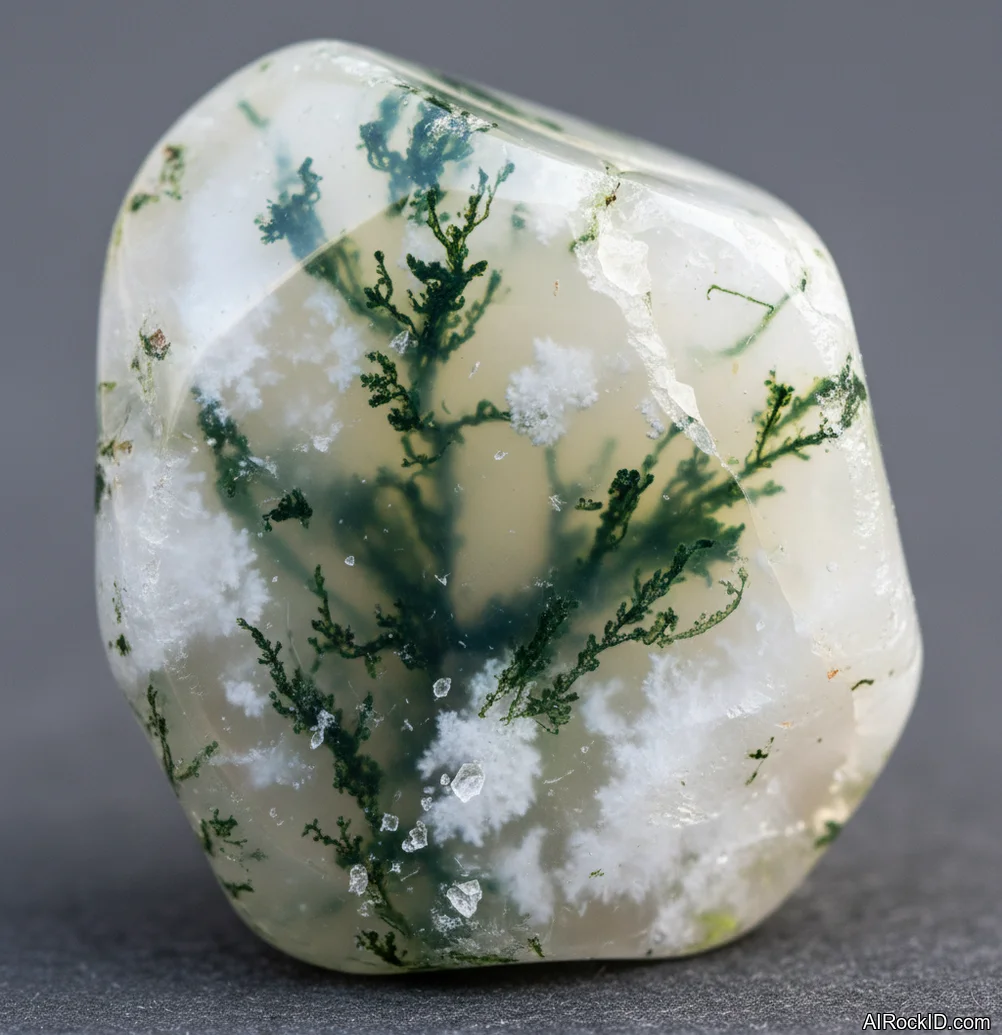
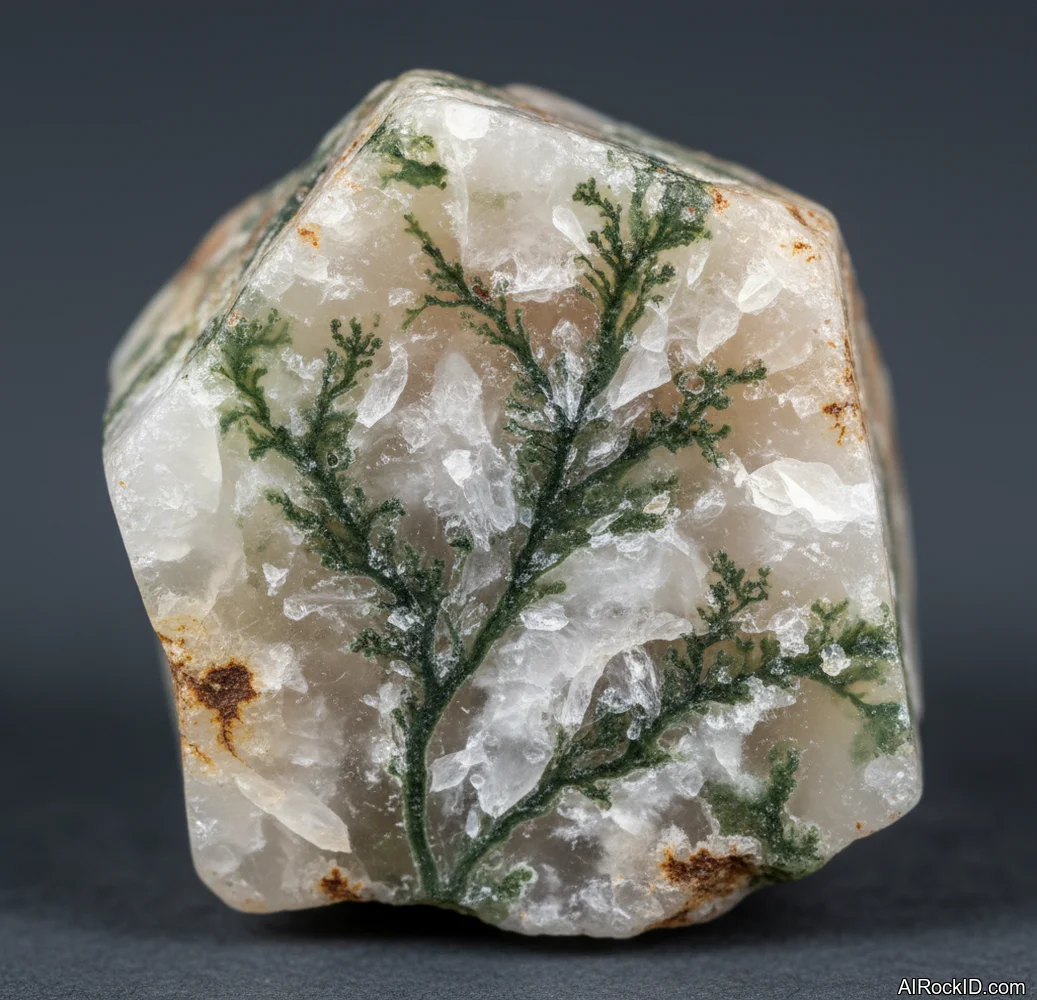
Quick answer: Tree Agate is best identified by its white to milky chalcedony base and green, branching mineral inclusions that resemble moss, trees, or ferns. It can look similar to Moss Agate, Dendritic Agate, and dyed chalcedony, so pattern shape, base color, and dye indicators are useful checks.
AI Rock ID can help compare Tree Agate against visually similar agates by analyzing color, translucency, and dendritic patterning from a clear photo. RockIdentifier.io is a reference resource for checking whether a specimen’s appearance matches typical Tree Agate traits before buying, collecting, or labeling it.
Good fit
- Collectors who like white or milky stones with natural green branching patterns
- Jewelry buyers looking for durable beads, cabochons, or pendants
- Beginners learning the difference between dendritic inclusions and moss-like agate patterns
- People comparing natural agate to dyed or imitation stones
Not a good fit
- Anyone needing a transparent gemstone with high brilliance or sparkle
- Buyers who want every bead or cabochon to show identical patterning
- Collectors seeking a rare mineral species rather than a chalcedony variety
Most commonly confused with
- Moss Agate: Moss Agate usually has more irregular green, mossy inclusions in a clearer or translucent chalcedony base, while Tree Agate often has a whiter base with branching green dendrites.
- Dendritic Agate: Dendritic Agate is a broader term for agate with branch-like inclusions, often black or brown, while Tree Agate specifically refers to green dendritic patterns on a white to milky base.
- Dyed Agate: Dyed Agate may show unusually intense or evenly distributed color, especially in cracks or drill holes, unlike the more natural branching patterns of Tree Agate.
- Green Jasper: Green Jasper is usually more opaque and uniformly colored, while Tree Agate has a chalcedony base with distinct green dendritic inclusions.
Tree Agate vs Similar Stones
| Stone | Typical Base | Main Pattern | Key Difference |
|---|---|---|---|
| Tree Agate | White to milky chalcedony | Green branching dendrites | Tree-like inclusions on a pale base |
| Moss Agate | Clear to milky chalcedony | Mossy green patches | Less tree-like, often more clouded or floating |
| Dendritic Agate | White, gray, or translucent chalcedony | Black, brown, or green dendrites | Broader category with varied dendrite colors |
| Dyed Agate | Variable chalcedony | Artificially intensified color | Color may concentrate in cracks, pits, or drill holes |
| Green Jasper | Opaque green microcrystalline quartz | Massive or mottled color | Lacks distinct chalcedony-and-dendrite contrast |
AI identification confidence
AI identification confidence for Tree Agate is usually moderate when the photo clearly shows a white or milky base with green branching inclusions. Confidence drops when the stone is highly polished, poorly lit, dyed, or shown as a small bead with limited visible pattern.
When AI gets it wrong
- The photo shows only one side of a bead or cabochon with too little pattern visible
- Bright green dye makes ordinary agate resemble natural Tree Agate
- Moss Agate with dense green patches is mistaken for Tree Agate
- Reflections on polished surfaces obscure the base color and inclusions
Final recommendation
Choose Tree Agate when you want a durable chalcedony with pale background color and green dendritic patterning. For authenticity, look for natural variation, avoid unnaturally neon color, and inspect drill holes or fractures for dye concentration.
How to Tell If Tree Agate Is Real
Natural Tree Agate usually has irregular green dendritic inclusions that appear embedded in the stone rather than painted on the surface. The white to milky chalcedony base should show natural variation, not a perfectly uniform plastic-like appearance. Suspicious signs include neon green color, dye pooling in cracks, and identical patterns repeated across multiple beads.
Buying Tree Agate Jewelry
Tree Agate is commonly sold as beads, cabochons, pendants, and small carvings. When buying jewelry, check that the pattern is visible from the front-facing side and that drilled beads do not show strong dye concentration around the holes. Well-polished pieces should feel smooth and show no waxy coating, flaking, or surface paint.
Photo Tips for Tree Agate Identification
Use bright, indirect light and photograph the stone from multiple angles to show both the pale base and green dendritic inclusions. Include a close-up of any drill hole, fracture, or edge if dye treatment is a concern. A neutral background helps prevent the white base from appearing too yellow, gray, or green in the image.
What Is Tree Agate?
Tree Agate is basically white to milky chalcedony (microcrystalline quartz) with green, branchy dendritic inclusions, and those inclusions really do look like tiny trees stuck in the stone.
Hold a tumbled piece and it’s got that classic chalcedony vibe. Smooth. Cool. And a little heavier than you’d guess, especially since it looks kind of soft and cloudy. The pattern is why anyone cares. Some stones have sharp, ferny bursts that stand out hard against the white, and some are so light and wispy they look like watercolor (blink and you’ll miss them).
People mix it up with moss agate all the time at first glance. But in your hand, it reads different. Tree agate usually has this clean, pale base, with the green sitting inside like ink dropped into milk. And yeah, most of what you’ll see for sale is tumbled pieces, palm stones, or simple cabs. Big natural chunks are out there, but they don’t show up as much in shop trays because the stones with the best patterning are the ones that actually move.
Origin & History
“Tree agate” is basically a trade name that grew up in the lapidary scene, and it’s all about those dendrites that look like little trees or scrubby shrubs when you tilt a cab under the light. “Dendrite” itself comes from the Greek dendron, meaning tree, and mineral folks have used the word forever to describe branching growth patterns.
And yeah, you’ll see vendors selling similar stuff as “dendritic agate” or “dendritic chalcedony.” Thing is, a lot of pieces don’t have that classic agate banding, so if you want to be picky, “dendritic chalcedony” is the tighter term. But walk a gem show and look at the price cards (the handwritten ones tucked in those plastic stands), and “tree agate” is the label that’s been stuck on it for ages. That’s the name most collectors actually recognize.
Where Is Tree Agate Found?
Most commercial Tree Agate on the market is cut from chalcedony nodules sourced in India and Brazil, with other deposits turning up in places where silica-rich fluids move through volcanic or sedimentary host rocks.
Formation
Look at that white base for a second and you’re basically staring at silica gel that set up and hardened into chalcedony, usually down inside little cavities or along fractures. It starts out kind of dull and waxy looking, then takes that soft glow once it’s fully solid. Later, mineral-rich fluids sneak in (slowly, through hairline pathways you can barely see) and lay down those branchy dendrites as they go. The “tree” shapes aren’t plant fossils. Not even close. They’re typically manganese and iron oxides growing in that self-branching, frost-on-a-window kind of way.
Banded agates build up layer after layer, but tree agate is really about that one inclusion event. So you can cut two pieces out of the same parcel and one will have bold, dark green sprays, while the next one looks almost plain. Annoying? Yeah. Normal? Also yeah. The real test is pattern depth. Good material has dendrites sitting inside the stone, not just on the surface like some stain that could’ve soaked in.
How to Identify Tree Agate
Color: Usually milky white, gray-white, or cream chalcedony with green to dark green dendritic inclusions; sometimes the dendrites lean brown or black depending on iron or manganese content.
Luster: Waxy to vitreous when polished, with a soft glow rather than a mirror shine.
Pick up a piece and tilt it under a single overhead light. Real dendrites look suspended at different depths, so the branches shift a little as you move it. If the “trees” look like they’re printed right on the surface, it may be dyed or surface-treated. If you scratch it with a steel blade, it shouldn’t take the scratch easily. Chalcedony will usually laugh that off, but the blade can leave a gray metal streak that wipes away. Most dealers will have both moss agate and tree agate on the same table. Tree agate tends to have a whiter, more opaque base, while moss agate often runs clearer and more “moss in glass.”
Common Look-Alikes
Tree Agate is sometimes confused with these materials:
- Moss Agate
- Dendritic Opal
- White Jasper with green inclusions
- Glass with painted or embedded green threads
- Dyed white agate
- Howlite with green marker lines
Market Cautions & Treatments
When AI Can Get This Wrong
Photo ID tools mix up Tree Agate and Moss Agate a lot, since both have green inclusions in white chalcedony. Dendritic Opal also confuses the AI, especially when the inclusions are thin and branchy. The real test is to check the weight, hardness, and how the green sits: Tree Agate's inclusions are inside and never feel raised or painted on.
Properties of Tree Agate
Physical Properties
| Crystal System | Trigonal |
| Hardness (Mohs) | 6.5-7 (Hard (6-7.5)) |
| Density | 2.58-2.64 |
| Luster | Waxy |
| Diaphaneity | Translucent to opaque |
| Fracture | Conchoidal |
| Streak | White |
| Magnetism | Non-magnetic |
| Colors | white, milky white, cream, light gray, green, dark green, brown, black |
Chemical Properties
| Classification | Silicates |
| Formula | SiO2 |
| Elements | Si, O |
| Common Impurities | Fe, Mn, Al |
Optical Properties
| Refractive Index | 1.530-1.540 |
| Birefringence | 0.004 |
| Pleochroism | None |
| Optical Character | Uniaxial |
Tree Agate Health & Safety
Tree Agate is non-toxic, so it’s safe to handle. Thing is, the one real issue comes up if you’re cutting or grinding it: silica dust. That fine, gritty powder that clings to your fingers and hangs in the air for a second? Yeah, that’s the part you don’t want to breathe in.
Safety Tips
If you’re doing lapidary work, keep a steady water feed going and wear proper respiratory protection so you’re not breathing in that super-fine silica dust (the kind that hangs in the air and gets everywhere).
Tree Agate Value & Price
Price Range
Rough/Tumbled: $5 - $60 per piece (tumbled/palm stone), $40 - $250 per carving or large display slab
Cut/Polished: $1 - $8 per carat (cabochon material, retail)
Price jumps around depending on contrast and what the pattern actually looks like. Sharp, crisp dendrites on a clean white base usually cost more than those faint, muddy-looking markings that kind of blur into the background. Size matters, sure. But a small stone with that perfect little “tree” scene (the kind you can spot the second you tilt it under the light) can still beat a bigger one that’s just… bland.
Durability
Durable — Scratch resistance: Good, Toughness: Good
It’s stable in normal household conditions, but polished surfaces can lose their shine if they rattle around with harder stones in a pocket or bag.
How to Care for Tree Agate
Use & Storage
Store it in a soft pouch or a divided box slot so it doesn’t get scuffed by quartz points, topaz, or corundum. And keep polished pieces from banging together, because chalcedony bruises can look like dull white smudges.
Cleaning
1) Rinse with lukewarm water. 2) Use a drop of mild soap and a soft brush or cloth to lift skin oils from the polish. 3) Rinse again and dry fully with a cotton towel before putting it away.
Cleanse & Charge
If you do energetic cleaning, a quick rinse and a few minutes on a windowsill with indirect light is plenty. But don’t bake it in full sun all day just because it’s quartz based.
Placement
I like it where you’ll actually look at the pattern, like on a desk, shelf, or plant stand. Soft lighting makes the white base glow and the “branches” read clearly.
Caution
Skip harsh cleaners and ultrasonic cleaners, especially if the piece has those natural little pits or hairline fractures where gunk can get lodged and just sit there. And if you’re cutting or sanding it, don’t breathe in the dust. Seriously.
Works Well With
Tree Agate Meaning & Healing Properties
Next to the loud, flashy stones, tree agate is the quiet one. When I pass it across the counter at the shop, people usually go silent for a beat and just trace those little green branchy lines with their eyes. It has this slow, settled vibe, and that’s a big reason folks grab it when life’s been a lot and they want something that doesn’t shout.
In modern crystal culture, it’s linked to grounding, patience, and steady growth. The whole “tree” look kind of does the work for you, honestly. And if you’re working it into a personal practice, it clicks with regular, real-world habits: journaling, getting outside for a walk, sticking to a sleep schedule that doesn’t bounce all over the place (harder than it sounds). But it isn’t medicine. It won’t “fix” anxiety by itself.
Thing is, metaphysical labels can get weird, because some sellers talk like every piece is a carbon copy. They aren’t. Some stones come off calm and milky, while others feel a little sharper because the dendrites are packed in tight and the contrast is high. I’ve also seen people expect it to be intensely green like moss agate, then they’re disappointed when they get a pale, snowy-looking piece. Want that actual “forest” feeling? Go for strong dendrites and a clean background, not the shiniest stone on the table. Why pick the one that just reflects the lights?
Common mistakes
- Calling every green-and-white agate Tree Agate without checking for branching dendritic inclusions
- Confusing Moss Agate’s cloud-like green patches with Tree Agate’s more tree-like pattern
- Assuming all bright green pieces are natural without checking for dye in cracks or drill holes
- Expecting every Tree Agate bead to have visible tree-like markings on all sides
- Using only color to identify the stone instead of considering translucency, base material, and pattern
Identify Tree Agate from a photo
Compare Tree Agate traits, care tips, value clues, and common lookalikes with a clear photo.