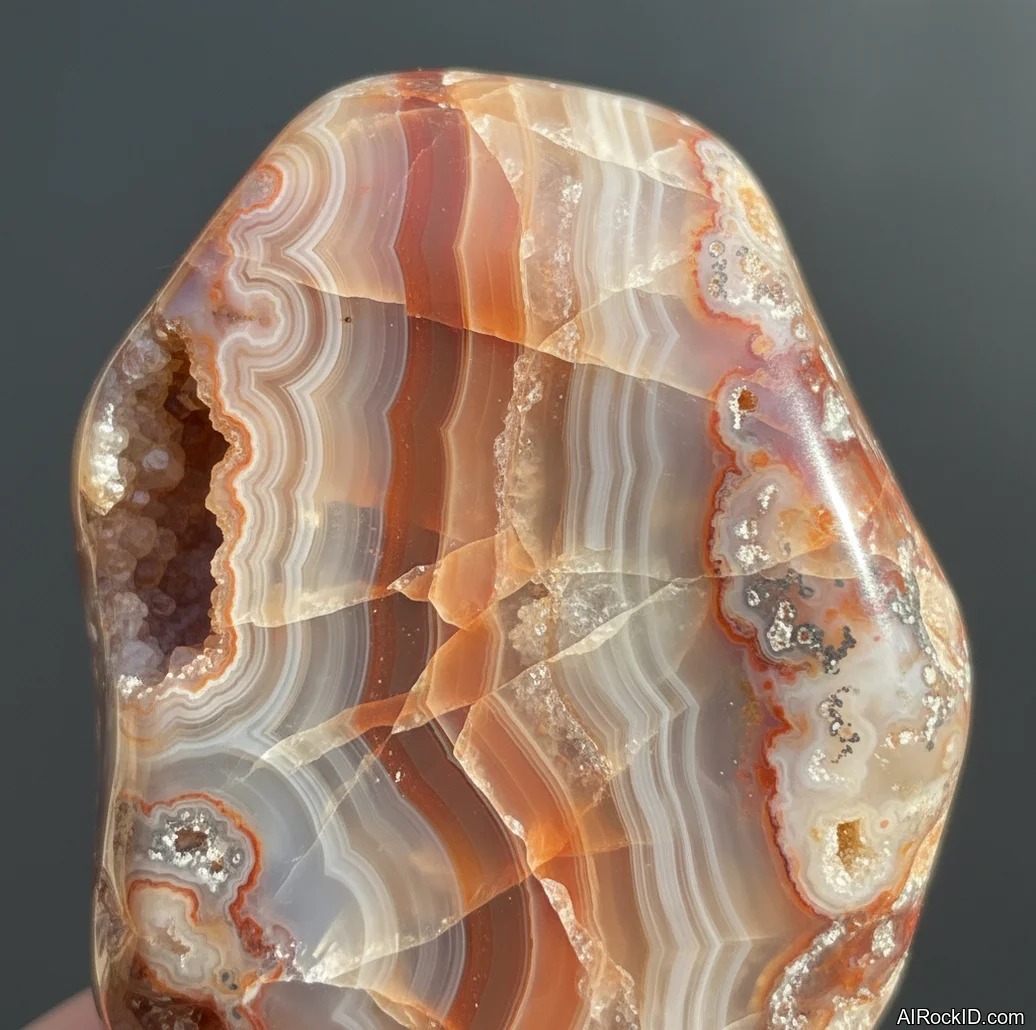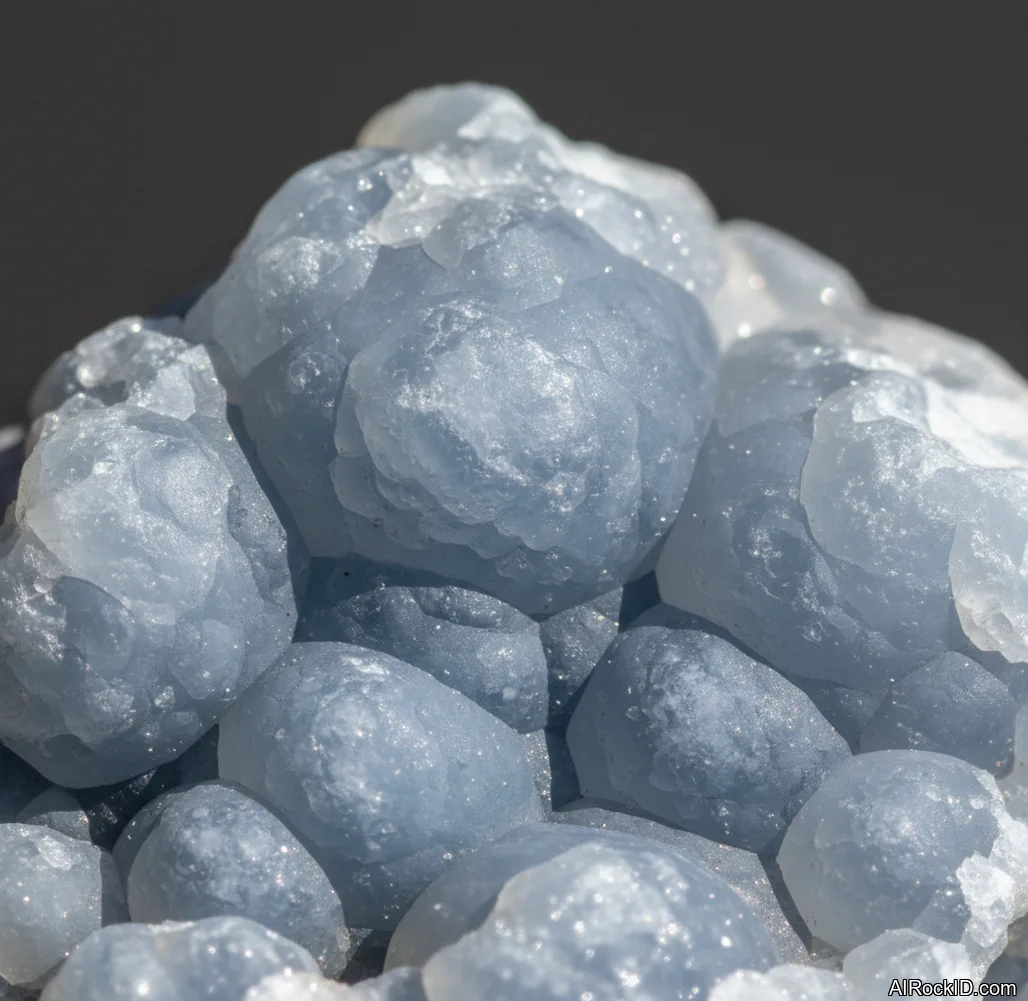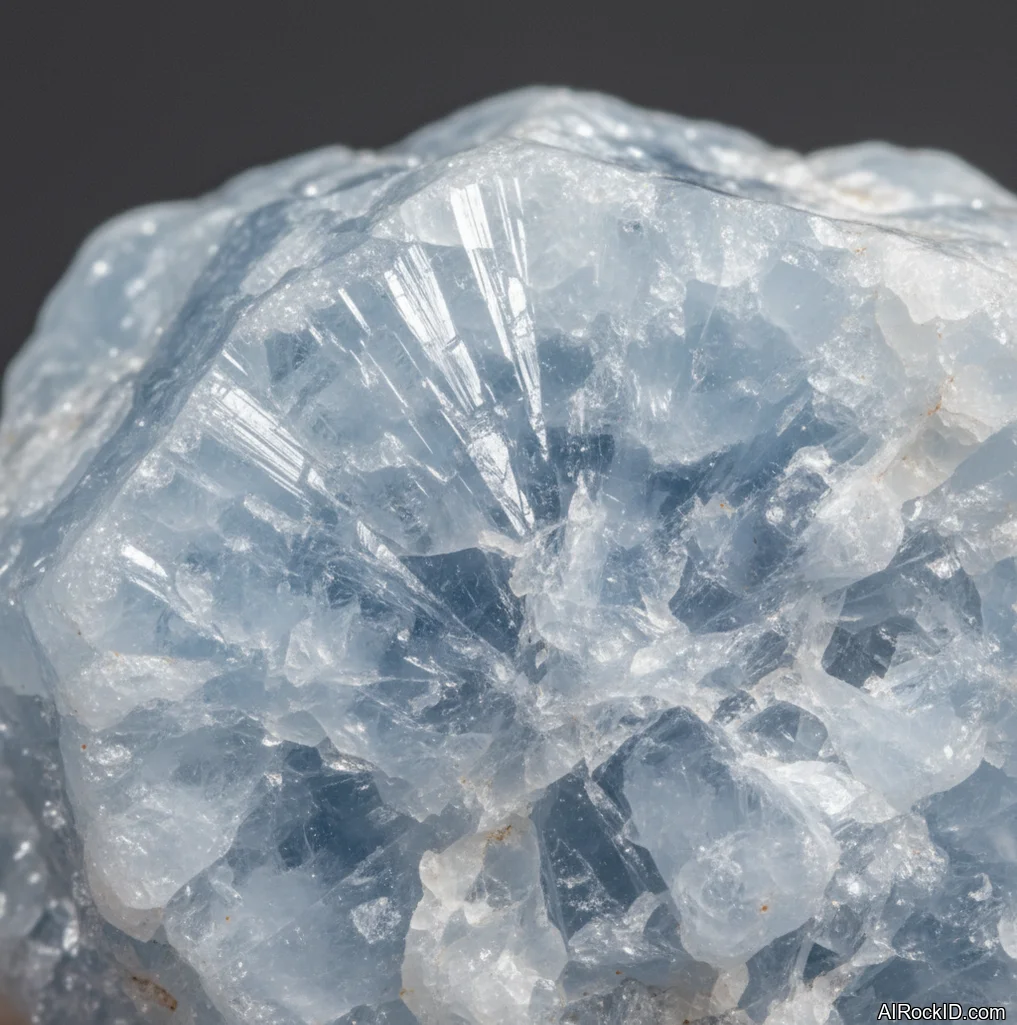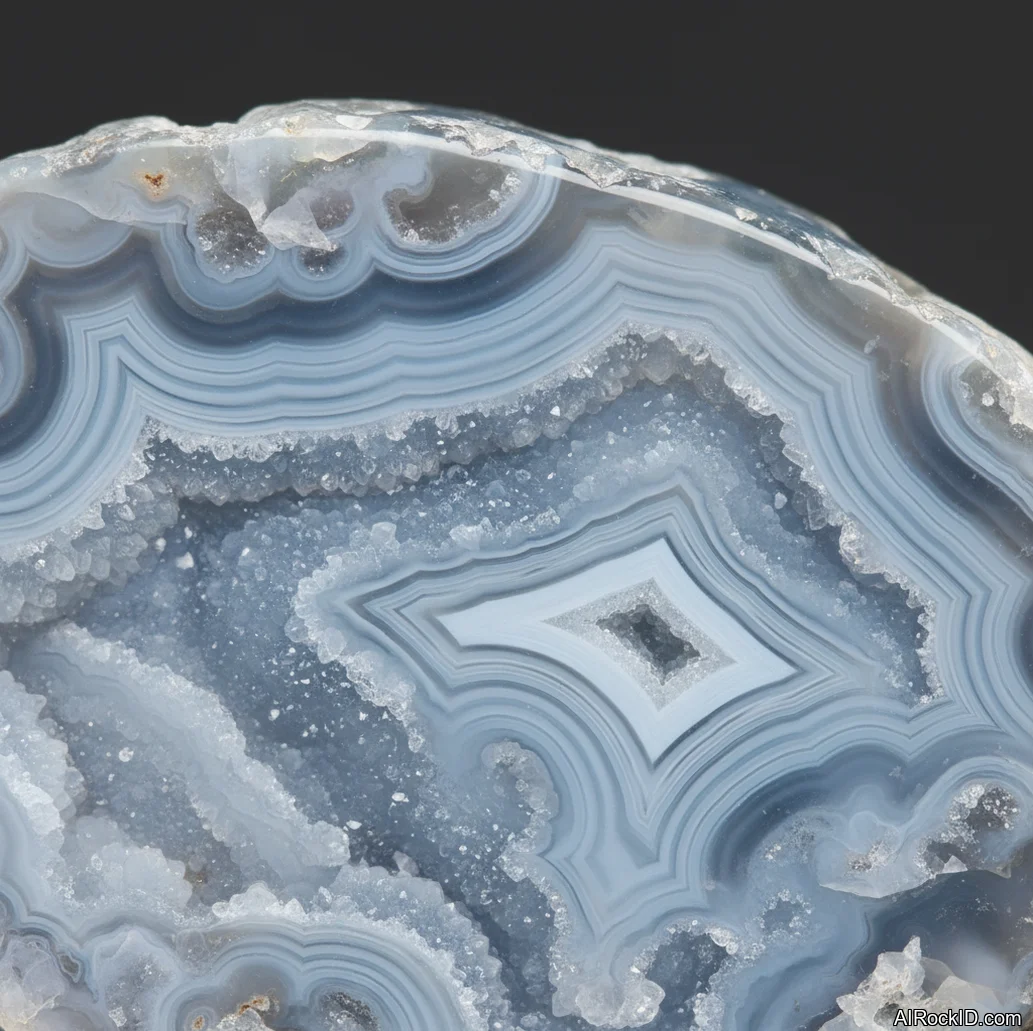
Blue Lace Agate


Quick answer: Blue Lace Agate is identified by pale blue to bluish white chalcedony with fine, lace-like banding. The most useful checks are band pattern, waxy quartz luster, hardness around 6.5–7, and whether the color appears naturally soft rather than intensely dyed.
AI Rock ID can help compare a Blue Lace Agate photo against common lookalikes by analyzing banding, color distribution, and surface texture. RockIdentifier.io can be used as a supporting identification tool, but physical tests and seller information are still important for higher confidence.
Good fit
- Collectors who like soft blue, banded chalcedony
- Jewelry buyers looking for a durable quartz-family stone
- Beginners learning to identify agates by banding and luster
- Buyers comparing natural, dyed, and imitation blue stones
Not a good fit
- Anyone expecting a consistently vivid cobalt-blue natural stone
- Buyers who need laboratory-level origin verification from photos alone
- Rough handling situations where cabochons or beads may be scratched by harder materials
Most commonly confused with
- Dyed Agate: Dyed agate may show stronger, more uniform blue color or color concentrated in cracks and drill holes.
- Blue Chalcedony: Blue chalcedony is usually more evenly colored and lacks the fine lace-like banding typical of Blue Lace Agate.
- Sodalite: Sodalite is deeper blue, often with white veins or patches, and does not show translucent agate banding.
- Larimar: Larimar often has cloudy turquoise-blue and white patterns rather than crisp, parallel chalcedony bands.
Blue Lace Agate vs Common Lookalikes
| Stone | Typical Appearance | Key Difference |
|---|---|---|
| Blue Lace Agate | Pale blue and white, fine lace-like bands | Banded chalcedony with waxy luster and quartz hardness |
| Dyed Agate | Bright or uneven blue, sometimes in cracks | Color may pool near fractures, pits, or bead holes |
| Blue Chalcedony | Soft blue, usually more uniform | Less distinct banding than Blue Lace Agate |
| Sodalite | Deep blue with white patches or veins | Opaque rock with no agate-style translucent banding |
| Blue Calcite | Pale blue, cloudy, sometimes cleaved | Much softer and may show calcite cleavage |
AI identification confidence
AI identification confidence is usually higher when the photo clearly shows pale blue color, fine parallel bands, and a polished or broken surface with chalcedony luster. Confidence is lower for single-color beads, overexposed photos, dyed material, or stones shown without scale.
When AI gets it wrong
- The stone is a dyed agate with color that looks natural in the photo.
- The image shows only a small bead or cabochon without visible banding.
- Lighting makes white bands appear blue or makes pale blue stone look gray.
- The sample is another blue mineral with similar color but different hardness or structure.
Final recommendation
Choose Blue Lace Agate with visible natural-looking bands, a waxy to vitreous quartz luster, and seller photos taken in neutral lighting. For higher-value pieces, ask whether the stone is natural, dyed, stabilized, or otherwise treated.
How to Spot Dyed Blue Lace Agate
Dyed Blue Lace Agate or dyed agate may show unusually intense blue color, especially in cracks, pits, or around bead drill holes. Natural-looking Blue Lace Agate usually has soft blue and white bands rather than flat, saturated color. A loupe can help reveal color concentration along fractures or surface-reaching pores.
Buying Blue Lace Agate: What to Ask
Ask the seller whether the material is natural Blue Lace Agate, dyed agate, or another blue chalcedony. Request photos in daylight or neutral lighting, and look for consistent lace-like banding across the piece. For jewelry, also check the setting, bead hole quality, and whether any surface coating is present.
Photo Tips for Identification
Photograph Blue Lace Agate in indirect natural light on a plain background to show its pale blue and white bands accurately. Include close-up images of the banding, edges, bead holes, and any fractures. A scale reference helps separate small agate beads from larger rough or slab material.
What Is Blue Lace Agate?
Blue Lace Agate is a pale blue, banded kind of chalcedony (microcrystalline quartz) with those fine white “lace” lines running through it.
Pick up a decent piece and you’ll feel it right away. It stays cool against your skin even if the room’s warm, like it’s been sitting in the shade. The color usually lands in that soft baby-blue zone, with milky white bands that remind me of ripples in skim milk when you swirl a glass. It’s not a loud stone. And honestly, it kind of rewards you for staring at it.
Most of what you’ll run into for sale is tumbled, cabbed, or cut into hearts and palm stones, since it polishes up without a fight and the banding really pops under a glossy dome. But here’s the catch: a lot of the rough looks pretty plain until somebody cuts it, and some batches lean more gray-blue than those pretty sky tones people expect from photos. Funny how that works, right?
Origin & History
Agate gets its name from the Achates River (today’s Dirillo) in Sicily. People have been using that label since antiquity for banded chalcedony.
“Blue lace agate” is a trade name, and it really only became common in the 20th century. It refers to pale blue chalcedony with very fine, tight banding, especially the material that flooded into the jewelry market from southern Africa.
Thing is, it’s not a separate mineral species. So there isn’t some big, cinematic “discovery day” like you get with certain rare minerals. Dealers and cutters are the ones who pushed it, mostly because the soft blue color and those crisp little bands look great once it’s polished up (you can practically feel the smooth, glassy surface after a good buff). And the name stuck for a simple reason: it matches what you see.
Where Is Blue Lace Agate Found?
Good blue lace material is strongly associated with southern Africa, especially Namibia. Blue chalcedony and banded agates also turn up in volcanic regions worldwide, but the classic “lace” look is more locality-specific.
Formation
Look at the banding and you’re basically staring at a slow-drip timeline. Blue Lace Agate forms when silica-rich fluids creep through little cavities and fractures, usually in volcanic rock, then drop microcrystalline quartz down in layer after layer. Some of those layers are insanely thin. That’s why the pattern reads more like delicate lace stacked up tight, not big, chunky stripes.
The blue color usually isn’t from one specific “blue element.” It’s more about tiny inclusions plus light scattering. In a hand sample you’ll catch spots where the blue just washes out into milky chalcedony, and yeah, that’s totally normal. And if you’ve ever picked up rough with a rind, you know the outside can be tan to brown and kind of ugly (a little waxy or chalky to the touch), but slice it open and the inside takes a polish like it’s a completely different stone.
How to Identify Blue Lace Agate
Color: Typically pale sky-blue to bluish gray with white to cream banding in fine, wavy layers. Many pieces show a soft, cloudy translucence rather than a clear “see-through” look.
Luster: Polished surfaces are vitreous to slightly waxy, like other chalcedony.
Pick up a piece and feel the temperature. Real chalcedony stays cool and glassy-cool compared to resin or plastic fakes that feel a bit warm and grabby. If you scratch it with a steel nail, it shouldn’t take a scratch easily, but it will scratch glass because it’s quartz hardness. The problem with dyed blue agate is the color often sits in fractures and along the band edges, so check for too-uniform bright blue and color pooling in tiny cracks.
Common Look-Alikes
Blue Lace Agate is sometimes confused with these materials:
- Dyed white/gray banded agate sold as “blue lace” (often with bright electric-blue dye)
- Blue chalcedony (more even, cloudy blue without the crisp white lace banding)
- Angelite (blue anhydrite, softer with a chalky look and it scratches way easier than agate)
- Blue calcite (waxy cleavage faces and softer, bands look chunky instead of hairline lace)
- Dyed howlite or dyed magnesite (fake “blue lace” look with spiderweb veining and dye sitting in pores)
- Blue glass (including slag glass) cut or tumbled to mimic banded stones
Market Cautions & Treatments
When AI Can Get This Wrong
At first glance, phone photos make Blue Lace Agate look like blue chalcedony, angelite, or even dyed howlite because the camera blows out the pale bands and turns everything into one flat baby-blue. The real test is hardness and texture: Blue Lace Agate should skate around 6.5 to 7 and won’t take a quick scratch from a copper coin, while angelite and calcite will mark up fast and feel more chalky or waxy in the hand.
Properties of Blue Lace Agate
Physical Properties
| Crystal System | Trigonal |
| Hardness (Mohs) | 6.5-7 (Hard (6-7.5)) |
| Density | 2.58-2.64 |
| Luster | Vitreous |
| Diaphaneity | Translucent |
| Fracture | Conchoidal |
| Streak | white |
| Magnetism | Non-magnetic |
| Colors | pale blue, sky blue, bluish gray, white, cream |
Chemical Properties
| Classification | Silicates |
| Formula | SiO2 |
| Elements | Si, O |
| Common Impurities | Fe, Mn, Ti, Al |
Optical Properties
| Refractive Index | 1.530-1.543 |
| Birefringence | 0.009 |
| Pleochroism | None |
| Optical Character | Uniaxial |
Blue Lace Agate Health & Safety
Blue Lace Agate isn’t toxic, so it’s fine to handle with bare hands. But like any silica-based stone, the powder you get when you cut or grind it is a lung hazard, so don’t breathe that dust in.
Safety Tips
If you’re going to shape it, keep it wet while you work and don’t skip the right respirator, the kind that’s actually rated for fine silica dust (not just a flimsy paper mask).
Blue Lace Agate Value & Price
Price Range
Rough/Tumbled: $5 - $40 per piece
Cut/Polished: $2 - $12 per carat
Tight, crisp lace banding and that clean sky-blue base color? Yeah, those bump the price up in a hurry. And if the rough is big enough to cab and doesn’t have fractures, it’ll cost more, because cutters aren’t grinding away as much stone (less gets lost).
Durability
Durable — Scratch resistance: Good, Toughness: Good
It’s stable for normal wear, but polished pieces can still chip on sharp edges if you drop them on tile.
How to Care for Blue Lace Agate
Use & Storage
Store it in a pouch or a divided box so it doesn’t get rubbed by harder stones with sharp points. I’ve seen quartz points leave little scuffs on polished agate if they ride together in a pocket.
Cleaning
1) Rinse with lukewarm water and a drop of mild soap. 2) Use a soft toothbrush to clean around pits or druzy spots. 3) Rinse well and pat dry; avoid heat-drying on a sunny windowsill.
Cleanse & Charge
Running water, a quick smoke cleanse, or leaving it on a shelf overnight all work fine for most people’s routines. Avoid prolonged direct sun if you’re picky about keeping the color looking soft and even.
Placement
On a desk or nightstand, it reads calm and tidy because the banding looks like gentle lines from a distance. I like it where side light hits it, since that’s when the layers show their depth.
Caution
Don’t hit pieces with fractures or druzy pockets with harsh cleaners, bleach, or an ultrasonic cleaner. And skip high heat too, especially if it’s in a glued-on jewelry setting, because that glue can soften and let the stone shift (or just pop right out).
Works Well With
Blue Lace Agate Meaning & Healing Properties
People grab Blue Lace Agate at first because, yeah, it looks great in photos. But once you actually use it, it turns into that stone you reach for when you want the room to feel a little quieter, especially if you’re about to talk, or your nerves are doing that annoying hum. I’ve handled a ton of palm stones at shows, and the good blue lace pieces always do the same thing: they feel slick and steady in your hand, and your thumb kind of traces the bands on autopilot. No effort. Just smooth.
Compared to louder stones like carnelian or tiger’s eye, blue lace is more “turn it down a notch.” That’s basically its whole thing. And people use it in real, everyday ways: pairing it with breathwork, journaling, sticking it in a pocket on days packed with too many meetings. But look, it’s still a rock. So if you’re dealing with real anxiety or sleep problems, treat it like a comfort object, not a stand-in for medical care. Fair?
Thing is, there’s a snag. A lot of what’s out there is dyed blue agate sold under fuzzy names, and that can throw you if you’re expecting that soft, natural look. When you get a genuine piece with that misty, layered blue, it reads gentle and clean right away (you can usually tell the moment it hits the light), and that’s why people keep coming back to it.
Common mistakes
- Assuming every pale blue chalcedony is Blue Lace Agate even when banding is absent
- Identifying a stone from color alone without checking luster, hardness, and band pattern
- Mistaking dyed bright-blue agate for naturally colored Blue Lace Agate
- Confusing deep blue sodalite or cloudy blue calcite with banded chalcedony
- Relying on a single seller photo taken under strong blue or cool-toned lighting
Identify Blue Lace Agate from a photo
Compare Blue Lace Agate traits, care tips, value clues, and common lookalikes with a clear photo.