Boulder Opal


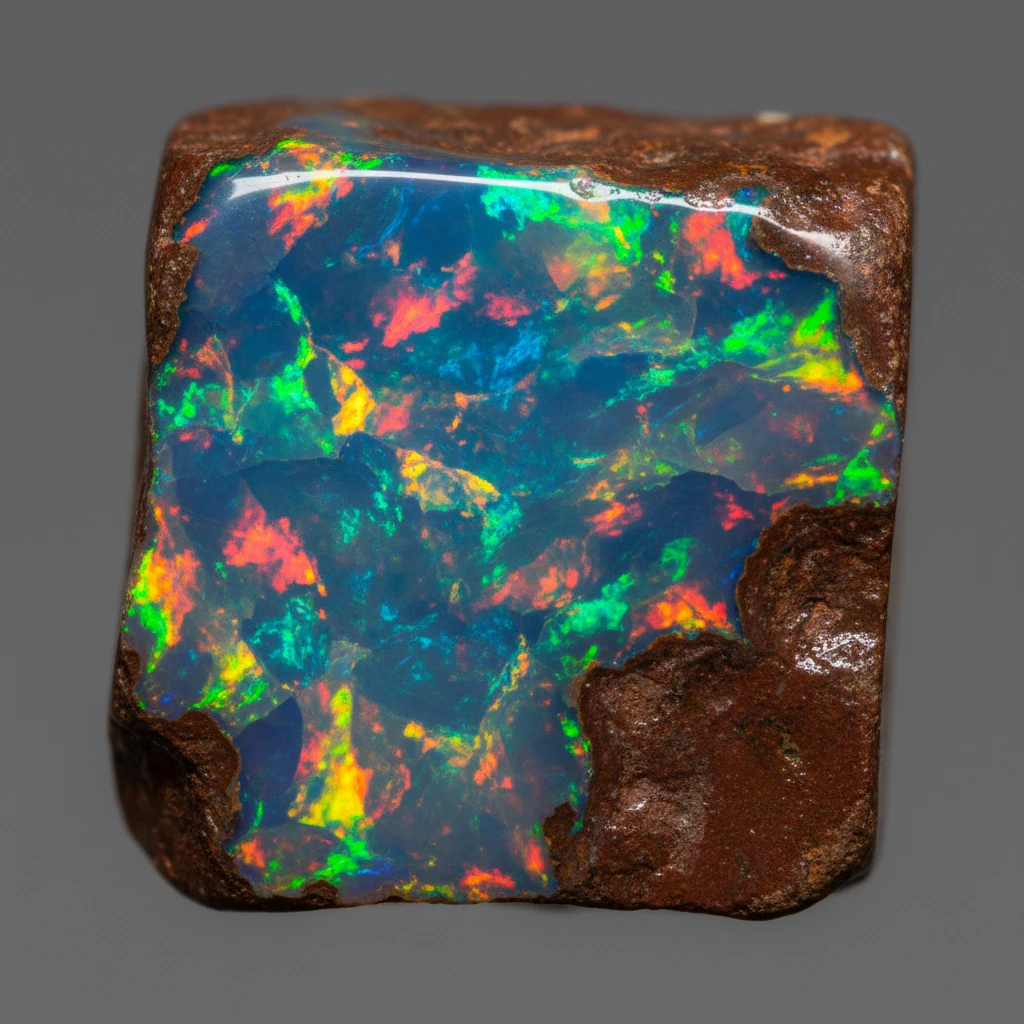
Quick answer: Boulder Opal is a natural opal that remains attached to its ironstone host rock, often showing thin seams or patches of play-of-color. Its dark brown matrix can make the color appear stronger, but the opal layer may be delicate and uneven.
AI Rock ID can help screen a Boulder Opal photo by looking for ironstone matrix, opal seams, and visible play-of-color. RockIdentifier.io can support identification, but gem testing or a trusted seller is still recommended for high-value specimens.
Good fit
- Collectors who like natural matrix stones with visible host rock
- Buyers comparing opal types by appearance and structure
- Jewelry wearers who understand opal needs careful handling
- People who want a dark-background opal without a fully solid black opal price range
Not a good fit
- Rings or bracelets that will receive frequent impact or abrasion
- Buyers who want a perfectly uniform, matrix-free opal surface
- Situations where exposure to harsh cleaners, heat, or sudden dryness is likely
- Anyone needing a low-maintenance everyday stone
Most commonly confused with
- Black Opal: Black Opal is usually cut as solid opal with a naturally dark body tone, while Boulder Opal includes ironstone host rock.
- Matrix Opal: Matrix Opal has opal distributed through porous host rock, while Boulder Opal often shows seams or faces of opal on ironstone.
- Doublet Opal: A doublet is assembled with a backing layer, while Boulder Opal is naturally attached to its ironstone matrix.
- Ammolite: Ammolite shows iridescence from fossil shell material rather than opal silica in ironstone.
Boulder Opal vs Similar Materials
| Material | Key Visual Clue | Main Difference |
|---|---|---|
| Boulder Opal | Opal color attached to brown ironstone | Natural opal remains on its host rock |
| Black Opal | Dark body tone with color across solid opal | No ironstone backing required |
| Matrix Opal | Color flecks or veins within host rock | Opal is dispersed through the matrix |
| Opal Doublet | Thin opal layer bonded to backing | Assembled stone with a glue line or artificial backing |
| Ammolite | Sheet-like red, green, or blue iridescence | Fossil shell material, not opal |
AI identification confidence
AI photo identification is often moderately confident when Boulder Opal shows both ironstone matrix and play-of-color in the same image. Confidence drops when the stone is polished into a small cabochon, photographed under intense light, or shown without side and back views.
When AI gets it wrong
- A photo shows only the colorful face and hides the ironstone back or edge.
- An opal doublet or triplet has a dark backing that resembles natural matrix.
- Strong lighting creates reflections that mimic play-of-color.
- Matrix Opal, ironstone jasper, or treated materials appear similar in a single front-view image.
How to Check Boulder Opal Authenticity
Inspect the edge and back of the stone for natural ironstone rather than a flat glued backing. A genuine Boulder Opal usually has irregular boundaries where opal meets host rock, while assembled stones may show a straight join line, bubbles, or a separate cap. For expensive pieces, request seller disclosure for treatments, assembly, origin, and any stability concerns.
Photo Tips for Identifying Boulder Opal
Use diffuse daylight or soft indoor light and take photos of the front, back, side, and close-up edge. A short video that tilts the stone can show whether the color shifts naturally with angle. Avoid overexposed flash photos because glare can hide cracks, glue lines, and the true thickness of the opal seam.
Buying Boulder Opal Online
Look for listings that show the full stone, not only the brightest color patch. Useful details include weight, dimensions, thickness, whether the piece is solid or assembled, and whether the surface has pits, cracks, or resin filling. A return policy is important because Boulder Opal color can look different under studio lighting than in normal daylight.
What Is Boulder Opal?
Boulder Opal is an uncommon precious opal variety that occurs inside ironstone boulders. Its signature look is vivid play of color set against a darker ironstone background, so a good piece can show blue, green, red, or yellow flashes while still carrying its natural host rock.
In hand, Boulder Opal reads as both gemstone and matrix specimen. It has a vitreous luster, opaque to translucent areas, and a medium Mohs hardness of 5.5-6.5, with fair scratch resistance and good toughness. Collectors value strong color intensity, larger size, and the clear presence of ironstone.
Origin & History
The name opal comes from the Latin word "opalus," with references reaching back to ancient Rome. Boulder Opal is part of that broader opal tradition, but its identity is tied to opal seams and patches held in ironstone rather than separated from it.
For a collector label, the ironstone is not a flaw; it is the defining context. Specimens from Australia, especially Queensland, Lightning Ridge, and Opalton, are commonly associated with Boulder Opal. For locality checking and specimen records, mindat.org is a useful plain-text reference alongside the locality names on a seller label.
Where Is Boulder Opal Found?
Boulder Opal is most commonly found in Australia. The listed notable localities are Queensland, Lightning Ridge, and Opalton, all names that matter to collectors because place can help explain the look of the ironstone-backed opal.
Formation
Boulder Opal forms when silica-rich water fills cracks and voids in ironstone. Over time, those filled spaces become colorful opal deposits, leaving the play-of-color material attached to or enclosed by the darker host rock.
That formation explains why many cut stones and specimens keep the ironstone in place. The matrix can frame the opal, strengthen the visual contrast, and make the color flashes easier to see. Chemically, Boulder Opal is hydrated silica, SiO2·nH2O, with listed common impurities of iron and manganese.
How to Identify Boulder Opal
Identify Boulder Opal by its play of color and its ironstone association. The best visual test is simple: turn the specimen under light and watch for vibrant blue, green, red, or yellow colors that appear in patterns against the darker rock.
Its physical profile supports the identification. Boulder Opal is amorphous, non-magnetic, has a white streak, vitreous luster, conchoidal fracture, density of 2.0-2.2 g/cm3, and refractive index of 1.44-1.46. It has no birefringence, no pleochroism, and is isotropic.
Properties of Boulder Opal
Physical Properties
| Crystal System | Amorphous |
| Hardness (Mohs) | 5.5-6.5 (Medium) |
| Density | 2.0-2.2 g/cm3 |
| Luster | Vitreous |
| Diaphaneity | Opaque to translucent |
| Fracture | Conchoidal |
| Streak | White |
| Magnetism | Non-magnetic |
| Colors | Blue, Green, Red, Yellow |
Chemical Properties
| Classification | Hydrated Silica |
| Formula | SiO2·nH2O |
| Elements | Si, O |
| Common Impurities | Fe, Mn |
Optical Properties
| Refractive Index | 1.44-1.46 |
| Birefringence | None |
| Pleochroism | None |
| Optical Character | Isotropic |
Boulder Opal Health & Safety
Boulder Opal poses no significant health risks.
Boulder Opal Value & Price
Price Range
Rough/Tumbled: $10 - $100 per specimen
Cut/Polished: $20 - $150 per carat
Price is influenced by color intensity and size.
Durability
Moderate — Scratch resistance: Fair, Toughness: Good
It can be sensitive to heat and strong chemicals.
How to Care for Boulder Opal
Use & Storage
Store in a soft pouch to prevent scratches.
Cleaning
Clean with mild soap and a soft cloth. Avoid ultrasonic cleaners.
Cleanse & Charge
Place it under moonlight to cleanse and charge.
Placement
Keep away from direct heat sources.
Caution
Avoid exposure to harsh chemicals.
Works Well With
Boulder Opal Meaning & Healing Properties
In crystal healing traditions, Boulder Opal is believed to enhance creativity, intuition, and clarity. It is associated with the Sacral and Crown chakras, the zodiac signs Libra and Pisces, the planet Venus, and the elements Water and Earth.
Use Boulder Opal as a reflective stone rather than a medical tool. It is considered safe to handle and safe in water, but it can be sensitive to heat and strong chemicals. Clean it with mild soap and a soft cloth, avoid ultrasonic cleaners, and place it under moonlight if you use cleansing and charging practices.
Identify Boulder Opal from a photo
Compare Boulder Opal traits, care tips, value clues, and common lookalikes with a clear photo.
Common mistakes
- Assuming every dark-backed opal is natural Boulder Opal.
- Judging value from color alone while ignoring cracks, thickness, polish, and pattern coverage.
- Buying a front-view-only photo without checking the back and side.
- Confusing natural ironstone matrix with an artificial backing on a doublet.
- Wearing thin-seam Boulder Opal in high-impact jewelry without protective settings.