Garnet Schist


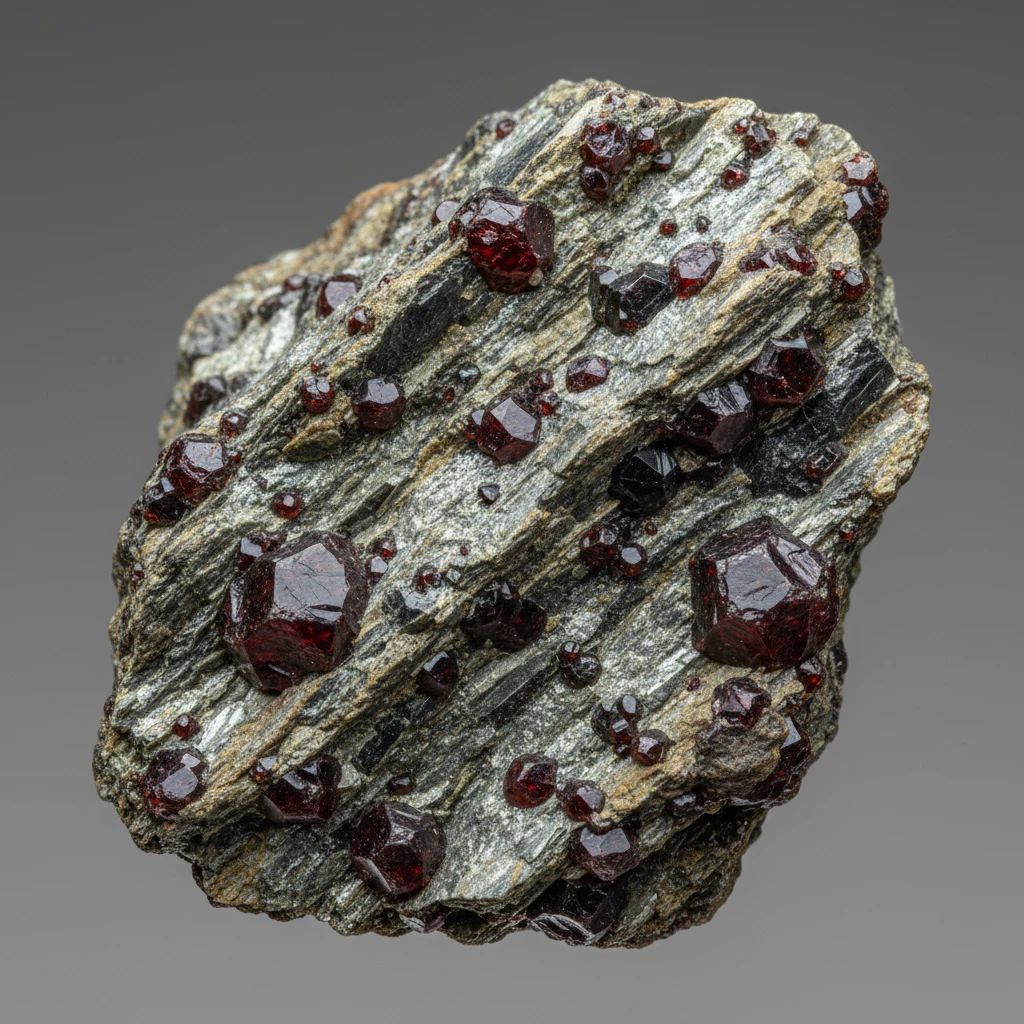
Quick answer: Garnet schist is a foliated metamorphic rock recognized by red to reddish-brown garnet crystals set in a shiny mica-rich matrix. It is best identified by the combination of visible garnets, layered foliation, and a variable hardness that depends on the mica, quartz, and garnet content.
AI Rock ID can help screen a specimen by comparing visible garnet crystals, mica sheen, and foliation patterns from a clear photo. RockIdentifier.io provides an accessible way to document suspected garnet schist, but final identification may still require a hand lens, streak test, or geologic context.
Good fit
- Collectors who like metamorphic rocks with visible mineral crystals
- Students learning foliation, index minerals, and regional metamorphism
- Display pieces where a platy mica texture and red garnets are easy to see
- Rockhounds comparing field specimens from schistose outcrops
Not a good fit
- Jewelry use where durability, polish, and uniform hardness are required
- Collectors who need a clean single-mineral garnet specimen
- Outdoor display in freeze-thaw climates if the rock flakes easily
Most commonly confused with
- Mica Schist: Mica schist may have the same shiny foliation but lacks abundant visible garnet porphyroblasts.
- Gneiss: Gneiss has more distinct light-and-dark mineral banding and usually less platy mica cleavage than schist.
- Amphibolite: Amphibolite is typically darker, denser, and dominated by amphibole rather than glittery mica.
- Garnet: Garnet is a mineral, while garnet schist is a rock made of garnet plus mica, quartz, and other minerals.
Garnet Schist Lookalike Comparison
| Specimen | Key Texture | Main Difference | Typical Clue |
|---|---|---|---|
| Garnet Schist | Shiny foliated mica with red garnets | Rock contains garnet crystals in schistose layers | Garnets stand out from a silvery or dark mica matrix |
| Mica Schist | Shiny platy foliation | Little to no visible garnet | Sparkly sheets dominate the surface |
| Gneiss | Coarse banding | More segregated light and dark bands | Striped appearance rather than flaky sheen |
| Amphibolite | Massive to weakly foliated | Dark amphibole-rich rock, less mica sparkle | Heavier, dark green to black surface |
| Eclogite | Granular, often red and green | High-pressure rock with green pyroxene | No obvious mica foliation |
AI identification confidence
Photo-based identification of garnet schist is usually moderate when red garnet crystals and mica foliation are both visible. Confidence drops when the specimen is weathered, wet, polished, or photographed too close to show the overall layering.
When AI gets it wrong
- Small red grains may be iron staining rather than garnet crystals.
- A close-up photo can hide foliation and make the rock look like a single mineral specimen.
- Wet mica surfaces may appear more reflective and obscure grain boundaries.
- Dark garnet amphibolite or garnet gneiss can be mislabeled if only the garnets are visible.
How to Photograph Garnet Schist for Identification
Use one photo of the full specimen and one close-up of the garnet crystals. Natural side lighting helps show mica foliation, while a dry surface prevents glare from hiding texture. Include a coin, ruler, or fingertip for scale because garnet size is useful for comparison.
Authenticity Checks for Garnet Schist
Authentic garnet schist should show garnets embedded within the rock, not glued onto the surface. The garnets may be rounded, fractured, or partly weathered, and the surrounding mica layers should wrap around or intersect them naturally. Be cautious with specimens that have uniformly bright red stones sitting only on one flat face.
Buying Tips for Garnet Schist Specimens
Look for stable pieces with visible garnets, clear foliation, and minimal loose flaking if the specimen is intended for display. Ask whether the piece is natural, cut, sealed, or stabilized, because treatments can affect appearance and care. A labeled locality adds educational value, especially for metamorphic rock collections.
What Is Garnet Schist?
Garnet schist is a foliated metamorphic rock, not a single mineral, recognized by visible garnet crystals set in a layered mica-rich matrix. In the hand, the rock often flashes silver, gray, brown, or black where muscovite and biotite catch the light, while red-brown to dark red garnets sit like hard knots in the schistose fabric.
Most garnet schist is a garnet-bearing mica schist composed with mica, quartz, feldspar, and other metamorphic minerals. The garnets are most commonly almandine and may appear rounded, protruding, or roughly dodecahedral. Because the rock splits more readily along mica-rich foliation than across it, collectors should handle thin flaky pieces with care.
Origin & History
The name schist comes from the Greek word "schistos," meaning split, a direct reference to the way mica-rich schist parts along foliation planes. Garnet schist earned practical importance in geology because garnet commonly grows during medium-grade regional metamorphism, especially in aluminum-rich mudstones and related rocks.
In classic metamorphic terrains, garnet-bearing schist helps geologists map metamorphic grade and reconstruct mountain-building events. For specimen labels and locality checking, mindat.org is a useful plain-text reference to compare reported locality names with recognized mineral and rock occurrences.
Where Is Garnet Schist Found?
Garnet schist is common in regional metamorphic belts, especially where clay-rich sedimentary rocks such as shale or mudstone were changed during continental collision and mountain building. It is also widespread in Precambrian shields and in Paleozoic to Cenozoic orogenic belts around the world.
Formation
Garnet schist forms during regional metamorphism, commonly from aluminum-rich sedimentary rocks such as shale, mudstone, or graywacke. As pressure and temperature rise, platy mica minerals align into foliation, giving the rock its sheeted, split-ready texture.
At the same time, garnet crystals grow as porphyroblasts within the matrix, often standing out as hard red-brown grains against softer mica layers. Associated minerals can include muscovite, biotite, quartz, plagioclase feldspar, chlorite, staurolite, kyanite, sillimanite, amphibole, and graphite, depending on the rock’s chemistry and metamorphic grade.
How to Identify Garnet Schist
Identify garnet schist by looking for a strongly foliated or flaky metamorphic rock with visible mica layers and embedded garnet crystals. Fresh broken surfaces may sparkle with a pearly to vitreous mica sheen, while garnets show vitreous to resinous luster on fresh faces and may look dull if weathered.
Good field clues are red, red-brown, wine-red, or nearly black hard grains in a silvery gray, dark gray, brown, greenish gray, or black schistose matrix. Do not rely on red spots alone; confirm that the grains are harder than the surrounding mica and that the rock splits along foliation. Garnet and quartz are hard, but mica-rich layers scratch, flake, and split more easily.
Properties of Garnet Schist
Physical Properties
| Crystal System | Not applicable; rock aggregate. Garnet is isometric/cubic, micas are monoclinic, and quartz is trigonal. |
| Hardness (Mohs) | Variable, commonly about 3-7 overall; garnet grains 6.5-7.5, quartz about 7, mica-rich layers about 2.5-3 (Variable) |
| Density | Approximately 2.7-3.3 g/cm³, depending on garnet, mica, quartz, feldspar, and accessory minerals |
| Luster | Pearly to vitreous in mica-rich matrix; vitreous to resinous on garnet grains |
| Diaphaneity | Opaque as a rock; individual garnet grains may be translucent in thin edges or small crystals |
| Fracture | Uneven to splintery across foliation; splits along schistosity |
| Streak | Not diagnostic as a rock; powdered material is usually white to gray, while garnet may give a white streak |
| Magnetism | Usually non-magnetic to very weak; may show slight response if magnetite or iron-rich minerals are present |
| Colors | gray, silver-gray, dark gray, brown, black, greenish gray, red-brown, dark red |
Chemical Properties
| Classification | Metamorphic silicate rock; commonly mica-quartz-feldspar schist with garnet porphyroblasts |
| Formula | Variable rock composition; common garnet component approximates almandine, Fe3Al2(SiO4)3, with muscovite/biotite, quartz SiO2, and feldspar |
| Elements | O, Si, Al, Fe, Mg, K, Na, Ca, Mn, Ti, H |
| Common Impurities | graphite, magnetite, ilmenite, chlorite, staurolite, kyanite, sillimanite, tourmaline, pyrite |
Optical Properties
| Refractive Index | Not applicable to the rock as a whole; almandine garnet about 1.78-1.83, quartz about 1.544-1.553 |
| Birefringence | Not applicable as a rock aggregate; garnet is isotropic, while quartz and micas are birefringent |
| Pleochroism | Not applicable to the rock as a whole; biotite may be strongly pleochroic in thin section |
| Optical Character | Aggregate; constituent minerals vary. Garnet is isotropic, quartz is uniaxial positive, and micas are biaxial. |
Garnet Schist Health & Safety
Garnet schist is generally safe to handle, but cutting, grinding, or sanding can create respirable mineral dust, including silica from quartz and fine mica particles. Some specimens may contain minor sulfides such as pyrite, which can stain or degrade when wet.
Garnet Schist Value & Price
Price Range
Rough/Tumbled: Common hand specimens are typically about $3-$25; attractive polished slabs, bookends, or specimens with large well-formed garnets may sell for about $20-$150 or more depending on size and display quality.
Cut/Polished:
Value depends on the size, abundance, color, and sharpness of the garnets; contrast with the mica-rich matrix; polish quality; specimen size; structural soundness; and locality. Gem-quality garnet is usually valued separately from the schist host rock.
Durability
Moderate — Scratch resistance: Mixed: garnet and quartz are hard, but mica-rich layers scratch and flake more easily., Toughness: Fair to variable; foliation planes can split or shed mica, especially on thin edges.
Generally stable under normal indoor conditions, but it can break along foliation and may weather or flake if repeatedly soaked, frozen, or handled roughly.
How to Care for Garnet Schist
Use & Storage
Store as a display specimen on a stable shelf or padded tray. Keep fragile, flaky pieces away from harder stones that may chip edges or loosen mica layers.
Cleaning
Clean with a soft dry brush or a lightly damp cloth. Avoid ultrasonic cleaners, acids, harsh detergents, and long soaking. Dry thoroughly after any brief rinse.
Cleanse & Charge
For non-geological spiritual use, cleanse with smoke, sound, moonlight, or by placing it near clear quartz rather than soaking it in water or saltwater.
Placement
Best displayed where the garnet crystals and mica foliation catch side lighting. Avoid outdoor exposure if the specimen is friable or contains sulfides.
Caution
Do not tumble fragile garnet schist unless it is a compact, polishable piece; many specimens split along foliation or shed mica. Wear respiratory protection for any sawing, grinding, or drilling.
Works Well With
Garnet Schist Meaning & Healing Properties
In crystal-healing traditions, garnet schist is used symbolically for grounding, resilience, focus, transformation, and stability. Practitioners often read it as a combined stone: garnet for vitality and perseverance, mica for reflection and insight, and schist texture for the idea of pressure reshaping material over time.
These meanings are cultural and spiritual beliefs, not medical claims. For energy work, garnet schist is commonly associated with the Root and Sacral chakras, the zodiac signs Capricorn, Scorpio, and Aries, the planets Mars and Earth, and the elements Earth and Fire. Because it can flake, place it on the body or nearby rather than soaking or rough-handling it.
Identify Garnet Schist from a photo
Compare Garnet Schist traits, care tips, value clues, and common lookalikes with a clear photo.
Common mistakes
- Calling the entire rock garnet instead of garnet schist.
- Assuming every red spot in schist is garnet without checking crystal shape and hardness.
- Mistaking mica sparkle for metallic ore minerals.
- Using one hardness value for the whole rock even though each mineral component differs.
- Cleaning flaky specimens aggressively and causing mica layers to peel.
- Identifying a polished slab without checking the unpolished edge or foliation.