Black Kyanite


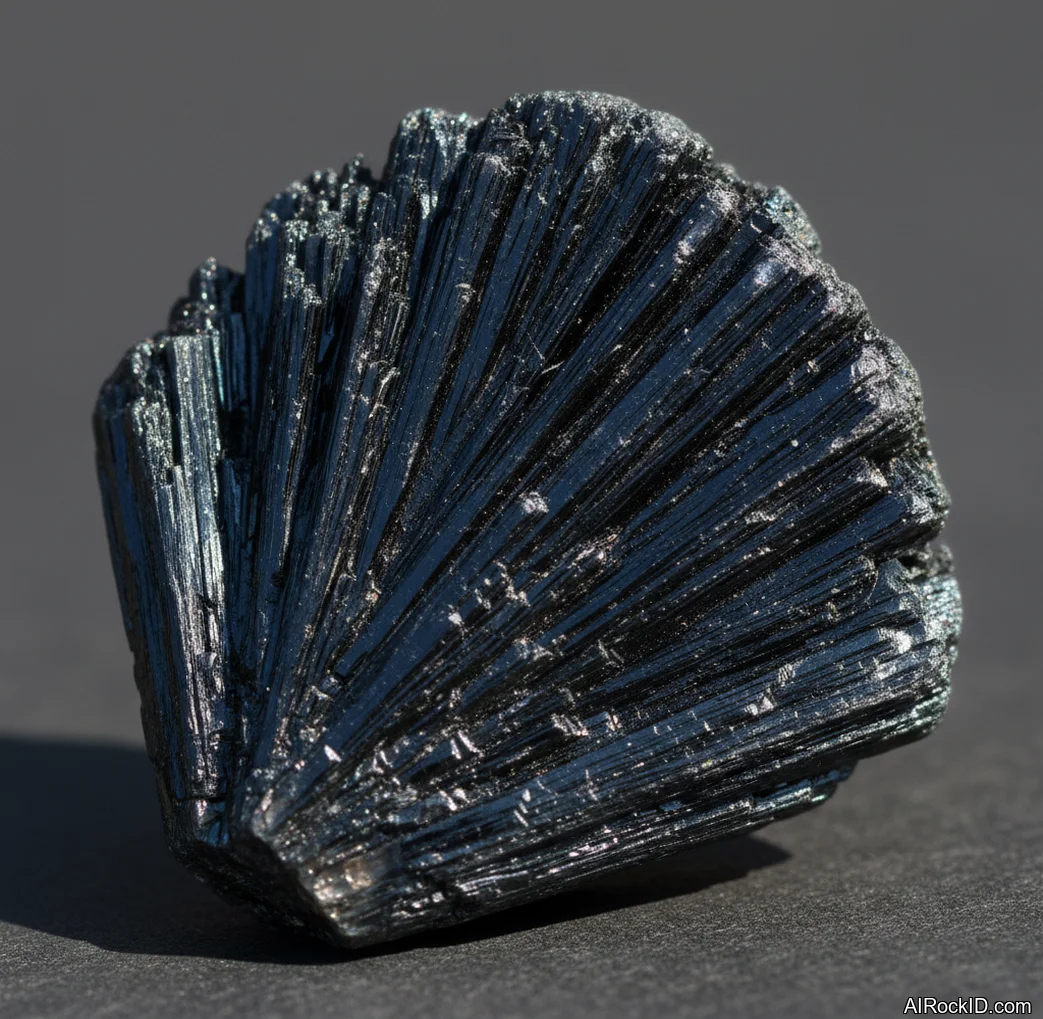
Quick answer: Black kyanite is typically identified by its dark gray to black color, long bladed crystals, and fan-like sprays. Its directional hardness and splintery habit help separate it from many black minerals that look similar in photos.
AI Rock ID can help compare a suspected black kyanite specimen against visual traits such as blade shape, luster, color, and crystal habit. RockIdentifier.io provides crystal identification support, but physical checks like streak, hardness direction, and texture are still useful for confirmation.
Good fit
- Collectors who like bladed or fan-shaped crystal habits
- Beginners who want a distinctive black mineral with recognizable structure
- People comparing rough black crystals rather than polished stones
- Buyers looking for affordable small sprays or display specimens
Not a good fit
- Anyone needing a durable pocket stone for daily carrying
- Buyers who prefer polished, rounded crystals with no splintery edges
- Collections handled frequently by children or pets
- People seeking a stone that can be reliably identified by color alone
Most commonly confused with
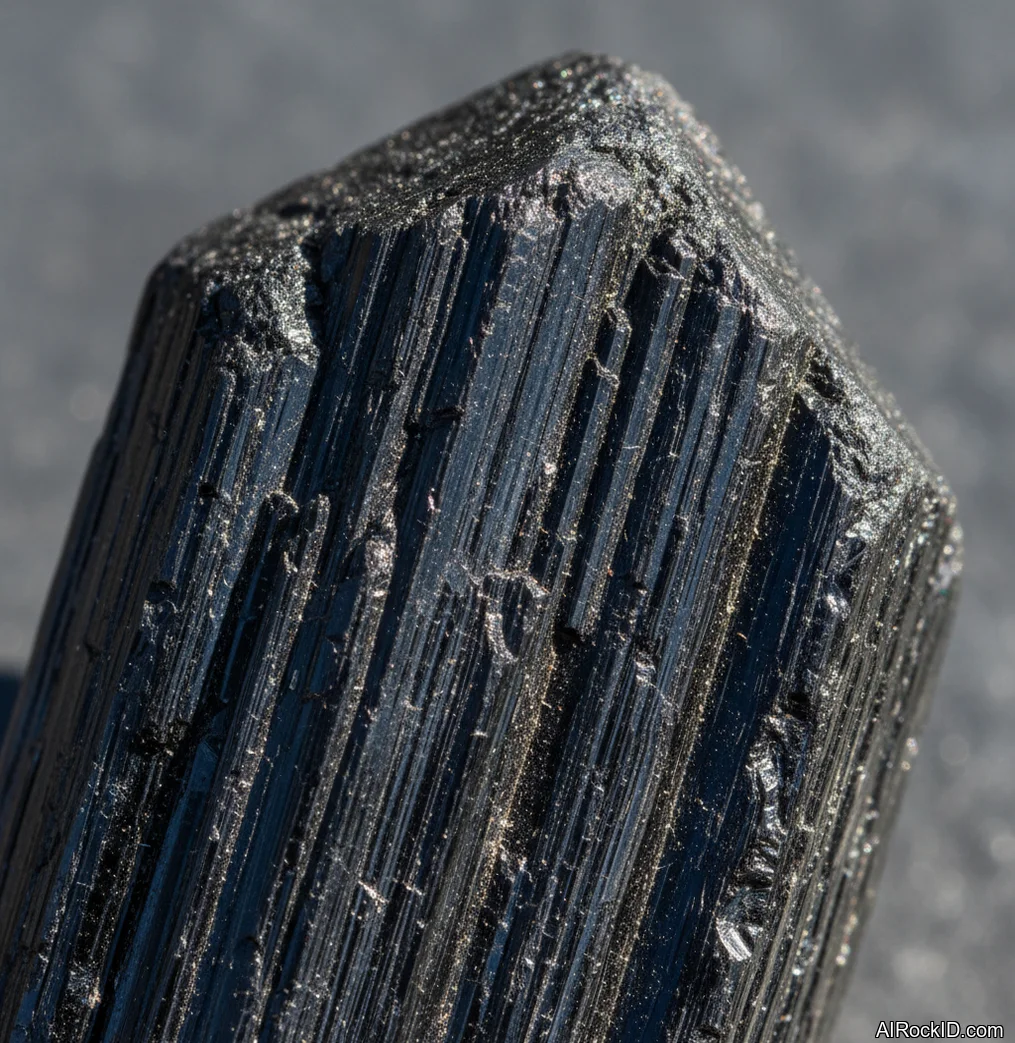
- Black Tourmaline: Black tourmaline usually forms striated prismatic crystals, while black kyanite commonly forms thin fan-like blades.
- Stibnite: Stibnite has a metallic lead-gray luster and is much softer; black kyanite is typically nonmetallic to vitreous and bladed.
- Actinolite: Actinolite may be fibrous or needle-like green to black, while black kyanite tends to show flatter, wider blades.
- Graphite: Graphite is very soft and leaves a dark mark, unlike kyanite, which has directional hardness and does not behave like pencil lead.
Black Kyanite vs Similar Black Minerals
| Specimen | Typical Habit | Key Difference |
|---|---|---|
| Black kyanite | Flat blades or fan sprays | Directional hardness; splintery bladed crystals |
| Black tourmaline | Striated prisms | More columnar and often triangular in cross-section |
| Stibnite | Metallic needles or blades | Metallic luster and much softer |
| Graphite | Massive, flaky, or earthy | Marks paper and feels greasy |
| Obsidian | Glassy chunks | No crystal blades; shell-like fracture |
AI identification confidence
AI identification confidence for black kyanite is usually stronger when the photo clearly shows fan-shaped sprays, flat blades, and nonmetallic luster. Confidence is lower for close-up dark fragments, polished pieces, or photos without scale and lighting that show the blade structure.
When AI gets it wrong
- The specimen is photographed as a dark mass with no visible individual blades.
- A polished or tumbled piece hides the natural crystal habit.
- Strong shadows make black tourmaline or actinolite look like fan-shaped kyanite.
- Metallic minerals such as stibnite are photographed without showing their reflective luster.
Final recommendation
Choose black kyanite when the specimen shows clear, natural blades or fan sprays rather than a generic black lump. For buying, prioritize photos from several angles and listings that state the locality, size, and whether the piece is natural or treated.
How to Check Black Kyanite Authenticity
Authentic black kyanite usually shows layered, splintery blades rather than a smooth glassy surface. A reliable listing should show the fan structure clearly and avoid vague labels such as “black crystal” without mineral information. Be cautious with overly uniform polished pieces, dyed fragments, or specimens sold only by metaphysical names with no mineral description.
Best Photos for Identifying Black Kyanite
Useful identification photos show the specimen from the front, side, and edge so the flat blade shape can be seen. Natural light or soft indirect light helps separate nonmetallic kyanite from metallic lookalikes. A ruler, coin, or hand for scale can help judge whether the piece is a thin spray, a broken blade, or a different black mineral.
Buying Tips for Black Kyanite Specimens
Black kyanite is commonly sold as rough sprays, loose blades, or small clusters. Intact fans with many unbroken blades usually cost more than single broken blades of similar size. Because the edges can be sharp and fragile, good packaging is important for shipped specimens.
What Is Black Kyanite?
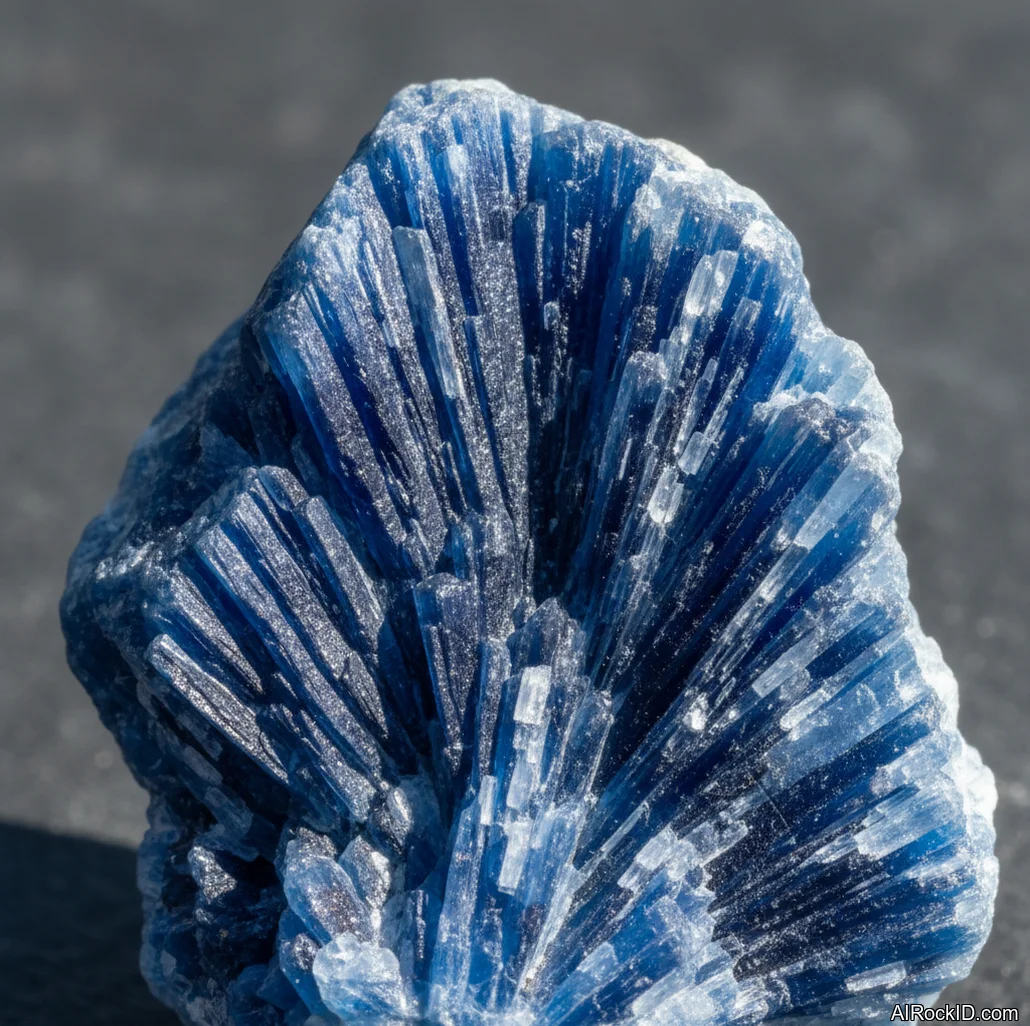
Black kyanite is the black, bladed variety of kyanite (Al2SiO5), and it often grows in those radiating “fan” sprays people talk about.
Pick up a piece and you’ll understand why it sticks in your head. It feels like a stiff little brush sitting in your palm. Thin blades snag your fingertips, and if the specimen’s a bit dusty, it can leave a tiny graphite-like smudge on your skin. The fan shapes are the classic look, sure. But you’ll also run into messy bundles and crisscrossed blades where it looks less like a neat crystal and more like a brittle black broom. Weirdly satisfying.
At first glance it just reads as “black rock.” But tilt it under a lamp and that silvery, satiny flash shows up along the blade faces. And it’s not the kind of stone you judge by polish. Most of the appeal is the raw texture, the way the blades radiate and overlap (even when the edges are chipped from being dug out of tough metamorphic host).
Origin & History
Kyanite got its formal write-up in 1789, when Abraham Gottlob Werner described it and called it “cyanite.” He pulled that name from the Greek *kyanos* (blue), since the stuff everyone knew best back then really was blue. The spelling “kyanite” settled in later. And black kyanite is basically the not-blue collector cousin you run into when the kyanite’s iron-stained or loaded up with dark inclusions (the kind that make the whole blade look smoky and sooty instead of bright).
For most of its life, kyanite has mattered way more to industry than to jewelry. Fire it, and it converts to mullite, which is what you want for high-temperature ceramics and refractories. Black kyanite doesn’t get its own special chapter in the older literature. But walk into a modern shop and it’s everywhere, mostly because those fan-like sprays are dead easy to spot and, honestly, hard to confuse with much else.
Where Is Black Kyanite Found?
Black kyanite turns up in metamorphic belts worldwide, especially in schists and gneisses that formed under high pressure. The fan sprays most collectors see are commonly sold from Brazil and the USA.
Formation
This stuff usually shows up as rough bits from metamorphic country rock. Kyanite forms when clay-rich sediments get squeezed and cooked during mountain building, at pressures high enough that aluminum and silica snap into the Al2SiO5 structure as kyanite, not andalusite or sillimanite.
And that black color? It’s usually not some separate “species” thing, it’s just hitchhikers. Iron, graphite, plus other dark inclusions can stain the blades, and those spray shapes can grow where the rock actually had a little breathing room for the blades to radiate outward as the crystal formed. If you’ve ever cracked open a kyanite-bearing schist, you know those crystals can be locked in like they’re glued, and the fan pieces people sell often have busted tips from being pried out (it happens a lot).
How to Identify Black Kyanite
Color: Most black kyanite is charcoal to deep black with silvery highlights on cleavage faces. Some pieces show dark gray bands or a slightly bluish cast in strong light.
Luster: Silky to pearly on the bladed faces, with a duller look on broken edges.
Look closely at the “fan” structure: thin blades radiating from a base is the giveaway. The real test is touch, because the blades feel sharp and fibrous and they’ll snag a cloth if you rub the edge. If you scratch it with a steel nail, it may mark in one direction but resist in another, since kyanite’s hardness changes with direction.
Common Look-Alikes
Black Kyanite is sometimes confused with these materials:
- Black tourmaline (schorl)
- Anthracite coal
- Smoky quartz (especially rough, blackened pieces)
- Stibnite (when bladed and dark)
- Dyed black kyanite (overly glossy or blue-black)
- Obsidian (in tumbled or carved forms)
Market Cautions & Treatments
When AI Can Get This Wrong
AI photo ID often gets tripped up by rough black tourmaline and stibnite—both can mimic the bladed, fan-like look in flat images. No photo app can show the gritty, almost scratchy feel or the way blades flex and break like wood shavings. If you’re unsure, try a simple scratch test: real black kyanite will leave a grayish streak on paper, while tourmaline and glass won’t budge.
Properties of Black Kyanite
Physical Properties
| Crystal System | Triclinic |
| Hardness (Mohs) | 4.5-5 parallel to length; 6.5-7 across (Medium (4-6)) |
| Density | 3.53-3.67 |
| Luster | Silky |
| Diaphaneity | Opaque |
| Fracture | Splintery |
| Streak | White |
| Magnetism | Non-magnetic |
| Colors | Black, Dark gray, Charcoal, Steel gray |
Chemical Properties
| Classification | Silicates |
| Formula | Al2SiO5 |
| Elements | Al, Si, O |
| Common Impurities | Fe, Ti, C |
Optical Properties
| Refractive Index | 1.712-1.734 |
| Birefringence | 0.012-0.020 |
| Pleochroism | Strong |
| Optical Character | Biaxial |
Black Kyanite Health & Safety
Black kyanite is usually safe to handle, and it isn’t considered toxic. The real problem is physical: those thin, knife-like blades can jab your fingers, and the edges sometimes flake off into little splinters (you’ll feel it right away).
Safety Tips
Hold fans by the base, and don’t go rubbing the blade edges hard with your bare fingers. Those edges bite, even when they don’t look sharp. And if you ever cut or grind kyanite, use dust control and wear eye protection. Dust gets everywhere fast (you’ll feel it in your throat), and it only takes one little chip to ruin your day.
Black Kyanite Value & Price
Price Range
Rough/Tumbled: $5 - $60 per piece
Price mostly comes down to size, how clean the fan is, and whether the blades are intact or all crushed up. Bigger, nicely symmetrical sprays cost more. But most of the material is pretty affordable, and it’s usually sold as raw specimens.
Durability
Nondurable — Scratch resistance: Fair, Toughness: Poor
It’s stable in normal indoor conditions, but the blades chip and shed splinters easily if it bangs around in a pocket or a crowded display tray.
How to Care for Black Kyanite
Use & Storage
Store it by itself or wrap it, because those blades chip if they knock against quartz points or other hard stuff. I keep my fans flat in a tray so nothing presses down on the tips.
Cleaning
1) Rinse quickly under lukewarm water if it’s dusty. 2) Use a soft paintbrush to coax dirt out from between blades. 3) Pat dry and let it air-dry fully before putting it back in a box or stand.
Cleanse & Charge
For metaphysical folks, smoke cleansing or sound works well since it doesn’t stress the blades. If you use moonlight, keep it off a sunny windowsill so the piece doesn’t get knocked or heat-cycled.
Placement
Set it where you won’t brush it with your sleeve, like the back of a shelf or on a stable dish. Fans look best with side lighting so the silky flash shows up.
Caution
Don’t run it through the tumbler, and don’t throw it into a mixed bowl of stones. Skip the ultrasonic cleaner, too. And go easy on the scrubbing, because those blades can split and start shedding little slivers.
Works Well With
Black Kyanite Meaning & Healing Properties
Next to glossy black stuff like obsidian, black kyanite doesn’t feel slick at all. It’s got this dry, ridged texture, and in your hand it reads more like a tool than a little worry stone you rub absentmindedly. In crystal shops, people talk it up for grounding and “clearing” energy, mostly because those blade-like strands splay out like a tiny broom.
So if you grab one in the middle of a long day, you’ll probably notice something practical before you notice anything mystical. Your grip has to change around the blades. You can’t just clamp down and forget about it, so you automatically slow down for a second. That sensation is real, and it’s likely part of why folks connect it with getting centered and cutting through mental noise. And I’ve noticed it’s the kind of piece that makes you tidy up, too, because if it’s sitting near clutter you’ll catch a blade on a charging cable or a messy stack of papers (and then, yeah, you clear a spot so it stops snagging).
None of this is medical care, and it won’t replace therapy, sleep, or a decent meal. But if you’re into ritual, black kyanite slides into a routine pretty easily: park it by the door as a “leave the day here” marker, keep it next to your journal so it nudges you to dump your thoughts on the page, tuck it somewhere you’ll actually touch it. Thing is, the market gets weird. Sellers sometimes hype it as indestructible or “never needs cleansing,” and that’s just shop talk. Physically it’s fragile, and energetically it’s whatever your practice says it is.
Common mistakes
- Identifying any black bladed crystal as black kyanite without checking luster and crystal habit.
- Confusing black tourmaline’s striated columns with kyanite’s flatter fan-like blades.
- Assuming a polished black stone is kyanite when the original blade structure is no longer visible.
- Using color alone for identification instead of habit, hardness direction, and surface texture.
- Handling thin sprays roughly; individual blades can chip or splinter.
Identify Black Kyanite from a photo
Compare Black Kyanite traits, care tips, value clues, and common lookalikes with a clear photo.