Mica Schist Identification


Quick answer: Mica schist is a foliated metamorphic rock recognized by its glittery mica flakes and layered texture. It is often identified by its platy mineral grains, moderate softness, and tendency to split along foliation planes.
How to identify mica schist
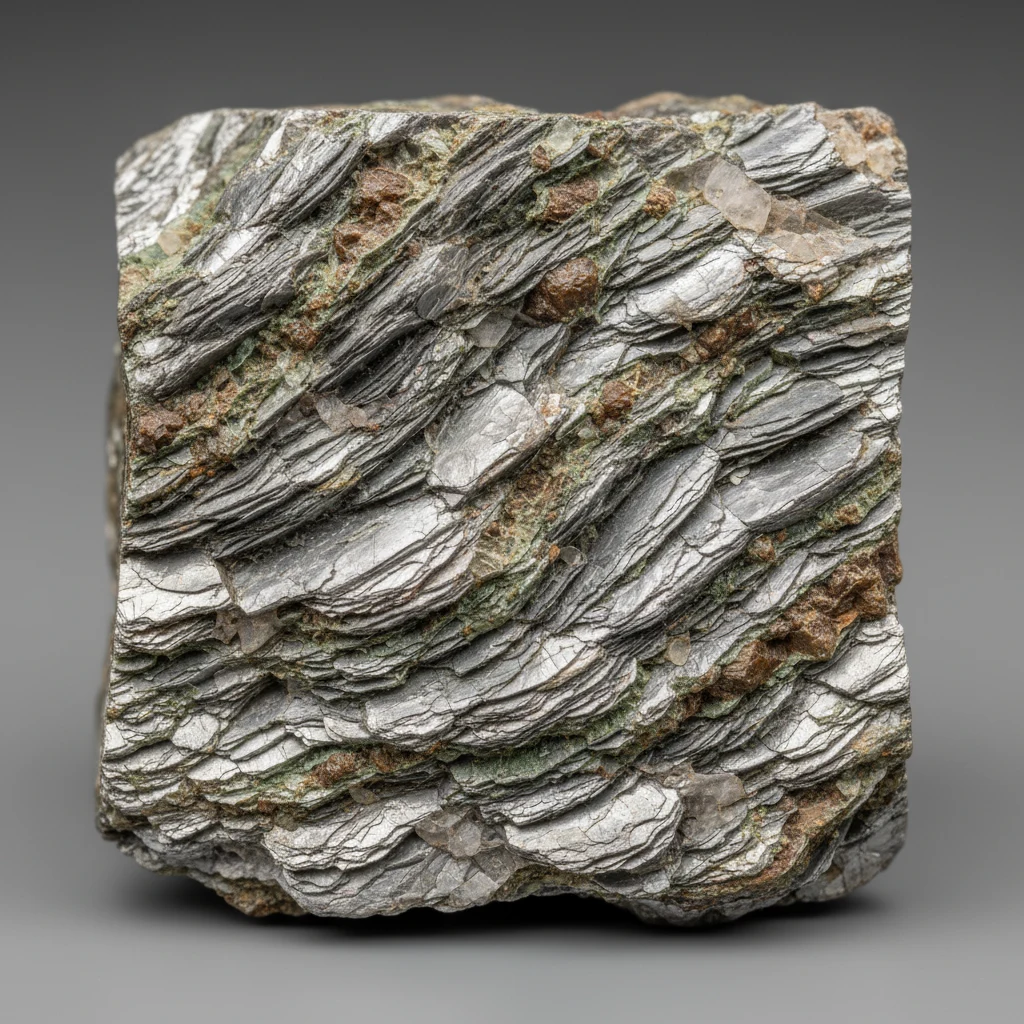
Mica schist is a medium- to coarse-grained metamorphic rock recognized by abundant, visible flakes of muscovite or biotite aligned into wavy layers. It often sparkles, splits along its schistosity and may contain quartz, feldspar, garnet or staurolite. Unlike fine-grained slate and phyllite, its mica grains are usually visible without magnification; unlike gneiss, it is dominated by platy minerals rather than distinct light and dark compositional bands.
AI Rock ID can help compare mica schist with visually similar rocks by checking foliation, mica sparkle, grain size, and overall texture. RockIdentifier.io provides photo-based identification support, but a hand sample, hardness test, and streak or scratch observations can improve confidence.
Good fit
- Collectors who want a common metamorphic rock with obvious foliation
- Students learning to recognize mica-rich rocks in geology labs
- Decorative stone users who like a sparkly, layered appearance
- Field collectors comparing schist, slate, phyllite, and gneiss
Not a good fit
- Jewelry designs that require a tough, polish-holding stone
- Outdoor use where thin layers may flake or weather quickly
- Situations where precise mineral content is needed without lab testing
Most commonly confused with
- Phyllite: Phyllite has a silky sheen and finer grains, while mica schist usually shows larger visible mica flakes.
- Slate: Slate is finer grained and splits into flatter, thinner sheets with little visible sparkle.
- Gneiss: Gneiss commonly has distinct light and dark mineral bands, while mica schist is dominated by flaky mica-rich foliation.
- Quartzite: Quartzite is much harder and granular, lacking the soft, platy mica layers typical of mica schist.
Mica Schist vs Similar Metamorphic Rocks
| Rock | Typical Texture | Key Difference | Hardness Clue |
|---|---|---|---|
| Mica schist | Coarse, sparkly, foliated | Visible mica flakes and layered cleavage | Often scratches with steel; mica flakes feel soft |
| Phyllite | Fine, silky, foliated | Sheen is smoother and grains are less visible | Generally similar but less flaky |
| Slate | Very fine, flat cleavage | Dull to slightly shiny with thin sheet splitting | Often harder-feeling and less sparkly |
| Gneiss | Banded, coarse | Light and dark mineral bands are more distinct | Variable; quartz/feldspar bands feel harder |
| Quartzite | Granular, non-foliated to weakly foliated | Sugar-like quartz grains instead of mica flakes | Harder; usually scratches glass |
AI identification confidence
AI identification confidence for mica schist is usually moderate to high when photos clearly show sparkly mica flakes, foliation, and fresh broken surfaces. Confidence drops when the image is wet, overly polished, zoomed out, or shows only a flat gray surface.
When AI gets it wrong
- Fine-grained phyllite may be labeled as mica schist if its silky sheen looks like visible mica.
- Gneiss can be mistaken for mica schist when banding is subtle or the photo is close-up.
- Weathered mica schist may lose sparkle and resemble slate or other gray metamorphic rocks.
- A single muscovite-rich surface may be identified as the mineral muscovite rather than the rock mica schist.
Final recommendation
For identification, look for visible mica flakes, layered foliation, and a tendency to split along platy surfaces. For buying or collecting, choose stable pieces with minimal crumbling if the specimen will be handled or displayed.
How to Identify Mica Schist in Photos
Good identification photos should show the rock from the side and the face so the foliation and mica sparkle are visible. Natural daylight usually shows mica flakes better than flash, which can create glare. A close-up of a fresh broken edge can help distinguish mica schist from slate, phyllite, and gneiss.
Buying and Authenticity Tips
Mica schist is common and usually not imitated, but labels may be vague when specimens contain garnet, quartz, graphite, or other minerals. A genuine mica schist specimen should show a natural layered fabric rather than a uniform cast or resin-like surface. If a piece is sold as garnet mica schist, check that the garnets are embedded in the schist rather than glued onto the surface.
Field Clues for Mica Schist
Mica schist commonly breaks along wavy, shiny layers and may shed small mica flakes when rubbed. Quartz veins or pods may cut through the rock, and accessory minerals such as garnet, staurolite, or kyanite may occur in some localities. The rock’s texture is often more useful for identification than color alone.
What Is Mica Schist?
Mica schist is a common medium-grade metamorphic rock best recognized by its shiny, flaky mica surfaces and layered texture. In hand, it often feels platy rather than blocky, with gray, green, or brown tones flashing as the mica catches the light. Its foliation is the key visual clue: the rock looks naturally stacked, as if it wants to split along thin, glittering planes.
Collectors value mica schist more for texture and geologic story than rarity. It is a rock, not a single mineral species, and its composition is variable, typically including SiO2, Al2O3, and metal oxides with Si, O, and Al listed among its elements. With Mohs hardness 3-4, fair scratch resistance, good toughness, and a density of 2.5-3.0 g/cm3, it is moderately durable but should still be handled with care around edges and flakes.
Origin & History
The name schist comes from the Greek word schizein, meaning “to split,” which describes exactly what a mica schist specimen seems ready to do along its foliated layers. The rock was first described in geological literature in the 18th century, and its name still works well in the field: a shiny, mica-rich rock that breaks or parts along aligned planes is immediately suggestive of schist.
For collectors, mica schist is a tactile history piece of heat, pressure, and movement. Its abundant mica gives it a lustrous, sometimes vitreous look, while the layered fabric records metamorphic activity. Locality and classification notes for schist and mica-bearing rocks can be compared with mindat.org when documenting a specimen, especially when a label points to a classic metamorphic region.
Where Is Mica Schist Found?
Mica schist is commonly found in regions with significant metamorphic activity. Reported countries include the United States, Canada, and Norway, with notable localities including the Appalachian Mountains in the USA, Scotland, and the Norwegian fjords. These are the kinds of settings where collectors expect layered metamorphic rocks to appear in outcrop, roadcut, or loose field material.
Formation
Mica schist forms when shale or other sedimentary rocks are changed by heat and pressure. During metamorphism, mica grains align, creating the distinct foliation that lets the rock split or part along shiny surfaces. That alignment is the signature feature: the rock is not just speckled with mica, it has mica arranged into a visible layered fabric.
This formation process gives mica schist its collector-friendly texture. The specimen may show uneven fracture where it breaks across the fabric, but along foliation it can look smoother, brighter, and more reflective. Its non-magnetic character, colorless streak, translucent diaphaneity, and weak pleochroism belong to the described physical and optical profile, while the overall look remains controlled by its mica-rich metamorphic layering.
How to Identify Mica Schist
Identify mica schist by its shiny mica flakes and strong foliation. A fresh hand specimen usually shows gray, green, or brown color with lustrous surfaces that flash when tilted. The rock’s layered texture is the most practical field mark: look for platy surfaces, aligned flakes, and a tendency to show sheet-like structure rather than a massive, uniform body.
A hardness test can help separate mica schist from similar-looking rocks, with the listed hardness at Mohs 3-4. It has vitreous luster, uneven fracture, colorless streak, and is non-magnetic. The provided crystal system is monoclinic, reflecting the mineral components rather than a single uniform crystal habit, so collectors should identify the rock by foliation, mica abundance, and shiny split surfaces first.
Properties of Mica Schist
Physical Properties
| Crystal System | Monoclinic |
| Hardness (Mohs) | 3-4 (Medium (4-6)) |
| Density | 2.5-3.0 g/cm3 |
| Luster | Vitreous |
| Diaphaneity | Translucent |
| Fracture | Uneven |
| Streak | Colorless |
| Magnetism | Non-magnetic |
| Colors | Gray, Green, Brown |
Chemical Properties
| Classification | Phyllosilicate |
| Formula | Variable, typically includes SiO2, Al2O3, and various metal oxides |
| Elements | Si, O, Al |
| Common Impurities | Fe, Mg |
Optical Properties
| Refractive Index | 1.54-1.65 |
| Birefringence | None |
| Pleochroism | Weak |
| Optical Character | Biaxial |
Mica Schist Health & Safety
There are no significant health risks associated with handling mica schist.
Mica Schist Value & Price
Price Range
Rough/Tumbled: $5 - $20 per specimen
Cut/Polished:
Price can be affected by the quality, size, and clarity of the specimen.
Durability
Moderate — Scratch resistance: Fair, Toughness: Good
Mica schist is relatively stable unless subjected to extreme conditions.
How to Care for Mica Schist
Use & Storage
Store in a cool, dry place away from direct sunlight.
Cleaning
Clean gently with a damp cloth. Avoid harsh chemicals that may damage the surface.
Cleanse & Charge
Place under moonlight or use sound to cleanse and recharge.
Placement
Best placed where you wish to enhance energy flow.
Caution
Avoid exposing to extreme temperatures to preserve integrity.
Works Well With
Mica Schist Meaning & Healing Properties
In crystal-healing practice, mica schist is used as a stone of clarity, grounding, and balance. Its layered surface gives it a natural meditative feel: holding it can draw attention to planes, reflections, and subtle shifts of light, which suits quiet focus work. It is commonly associated with communication, insight, inner peace, emotional healing, transformation, joy, confidence, and meditation.
Mica schist is linked with the Throat and Third Eye chakras, Gemini and Aquarius, the planets Mercury and Uranus, and the Earth element. It is safe to handle and safe in water, with no significant health risks noted, but it should still be cleaned gently with a damp cloth and kept away from harsh chemicals. For energetic care, place it under moonlight or use sound, then store it in a cool, dry place away from direct sunlight.
Identify Mica Schist from a photo
Compare Mica Schist traits, care tips, value clues, and common lookalikes with a clear photo.
Common mistakes
- Identifying any shiny gray metamorphic rock as mica schist without checking grain size.
- Confusing foliation with sedimentary bedding; mica schist foliation forms during metamorphism.
- Assuming all mica schist has the same mineral content; quartz, feldspar, garnet, and other minerals can vary.
- Using color alone for identification, since mica schist can appear silver, gray, brown, greenish, or black.
- Expecting mica schist to behave like a durable gemstone; many pieces split or flake along mica-rich layers.