Shark Tooth Fossil


Quick answer: A shark tooth fossil is a mineralized tooth from an extinct or ancient shark, most often preserved as apatite with colors influenced by surrounding sediments. Identification usually depends on tooth shape, serrations, root form, size, and whether the specimen shows natural wear or modern alteration.
AI Rock ID can help screen a shark tooth fossil by comparing overall tooth shape, root structure, color, and surface texture from a clear photo. RockIdentifier.io provides fossil and mineral reference information, but species-level shark tooth identification may still require measurements, locality data, and expert review.
Good fit
- Collectors who want an affordable fossil with visible biological structure
- Beginners learning to compare tooth shapes, roots, and serrations
- People interested in fossils from specific localities such as coastal deposits, rivers, or phosphate mines
- Display collections where durability is useful but sharp edges can be protected
- Buyers who can evaluate authenticity using photos, measurements, and seller locality information
Not a good fit
- Anyone expecting precise species identification from color alone
- Collections that require only gem-grade minerals or faceted stones
- Young children without supervision, because points and serrations can be sharp
- Buyers who cannot verify repairs, polishing, or composite restoration on high-priced teeth
Most commonly confused with
- Modern Shark Tooth: Modern teeth are usually white to cream and less mineral-stained, while fossils commonly show darker colors from sediment chemistry.
- Dinosaur Tooth Fossil: Dinosaur teeth often have different enamel texture and root preservation patterns; shark teeth are typically flatter with species-specific triangular or blade-like forms.
- Ray Dental Plate Fossil: Ray dental plates are broad crushing surfaces made of joined tooth elements, not single triangular cutting teeth.
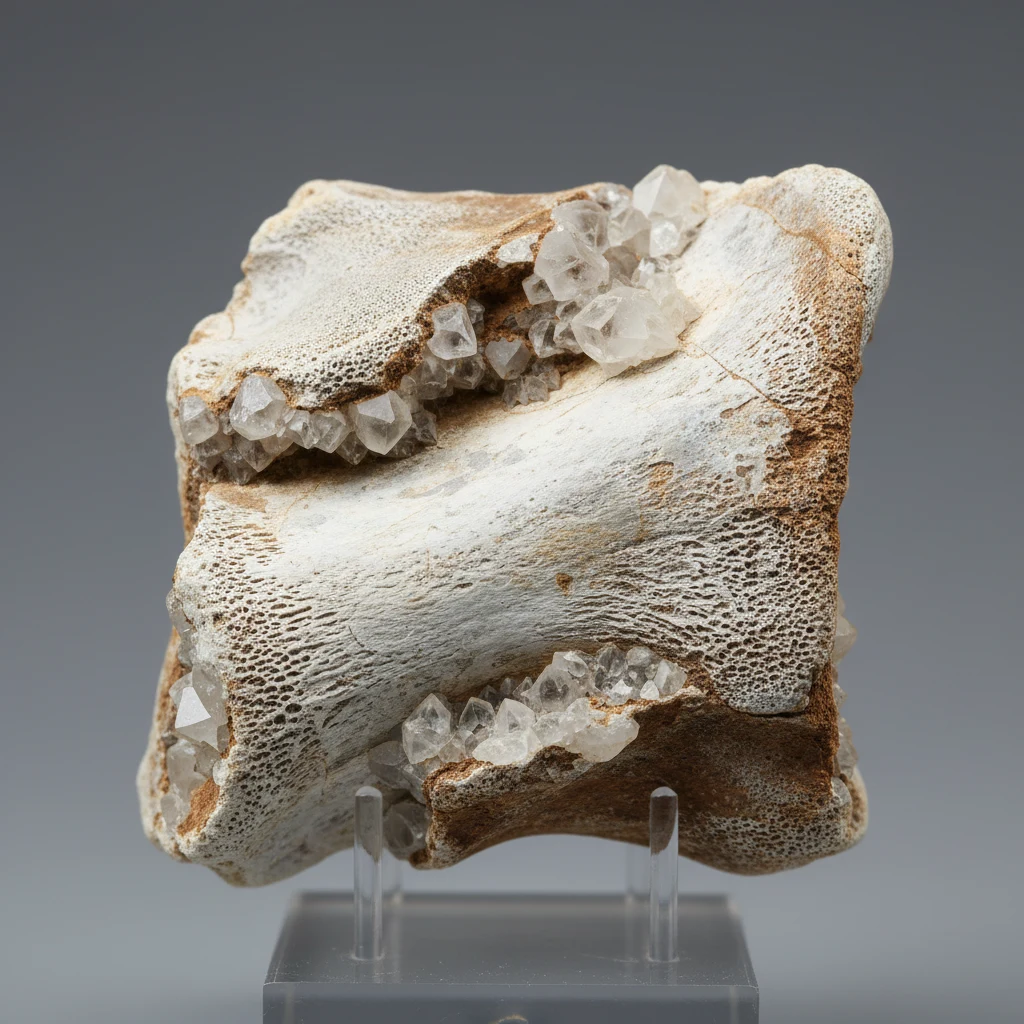
- Bone Fossil: Bone fossils usually show porous internal texture, while shark teeth have smoother enamel and a distinct root.
Shark Tooth Fossil Lookalike Comparison
| Specimen | Key Visual Clue | Main Difference |
|---|---|---|
| Shark tooth fossil | Triangular or blade-like crown with root; may have serrations | Mineralized biological tooth structure |
| Modern shark tooth | White or cream color with fresh-looking enamel | Not fully fossilized or sediment-stained |
| Ray dental plate fossil | Flat, pavement-like crushing surface | Made of fused tooth plates rather than a single pointed tooth |
| Bone fossil | Porous or spongy texture | Lacks enamel crown and tooth-root form |
| Carved or cast replica | Uniform surface, mold lines, or artificial staining | May lack natural enamel-root boundary and sediment wear |
AI identification confidence
AI identification is often useful for separating shark tooth fossils from common lookalikes when photos show the crown, root, edge, and scale. Confidence is lower for exact species, repaired specimens, heavily worn fragments, or teeth photographed without locality and size information.
When AI gets it wrong
- The photo shows only a dark triangular object without the root or enamel surface.
- The tooth has been polished, dyed, repaired, or mounted in jewelry.
- A broken bone fragment or shell piece mimics a pointed tooth shape.
- Species identification is attempted without measurements, serration detail, or collection locality.
Final recommendation
Choose a shark tooth fossil with clear photos of both sides, visible root condition, and accurate measurements. For higher-value teeth, ask for locality, repair disclosure, and close-up images of serrations, bourlette, tip, and root edges.
How to Photograph a Shark Tooth Fossil for Identification
Use natural or diffuse light and photograph the tooth on a plain background with a ruler or coin for scale. Capture the front, back, side profile, root, tip, and serrated edges if present. Avoid heavy filters or wetting the tooth, because shine can hide repairs, polish, or natural surface texture.
Authenticity Checks Before Buying
Natural shark tooth fossils often show subtle color variation, sediment staining, worn edges, and a clear transition between enamel and root. Warning signs include identical repeated shapes, mold seams, painted color in cracks, glossy artificial coatings, or vague listings for unusually expensive teeth. Large megalodon teeth and rare species should be evaluated more carefully for repaired tips, filled roots, and restored serrations.
Locality and Label Importance
A label with collection area, formation, or seller source can add scientific and collector value to a shark tooth fossil. Color alone is not a reliable locality marker, because similar black, gray, tan, or blue tones can form in different sediments. Keep any original label or receipt with the specimen to preserve provenance information.
What Is Shark Tooth Fossil?
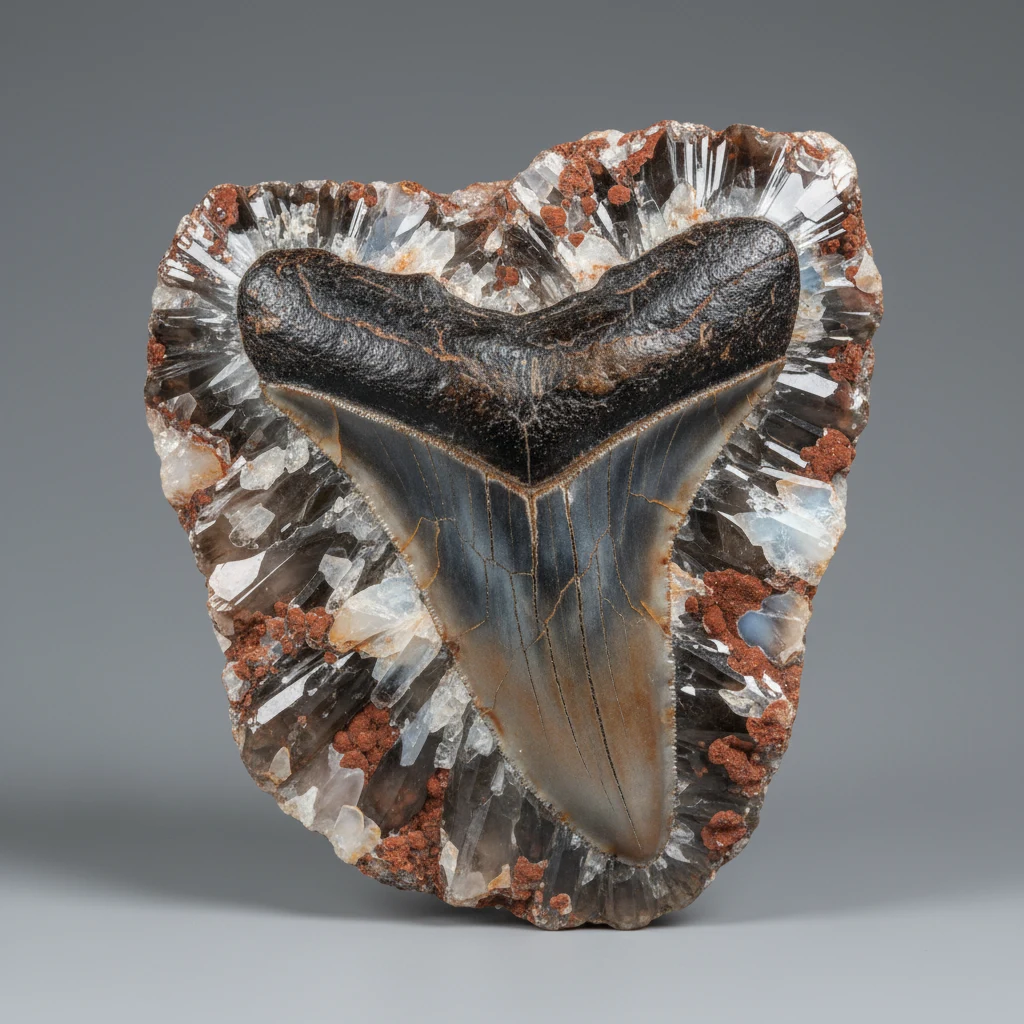
A Shark Tooth Fossil is the mineralized tooth of an ancient shark, preserved as a durable fossil rather than as bone. In the hand, a good specimen feels tooth-hard and compact, with a smoother crown and a root that is usually duller, more porous, and more earthy to the touch.
Most examples are composed chiefly of phosphate minerals in the apatite group, especially carbonate-rich fluorapatite. Their black, brown, gray, tan, cream, blue-gray, orange, or reddish-brown colors come from burial chemistry, including iron, manganese, phosphate-rich sediment, and organic deposits, not from the shark species alone.
Origin & History
Shark Tooth Fossils are abundant because sharks shed thousands of teeth during life, while their cartilage skeletons fossilize far less readily. Sharks have existed for more than 400 million years, so their teeth form one of the most familiar vertebrate fossil records collectors can actually hold, sort, label, and compare.
Collectible teeth commonly come from Cretaceous, Paleogene, Neogene, and Pleistocene marine sediments. Noted fossil sharks represented in collections include Otodus megalodon, Carcharocles/Otodus chubutensis, Carcharodon hastalis, tiger sharks, mako sharks, sand tiger sharks, and many extinct lamniform sharks; locality and age records should be kept with the specimen, as emphasized in public mineral and fossil references such as mindat.org.
Where Is Shark Tooth Fossil Found?
Shark Tooth Fossils are found worldwide in ancient marine sediments, phosphate beds, river gravels, beach deposits, and eroding coastal cliffs. Productive collecting areas are usually places where Miocene, Pliocene, Eocene, or Cretaceous marine layers are exposed directly or reworked into rivers and beaches.
Formation
A Shark Tooth Fossil forms when a naturally shed shark tooth settles into marine sediment and survives burial. The original tooth material is already rich in calcium phosphate, so most examples do not need to be replaced by silica or calcite; they remain largely phosphate-based fossil teeth.
Over time, the tooth material can recrystallize and absorb minerals from groundwater. Iron, manganese, and organic compounds can enter pores and microscopic structures, producing dark, earthy, blue-gray, orange, or mottled colors. This is why two teeth from similar sharks can look completely different if they fossilized in different sediments.
How to Identify Shark Tooth Fossil
Identify a Shark Tooth Fossil by looking for a hard, tooth-shaped object with a glossy to vitreous crown and a duller, porous root. The material is opaque, non-magnetic, and about 5 on the Mohs scale, though preservation varies; avoid streak testing because it can damage a fossil.
For species-level identification, study crown outline, serrations, root form, nutrient groove, side cusplets, curvature, and thickness. Megalodon teeth are typically broad, triangular, robust, and serrated, while sand tiger teeth are narrow with long cusps and often small side cusplets. Modern shark teeth are usually white or very light unless stained, while true fossils commonly show mineralized dark or earthy colors.
Properties of Shark Tooth Fossil
Physical Properties
| Crystal System | Biogenic microcrystalline apatite; apatite group minerals are hexagonal |
| Hardness (Mohs) | About 5 on the Mohs scale, variable with preservation (Moderate) |
| Density | Approximately 2.8-3.2 g/cm³ |
| Luster | Vitreous to waxy on crown; dull to earthy on root |
| Diaphaneity | Opaque |
| Fracture | Uneven to splintery; roots may break granular or porous |
| Streak | White to pale brown, though streak testing is not recommended for fossils |
| Magnetism | Non-magnetic |
| Colors | Black, Brown, Gray, Tan, Cream, Blue-gray, Orange, Reddish brown |
Chemical Properties
| Classification | Biogenic phosphate fossil, apatite group material |
| Formula | Primarily carbonate-rich fluorapatite, approximated as Ca5(PO4,CO3)3F with organic and trace mineral impurities |
| Elements | Calcium, Phosphorus, Oxygen, Fluorine, Carbon, Hydrogen |
| Common Impurities | Iron oxides, Manganese oxides, Silica, Calcite, Clay minerals, Organic carbon |
Optical Properties
| Refractive Index | Not normally measured for whole fossils; apatite component approximately n=1.63-1.67 |
| Birefringence | Low for apatite, approximately 0.002-0.008; not diagnostic in hand specimens |
| Pleochroism | None observed in hand specimens |
| Optical Character | Apatite component is uniaxial negative; whole fossil is opaque and not gemologically tested this way |
Shark Tooth Fossil Health & Safety
Shark tooth fossils are safe to handle, but grinding, drilling, or cutting can create phosphate and sediment dust that should not be inhaled. Some fossils may contain traces of iron, manganese, clay, or phosphate matrix, but normal collecting and display use is low risk.
Shark Tooth Fossil Value & Price
Price Range
Rough/Tumbled: Small common teeth often sell for under $1-$10 each; attractive identified teeth commonly range from $10-$100; large, complete, well-preserved megalodon teeth can range from hundreds to several thousand USD depending on size and quality.
Cut/Polished:
Value depends on species, size, completeness, sharpness of serrations, root preservation, enamel quality, repair or restoration, color, locality, scientific documentation, and legality of collection. Megalodon teeth over 5 inches with intact tips, roots, and serrations are especially desirable.
Durability
Moderate — Scratch resistance: Comparable to apatite; it can be scratched by quartz, steel tools, and abrasive sand., Toughness: Variable; crowns may be fairly solid, but roots, repaired teeth, and matrix-attached specimens can be brittle.
Generally stable in normal indoor conditions. Avoid acids, harsh chemicals, ultrasonic cleaners, and prolonged soaking, especially for fragile or repaired specimens.
How to Care for Shark Tooth Fossil
Use & Storage
Store in a padded display box, fossil case, or labeled tray. Keep large teeth supported so the root and tip are not stressed.
Cleaning
Rinse gently with clean water and use a soft toothbrush for loose sediment. Avoid vinegar, muriatic acid, bleach, ultrasonic cleaners, and aggressive scraping.
Cleanse & Charge
For metaphysical care, use dry methods such as placing near selenite, clear quartz, or natural light for a short time. Avoid saltwater soaking for fragile or repaired fossils.
Placement
Display away from edges, direct high heat, and high-traffic areas where the tip or root could be chipped.
Caution
Many shark tooth fossils are repaired, polished, restored, or artificially colored. Buy important specimens from reputable sellers who disclose restoration and locality.
Works Well With
Shark Tooth Fossil Meaning & Healing Properties
In modern crystal and fossil traditions, Shark Tooth Fossil is used as a symbol of ancient strength, survival, confidence, focus, and protection. These meanings are cultural and spiritual interpretations rather than scientific properties, but collectors often choose the tooth shape for its direct, predatory, ocean-born presence.
Metaphysically, it is commonly linked with the Root and Solar Plexus chakras, the zodiac signs Aries, Scorpio, and Capricorn, and the planets Mars and Saturn. For gentle energetic care, keep it dry and place it near selenite, clear quartz, or natural light for a short time; avoid saltwater soaking, especially if the tooth is fragile, cracked, glued, repaired, or matrix-attached.
Identify Shark Tooth Fossil from a photo
Compare Shark Tooth Fossil traits, care tips, value clues, and common lookalikes with a clear photo.
Common mistakes
- Assuming every black triangular fossil is a shark tooth.
- Using color as the main way to identify species or age.
- Ignoring repaired roots, filled chips, or restored tips on expensive specimens.
- Cleaning with acid, bleach, or abrasive tools that can damage enamel and root texture.
- Buying a high-priced tooth without size, locality, and close-up photos of both sides.
- Calling every large triangular shark tooth a megalodon without checking shape and diagnostic features.