Ammonite


Quick answer: Ammonite is a fossil, not a single mineral, and most specimens are mineralized with calcite, aragonite, pyrite, or other replacement materials. It is identified by its coiled chambered shell pattern, ribbing, and fossil structure rather than by one consistent crystal habit.
AI Rock ID can help screen an ammonite photo by checking for spiral shell geometry, chamber lines, ribbing, and surface texture. RockIdentifier.io can support visual identification, but fossil authentication may still require close inspection of matrix, repair lines, and mineral replacement.
Good fit
- Collectors who want a recognizable fossil with natural spiral geometry
- Beginners learning the difference between fossils, minerals, and shells
- Decorative display pieces where shape and preservation matter more than hardness
- Buyers comparing natural, polished, split, and iridescent ammonite specimens
Not a good fit
- Anyone needing a durable stone for daily-wear rings or bracelets
- Buyers who want every specimen to show rainbow iridescence
- Collectors seeking a single-mineral specimen with consistent gem properties
- Aquarium or terrarium use without confirming the specimen is stable and untreated
Most commonly confused with
- Ammolite: Ammolite is the iridescent gem material from certain ammonite shells, while ammonite refers to the fossil shell itself.
- Nautilus Shell: Nautilus shells are modern or recent biological shells with smoother chambers, while ammonites are extinct fossils with varied ribbing and suture patterns.
- Turritella Agate: Turritella agate contains many small fossil snail-like shells in chalcedony, not one coiled cephalopod shell.
- Orthoceras: Orthoceras fossils are straight-shelled cephalopods, while ammonites are typically coiled.
Ammonite Lookalike Comparison
| Specimen | Main Visual Clue | Key Difference |
|---|---|---|
| Ammonite | Coiled fossil shell with ribs, chambers, or sutures | Extinct cephalopod fossil; mineral content varies |
| Ammolite | Bright iridescent shell layer, often backed or stabilized | Gem-grade iridescent material from specific ammonites |
| Nautilus shell | Smooth modern shell with regular chamber partitions | Not an extinct ammonite fossil |
| Turritella agate | Many small shell fossils in chalcedony | Rock containing multiple fossils, not a single ammonite |
| Orthoceras | Long straight fossil shell | Straight cephalopod form rather than spiral |
AI identification confidence
AI identification is usually moderate to high for complete ammonite fossils because the spiral form is distinctive. Confidence drops for fragments, polished cross sections, repaired specimens, or pieces photographed without scale or surface detail.
When AI gets it wrong
- Polished ammonite halves may look like agate or decorative stone if chamber lines are unclear.
- Iridescent ammonite shell can be mistaken for ammolite without context about gem quality and stabilization.
- Fragments with ribbing may resemble shell fossils, coral, or carved stone.
- Painted, dyed, or resin-coated specimens can hide repairs and reduce visual ID accuracy.
Final recommendation
Choose ammonite by preservation quality, natural structure, and any disclosed repairs or coatings rather than by color alone. For higher-value iridescent or gem-grade material, request origin details, treatment disclosure, and clear photos of the front, back, and edges.
How to Check Ammonite Authenticity
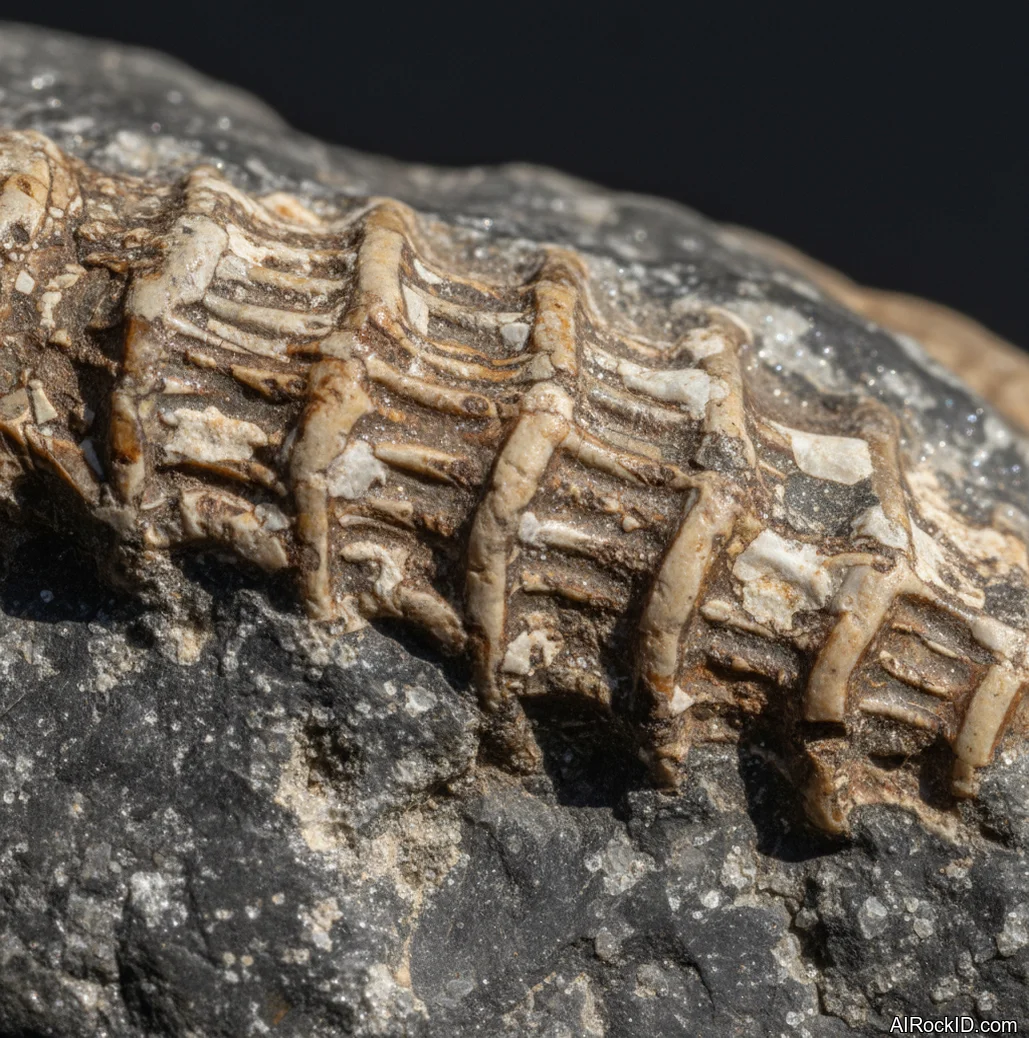
A natural ammonite should show fossil shell structure such as ribs, chamber divisions, sutures, or mineral-filled chambers. Look for filled cracks, glue lines, mismatched sections, heavy resin coatings, or carved grooves that imitate fossil detail. Repairs are common in fossil specimens and are not always a problem when clearly disclosed.
Natural, Polished, and Split Ammonite Forms
Natural ammonites keep more of the outer shell texture and are useful for studying ribbing and suture patterns. Polished or split ammonites reveal internal chambers that may be filled with calcite, aragonite, chalcedony, or other minerals. A polished finish can improve visibility but may also make repairs or added coatings harder to notice.
Buying Iridescent Ammonite
Iridescent ammonite should be evaluated for color coverage, shell stability, thickness, and whether it has been backed or stabilized. Ammolite-quality material is a narrower category than ordinary ammonite and is often sold with treatment or origin information. Strong iridescence on only a thin surface layer can be fragile if not protected.
What Is Ammonite?
An ammonite is a fossil shell from an extinct marine cephalopod. Most of the time it’s preserved as calcite or aragonite, and sometimes the original material gets swapped out and you end up with silica or pyrite instead.
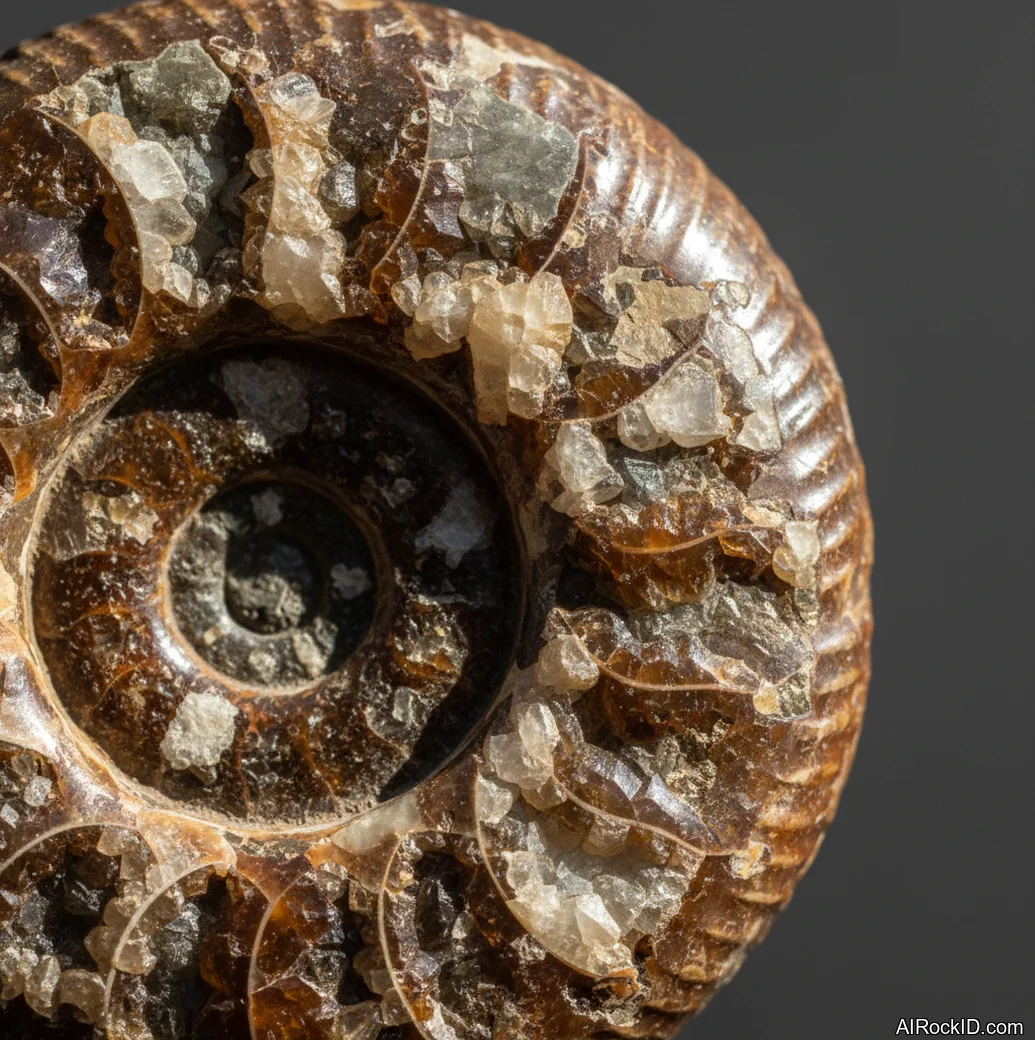
Most of the ones people actually sell are cut and polished so the spiral shows up clearly, like a clean cinnamon-roll shape. The chamber walls show as thin lines, and up close they look like tiny ribs or even stitching. And when you pick one up, the first thing you register is the weight. A palm-sized ammonite can feel weirdly heavy because you’re not holding a shell anymore. You’re holding stone.
From across the room they can all look kind of the same, but that falls apart once you’ve handled a pile of them. Some have that warm caramel-brown “classic fossil” look. Some are jet black with bright chamber lines. And every so often you’ll get one that flashes rainbow colors because the original nacre survived (that’s what gets sold as ammolite, especially from Canada). Thing is, there’s a catch. A lot of what’s out there is composite work. You’ll see halves glued onto a backing. You’ll spot repaired cracks filled with resin (sometimes you can feel it with a fingernail if you catch the edge). And you’ll run into those “full spirals” that are really two halves pieced together. That stuff isn’t automatically bad. You just want to know what you’re buying, right?
Compared to a quartz crystal, ammonite doesn’t feel glassy. It feels more like a polished limestone pebble, or like a shell that’s literally turned to rock. Smooth. Sometimes a little waxy if the polish is heavy. But if it’s a pyritized specimen, it’s a whole different animal: cold, metallic, and it kicks light back at you like a mirror when you tilt it under a shop lamp.
Origin & History
“Ammonite” comes from Ammon, the Egyptian god who’s usually shown with ram’s horns. People looked at those tight, coiled spirals and basically went, “Yep, that’s it.” The name shows up in European writing well before modern geology was a thing. But the idea that ammonites were fossils from extinct animals didn’t really lock in until the late 1700s and early 1800s, right as paleontology started taking shape.
Collectors are into them for more than the obvious spiral beauty. Ammonites turned into key index fossils, meaning certain species line up with specific slices of geologic time. So museum people will genuinely light up over a particular whorl pattern or the way a suture line zigzags when you tilt the piece under a lamp and the grooves catch the light. In a dealer’s tray, though, most of them are there to look good. Polished pairs, bookends, and cross-sections you can stare at for way too long (and still spot something new).
Where Is Ammonite Found?
Ammonites are found worldwide in marine sedimentary rocks, with big commercial supplies coming from Madagascar and Morocco and gem iridescent material best known from Alberta, Canada.
Formation
Most ammonites lived in ancient seas, and what they left us are those familiar coiled shells with little internal chambers tucked inside. Once the animal gets buried under muds and sands, groundwater chemistry is what really takes over, and it can take millions of years to do its thing: the shell material might stay as aragonite, it might recrystallize to calcite, or it can be replaced by silica. And sometimes the empty spaces in the chambers don’t stay empty at all, they fill in with calcite, quartz, or even pyrite.
If you’ve ever held a polished cross-section up to the light, you can literally see the whole fossilization story right there on the cut face (you can feel that slick, glassy polish under your thumb, too). Those thin chamber lines you’re looking at are the old internal walls. In some specimens, different minerals fill different chambers, like somebody poured them in at different times, and you get that clear “layered” look from one pocket to the next. But the preservation can be finicky. Pressure can crack the shell, later minerals can stain it, and once a spiral’s chipped or cloudy, you can’t unsee it. So, yeah, clean, unbroken spirals cost more, even when the ammonite itself isn’t rare.
How to Identify Ammonite
Color: Most ammonite fossils are brown, tan, gray, or black, often with lighter chamber lines; gem-quality iridescent shell can show green, red, and blue flashes. Pyritized ammonites are brassy gold with a metallic look.
Luster: Polished pieces range from waxy to vitreous, while pyritized material is metallic.
Pick up a piece and feel the temperature. Real stone-fossil ammonite stays cool in your hand, while resin casts warm up fast. The real test is the chamber detail: natural chamber walls look crisp and slightly uneven, not perfectly repeated like a mold. But don’t get fooled by shine. Heavy lacquer can make a beat-up specimen look “wet” and perfect. If you can, look at the back and edges for glue lines, black backing, or a seam where two halves were married together.
Common Look-Alikes
Ammonite is sometimes confused with these materials:
- Orthoceras fossil slabs
- Chambered nautilus shell (modern)
- Resin-cast ammonite replicas
- Dyed or stabilized ammonite (bright blues, greens)
- Pyrite ammonite fakes from Morocco
- Glass or ceramic spiral imitations
Market Cautions & Treatments
When AI Can Get This Wrong
AI photo tools often mix up ammonite fossils with orthoceras or modern chambered shells, especially if the spiral is partly hidden. They also get tripped up by resin or glass fakes with too-perfect patterns. The best real-world test is weight and temperature in the hand—real ammonite stays cool, while resin feels off. Under a loupe, chamber walls in real ammonite look sharp and ribbed, not fuzzy or slick.
Properties of Ammonite
Physical Properties
| Crystal System | Amorphous |
| Hardness (Mohs) | 3 (calcite) to 3.5-4 (aragonite); up to 7 if silicified (Soft (2-4)) |
| Density | 2.70-2.95 g/cm3 |
| Luster | Waxy |
| Diaphaneity | Opaque |
| Fracture | Uneven |
| Streak | white |
| Magnetism | Non-magnetic |
| Colors | brown, tan, gray, black, cream, iridescent green, iridescent red, iridescent blue, brassy gold (pyritized) |
Chemical Properties
| Classification | Carbonates (commonly calcite or aragonite); may be silicified or pyritized |
| Formula | CaCO3 (common preserved mineral phase) |
| Elements | Ca, C, O |
| Common Impurities | Fe, Mn, Mg |
Optical Properties
| Refractive Index | 1.49-1.68 (varies with mineral phase; calcite ~1.49-1.66, aragonite ~1.53-1.68) |
| Birefringence | 0.154 (calcite) to 0.156 (aragonite) |
| Pleochroism | None |
| Optical Character | Biaxial |
Ammonite Health & Safety
Handling ammonite is usually safe. But the thin, fragile edges can chip if you bump them, and that shiny polished coating scratches fast, like when it rubs against grit on a countertop. So skip acids and harsh cleaners since they can etch calcite-based fossils.
Safety Tips
If you’re going to cut or sand, put on eye protection and a respirator. And don’t just let the dust fly everywhere. Use wet methods to keep dust down (a little water goes a long way).
Ammonite Value & Price
Price Range
Rough/Tumbled: $10 - $250 per piece (common polished fossils); $300 - $3,000+ for high-grade ammolite or large display specimens
Bigger pieces cost more. So do ones where the spiral is actually complete and the chambers read clean instead of looking muddy. You can see it right away when you tilt it under a light and the internal walls snap into focus (or they don’t). Thing is, for ammolite-grade material, the iridescent shell color coverage is a huge deal, and it’s not just about how flashy it looks. Stability matters too. If the color shifts, flakes, or looks like it’s going to lift when you handle it, that hits the value fast.
Durability
Nondurable — Scratch resistance: Fair, Toughness: Poor
Ammonite is often calcite or aragonite, so it can scratch and chip easily and can be damaged by acids, heat, or very dry conditions.
How to Care for Ammonite
Use & Storage
Store ammonite where it won’t bang into harder stones, because calcite-based fossils scratch fast. I keep mine in a padded flat, not standing on edge where a small tip-over turns into a chip.
Cleaning
1) Dust with a soft brush or microfiber cloth. 2) If needed, wipe with lukewarm water and a drop of mild soap. 3) Rinse quickly and dry right away; do not soak, and avoid vinegar or any acidic cleaner.
Cleanse & Charge
If you do energy-style cleansing, smoke, sound, or a quick pass on a selenite plate are gentle options. Skip salt water or anything acidic, especially on calcite or aragonite shells.
Placement
Put it somewhere stable, like a shelf with a lip, because a fall is the usual cause of damage. Indirect light is fine, but I wouldn’t bake it in a sunny window if it has a coating or delicate iridescence.
Caution
Skip acids, ultrasonic cleaners, steam cleaners, and any long dunk in water. That stuff can knock the shine down fast and even bite into carbonate material, leaving a faint etched look you can feel with a fingernail. And with pyritized ammonites, use dry hands. Seriously. If you spot any powdery oxidation (that dusty, crumbly film that shows up in little patches), keep the piece out of humidity and don’t let it sit around in a damp room.
Works Well With
Ammonite Meaning & Healing Properties
Pick up an ammonite and you feel it immediately. It’s heavy in your palm, cool at first, and that spiral kind of yanks your attention inward so you slow down without trying. After a show, when I’m sorting trays and everything’s a mess of labels and little baggies, I’ll leave one sitting on the table just to look at between customers. It helps. Simple as that.
A lot of folks who are into metaphysical stuff connect ammonite with cycles, time, and steady change. And yeah, I can see it. You can run your thumb along the whorls and it turns into this built-in focus drill, like a worry stone that already knows where your fingers want to go. But it’s still a fossil, not a prescription, you know? If anxiety or sleep is what you’re wrestling with, use it as a tactile anchor, not as a stand-in for actual help.
One practical thing from handling a ton of these (and packing them, and unwrapping them, and getting dust under my nails): the super flashy “ammolite” pieces are usually a thin layer of shell on a backing, then sealed under a clear cap. They’re gorgeous, but they’re touchy. If you want something you can actually hold and fidget with, a thicker Madagascar polished ammonite tends to handle day-to-day contact better, even if it doesn’t kick out that neon color.
Common mistakes
- Assuming all ammonite is ammolite; only some ammonite shell produces gem-grade iridescent ammolite.
- Judging authenticity by weight alone, since mineral replacement and matrix can vary widely.
- Ignoring repair lines; many fossil ammonites have restoration, but undisclosed repairs affect value.
- Cleaning with acids or harsh chemicals, which can damage calcite, aragonite, shell layers, or coatings.
- Expecting every ammonite to show visible chambers; some specimens preserve mainly the outer shell surface.
- Buying brightly colored pieces without checking whether color comes from natural iridescence, dye, paint, or coating.
Identify Ammonite from a photo
Compare Ammonite traits, care tips, value clues, and common lookalikes with a clear photo.