Tourmaline (specifically Elbaite)


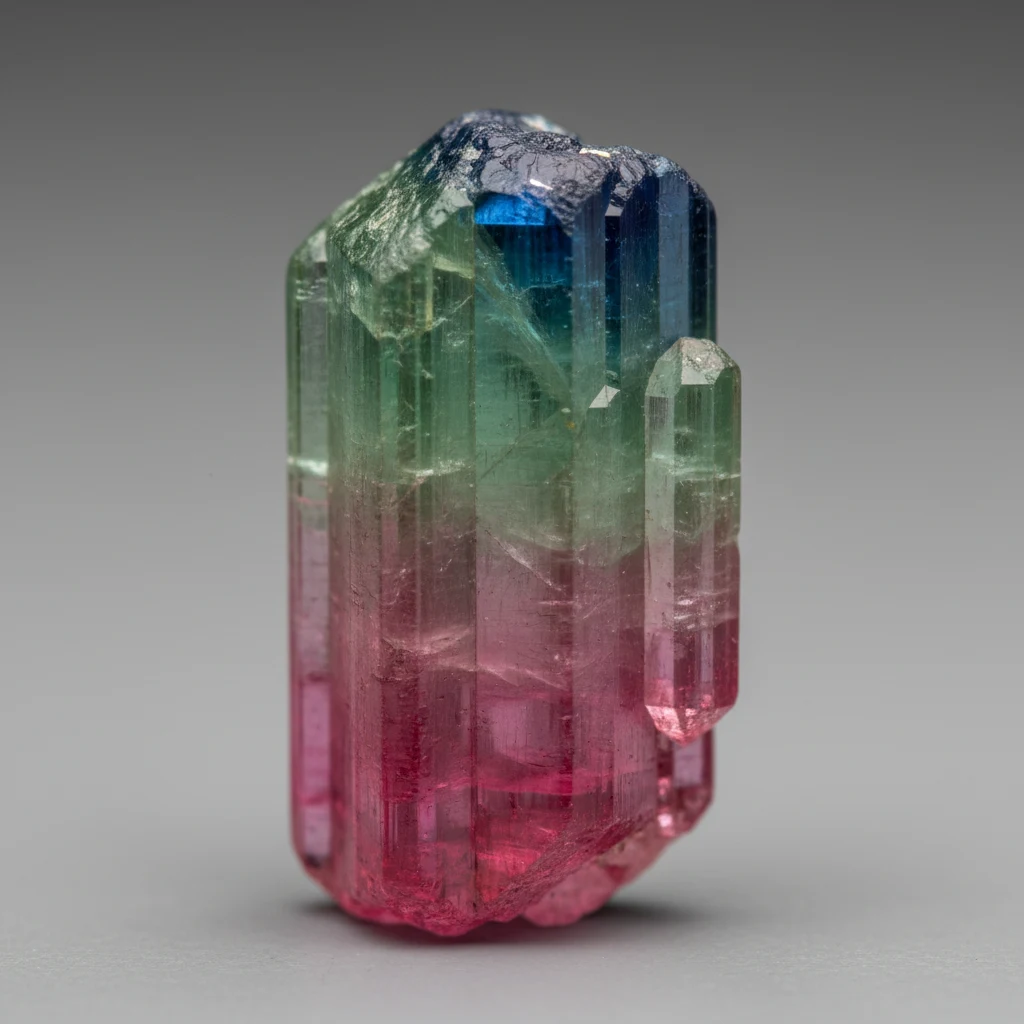
Quick answer: Elbaite is the gem-quality, lithium-rich member of the tourmaline group, known for pink, green, blue, multicolor, and watermelon zoning. It is usually identifiable by its prismatic crystal habit, lengthwise striations, strong color zoning, and Mohs hardness of about 7 to 7.5.
AI Rock ID can help screen a suspected elbaite specimen by checking visible traits such as crystal shape, color zoning, surface striations, and transparency. RockIdentifier.io provides visual identification support, but lab testing is recommended for high-value gems or unusual colors.
Good fit
- Collectors who want naturally colorful crystals with strong zoning
- Jewelry buyers looking for a durable gem for rings, pendants, or earrings
- Beginners comparing pink, green, blue, or watermelon tourmaline varieties
- Specimen collectors interested in pegmatite minerals and striated crystals
Not a good fit
- Buyers who need a low-cost alternative to colored quartz or glass
- Situations where a gem must be identified from color alone
- Collectors who prefer minerals that rarely receive treatments or enhancements
Most commonly confused with
- Rubellite: Rubellite is the pink to red trade variety of elbaite, so it is not a separate mineral species.
- Indicolite: Indicolite is the blue variety of elbaite and may overlap with blue-green tourmaline colors.
- Quartz: Quartz lacks tourmaline’s typical triangular cross-section, strong vertical striations, and complex color zoning.
- Beryl: Beryl forms hexagonal crystals and has different optical properties from trigonal tourmaline.
Elbaite vs. Common Lookalikes
| Feature | Elbaite Tourmaline | Common Lookalike |
|---|---|---|
| Crystal habit | Prismatic, often triangular cross-section | Quartz and beryl commonly show hexagonal habits |
| Surface texture | Lengthwise striations are common | Glass is usually smooth; quartz may have different growth markings |
| Color pattern | Strong zoning and multicolor bands can occur | Dyed stones or glass may show color concentrated in cracks or overly even color |
| Hardness | Mohs 7–7.5 | Glass is softer; quartz is about Mohs 7 |
| Best confirmation | Refractive index, specific gravity, and spectroscopy | Visual checks alone may be inconclusive |
AI identification confidence
AI identification confidence is usually higher for elbaite crystals that show clear prismatic form, vertical striations, and natural color zoning. Confidence is lower for faceted stones, tumbled pieces, single-color fragments, or photos with poor lighting because many gems can share similar colors.
When AI gets it wrong
- A faceted pink or green gem is shown without inclusions, scale, or crystal faces
- The specimen is backlit or oversaturated, hiding surface texture and zoning
- Dyed quartz, glass, or synthetic material imitates tourmaline color
- A different tourmaline species looks visually similar to elbaite
Final recommendation
For collecting, choose elbaite with clear natural zoning, intact crystal faces, and documented locality when available. For jewelry or high-value purchases, request gemological testing or a reputable report because color and appearance alone do not prove identity or treatment status.
How to Check Authenticity Before Buying
Authentic elbaite should be evaluated by more than color because many pink, green, and blue materials can look similar in photos. Look for natural growth features such as lengthwise striations, color zoning, mineral inclusions, and a consistent prismatic habit in crystal specimens. For cut gems, ask whether the stone is natural, treated, or assembled, and request refractive index or gem lab documentation for expensive pieces.
Photo Tips for More Accurate Identification
Photograph elbaite in daylight or neutral white light, and include views of the crystal termination, side striations, and any color zoning. Add a ruler, coin, or hand for scale, and avoid heavy filters that change pink, green, or blue tones. For faceted stones, include close photos from the table, side, and pavilion because inclusions and pleochroism can affect identification.
Treatments and Trade Names to Know
Some elbaite gems may be heated or irradiated to improve or modify color, and disclosure standards can vary by seller and market. Trade names such as rubellite, indicolite, verdelite, and watermelon tourmaline describe color varieties rather than separate mineral species. A trade name should not replace mineral identification, treatment disclosure, or quality grading.
What Is Tourmaline (specifically Elbaite)?
Tourmaline (specifically Elbaite) is the colorful, lithium-bearing variety of tourmaline known for bright pink, green, blue, and zoned crystals. In the hand, a good Elbaite specimen often feels like a clean little prism: elongated, glassy, and visually alive as the color shifts along the crystal. Collector names such as Rubellite, Indicolite, and Watermelon Tourmaline refer to familiar color expressions within this Elbaite group.
As a semi-precious gemstone, Elbaite combines strong visual appeal with practical durability. Its Mohs hardness is 7–7.5, with good scratch resistance and good toughness, so it suits both cabinet specimens and cut stones when cared for properly. It is transparent to translucent, non-magnetic, white-streaked, and typically shows a vitreous luster over conchoidal fractures.
Origin & History
Elbaite takes its name from the island of Elba in Italy, where it was first described in the 19th century. That origin story is still useful to collectors because the name separates this colorful tourmaline variety from the broader tourmaline family. In a tray of mixed crystals, Elbaite is the one many people reach for first because the color can be vivid, zoned, and gemmy in a single prismatic piece.
Mineralogically, Elbaite is a cyclo-silicate with the formula Na(Li,Al)3Al6(BO3)3Si6O18(OH)4, and it may contain common impurities such as Fe and Mn. For locality and mineral-name checking, collectors often compare labels with mindat.org while keeping the specimen’s visual clues—prismatic habit, vitreous luster, and color zoning—front and center.
Where Is Tourmaline (specifically Elbaite) Found?
Tourmaline (specifically Elbaite) is found in Brazil, the USA, and Nigeria, with notable localities including Minas Gerais, Brazil; Maine, USA; and Maharashtra, India. It is commonly found in granitic pegmatites, so the best specimens often come out as elongated crystals with enough room to show clean faces, strong color, and transparent to translucent zones.
Formation
Tourmaline (specifically Elbaite) forms in granite pegmatites through crystallization from a fluid-rich environment. That setting helps explain why specimens can grow as elongated prismatic crystals and why a single piece may carry more than one color. When the crystal has enough open space and the chemistry shifts during growth, the finished specimen can show the prized zoning collectors associate with Elbaite.
Its physical identity fits that pegmatite-grown look: trigonal crystal system, vitreous luster, transparent to translucent diaphaneity, and a density of 3.0–3.2 g/cm3. Elbaite is stable under normal conditions, but it can be sensitive to acids, so field grime should be removed gently rather than aggressively. A soft cloth, mild soap, and water are the safe practical approach.
How to Identify Tourmaline (specifically Elbaite)
Identify Tourmaline (specifically Elbaite) by looking first for elongated prismatic crystals, vitreous luster, and strong color in pink, green, blue, or zoned combinations. The best quick field clue is the way color can change along the crystal, especially in pieces sold as Rubellite, Indicolite, or Watermelon Tourmaline. A white streak, non-magnetic response, and transparent to translucent body support the identification.
For confirmation, use its physical and optical profile rather than color alone. Elbaite has Mohs hardness 7–7.5, conchoidal fracture, trigonal structure, refractive index 1.61–1.65, birefringence of 0.010, strong pleochroism, and uniaxial optical character. Because it is durable but not invincible, avoid harsh chemicals, acids, and high heat while testing or cleaning.
Properties of Tourmaline (specifically Elbaite)
Physical Properties
| Crystal System | Trigonal |
| Hardness (Mohs) | 7-7.5 (Hard (6-7.5)) |
| Density | 3.0-3.2 g/cm3 |
| Luster | Vitreous |
| Diaphaneity | Transparent to translucent |
| Fracture | Conchoidal |
| Streak | White |
| Magnetism | Non-magnetic |
| Colors | Pink, Green, Blue |
Chemical Properties
| Classification | Cyclo-silicate |
| Formula | Na(Li,Al)3Al6(BO3)3Si6O18(OH)4 |
| Elements | Si, O, B, Al, Na, Li |
| Common Impurities | Fe, Mn |
Optical Properties
| Refractive Index | 1.61-1.65 |
| Birefringence | 0.010 |
| Pleochroism | Strong |
| Optical Character | Uniaxial |
Tourmaline (specifically Elbaite) Health & Safety
No significant health risks associated with handling Elbaite.
Tourmaline (specifically Elbaite) Value & Price
Price Range
Rough/Tumbled: $10 - $50 per specimen
Cut/Polished: $50 - $200 per carat
Color, clarity, and size significantly affect the price.
Durability
Durable — Scratch resistance: Good, Toughness: Good
Elbaite is stable under normal conditions but can be sensitive to acids.
How to Care for Tourmaline (specifically Elbaite)
Use & Storage
Store in a soft pouch to avoid scratches.
Cleaning
Clean with mild soap and water using a soft cloth. Avoid harsh chemicals.
Cleanse & Charge
Place under moonlight or keep with cleansing crystals.
Placement
Keep in a space that promotes peace and calm.
Caution
Avoid exposure to high heat or acids.
Works Well With
Tourmaline (specifically Elbaite) Meaning & Healing Properties
In crystal healing traditions, Tourmaline (specifically Elbaite) is believed to support emotional healing, balance, protection, compassion, inner peace, and transformation. Practitioners often choose it when they want a stone that feels bright but calming: the polished or natural prism can be held during meditation, placed in a peaceful room, or kept nearby as a reminder of steadier emotional footing. These uses are spiritual practices and are not a substitute for medical treatment.
Elbaite is associated with the Heart, Throat, and Crown chakras, and with Libra, Scorpio, and Pisces. Its cultural correspondences include Venus and Neptune, plus Water and Air elements, which fits the stone’s reputation for love, intuition, stress relief, joy, and gentle communication. It pairs well with quartz, amethyst, and rose quartz, especially when the goal is calm placement, cleansing, or meditation work.
Identify Tourmaline (specifically Elbaite) from a photo
Compare Tourmaline (specifically Elbaite) traits, care tips, value clues, and common lookalikes with a clear photo.
Common mistakes
- Identifying every pink tourmaline as rubellite without considering tone, saturation, and trade usage
- Assuming watermelon color zoning proves a specimen is untreated or high value
- Using color alone to separate elbaite from quartz, beryl, glass, or other tourmaline species
- Ignoring surface striations, crystal habit, and zoning when evaluating rough specimens
- Buying expensive faceted stones without asking for treatment disclosure or gemological testing