Tuff


Quick answer: Tuff is a volcanic rock formed from compacted ash and other pyroclastic fragments. It is usually lightweight to moderately dense, may contain pumice or lithic fragments, and can resemble sandstone, limestone, or concrete depending on color and texture.
AI Rock ID can help screen tuff by checking for volcanic ash texture, fragment shapes, porosity, and possible welded patterns in a photo. RockIdentifier.io can support field-style comparison, but uncertain tuff identifications may still require location context, magnification, or a geologic test.
Good fit
- Collectors who want a common volcanic rock with visible ash or fragment textures
- Students learning to identify pyroclastic rocks and volcanic deposits
- Landscape or architectural users evaluating a lightweight natural stone
- Anyone comparing volcanic ash rock with pumice, sandstone, or limestone
Not a good fit
- People looking for a durable gemstone for rings or daily-wear jewelry
- Collectors who need a single diagnostic crystal habit or transparent mineral specimen
- Outdoor projects in freeze-thaw climates unless the specific tuff has been tested for durability
- Situations where asbestos-like fibrous minerals, silica dust, or unknown quarry sources are a concern
Most commonly confused with
- Pumice: Pumice is usually extremely vesicular and often light enough to float, while tuff is consolidated ash that may include pumice fragments.
- Sandstone: Sandstone is made of sand-sized sedimentary grains, while tuff is made mainly from volcanic ash and pyroclastic material.
- Limestone: Limestone commonly reacts with dilute acid because of calcite content, while many tuffs do not unless they contain carbonate cement.
- Rhyolite: Rhyolite is a volcanic igneous rock with fine crystalline or glassy texture, while tuff is fragmental and ash-rich.
Tuff vs. Common Lookalikes
| Material | Typical Texture | Helpful Clue | Main Difference from Tuff |
|---|---|---|---|
| Tuff | Ashy, fragmental, sometimes porous or welded | May contain pumice, lithic fragments, or flattened ash pieces | Formed from compacted volcanic ash |
| Pumice | Very vesicular and frothy | Often unusually light for its size | Usually a volcanic glass foam rather than a consolidated ash rock |
| Sandstone | Sand-sized grains, often gritty | Grains may be rounded and layered | Sedimentary origin, not pyroclastic ash |
| Limestone | Fine to fossiliferous, sometimes chalky | May fizz with dilute acid | Carbonate rock rather than volcanic ash |
| Concrete | Mixed aggregate in cement paste | May show modern debris, bubbles, or uniform man-made matrix | Artificial construction material |
AI identification confidence
AI identification of tuff is usually moderate when photos show fresh broken surfaces, ash-sized matrix, and volcanic fragments. Confidence drops when the sample is weathered, coated, cut into building stone, or photographed without scale and location context.
When AI gets it wrong
- Weathered tuff can look like sandstone, mudstone, or degraded concrete.
- Welded tuff may appear similar to rhyolite or other fine-grained volcanic rocks.
- Carbonate-cemented tuff may react with acid and be mistaken for limestone.
- Small close-up photos without scale can hide the fragmental ash texture needed for identification.
Final recommendation
Use texture, density, visible volcanic fragments, and local geology together before labeling a specimen as tuff. For buying or collecting, request clear photos of fresh surfaces and avoid claims that cannot be supported by provenance or basic rock properties.
How to Check Tuff Authenticity When Buying
Authentic tuff should show a natural fragmental texture rather than a uniform molded surface. Ask for photos of an unpolished or broken edge, because fresh surfaces can reveal ash matrix, pumice clasts, lithic fragments, or welded streaks. If the item is sold as carved stone, confirm whether it is natural tuff, reconstituted volcanic ash material, or dyed concrete.
Field Clues for Identifying Tuff
Tuff is often found near volcanic regions and may occur in layered beds, cliff-forming units, or soft road cuts. A hand lens can reveal tiny angular volcanic fragments and ash particles that are less rounded than typical beach or river sand. Fresh color may differ from weathered color, so a small broken surface is more useful than an oxidized exterior.
Welded vs. Non-Welded Tuff
Non-welded tuff is typically softer, more porous, and easier to scratch or crumble. Welded tuff forms when hot ash deposits compact and fuse, producing denser rock with flattened pumice fragments called fiamme. This difference affects durability, weight, and how closely the rock may resemble rhyolite.
What Is Tuff?
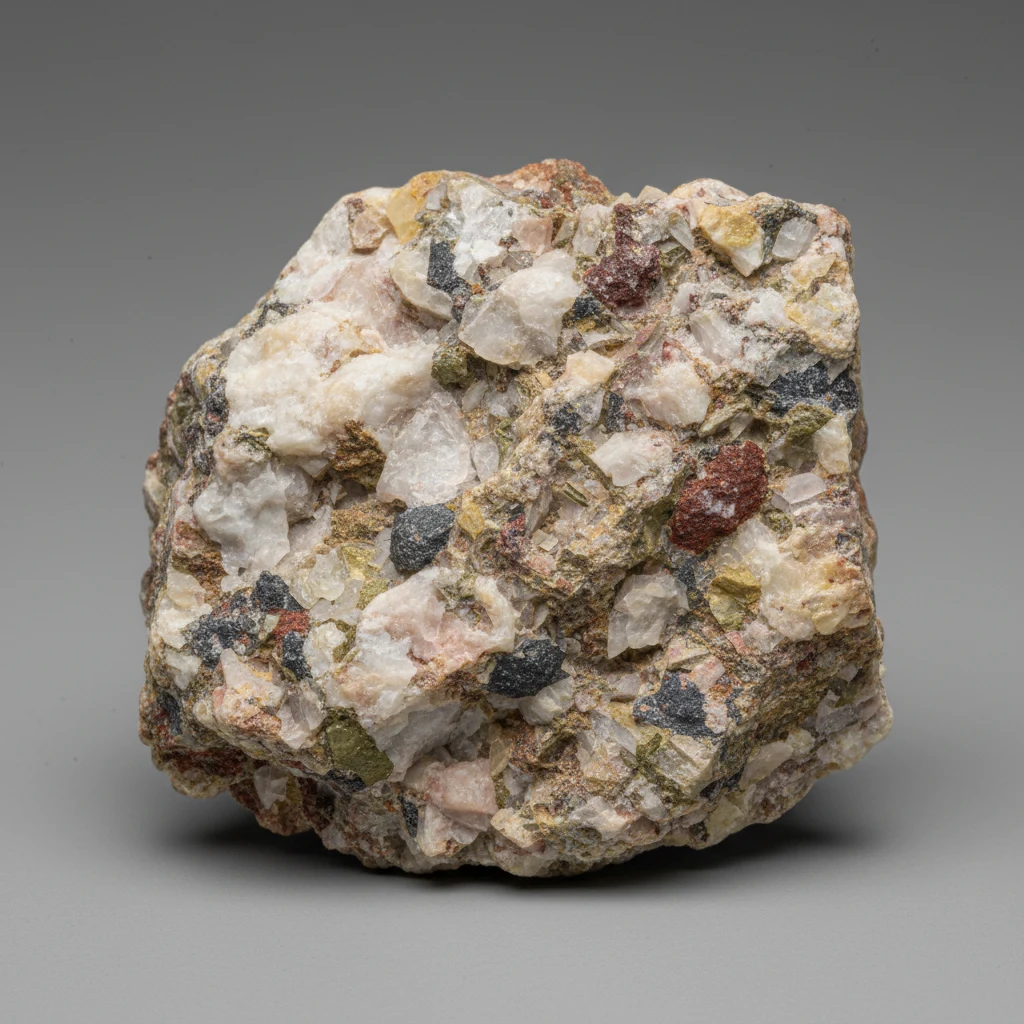
Tuff is a rock made from consolidated volcanic ash and pyroclastic fragments. In the hand, it often feels lighter and more earthy than a dense lava rock, with a fine ash-rich matrix that may hold tiny pumice bits, angular rock chips, volcanic glass, or crystal grains. Collectors also know it as volcanic tuff, ash tuff, volcanic ash rock, or, when compacted hot enough to fuse, welded tuff.
Its appearance is highly variable: white, cream, gray, tan, yellow, pink, red-brown, greenish, or dark gray. The luster is usually dull, matte, or earthy, though fresh glass-rich spots may catch tiny vitreous sparkles. Because tuff can resemble limestone, sandstone, pumice, concrete, or weathered rhyolite, its volcanic ash texture is the key feature to read first.
Origin & History
The word tuff comes from the Italian word "tufo," a name used for soft volcanic building stone around Rome and other volcanic districts. That history fits the material well: many tuffs are lightweight, workable, and available in thick volcanic ash deposits, so they have been used as construction stone since ancient times.
In geology, tuff means a rock formed from volcanic ash deposits, whether the ash was later cemented, compacted, or welded while still hot. For locality and terminology comparisons, mindat.org is a useful plain-text reference for tuff and named tuff deposits. A labeled specimen from Bishop Tuff, Bandelier Tuff, or Cappadocia carries more context than a loose, unprovenanced field piece.
Where Is Tuff Found?
Tuff is found in volcanic provinces worldwide, especially around calderas, ash-flow sheets, stratovolcanoes, and ancient volcanic arcs. Important countries include the United States, Italy, Turkey, Japan, Indonesia, New Zealand, Iceland, Mexico, Greece, and the Philippines. In the field, it commonly appears as pale to reddish beds, cliffs, or soft-weathering layers among volcanic rocks.
Formation
Tuff forms when explosive volcanic eruptions eject ash, glass shards, pumice, crystals, and lithic fragments. That material either settles from eruption columns or moves as pyroclastic density currents, then compacts and cements into rock. A fresh broken piece can look like frozen ash: fine-grained, fragment-rich, and sometimes surprisingly light for its size.
When the ash is still hot enough after deposition, glassy particles may flatten and fuse, producing welded tuff or ignimbrite. Welded pieces may show flattened pumice fragments called fiamme, which look like stretched dark streaks or flame-shaped marks. This hot-welding history is one reason tuff can range from crumbly, chalky material to tougher, denser rock.
How to Identify Tuff
Identify tuff by looking for a fine ash matrix with scattered angular fragments, pumice pieces, crystal grains, or volcanic glass. It usually has a dull, earthy, or matte surface and may feel gritty or chalky if weathered. Its hardness is variable, commonly about 3-6 on Mohs depending on welding, cement, and mineral content, so one sample may scratch easily while another resists a knife better.
Tuff differs from sandstone because it lacks consistently rounded sand grains, and it differs from limestone because it usually does not show a strong acid fizz unless carbonate cement is present. Porous samples may have a white, pale gray, or pale tan streak and a density around 1.2-2.6 g/cm³. Welded tuff can look streaky or flow-banded because flattened pumice fragments, or fiamme, have been compacted into the rock.
Properties of Tuff
Physical Properties
| Crystal System | Not applicable; tuff is a rock composed of variable mineral and glass fragments |
| Hardness (Mohs) | Variable, commonly about 3-6 on Mohs depending on welding, cement, and mineral content (Variable) |
| Density | Approximately 1.2-2.6 g/cm³; highly porous varieties are lighter, welded varieties are denser |
| Luster | Dull, earthy, matte, rarely slightly vitreous on fresh glassy surfaces |
| Diaphaneity | Opaque |
| Fracture | Uneven, earthy, granular, or blocky; welded tuff may fracture more conchoidally to splintery |
| Streak | White, pale gray, or pale tan; variable with composition |
| Magnetism | Usually non-magnetic to weakly magnetic if it contains magnetite or other iron oxides |
| Colors | white, cream, gray, tan, yellow, pink, red-brown, green, dark gray |
Chemical Properties
| Classification | Volcaniclastic igneous rock; composition ranges from rhyolitic to andesitic, dacitic, basaltic, or mixed |
| Formula | Variable; commonly dominated by silicate glass and minerals such as quartz, feldspar, volcanic glass, clay minerals, zeolites, and iron oxides |
| Elements | O, Si, Al, K, Na, Ca, Fe, Mg, Ti |
| Common Impurities | pumice fragments, lithic rock fragments, volcanic glass, clay minerals, zeolites, iron oxides, calcite cement |
Optical Properties
| Refractive Index | Not applicable as a rock; component minerals and volcanic glass vary, commonly about 1.48-1.55 for volcanic glass |
| Birefringence | Variable by mineral content; volcanic glass is isotropic, quartz and feldspar grains are birefringent |
| Pleochroism | Not applicable overall; individual minerals may show weak to strong pleochroism |
| Optical Character | Aggregate; not a single optical mineral |
Tuff Health & Safety
Tuff is generally safe to handle, but cutting, grinding, or drilling can release respirable silica-bearing dust from volcanic glass, quartz, and silicate minerals. Some tuffs may also contain natural zeolites, clays, or minor trace elements, so avoid inhaling dust and avoid using unknown tuff in drinking water or aquariums without testing.
Tuff Value & Price
Price Range
Rough/Tumbled: Common field pieces are usually inexpensive, often under $5-$20 USD; large decorative, architectural, or well-documented locality specimens may range from about $20-$100+ USD depending on size, provenance, and appearance.
Cut/Polished:
Value depends on locality, welding texture, visible pumice or lithic fragments, scientific context, use as building stone, and whether the specimen comes from a famous eruption deposit such as the Bishop Tuff, Bandelier Tuff, or Cappadocia tuffs.
Durability
Variable — Scratch resistance: Poor to moderate; soft altered tuff scratches easily, while strongly welded silica-rich tuff can be harder., Toughness: Generally fair to poor in porous or weathered pieces; compact welded tuff is tougher but may still break along ash layers or fragment-rich zones.
Stable for dry display, but porous tuff can absorb water, shed grains, or weaken if repeatedly soaked. Weathered tuff may crumble or powder with handling.
How to Care for Tuff
Use & Storage
Store dry on a stable shelf or in a labeled specimen tray. Support fragile, porous, or crumbly pieces so edges do not abrade against harder rocks.
Cleaning
Dust gently with a soft brush or compressed air. If needed, wipe briefly with a damp cloth, but avoid soaking porous or weakly cemented tuff.
Cleanse & Charge
For metaphysical use, cleanse by smoke, sound, moonlight, or placing near clear quartz rather than by prolonged water soaking.
Placement
Best for dry display, educational rock kits, volcanic geology collections, and locality-based collections. Avoid humid places if the sample is soft or shedding grains.
Caution
Do not use vinegar or acid tests except on a tiny inconspicuous spot, because carbonate cement may fizz and weathered surfaces can be damaged. Avoid tumbling or ultrasonic cleaning, which may break down porous tuff.
Works Well With
Tuff Meaning & Healing Properties
Tuff is used metaphysically as a stone of grounding, resilience, transformation, and stability. It is not a traditional gemstone; its modern meaning comes from its volcanic story, where loose ash from an explosive event becomes a coherent rock. In a display or meditation space, it has a quiet, earthy presence rather than a bright gem-like sparkle.
Practitioners often connect tuff with the Root chakra, the Fire and Earth elements, and the signs Aries and Capricorn. Because it is porous and may shed grains, it is better kept dry and cleansed by smoke, sound, moonlight, or placement near clear quartz instead of soaking. Handle intact pieces normally, but avoid inhaling dust from cutting, sanding, or drilling.
Identify Tuff from a photo
Compare Tuff traits, care tips, value clues, and common lookalikes with a clear photo.
Common mistakes
- Assuming all light volcanic rocks are pumice instead of checking whether the ash is consolidated into tuff.
- Identifying tuff from color alone, even though it can be white, gray, tan, pink, brown, or greenish.
- Confusing cut tuff building stone with concrete because both can have a pale, porous appearance.
- Ignoring local geology; tuff is more likely near volcanic ash deposits than in non-volcanic sedimentary settings.
- Using a scratch test as the only proof, since tuff hardness varies with mineral content, welding, and cementation.
- Overlooking dust precautions when cutting, grinding, or drilling silica-bearing volcanic rock.