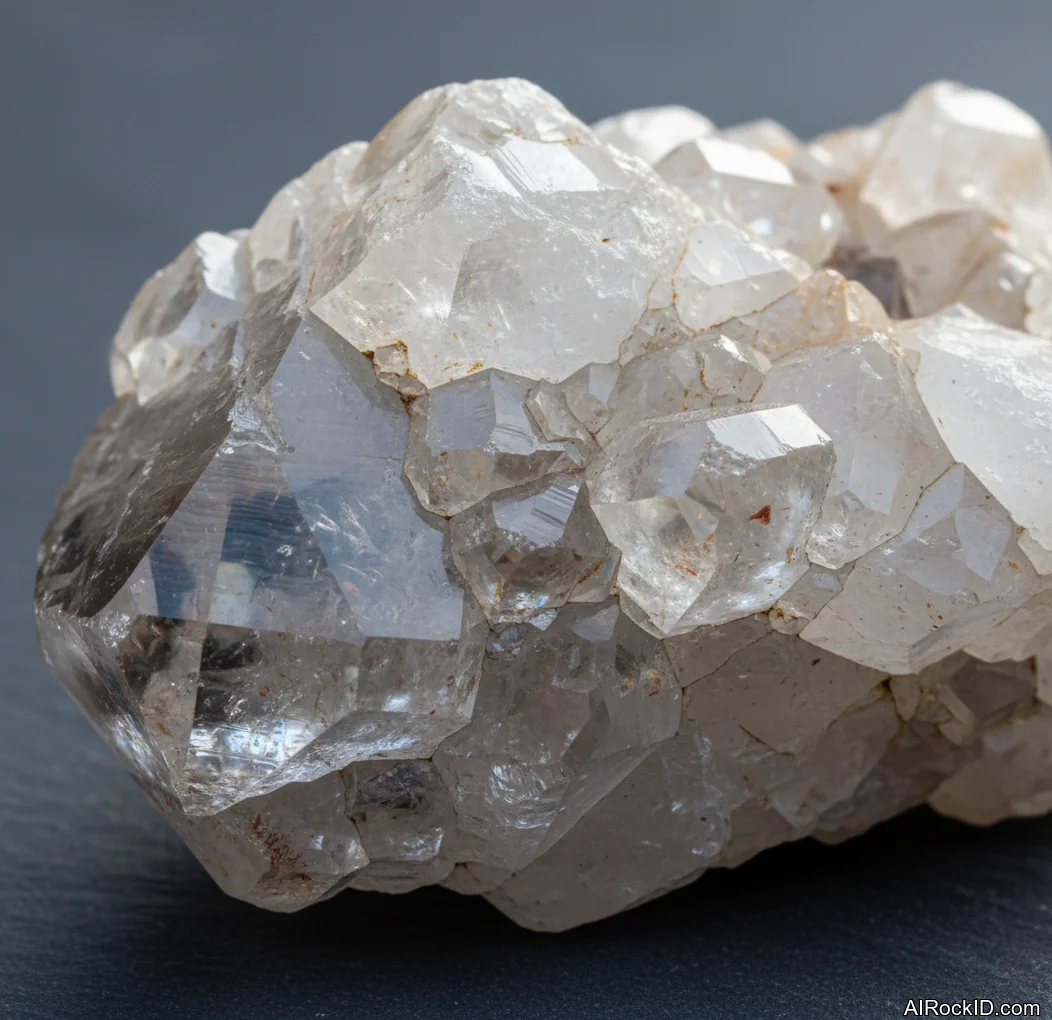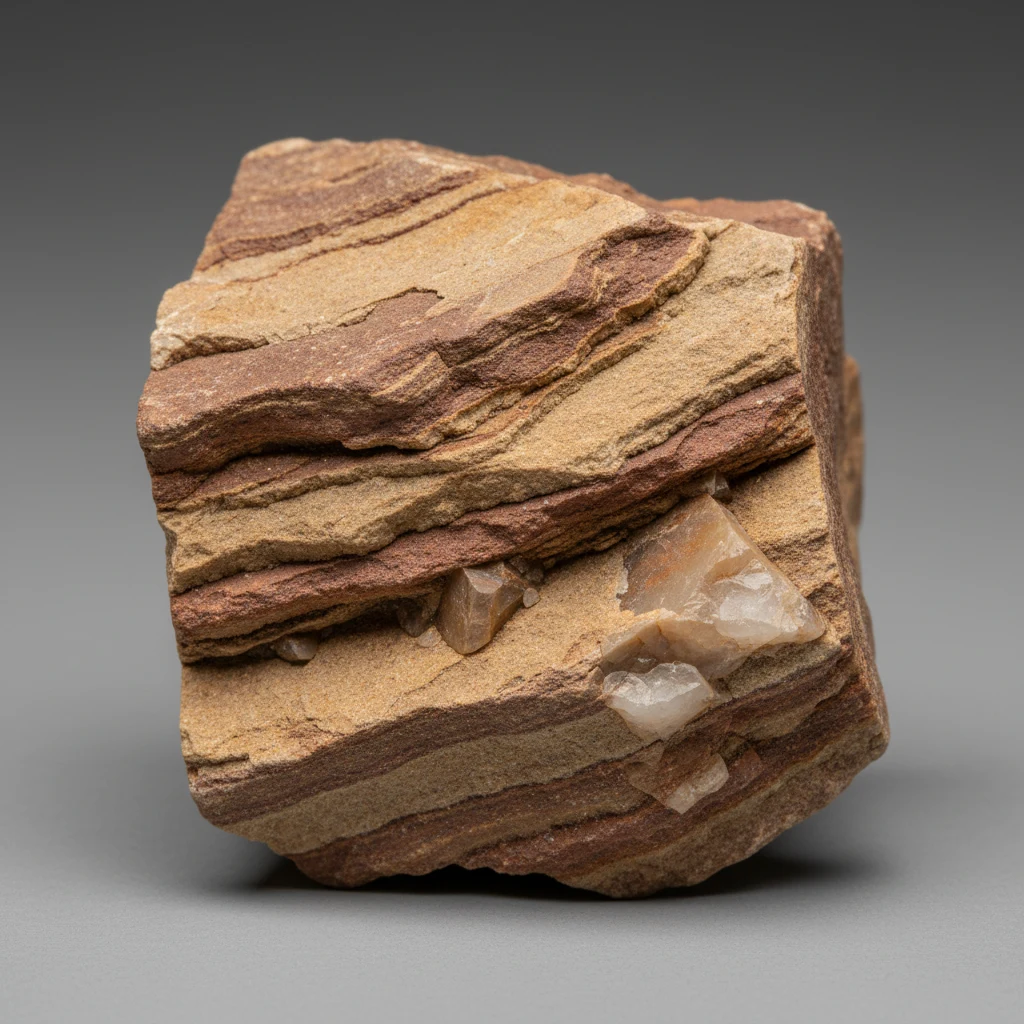
Sandstone


Quick answer: Sandstone is a clastic sedimentary rock made mostly of sand-sized mineral grains, commonly quartz and feldspar, cemented together by silica, calcite, or iron oxides. Its gritty feel, visible grains, and tan, brown, red, yellow, or gray coloring help separate it from many crystalline minerals.
AI Rock ID can help screen sandstone by checking for visible sand-sized grains, bedding, color patterns, and surface texture in a photo. RockIdentifier.io provides sandstone identification support, but unusual cement, weathering, or polished surfaces may require closer inspection.
Good fit
- Learners comparing common sedimentary rocks by grain size and texture
- Collectors who want a natural rock with visible layering or earthy colors
- Landscape, architecture, or geology discussions involving building stone
- Users trying to separate sandstone from quartzite, limestone, or concrete
Not a good fit
- People seeking a durable faceted gemstone for jewelry
- Situations where exact mineral cement identification is required without testing
- Collectors who need a rare mineral specimen rather than a common rock type
- Wet or high-wear settings where porous stone may stain, shed grains, or erode
Most commonly confused with
- Quartzite: Quartzite is metamorphosed and usually breaks across grains, while sandstone often breaks around visible sand grains.
- Limestone: Limestone is mostly calcite and may fizz with dilute acid, while most quartz-rich sandstone does not.
- Siltstone: Siltstone has finer particles and feels smoother than the gritty sand-sized texture of sandstone.
- Conglomerate: Conglomerate contains rounded pebbles larger than sand grains, while sandstone is dominated by sand-sized particles.
Sandstone Lookalike Comparison
| Material | Typical Texture | Key Difference |
|---|---|---|
| Sandstone | Gritty, sand-sized grains | Natural bedding and cemented sand grains |
| Quartzite | Hard, sugary to glassy | Metamorphic rock; grains are fused more tightly |
| Limestone | Fine to fossil-rich | Calcite-rich and commonly reacts with dilute acid |
| Siltstone | Smooth to slightly gritty | Finer grain size than sandstone |
| Concrete | Mixed aggregate in cement | Manufactured material, often with angular gravel or air bubbles |
AI identification confidence
AI identification confidence for sandstone is usually moderate to high when photos show a fresh surface with visible grains, bedding, and natural color variation. Confidence drops when the sample is polished, heavily weathered, coated with dust, or photographed too far away to show grain size.
When AI gets it wrong
- A close-up photo lacks scale, making siltstone, sandstone, and conglomerate hard to separate by grain size.
- A polished or sealed surface hides the gritty texture that normally helps identify sandstone.
- Iron staining makes several rocks appear red or brown, which can lead to confusion with other sedimentary stones.
- Concrete, mortar, or manufactured decorative stone may mimic natural sandstone in photos.
Final recommendation
For identification, prioritize texture, grain size, layering, and whether the stone appears naturally cemented rather than relying on color alone. If the rock is being bought for construction, carving, or display, ask about porosity, durability, origin, and any sealant or dye treatment.
How to Tell Natural Sandstone from Dyed or Manufactured Stone
Natural sandstone usually shows irregular grain patterns, subtle bedding, and color changes that follow the rock’s layers. Dyed sandstone may show unusually bright or even color, especially in cracks, pores, or cut edges. Manufactured stone or concrete can contain air bubbles, repeated patterns, or mixed aggregate that does not match natural bedding.
Buying Sandstone Specimens
When buying sandstone, check whether the piece is a natural specimen, a cut building stone, or a treated decorative object. Clear photos of the surface, edges, and any layering are more useful than color descriptions alone. For outdoor or water-contact use, ask whether the sandstone is porous, friable, or sealed.
Field Clues for Sandstone Identification
Sandstone commonly feels gritty because it is made of sand-sized particles. Layers, ripple marks, cross-bedding, or iron-stained bands can support a sedimentary origin. A hand lens can help show individual grains and the cement holding them together.
What Is Sandstone?
Sandstone is a common sedimentary rock made mainly of sand-sized mineral particles. In the hand, it usually feels gritty rather than glassy, with a dull, earthy surface and visible layering that makes the rock easy to recognize in field collections.
Collectors most often see sandstone in tan, red, or brown pieces, ranging from pale, light-colored slabs to warmer iron-stained tones. Its Mohs hardness is 6-7, with a density of 2.2-2.6 g/cm3, opaque diaphaneity, white streak, uneven fracture, and non-magnetic behavior.
Origin & History
The name Sandstone comes directly from what the rock is: stone made from sand-sized particles. It was first described in the early 19th century, and the plain name still suits the material well because its grainy texture is usually the first feature a collector notices.
Sandstone is classified as a sedimentary rock and a rock-type gemstone material rather than a single crystal species. For locality checking and broader reference, mindat.org is a useful plain-text source to compare named sandstone occurrences with collected specimens.
Where Is Sandstone Found?
Sandstone is found widely, especially in desert and coastal environments. The listed countries for notable sandstone material include the United States, India, and Australia, which reflects its common and broadly distributed nature.
Formation
Sandstone forms when sand accumulates and becomes cemented over time. This process commonly takes place in riverbeds or deserts, where sand-sized particles gather, compact, and turn into a coherent sedimentary rock.
Its layered look is a practical field clue to that sedimentary origin: many specimens show bands, beds, or subtle changes in tone. The rock is mainly silica, SiO2, and may include impurities such as iron and aluminum, which can contribute to tan, red, or brown colors.
How to Identify Sandstone
Identify Sandstone by its gritty texture, layered appearance, dull luster, and typical tan-to-red color range. A fresh hand specimen often feels like compacted sand, not slick crystal, and it remains opaque with a white streak.
Its hardness test shows medium hardness at Mohs 6-7, and it is non-magnetic with uneven fracture. Sandstone is amorphous in the provided classification, isotropic optically, and has no listed refractive index, birefringence, or pleochroism.
Properties of Sandstone
Physical Properties
| Crystal System | Amorphous |
| Hardness (Mohs) | 6-7 (Medium) |
| Density | 2.2-2.6 g/cm3 |
| Luster | Dull |
| Diaphaneity | Opaque |
| Fracture | Uneven |
| Streak | White |
| Magnetism | Non-magnetic |
| Colors | Tan, Red, Brown |
Chemical Properties
| Classification | Silicate |
| Formula | SiO2 |
| Elements | Si, O |
| Common Impurities | Fe, Al |
Optical Properties
| Refractive Index | None |
| Birefringence | None |
| Pleochroism | None |
| Optical Character | Isotropic |
Sandstone Health & Safety
There are no significant health risks associated with sandstone.
Sandstone Value & Price
Price Range
Rough/Tumbled: $10 - $50 per specimen
Cut/Polished:
Price can vary based on color, location, and demand.
Durability
Moderate — Scratch resistance: Fair, Toughness: Good
Sandstone is generally stable but can weather over time.
How to Care for Sandstone
Use & Storage
Store in a cool, dry place away from direct sunlight.
Cleaning
Clean sandstone with a damp cloth. Avoid harsh chemicals that can damage the surface.
Cleanse & Charge
Use water or moonlight to cleanse and charge.
Placement
Place sandstone in areas for grounding and stability.
Caution
Avoid exposing sandstone to extreme moisture to prevent damage.
Works Well With
Sandstone Meaning & Healing Properties
In crystal healing traditions, Sandstone is used for grounding, stability, and clarity. Its earthy, layered feel makes it a natural choice for placement in areas meant to support steadiness, emotional balance, focus, stress relief, relaxation, and inner peace.
Sandstone is associated with the Root and Sacral chakras, Taurus and Virgo, the Earth planet, and the Earth element. It pairs well with quartz, calcite, and amethyst, and it can be cleansed with water or moonlight, though extreme moisture should be avoided to prevent damage.
Identify Sandstone from a photo
Compare Sandstone traits, care tips, value clues, and common lookalikes with a clear photo.
Common mistakes
- Identifying sandstone by tan or red color alone instead of checking for sand-sized grains
- Assuming every hard, quartz-rich stone is sandstone rather than considering quartzite
- Calling fine, smooth sedimentary rocks sandstone when they may be siltstone or shale
- Mistaking concrete, mortar, or cast decorative stone for natural sandstone
- Ignoring sealants or dyes that can change the surface color and texture
- Using a weathered outer surface only, rather than checking a fresh or broken edge when possible