Ulexite


Ulexite is a hydrated sodium calcium borate, NaCaB5O6(OH)6·5H2O, that usually forms white, silky, fibrous masses. Its most useful identifying trait is the image effect: parallel fibers carry text from one face to the other, which is why it is called TV rock. Crystal traditions link it with the Third Eye and Crown chakras.
Most commonly confused with
- Selenite: Selenite is also soft and pale, but it commonly forms clear blades or satin-spar fibers and does not transmit images like polished ulexite.
- Howlite: Howlite is a white borate often cut for beads, but it usually has gray veining and lacks ulexite’s fiber-optic image effect.
- Calcite: Clear calcite can show double refraction, while ulexite transmits a single image through aligned fibers when placed on text.
- Gypsum: Gypsum varieties can look silky or white, but they are sulfate minerals rather than borates and do not show the same TV-rock behavior.
Ulexite vs. Common Lookalikes
| Feature | Ulexite | Common Lookalike |
|---|---|---|
| Image effect | Transfers printed images through polished fibrous pieces | Usually absent; calcite may show double refraction instead |
| Typical appearance | White to colorless, silky, fibrous masses | Selenite may be bladed; howlite often has gray veining |
| Hardness | Very soft, about 2.5 on Mohs scale | Howlite is harder; gypsum is similarly soft |
| Water sensitivity | Can be damaged by moisture and prolonged soaking | Varies by mineral; gypsum is also moisture-sensitive |
| Common use | Specimens, educational samples, novelty polished pieces | Jewelry, carvings, or display depending on mineral |
How to Check the TV Rock Effect
Place a polished ulexite face flat against printed text or a sharp image. Real fiber-optic ulexite should appear to carry the image to the upper surface, but the effect is strongest when the fibers are cut perpendicular to the polished face. Rough, broken, or incorrectly cut pieces may be genuine ulexite without showing a clear image.
Buying Authentic Ulexite
Authentic ulexite is usually sold as white fibrous rough, polished slabs, or small domed pieces labeled as TV rock. Ask for a photo of the stone placed directly on printed text if the image-transfer effect is important. Avoid pieces marketed as durable jewelry stones, because ulexite is too soft and moisture-sensitive for most everyday wear.
Ulexite in Collections
Ulexite is useful in mineral collections because it demonstrates a natural fiber-optic structure rather than a typical transparent crystal habit. Specimens are best stored in a dry box or display case away from harder minerals that can scratch the surface. Labels should note that ulexite is a borate mineral and may be damaged by water or rough handling.
What Is Ulexite?
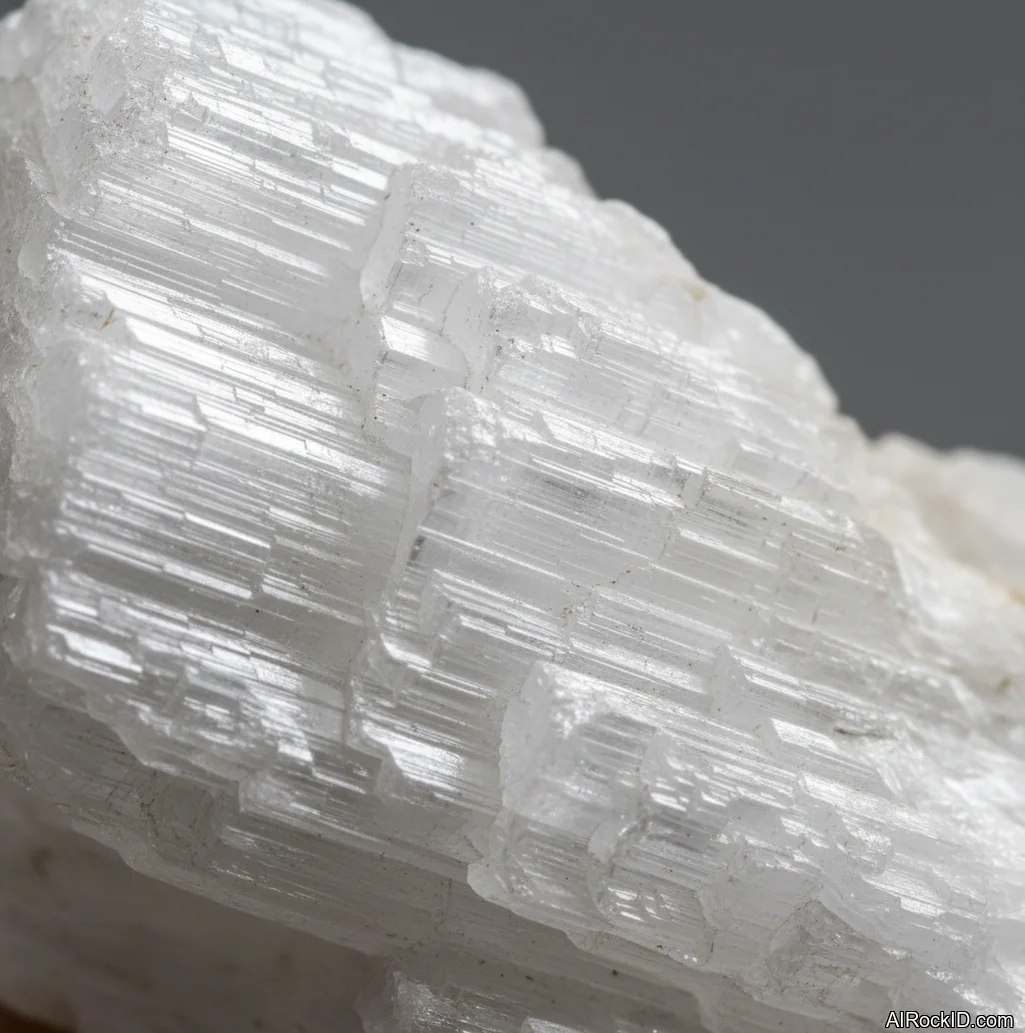
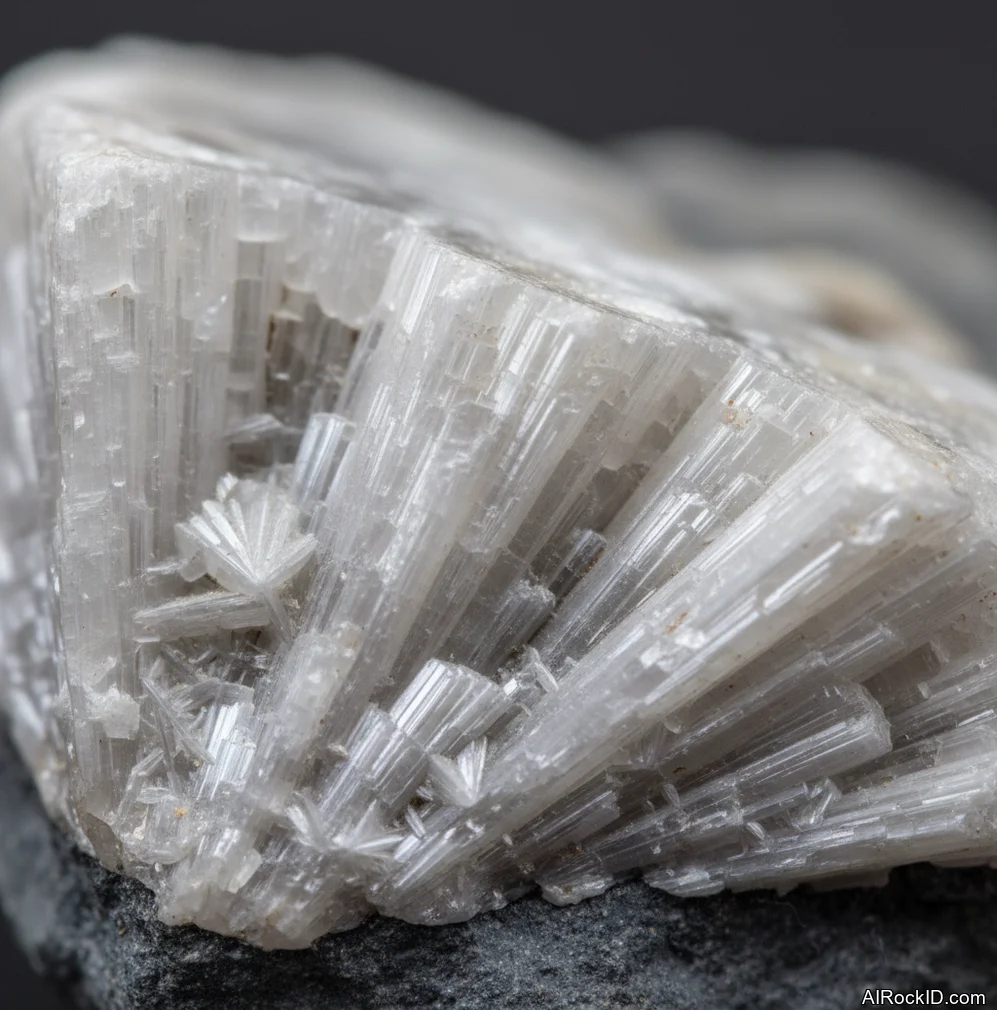
Ulexite is a hydrated sodium calcium borate mineral that usually occurs as white, silky, fibrous clumps. It is nicknamed "TV rock" because its straight, parallel fibers can carry an image from one side to the other, much like a bundle of tiny light pipes.
Grab a decent chunk and you’ll notice the weight first. It feels weirdly light for its size. Not that springy, airy pumice light. More like dry, chalky light, the kind that makes you think it might leave a faint dust on your fingers. And when you drag your thumb across the fibers, it’s soft but a little grabby, almost like satin ribbon (or that slick ribbon on a gift box that still has some bite to it).
Then you try the party trick. Set it right on top of printed text. If the fibers are lined up the right way, the letters jump up onto the top surface in this ghosty little window, sharp enough that you do a double take. How is it doing that?
At a distance, ulexite can resemble plain white "desert fluff," but it has more to offer on closer inspection. Under direct light it shows a silky, cat's-eye sheen, especially on cut and polished slabs. There is a caveat: much of the raw ulexite sold online is crumbly or still packed with dust and clay, and the image effect then barely shows, which often disappoints buyers. Clean, well-aligned fiber bundles separate a good demonstration piece from a chalky lump.
Origin & History
Ulexite is named after Georg Ludwig Ulex, a German chemist. The species was described in 1840, after material from Peru was studied and identified as a new borate.
The “TV rock” nickname showed up way later. Once lapidaries and science teachers caught on that its fibrous structure can actually transmit an image, it took off. And it slid into that classic classroom-mineral slot, sitting alongside magnetite and calcite, because you can drop it in someone’s palm and they instantly see minerals aren’t just pretty, they do strange little tricks too.
Where Is Ulexite Found?
You see the best “TV rock” material from borate-rich desert basins, especially in northern Chile and in California’s borax districts. It shows up anywhere evaporite borates form, but clean fiber bundles are more hit-or-miss.
Formation
Look for ulexite out in dry, salty places where water shows up, then disappears again. It forms in evaporite deposits, basically when boron-rich brines evaporate and start dropping minerals out of solution. Think closed basins, playas, salt flats, plus those crusty rings and flaky white layers you see around springs in arid country (the kind that crunch a little under your boot).
Compared to sparkly pegmatite minerals, this one’s more “chemistry in a basin” than anything flashy. The fibers can grow in parallel as the mineral precipitates, and later it gets compacted, which is how you end up with that tight, fibrous look. And ulexite likes company. You’ll find it with borax, colemanite, gypsum, halite, and other evaporite material that turns to mush if you treat it like quartz. Why? Because it just doesn’t handle rough, dry handling the same way.
How to Identify Ulexite
Color: Usually white to off-white, sometimes grayish or tan from clay staining. Fresh broken fibers can look brighter white than weathered surfaces.
Luster: Silky to dull, with a strong silky sheen on aligned fibrous faces.
Pick up a piece and test the “TV rock” effect on printed text or your phone screen, but rotate it until the fibers line up with the image. If you scratch it with a fingernail, it should mark pretty easily because it’s very soft. The real test is the feel: fibrous ulexite has that soft, hairlike texture and it tends to shed powder if it’s low quality or dry.
Common Look-Alikes
Ulexite is sometimes confused with these materials:
- Satin Spar Gypsum (Selenite)
- Fibrous Tremolite
- Howlite
- Dyed Borax
- Glass fiber bundles
Market Cautions & Treatments
Properties of Ulexite
Physical Properties
| Crystal System | Triclinic |
| Hardness (Mohs) | 2.0-2.5 (Soft (2-4)) |
| Density | 1.95-2.00 |
| Luster | Silky |
| Diaphaneity | Translucent |
| Fracture | Splintery |
| Streak | White |
| Magnetism | Non-magnetic |
| Colors | White, Off-white, Gray, Tan |
Chemical Properties
| Classification | Borates |
| Formula | NaCaB5O6(OH)6·5H2O |
| Elements | Na, Ca, B, O, H |
| Common Impurities | Fe, Mn, Cl, SO4 |
Optical Properties
| Refractive Index | 1.490-1.510 |
| Birefringence | 0.020 |
| Pleochroism | None |
| Optical Character | Biaxial |
Ulexite Health & Safety
Handling ulexite carries low risk. Avoid raising dust, and do not rub the eyes after touching powdery material, since fine grit spreads easily. When cutting it, treat it like any soft evaporite mineral: use good ventilation and wear a mask.
Safety Tips
Wash your hands after you handle crumbly specimens, and don’t leave it where little kids can grab it and lick the powder (because they will, right?). If you’re doing any lapidary work on it, keep things wet to control dust, and put on eye protection.
Ulexite Value & Price
Price Range
Rough/Tumbled: $5 - $60 per specimen
Price mostly comes down to how strong the image effect looks, how well the fibers line up, and how clean the surface is when you actually run your hand over it. Big slabs that transmit sharply (crisp, no haze) cost more. But those chalky chunks you get out of bulk flats, with that dull, dusty look? They’re cheap.
Durability
Fragile — Scratch resistance: Poor, Toughness: Poor
It bruises and powders easily, and the fibers can fray if it’s bumped around loose in a box.
How to Care for Ulexite
Use & Storage
Store it in a padded box or a little perky box, not rattling around with quartz points. If you keep it on a shelf, keep it away from places where it’ll get knocked or vibrated.
Cleaning
1) Blow off loose dust with a bulb blower or very gentle canned air from a distance. 2) If it needs more, do a quick rinse in cool water and pat dry, don’t scrub. 3) Let it air-dry fully before putting it back in a closed container.
Cleanse & Charge
For those who practice crystal cleansing, smoke, sound or moonlight are the safer methods. Burying ulexite in soil or salt is not advised, because it scratches easily and picks up grime quickly.
Placement
Set it on top of text or a phone screen for the classic demo, and keep it on a stable surface. A small acrylic stand helps because it keeps the fibers from getting mashed.
Caution
It’s really soft, and it splinters if you look at it wrong. So skip ultrasonic cleaners, harsh soaps, and brushing. And don’t just chuck it in your pocket next to your keys either.
Works Well With
Ulexite Meaning and Uses
Because of the way it transmits an image, ulexite is traditionally associated with clarity, focus and seeing what is directly in front of you. Practitioners link it with the Third Eye and Crown chakras, the zodiac signs Aquarius and Virgo, and the elements Air and Water. People who follow these traditions often keep a piece on a desk during study or reading, or use it as a prompt for slowing down before meditation or journaling.
Practical use is shaped by the mineral's softness. With a hardness of 2 to 2.5 and poor toughness, ulexite scuffs, powders and frays easily, so it suits display and stationary use better than carrying in a pocket or bag. Polished slabs and cabochons are also sold as demonstration pieces. Cleansing in crystal practice is usually done with smoke, sound or moonlight, since soaking can damage the fibers. These associations are cultural beliefs, not proven effects, and they are not a substitute for medical care.
Common mistakes
- Assuming every white fibrous mineral is ulexite without testing the image-transfer effect.
- Soaking ulexite in water to clean it, which can damage the surface.
- Buying ulexite for rings or bracelets despite its low hardness.
- Expecting rough ulexite to show the same clear TV-rock effect as a polished, correctly cut piece.
- Confusing calcite’s double refraction with ulexite’s fiber-optic image transmission.
Identify Ulexite from a photo
Compare Ulexite traits, care tips, value clues, and common lookalikes with a clear photo.