Howlite


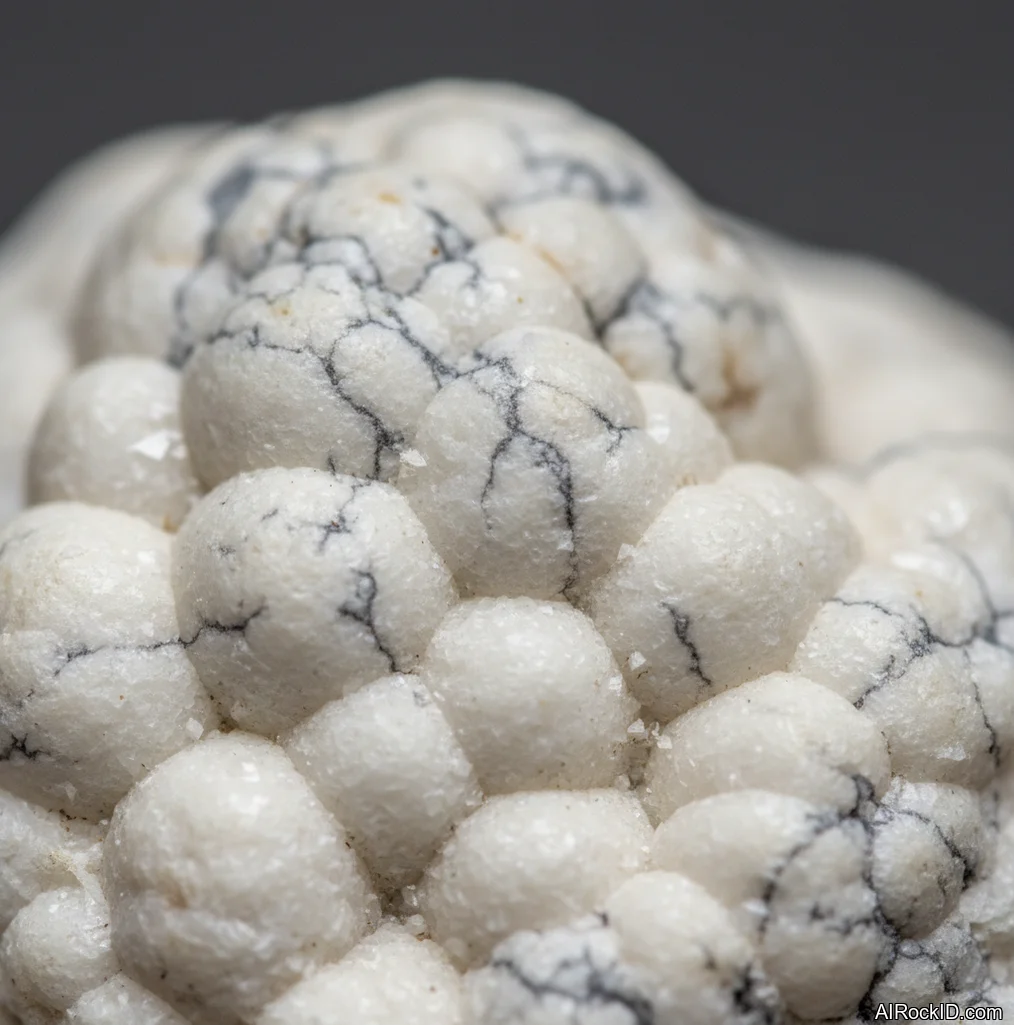
Quick answer: Howlite is a soft, porous white to gray borate mineral commonly recognized by gray, brown, or black web-like veining. Because it readily absorbs dye, it is often used as an imitation of turquoise, lapis lazuli, or other more expensive stones.
AI Rock ID can help screen a suspected howlite specimen by comparing color, veining, luster, and visible texture from a clear photo. RockIdentifier.io provides mineral information and identification support, but final confirmation may require hardness, streak, or lab testing when dye or treatment is suspected.
Good fit
- Collectors who want an inexpensive white mineral with natural-looking gray veining
- Jewelry makers using beads, cabochons, or carvings where softness is acceptable
- Beginners learning to recognize dyed stones and common imitations
- Decorative use in tumbled stones, small carvings, and display pieces
Not a good fit
- Rings or bracelets that receive heavy daily impact or abrasion
- Buyers seeking natural turquoise, lapis lazuli, or other higher-value blue stones
- Outdoor or wet settings where porous material may stain or absorb moisture
- Anyone needing a hard gemstone for long-term wear
Why people search for this
People often search for howlite because it is widely sold as beads and carvings, sometimes in natural white form and sometimes dyed bright colors. It is also searched by buyers trying to tell whether a blue stone is genuine turquoise or dyed howlite.
Most commonly confused with
- Turquoise: Natural turquoise is typically blue to green and harder to scratch than howlite; dyed howlite may show overly uniform blue color in cracks and pores.
- Magnesite: White magnesite can look very similar but is a magnesium carbonate, while howlite is a calcium borosilicate hydroxide.
- Marble: Marble may have gray veining but is usually crystalline calcite or dolomite and reacts with dilute acid more readily than howlite.
- White Jasper: Jasper is microcrystalline quartz and is much harder, usually around Mohs 6.5 to 7.
Howlite vs. Common Lookalikes
| Material | Typical Clue | Hardness / Test Note | Common Issue |
|---|---|---|---|
| Howlite | White to gray with dark web-like veining | Mohs about 3.5; scratches relatively easily | Often dyed blue or other colors |
| Turquoise | Blue to green, sometimes with matrix | Mohs about 5 to 6 | Frequently imitated by dyed howlite |
| Magnesite | White with gray veining, very similar appearance | Mohs about 3.5 to 4.5 | Also commonly dyed as turquoise imitation |
| Marble | Veined stone with granular or crystalline texture | Mohs about 3; reacts with acid if calcite-rich | Can be confused in carvings |
| White Jasper | Opaque white, cream, or patterned quartz | Mohs about 6.5 to 7 | Hardness separates it from howlite |
AI identification confidence
AI identification of howlite is usually moderate from photos when the specimen is white with distinct gray veining and a matte to waxy surface. Confidence drops when the stone is dyed, polished into uniform beads, or photographed without scale and close-up detail.
When AI gets it wrong
- Dyed blue howlite may be labeled as turquoise if the photo does not show pores, drill holes, or surface wear.
- White magnesite can be difficult to separate from howlite by image alone.
- Polished beads may hide natural texture and make hardness or streak testing more important.
- Lighting can exaggerate gray veining or make resin-filled cracks look natural.
Final recommendation
Choose natural white howlite if you want a low-cost, soft mineral with distinctive veining for display or gentle jewelry use. If buying blue material, ask whether it is dyed howlite, stabilized turquoise, or natural turquoise, because appearance alone is often not enough.
How to Spot Dyed Howlite
Dyed howlite often shows strong color in cracks, pores, drill holes, or chipped areas. Blue-dyed pieces may have a very even turquoise-like color, while natural howlite is usually white, gray, or cream with darker veining. A cotton swab with a small amount of acetone may lift dye from some treated pieces, but this can damage finishes and should not be used on valuable jewelry.
Buying Tips for Howlite Beads and Carvings
Ask sellers whether the howlite is natural color, dyed, stabilized, or sealed. Natural howlite is usually inexpensive, so unusually high prices should be supported by clear claims, provenance, or evidence that the piece is not an imitation of another stone. Check bead holes and edges for concentrated dye, scratches, or chalky surfaces.
Simple At-Home Checks
Howlite can be scratched by harder household materials more easily than quartz, but scratch tests should be done only on an inconspicuous area. A visual check with magnification can reveal porous texture, dye concentration, or coating. At-home checks can suggest an identification, but they cannot always distinguish howlite from magnesite without additional testing.
What Is Howlite?
Howlite is a calcium borosilicate hydroxide mineral, Ca2B5SiO9(OH)5, and you usually run into it as white-to-gray nodules streaked with darker veining.
Hold a piece in your hand and the first thing you’ll notice is the weight. It’s lighter than most folks expect, kind of like chalky marble that never fully decided to be stone. A lot of what’s sold in shops is polished, and yeah, it’ll take a decent shine, but it still feels a little soft and “dry” on the surface compared to quartz or agate (more like a smooth sidewalk than glass). And the veins? Look closer. They’re those thin, smoky gray to black lines that meander around like tiny river maps.
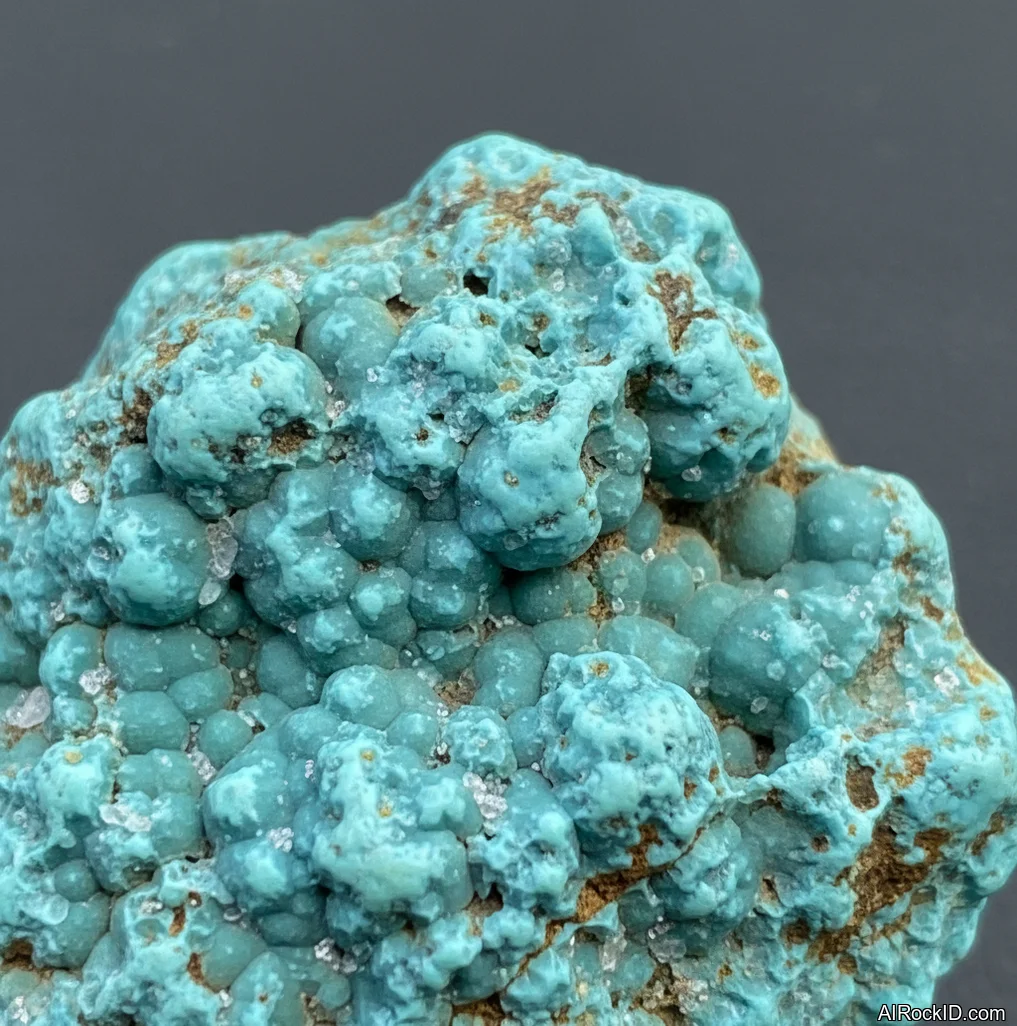
People mix it up with magnesite all the time at a glance. And in bead trays it gets labeled as “white turquoise” constantly, which is just how the market works. Real howlite is common and affordable, and it’s also one of the most dyed minerals you’ll ever bump into, because the pores and those little fractures drink up color like a sponge.
Origin & History
Most collectors peg howlite’s origins to Nova Scotia in the 1800s. It got its first proper write-up in 1868, when Henry How, a Canadian chemist and geologist, documented it after the material showed up mixed in with gypsum and anhydrite in quarry workings (the kind of chalky white stuff that leaves dust everywhere).
The name just comes from his last name, which was pretty standard for that time. But even though howlite is a real, valid mineral species, its biggest “historical significance” today is mostly about commerce: once people realized it takes dye really well, it started getting used as a stand-in for turquoise in inexpensive jewelry.
Where Is Howlite Found?
Howlite is best known from Nova Scotia and California, and it also turns up in borate-bearing evaporite settings in a handful of other countries.
Formation
Most howlite turns up in evaporite settings, where boron-rich fluids actually have some space and time to react with calcium-bearing rocks. Think salty brines, altered limestones, and that weird chemical-soup vibe you get hanging around gypsum and anhydrite beds.
In a hand sample, you usually don’t see crisp, pointy crystals. It’s more like nodules or lumpy, irregular masses, the kind you’d pick up and notice feel a bit chalky and lightweight for their size. And that makes sense, because it tends to grow by filling gaps and fractures as fluids snake through the rock.
Thing is, it’s porous, so it’ll soak up stains from whatever it formed next to. So even if the base color is pretty plain, the veining can come out looking surprisingly dramatic. Why? Those tiny pores grab onto color like a sponge.
How to Identify Howlite
Color: Typically white to light gray with gray to black veining; dyed material can be bright blue, green, red, or purple and usually looks too even in color.
Luster: Waxy to dull when raw, and a soft polish when finished.
If you scratch it with a copper penny or a steel nail, it’ll mark more easily than people expect, because it’s only about Mohs 3.5. The real test is dye: rub a bead with acetone on a cotton swab and you can sometimes pull color right off dyed pieces. And in the hand, polished howlite still feels a bit “grippy” compared to glassy stones like chalcedony.
Common Look-Alikes
Howlite is sometimes confused with these materials:
- Magnesite (often dyed bright “turquoise” blue and sold as turquoise or “dyed howlite”)
- White marble or calcite (polished, white, sometimes with gray veining)
- White jasper or chert (opaque white with gray lines, usually tougher than howlite)
- Porcelain, ceramic, or “reconstituted stone” beads (uniform white with printed or painted veining)
- Dyed quartz or glass sold as “turquoise howlite” (too glossy, color sits weird in pits)
Market Cautions & Treatments
When AI Can Get This Wrong
In photos, AI mixes up howlite with magnesite, marble, and even white jasper because the white base plus gray webbing looks the same under shop lighting. The real test is physical: howlite feels light and slightly porous, and a steel pin will bite it easier than it should if it was quartz-based. If the piece is “turquoise howlite,” assume dye until you can check for color pooling in cracks and around bead holes.
Properties of Howlite
Physical Properties
| Crystal System | Monoclinic |
| Hardness (Mohs) | 3.5 (Soft (2-4)) |
| Density | 2.53-2.59 |
| Luster | Waxy |
| Diaphaneity | Opaque |
| Fracture | Uneven |
| Streak | White |
| Magnetism | Non-magnetic |
| Colors | White, Gray, Black (veining) |
Chemical Properties
| Classification | Borates |
| Formula | Ca2B5SiO9(OH)5 |
| Elements | Ca, B, Si, O, H |
| Common Impurities | Fe, Mn, C |
Optical Properties
| Refractive Index | 1.586-1.605 |
| Birefringence | 0.019 |
| Pleochroism | None |
| Optical Character | Biaxial |
Howlite Health & Safety
Howlite’s usually safe to pick up and keep on a shelf. Just use basic shop sense if you’re cutting or sanding any mineral, because that fine dust gets everywhere, sticks to your fingers, and ends up in your nose if you’re not paying attention.
Safety Tips
If you’re going to grind or drill it, put on a dust mask. And run a little water while you work so the dust doesn’t get everywhere.
Howlite Value & Price
Price Range
Rough/Tumbled: $2 - $25 per piece
Price swings mostly come down to the pattern (tight, clean webbing is what sells) and the finish. Big, clean nodules and well-done carvings usually cost more, but bead strands stay cheap since the supply stays steady.
Durability
Nondurable — Scratch resistance: Poor, Toughness: Fair
Howlite is stable in normal conditions, but it scratches easily and dyed material can fade or bleed if it’s treated roughly.
How to Care for Howlite
Use & Storage
Keep it in a soft pouch or a separate compartment so harder stones don’t scuff it up. If it’s dyed, don’t store it pressed against porous fabrics that could pick up color.
Cleaning
1) Rinse quickly in lukewarm water. 2) Use a mild soap and your fingers or a very soft brush for crevices. 3) Pat dry and let it air-dry fully before putting it away.
Cleanse & Charge
If you do energy-style cleansing, gentle methods work best: smoke, sound, or a quick pass in cool water. Skip salt soaks if you’re not sure whether the piece is dyed.
Placement
I like it on a desk or nightstand where it won’t get knocked into keys or coins. In a display case, give it a little space from quartz points and other scratchy neighbors.
Caution
Skip ultrasonic cleaners and any strong solvents, especially with dyed howlite, because the color can start to lift or go patchy (you’ll see little pale spots and uneven blotches that weren’t there before). And don’t assume it’s a daily-wear ring stone unless you’re genuinely fine with scratches showing up fast.
Works Well With
Howlite Meaning & Healing Properties
Next to the flashy stuff, howlite is basically the quiet kid in the room. In my own stash, it’s the stone I pass to someone who wants something calming but doesn’t want a glitter bomb sitting on their desk. It doesn’t try to show off. That’s the whole point.
In the crystal world, people link howlite with settling an over-busy mind, taking the edge off irritability, and helping with sleep routines. I’ve sold a lot of palm stones to folks who like having something cool and smooth in their hand while they’re winding down at night. And yeah, the feel matters. Howlite has this soft, steady weight, and the polish is nice to rub with your thumb even though it’s not a super hard mineral (you can tell).
But here’s the practical catch: a lot of “howlite” out there is dyed, and the color story gets changed to match whatever a seller feels like pushing that week. So, if you’re buying it for personal meaning, great, just double-check you’re actually getting what you think you’re getting. And none of this replaces medical help for anxiety or sleep issues. I treat it like a tactile reminder and a focus object, not a cure.
Common mistakes
- Assuming every blue howlite bead is turquoise
- Judging authenticity by color alone instead of checking pores, veining, and drill holes
- Wearing howlite in high-impact jewelry and expecting it to resist scratches like quartz
- Cleaning dyed howlite with harsh chemicals that may fade or remove color
- Paying turquoise prices for material described only as dyed or reconstituted stone
Identify Howlite from a photo
Compare Howlite traits, care tips, value clues, and common lookalikes with a clear photo.