White Opal


Quick answer: White opal is best identified by its light milky to white body color, waxy to vitreous luster, and possible rainbow play-of-color. It can resemble glass, moonstone, or white chalcedony, so look for opal’s softer hardness, subtle translucency, and patchy color flashes rather than relying on color alone.
AI Rock ID can help screen a white opal photo by checking body color, luster, translucency, and visible play-of-color patterns. RockIdentifier.io provides visual identification support, but gem testing may still be needed for valuable, treated, or mounted opals.
Good fit
- Collectors who want a light-colored opal with visible play-of-color
- Jewelry buyers looking for a softer gem suited to earrings, pendants, or occasional-wear rings
- Beginners comparing natural opal with glass or synthetic lookalikes
- People interested in traditional opal symbolism without relying on medical claims
Not a good fit
- Daily-wear rings exposed to knocks, water, heat, or chemicals
- Buyers who want a highly scratch-resistant gemstone
- Situations where only a photo is available and authenticity must be guaranteed
- Anyone seeking a gemstone for medical treatment or health effects
Most commonly confused with
- Moonstone: Moonstone usually shows a soft floating sheen called adularescence rather than opal’s patchy rainbow play-of-color.
- White Chalcedony: White chalcedony is typically harder and more uniformly waxy, without true rainbow play-of-color.
- Common Opal: Common opal may have a similar milky body color but lacks noticeable play-of-color.
- Opalite: Opalite is usually man-made glass with a uniform bluish glow and no natural opal patterning.
White Opal Lookalike Comparison
| Material | Typical Look | Key Difference | Mohs Hardness |
|---|---|---|---|
| White Opal | Milky white, translucent to opaque, possible rainbow flashes | Patchy play-of-color in a softer hydrated silica gem | 5.5-6.5 |
| Moonstone | White to colorless with blue or white sheen | Floating adularescence rather than multicolor pinfire | 6-6.5 |
| White Chalcedony | Even white to grayish, waxy luster | No true play-of-color and generally tougher quartz material | 6.5-7 |
| Opalite | Milky glass with blue-orange glow | Man-made glass with uniform translucency | About 5.5-6 |
| Milky Quartz | Cloudy white, glassy to greasy luster | Harder and lacks opal color play | 7 |
AI identification confidence
Photo-based AI identification is usually more confident when white opal shows clear rainbow play-of-color, a natural cabochon surface, and multiple images under different lighting. Confidence is lower for plain white, opaque, highly polished, or mounted pieces because several minerals and glasses share a similar appearance.
When AI gets it wrong
- A smooth white stone is photographed under a single strong light, hiding or exaggerating color flashes.
- Opalite glass, resin, or synthetic opal has a uniform glow that looks natural in photos.
- A mounted stone cannot be checked for backings, doublets, triplets, or glue layers.
- White chalcedony, moonstone, or milky quartz is submitted without scale, hardness context, or side views.
Final recommendation
Choose white opal when you want a light-bodied opal with visible natural color play and are comfortable with careful wear. For higher-value purchases, ask for disclosure of treatments, doublet or triplet construction, and any available gemological documentation.
How to Check White Opal Authenticity
Authentic white opal often shows irregular, depth-dependent play-of-color rather than a perfectly repeated pattern. Examine the stone from the side for a dark backing, clear cap, or visible glue line, which may indicate a doublet or triplet rather than a solid opal. A seller should disclose whether the stone is natural, synthetic, treated, composite, or imitation.
White Opal Doublets and Triplets
A white opal doublet is a thin opal layer attached to a backing, while a triplet adds a clear protective cap above the opal layer. These constructions can be attractive and affordable, but they are not the same as solid opal. Side views, magnification, and seller disclosure are important because composites may look convincing from the top.
Photo Tips for Identifying White Opal
Photograph white opal in indirect daylight and from several angles to capture any play-of-color without glare. Include a close-up, a side view, and an image beside a common object for scale. Avoid color filters or overly warm lighting because they can make glass, moonstone, or quartz look more opal-like.
What Is White Opal?
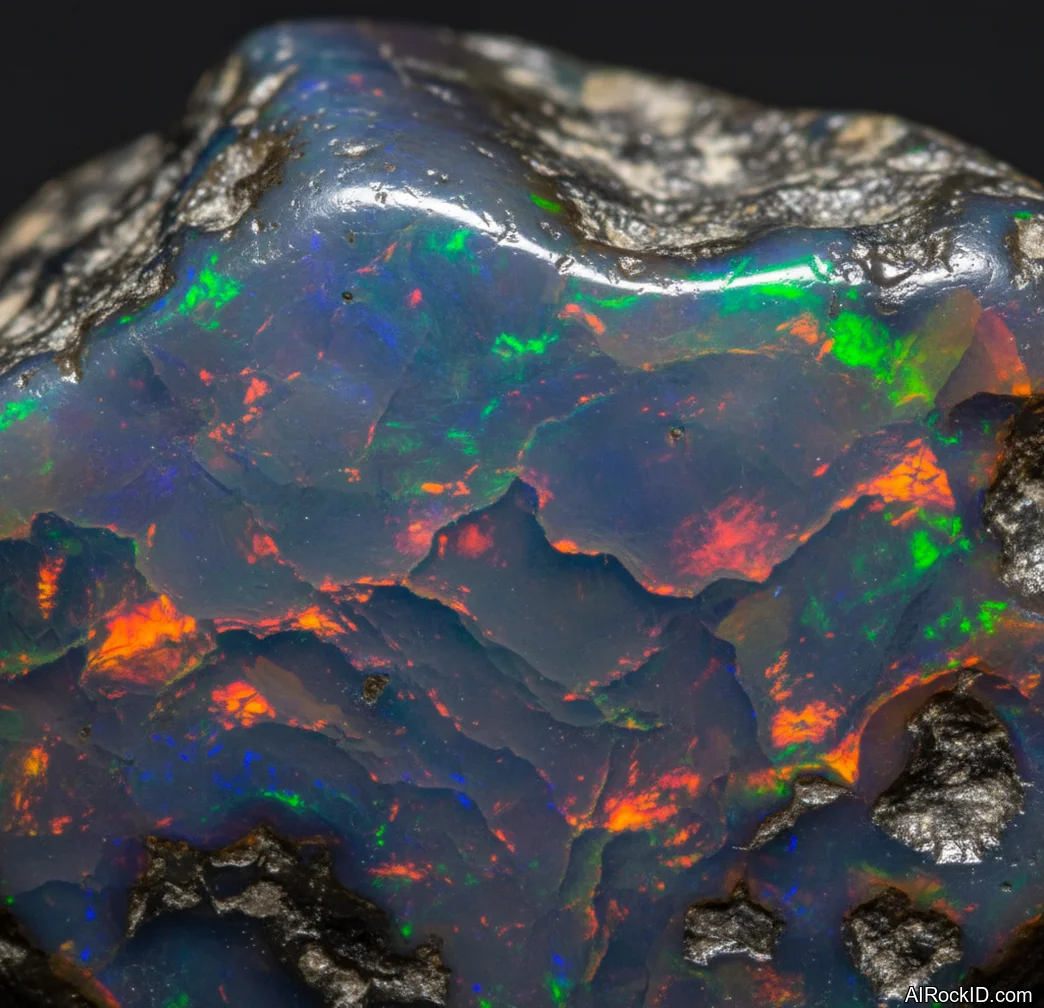
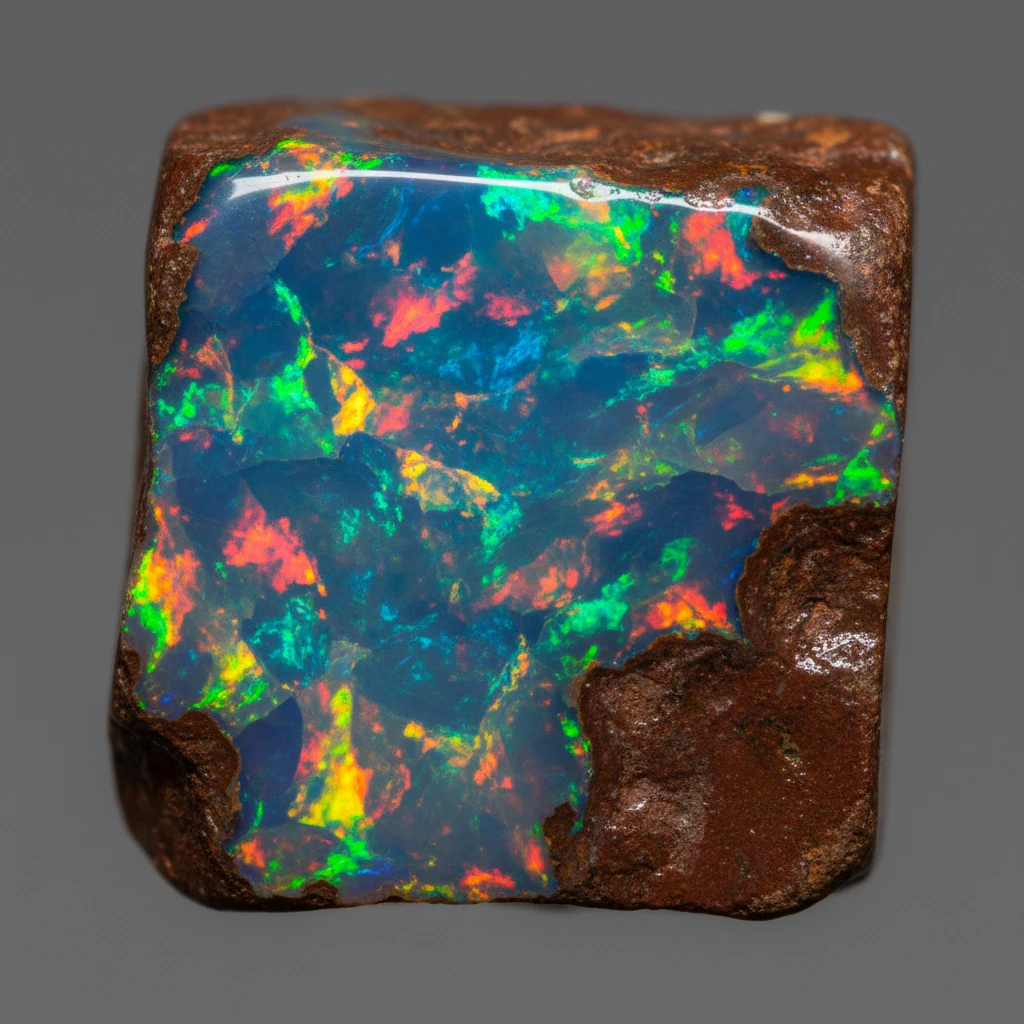
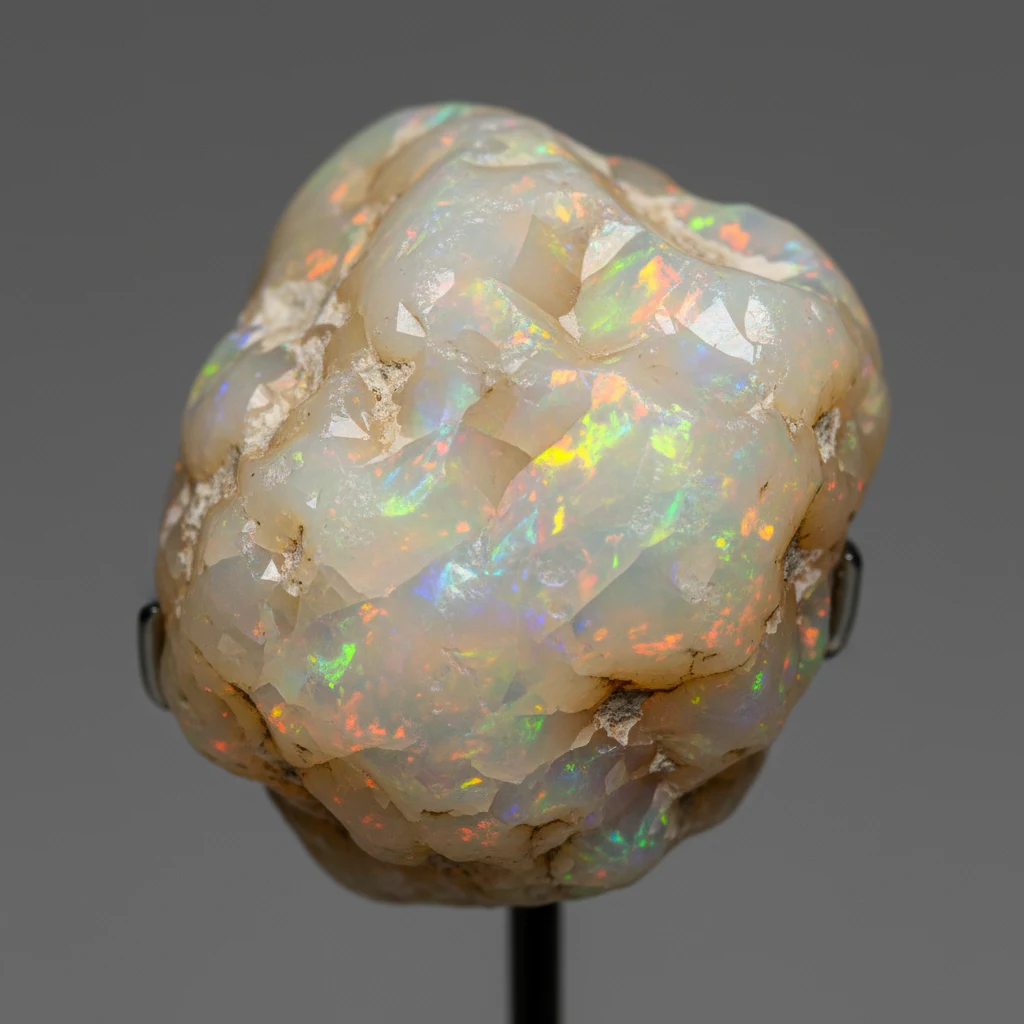
White Opal is a precious gemstone variety of opal with a white to creamy body color and flashes of rainbow play-of-color. In the hand, good material looks softly milky rather than glass-clear, with color sparks that wake up as the stone is turned under light. Its luster can read vitreous on polished faces and more waxy on natural or less polished surfaces.
For collectors, White Opal is appealing because it is common enough to study and buy, but still visually expressive when the play-of-color is strong. Its Mohs hardness is 5.5 to 6.5, so it has fair scratch resistance rather than everyday toughness. Store it in a soft pouch, keep it away from harsh chemicals, and avoid sudden temperature changes because it can crack under thermal stress.
Origin & History
The name opal comes from the Latin word “opalus,” meaning “precious stone,” and White Opal belongs to that long ornamental tradition. It has been used since ancient times for adornment, valued for the way a pale, quiet body color can suddenly throw small flashes of color when moved. That contrast is the collector’s pleasure: a calm white surface with hidden fire.
On labels and in trade, White Opal is usually described by body color, transparency, and the strength of its play-of-color. When checking locality information, use mindat.org as a plain-text reference alongside the seller’s label and any mine or field notes. The most useful descriptions are specific: white or cream body color, translucent to opaque diaphaneity, and visible iridescent flashes.
Where Is White Opal Found?
White Opal is primarily found in Australia, with additional deposits known from Mexico and Ethiopia. Notable localities listed for this material include Lightning Ridge in New South Wales, Coober Pedy in South Australia, and Welo in Ethiopia. For a collector, locality matters because it adds context to the specimen, even when the visual test still begins with body color and play-of-color.
Formation
White Opal forms when silica-rich solutions fill cavities in sedimentary rocks and then solidify over time. Its composition is given as SiO2·nH2O, and its structure is amorphous rather than a regular crystal system. That lack of crystal faces is one reason opal is judged less by crystal shape and more by body color, luster, transparency, and the moving effect of play-of-color.
In a specimen tray, this formation history shows as nodules, pieces, or cut stones rather than sharp crystals. The fracture is conchoidal, the streak is white, and the density is listed at 1.98 to 2.20 g/cm3. White Opal is non-magnetic and optically isotropic, with no birefringence or pleochroism, so the field eye should focus on the milky body and iridescent flashes.
How to Identify White Opal
Identify White Opal by its white to creamy appearance, translucent to opaque body, and play-of-color. Rotate the specimen slowly under a steady light: true interest appears as iridescent flashes of various colors across or within the pale base. The surface may look vitreous when polished, while rougher areas can show a waxy feel and look.
Useful checks include its Mohs hardness of 5.5 to 6.5, white streak, conchoidal fracture, and non-magnetic response. The refractive index range is 1.37 to 1.47, with no birefringence and no pleochroism. Do not expect a crystal habit, because White Opal is amorphous; instead, compare color, luster, transparency, and the quality of the play-of-color.
Properties of White Opal
Physical Properties
| Crystal System | Amorphous |
| Hardness (Mohs) | 5.5 - 6.5 (Medium) |
| Density | 1.98 - 2.20 g/cm3 |
| Luster | Vitreous |
| Diaphaneity | Translucent to opaque |
| Fracture | Conchoidal |
| Streak | white |
| Magnetism | Non-magnetic |
| Colors | White, Cream, Rainbow |
Chemical Properties
| Classification | Tectosilicate |
| Formula | SiO2·nH2O |
| Elements | Si, O |
| Common Impurities | Fe, Mn |
Optical Properties
| Refractive Index | 1.37 - 1.47 |
| Birefringence | None |
| Pleochroism | None |
| Optical Character | Isotropic |
White Opal Health & Safety
There are no significant health risks associated with handling White Opal.
White Opal Value & Price
Price Range
Rough/Tumbled: $10 - $100 per specimen
Cut/Polished: $20 - $500 per carat
Price is influenced by color play, transparency, and size.
Durability
Moderate — Scratch resistance: Fair, Toughness: Fair
It is sensitive to heat and can crack if subjected to sudden temperature changes.
How to Care for White Opal
Use & Storage
Store in a soft pouch to prevent scratches.
Cleaning
Clean with warm soapy water and a soft cloth. Avoid harsh chemicals.
Cleanse & Charge
Place under moonlight to cleanse and recharge.
Placement
Keep away from direct sunlight to prevent damage.
Caution
Avoid exposure to extreme temperatures.
Works Well With
White Opal Meaning & Healing Properties
In crystal healing traditions, White Opal is believed to support creativity, emotional balance, intuition, and self-discovery. Practitioners often use it when they want a quieter stone: pale in the palm, visually soft, but animated by flashes of color that feel suited to reflection and personal growth. Its associated qualities include creativity, balance, and intuition.
White Opal is linked with the Crown and Third Eye chakras, the zodiac signs Libra and Scorpio, the planet Venus, and the elements Water and Air. For gentle energetic care, it may be placed under moonlight to cleanse and recharge. Pair it with rose quartz, amethyst, or clear quartz, and keep practical care in mind: avoid harsh chemicals, direct sunlight, and extreme temperatures.
Identify White Opal from a photo
Compare White Opal traits, care tips, value clues, and common lookalikes with a clear photo.
Common mistakes
- Assuming every milky white stone with a glow is natural white opal
- Confusing uniform opalite glass with natural opal play-of-color
- Ignoring side views that may reveal a doublet, triplet, or backing layer
- Using water soaking, heat, or household chemicals as identification tests
- Buying high-priced white opal without treatment or construction disclosure
- Expecting white opal to withstand the same daily wear as quartz or sapphire