Moonstone


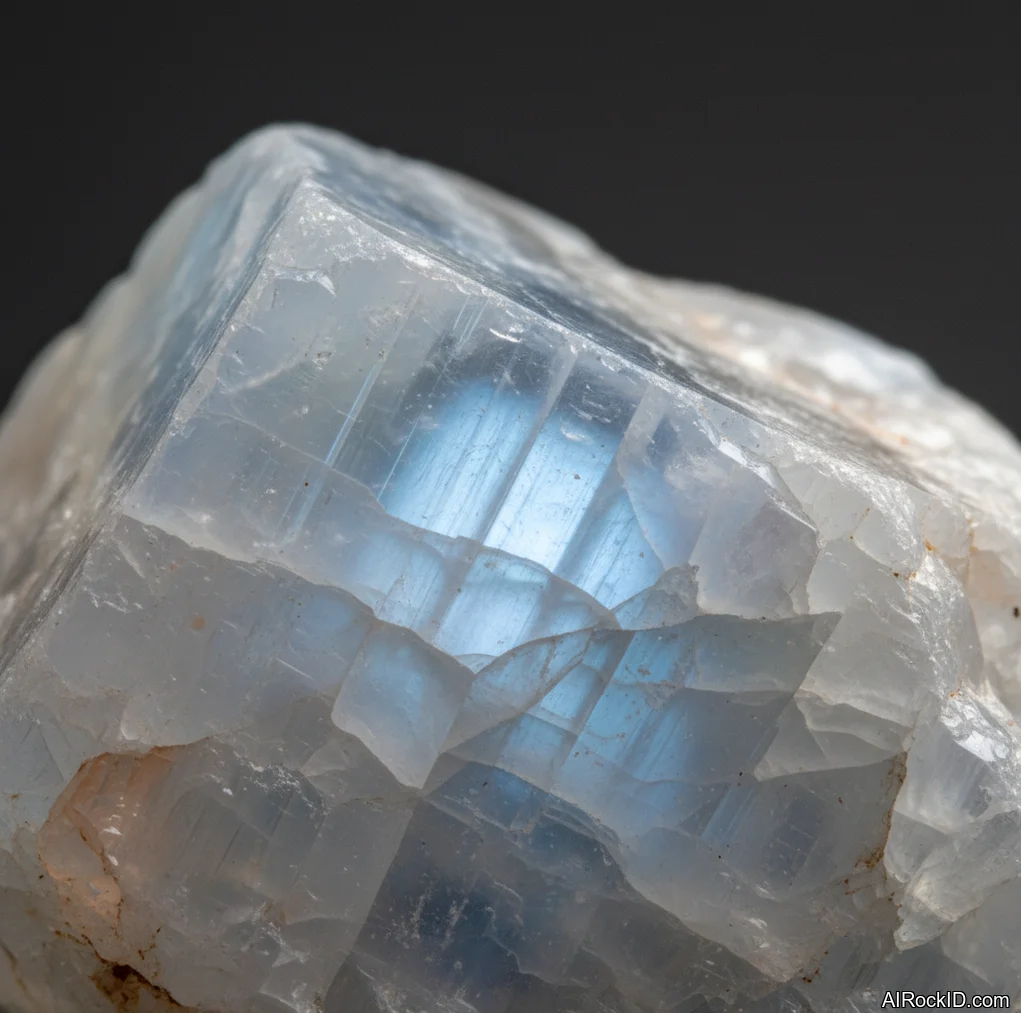
Quick answer: Moonstone is a feldspar gemstone best known for adularescence, a soft floating glow caused by light scattering between microscopic feldspar layers. It is commonly confused with opalite, labradorite, selenite, and pale chalcedony, so surface glow, hardness, and internal structure are useful identification clues.
AI Rock ID can help screen a moonstone photo by checking visual traits such as body color, translucency, cleavage, and blue-white sheen. RockIdentifier.io can support comparison with common lookalikes, but lab testing is the most reliable option for high-value or treated stones.
Good fit
- Collectors who want a feldspar gem with a soft blue, white, or rainbow sheen
- Jewelry wearers who prefer pendants, earrings, or protected ring settings
- Beginners learning to recognize optical effects such as adularescence
- Buyers comparing natural moonstone with opalite or glass imitations
Not a good fit
- Daily-wear rings that may receive heavy knocks or abrasion
- People looking for a very hard gemstone like sapphire or diamond
- Situations where water, steam, or ultrasonic cleaning will be used frequently
Most commonly confused with
- Opalite: Opalite is usually man-made glass with a uniform milky glow, while moonstone is natural feldspar with layered adularescence.
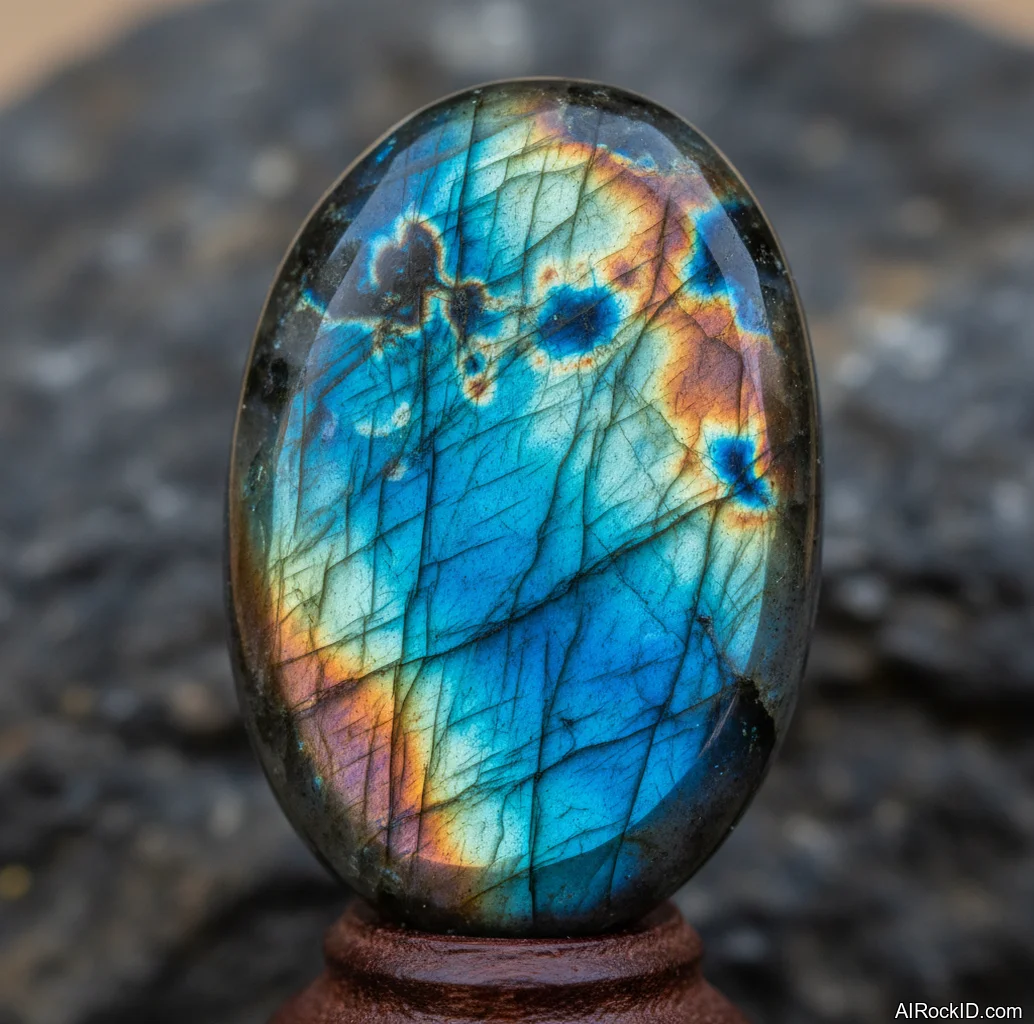
- Labradorite: Labradorite often shows stronger flashes of blue, green, gold, or orange, while moonstone usually has a softer floating sheen.
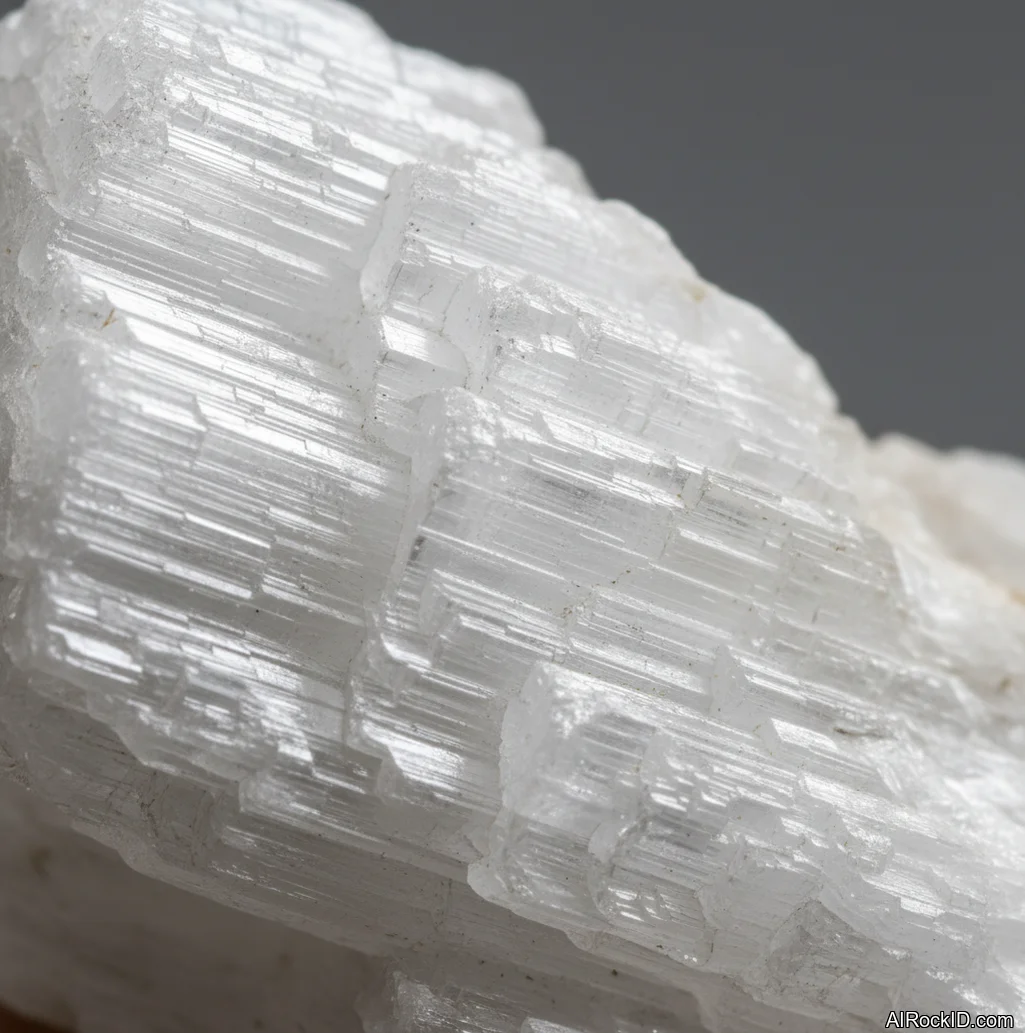
- Selenite: Selenite is much softer and can be scratched by a fingernail, unlike moonstone at Mohs 6–6.5.
- Chalcedony: Chalcedony has a waxy, even translucency and lacks the moving feldspar sheen typical of moonstone.
Moonstone vs Common Lookalikes
| Stone | Key visual clue | Hardness | Common ID note |
|---|---|---|---|
| Moonstone | Soft floating white, blue, or rainbow adularescence | Mohs 6–6.5 | Natural feldspar with cleavage |
| Opalite | Uniform milky blue-orange glow | About Mohs 5.5–6 | Usually man-made glass |
| Labradorite | Stronger directional color flash | Mohs 6–6.5 | Feldspar with labradorescence |
| Selenite | Silky or fibrous white translucency | Mohs 2 | Very soft and easily scratched |
| Chalcedony | Waxy, even translucency | Mohs 6.5–7 | No floating feldspar sheen |
AI identification confidence
AI identification of moonstone is usually moderate when the photo clearly shows adularescence, translucency, and surface condition. Confidence drops when the stone is highly polished, overexposed, dyed, set in jewelry, or photographed under colored lighting.
When AI gets it wrong
- Opalite or glass can appear similar because camera lighting may create a blue-white glow.
- Labradorite may be mislabeled as moonstone when only a pale blue flash is visible.
- Selenite, milky quartz, and chalcedony can resemble low-sheen moonstone in single-angle photos.
- Coatings, backing foils, or seller lighting can exaggerate flash and color.
Final recommendation
For buying, prioritize stones with a natural-looking floating sheen, clear seller disclosure, and photos taken from multiple angles. For valuable moonstone jewelry, request gemological confirmation rather than relying only on appearance.
How to Check Moonstone Authenticity
Authentic moonstone should show a sheen that appears to move under the surface as the stone is tilted, not just a flat surface reflection. Uniform milky color, bubbles, mold-like shapes, or identical beads in a strand can suggest glass or opalite. A refractive index test, specific gravity test, or examination by a gemologist can separate moonstone from many lookalikes.
What to Look for When Buying Moonstone
Desirable moonstone is often judged by the strength, color, and placement of its adularescence, along with transparency, cut, and visible inclusions. Blue sheen on a mostly transparent body is often priced higher than cloudy material with weak glow. Rainbow moonstone is commonly a trade name for a variety of labradorite feldspar, not always orthoclase moonstone.
Photo Tips for Identifying Moonstone
Photograph moonstone in indirect daylight or under a single neutral light source, then tilt it slowly to capture the moving sheen. Include a close-up, a side view, and a photo beside a common object for scale. Avoid colored LEDs or heavy filters because they can make glass, opalite, or labradorite look more like moonstone.
What Is Moonstone?
Moonstone is a feldspar gem that shows adularescence, that drifting, floating glow you get when light scatters through those thin internal layers.
Pick up a good cab and you’ll see why cutters keep going back to domes. The glow isn’t sitting on top like a film, it’s down under the polish, kind of sliding around as you tilt it, and it can jump from dead to electric in half a degree. I’ve handled plenty that looked boring in a tray, then the dealer shifts the lamp just a hair and, bam, there’s a clean blue sheet of sheen riding across the crown.
But moonstone’s also one of the most misunderstood stones at shows. A lot of stuff tagged “rainbow moonstone” is actually labradorite, which is still feldspar, just a different one with a different sort of flash. Real, classic moonstone tends to look softer and milkier, and the best pieces have that calm blue adularescence, not the louder multicolor labradorescence.
Origin & History
“Moonstone” started out as a trade name, and it’s been around forever because of that moon-like sheen. People were using the word long before mineralogists really pinned down what, exactly, was going on inside the feldspar to make it shimmer like that.
The more technical term, “adularia,” comes from Mt. Adula in the Swiss Alps. That’s where clear to whitish feldspar crystals got linked with the effect, the kind you can turn in your fingers and watch the soft glow drift just under the surface.
On the science side of the timeline, feldspar species such as orthoclase were described in the late 1700s, and Abraham Gottlob Werner is the name you’ll keep bumping into in that period of mineral naming. But “moonstone” stuck as a gem term because it’s easy and it fits what you actually see: that moving, moonlit glow that slides across a cabochon when you tilt it (and once you’ve watched it, you don’t really forget it).
Where Is Moonstone Found?
Fine classic blue-sheen moonstone is strongly associated with Sri Lanka, while India and Madagascar supply a lot of the commercial white to peach material seen in beads, carvings, and tumbled stones.
Formation
Moonstone shows up in igneous and metamorphic environments where feldspar crystallizes, then later picks up super fine intergrowths and exsolution lamellae. Thing is, the crystal ends up built from microscopic layers of two feldspar compositions, and when light bounces through those layers you get that soft, floating adularescence.
Unlike a quartz crystal that grows those clean, obvious faces, moonstone usually gets cut from massive material or just chunky rough with no pretty terminations. The rough I’ve bought most often looks like plain, washed out feldspar, kind of chalky on the outside (sometimes with a gritty saw mark), right up until you wet it or hit it with a strong point light. And then the sheen pops in, like somebody quietly cranked a dimmer switch inside the stone. Pretty wild, honestly.
How to Identify Moonstone
Color: Body color ranges from colorless to milky white, gray, cream, or peach, often with a blue to white sheen; some pieces show a subtle cat’s-eye line. “Rainbow moonstone” in the trade often shows blue flash with scattered color but is typically labradorite rather than true moonstone.
Luster: Polished moonstone is vitreous with a soft, pearly look over the sheen.
Look closely under a single bright light and rotate it slowly; real adularescence moves as a broad glow, not as glittery sparkles. The real test is feel and temperature too: glassy fakes tend to feel a bit warmer and “slick,” while feldspar stays cool and can feel slightly waxy at the edge. If you scratch it with a steel knife you might get a faint mark, but it should still scratch ordinary window glass only with effort, not instantly.
Common Look-Alikes
Moonstone is sometimes confused with these materials:
- White labradorite (often sold as “rainbow moonstone”)
- Milky quartz (especially tumbled pieces with a soft sheen)
- White opalite glass (man-made “opalite” sold as moonstone)
- Selenite/satin spar gypsum (soft, fibrous glow that gets mislabeled)
- Dyed white chalcedony or dyed agate sold as “blue flash moonstone”
Market Cautions & Treatments
When AI Can Get This Wrong
AI photo ID trips up hard on white labradorite and milky quartz because a single still photo can’t show that moving adularescence. Opalite glass also fools cameras since it photographs like a perfect, even blue glow with zero internal mess. The real test is motion plus a quick hardness reality check: moonstone should scratch glass, while “selenite moonstone” won’t and will dent with a fingernail.
Properties of Moonstone
Physical Properties
| Crystal System | Monoclinic |
| Hardness (Mohs) | 6-6.5 (Hard (6-7.5)) |
| Density | 2.55-2.63 g/cm3 |
| Luster | Vitreous |
| Diaphaneity | Transparent to translucent |
| Fracture | Uneven |
| Streak | White |
| Magnetism | Non-magnetic |
| Colors | Colorless, White, Gray, Cream, Peach, Greenish (rare), Blue sheen |
Chemical Properties
| Classification | Silicates (tectosilicate feldspar) |
| Formula | (K,Na)AlSi3O8 |
| Elements | K, Na, Al, Si, O |
| Common Impurities | Fe, Ca, Ti |
Optical Properties
| Refractive Index | 1.518-1.526 |
| Birefringence | 0.005-0.008 |
| Pleochroism | None |
| Optical Character | Biaxial |
Moonstone Health & Safety
Moonstone is a non-toxic feldspar, so it’s generally safe to handle. Thing is, the real “risk” isn’t to you. It’s to the stone. Drop it on a hard tile floor or knock it against a metal ring and you’ll probably end up with a chip or a scratch long before you’d ever have a problem from touching it.
Safety Tips
If you’re going to cut or sand it, throw on a dust mask. And keep it wet with water while you work, so you’re not kicking up that fine, silica-bearing dust (the floaty stuff that gets everywhere).
Moonstone Value & Price
Price Range
Rough/Tumbled: $3 - $60 per piece
Cut/Polished: $5 - $150 per carat
Thing is, the price jumps all over the place depending on the adularescence, how clear the body is, and whether the cutter actually aimed the dome the right way so it lines up with those internal layers. A big, clean cab with that in-your-face blue sheen costs real money. But the chalky white stuff? That gets dumped out and sold by the strand.
Durability
Moderate — Scratch resistance: Good, Toughness: Fair
It’s stable in normal wear, but it can chip along cleavage and it’ll pick up scratches if it rides in a pocket with quartz or corundum.
How to Care for Moonstone
Use & Storage
Store moonstone in a soft pouch or a separate box slot so harder stones don’t haze the polish. I don’t toss it loose in a bowl with quartz points unless I want it to look tired fast.
Cleaning
1) Rinse with lukewarm water and a drop of mild soap. 2) Use a soft toothbrush around settings and the back of cabochons. 3) Rinse well and pat dry; skip ultrasonic and steam cleaners.
Cleanse & Charge
For a simple reset, rinse briefly and dry, or leave it on a windowsill for gentle morning light rather than harsh midday sun. If you’re into smoke or sound, either works and won’t stress the stone.
Placement
If you display it, set it where a single lamp can hit it from the side so the sheen actually shows. Flat overhead lighting can make even great moonstone look washed out.
Caution
Skip the hard knocks and big, sudden temperature swings. And don’t toss set jewelry into an ultrasonic cleaner or hit it with harsh chemicals. Keep an eye on the prongs, too, because moonstone’s girdle can chip way faster than most people think.
Works Well With
Moonstone Meaning & Healing Properties
Moonstone gets pitched like it’s all foggy vibes and midnight secrets, but in real life it’s way more straightforward. People grab it because they want something calming that still feels kind of “alive” in the hand. That sliding glow gives your brain something simple to track, and yeah, that can be grounding without making a big production out of it.
Look, pick up a palm stone and run your thumb across the dome. It’s funny. Even when it looks glass-smooth under the shop lights, you can still catch these tiny shifts in feel where the polish moves over different internal planes. Not dramatic. Just there. And that tactile bit is a big reason people keep it near the bed, use it during meditation, or set it next to a notebook when they’re journaling. It’s not medicine. It’s a way to aim your attention.
Thing is, the online moonstone scene can be a hype machine. Some sellers promise the moon and price it like it’s rare, when a lot of what’s out there is common feldspar that’s simply been cut nicely and photographed under perfect lighting. I’m not mad at anyone for using it for intention setting, but I’d rather be straight about it: if you’re buying it for “energy,” get a piece you genuinely like holding and staring at. Because if the sheen goes flat the second you tilt it, are you really going to reach for it? Probably not. And that’s the real failure mode.
Common mistakes
- Assuming every milky blue-white stone is moonstone.
- Confusing opalite glass with natural moonstone because both can glow in bright light.
- Calling all rainbow moonstone true orthoclase moonstone; much material sold this way is feldspar related to labradorite.
- Using only color for identification instead of checking sheen, hardness, and internal texture.
- Wearing moonstone in exposed ring settings without considering its cleavage and moderate hardness.
- Cleaning moonstone with ultrasonic cleaners, steam, or harsh chemicals.
Identify Moonstone from a photo
Compare Moonstone traits, care tips, value clues, and common lookalikes with a clear photo.