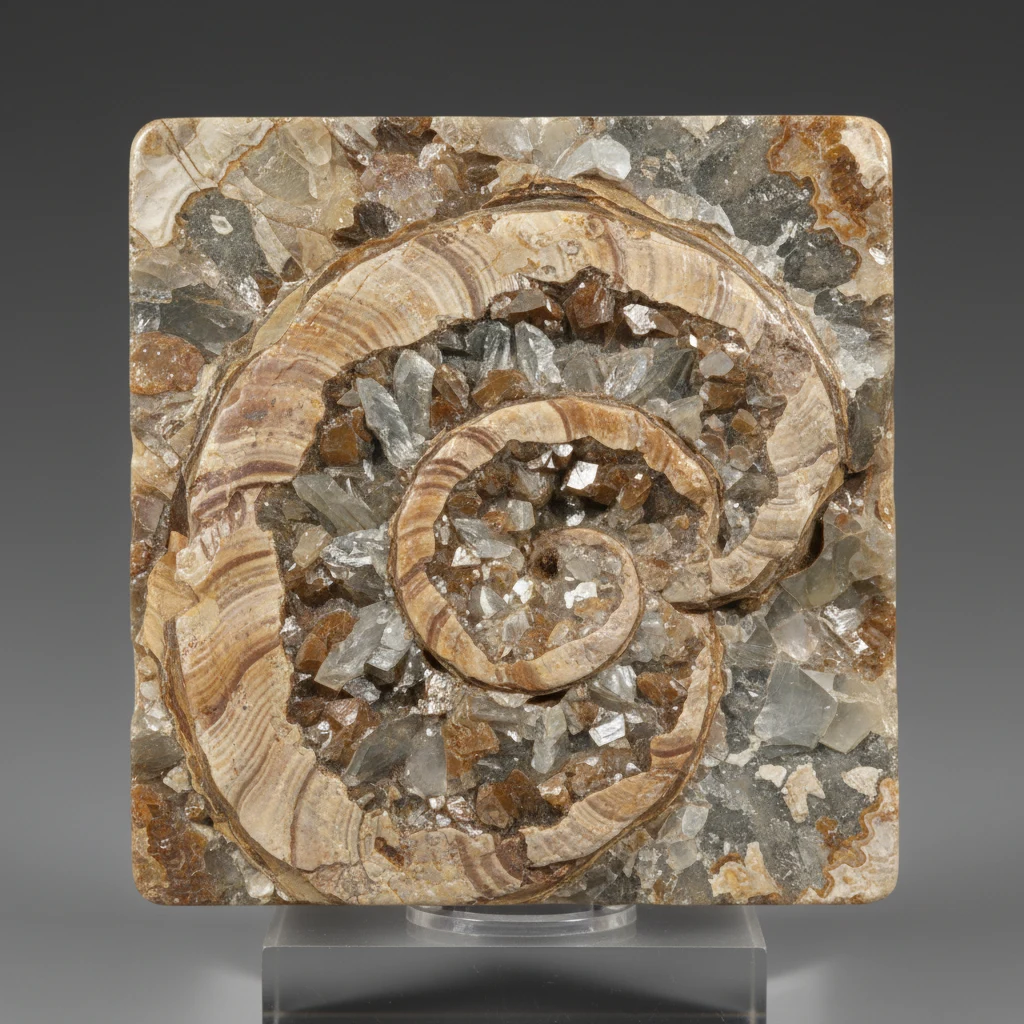
Fossilized Clam Shell


Quick answer: Fossilized clam shell is the preserved shell or shell impression of an ancient bivalve, most often found in limestone, shale, sandstone, or other sedimentary rock. It is usually identified by its paired-shell shape, growth lines, ribbing, and calcium carbonate composition with a Mohs hardness around 3–4.
AI Rock ID can help screen a fossilized clam shell by checking for bivalve outline, shell ribbing, growth bands, and sedimentary matrix. RockIdentifier.io should be used as a visual aid alongside location context, hardness checks, and expert confirmation for unusual or valuable fossil finds.
Good fit
- Collectors who want a recognizable marine fossil with a clear shell shape
- Beginners learning to identify common fossils in sedimentary rocks
- Classroom, display, or educational collections focused on ancient sea life
- Buyers looking for affordable fossils with visible natural texture
Not a good fit
- People seeking a rare gemstone or faceted crystal material
- Jewelry use that requires high toughness or scratch resistance
- Specimens intended for acid cleaning, which can damage calcium carbonate
- Collectors who need species-level identification without fossil documentation
Most commonly confused with
- Fossilized Oyster Shell: Oyster fossils are usually more irregular and layered, while clam shells often show a more symmetrical bivalve outline.
- Fossilized Coral: Fossil coral commonly has honeycomb, star, or branching patterns instead of a hinged two-shell form.
- Limestone: Limestone may contain shell fragments, but it does not always preserve a distinct clam shape or hinge area.
- Coquina: Coquina is a rock made of many broken shell fragments, while a fossilized clam shell is usually a single identifiable shell or mold.
Fossilized Clam Shell vs Similar Finds
| Specimen | Typical Shape | Key ID Clue | Common Matrix |
|---|---|---|---|
| Fossilized clam shell | Paired bivalve shell or oval shell mold | Growth lines, hinge area, matching shell halves | Limestone, shale, sandstone |
| Fossilized oyster shell | Irregular, lumpy, layered shell | Uneven shell layers and rough attachment surface | Marine limestone or marl |
| Fossilized coral | Branching, honeycomb, or star-patterned structure | Repeating coral corallite pattern | Limestone or reef deposits |
| Coquina | Rock full of broken shell pieces | Many shell fragments cemented together | Shell-rich limestone |
| Brachiopod fossil | Shell-like fossil with strong bilateral pattern | Symmetry through each valve, not between two valves | Paleozoic limestone or shale |
AI identification confidence
AI identification confidence is usually moderate to high when the fossil has a complete bivalve outline, visible hinge area, and clear shell ornamentation. Confidence drops when the specimen is only a fragment, a mold without texture, or embedded in a shell-rich rock with many overlapping fossils.
When AI gets it wrong
- Broken shell fragments may be labeled as complete fossilized clams even when they are part of coquina.
- Brachiopods can be mistaken for clams because both have two shell-like valves.
- Modern beach shells with staining or mineral coating may be misread as fossils from photos alone.
- Fossil coral or shell hash can be confused with clam shell if only a small patterned area is visible.
Final recommendation
Choose fossilized clam shell specimens with a clear bivalve outline, visible growth lines, and stable surrounding matrix if display or study value matters. For buying, request the locality, approximate age if known, and photos of both sides to separate natural fossils from modern shells or repaired pieces.
How to Tell Fossilized Clam Shell from a Modern Shell
A fossilized clam shell is commonly heavier, more stone-like, and partly or fully replaced or filled by minerals. It is often attached to limestone, shale, or sandstone, while a modern shell usually feels lighter and may show a fresh nacreous or chalky interior. Context is important because a shell found in loose beach sand is more likely modern than one recovered from consolidated sedimentary rock.
Buying and Authenticity Tips
Authentic fossilized clam shells should show natural wear, sediment contact, or mineral-filled cavities rather than a uniformly polished modern-shell surface. Ask for locality information, formation name if available, and whether the specimen has been repaired, stabilized, or glued into matrix. Very low-cost specimens are common, so unusually high prices should be supported by rare species identification, exceptional preservation, or documented provenance.
Field Identification Clues
Look for a hinged bivalve outline, concentric growth lines, radial ribs, or a shell-shaped cavity in sedimentary rock. A small scratch test may indicate calcite or aragonite if the shell material is easily scratched by steel but not by a fingernail, though testing should be done on an inconspicuous area. Dilute acid will fizz on calcium carbonate, but acid testing can permanently mark the specimen.
What Is Fossilized Clam Shell?
Fossilized Clam Shell is an organic gem made from the preserved remains of ancient clams. In the hand, it is usually recognized less by sparkle and more by form: the bivalve outline, layered shell structure, and worn, time-softened surface. Typical colors are beige, brown, and gray, with an opaque body and a dull to slightly glossy surface.
As a calcium carbonate material with the formula CaCO3, Fossilized Clam Shell has a Mohs hardness of 3-4 and moderate durability. It is common, collectible, and often chosen for its natural history value rather than rarity. Handle it like a fossil first and a decorative stone second, because specimens can be fragile and may chip or crack.
Origin & History
Fossilized Clam Shell is named for exactly what it is: a clam shell that was buried, preserved, and mineralized over vast time. The word “fossil” comes from the Latin “fossilis,” meaning “dug up,” a fitting name for specimens that often emerge from sedimentary rock rather than from a gem pocket.
Fossilized clams have been studied since the early 19th century, and collectors still read them as both natural objects and records of ancient life. When checking specimen context, locality labels and references such as mindat.org can help keep names and source information organized, especially for well-known sedimentary formations.
Where Is Fossilized Clam Shell Found?
Fossilized Clam Shell is commonly found in sedimentary rock formations. Reported countries include the USA, Canada, and Germany, with notable localities including the Green River Formation in Wyoming, the Burgess Shale in Canada, and the Solnhofen Limestone in Germany.
Formation
Fossilized Clam Shell forms when clams are buried in sediment and undergo mineralization over millions of years. The original shell shape may remain readable, while the material becomes preserved as a calcium carbonate fossil with common impurities such as iron and magnesium.
That sedimentary origin is why these fossils often feel more earthy than jewel-like. Their surfaces may be smooth or worn, and their colors tend toward beige, brown, or gray rather than bright gem tones. A good specimen invites close inspection: hinge lines, layered shell edges, and the quiet symmetry of the bivalve form are the main attractions.
How to Identify Fossilized Clam Shell
Identify Fossilized Clam Shell by its characteristic bivalve shape, layered structure, and fossil texture. Most pieces are beige, brown, or gray, opaque, and dull in luster, though some surfaces can look slightly glossy from wear. The streak is white, and the material is non-magnetic.
On the bench, it should feel like a preserved shell form rather than a crystal cluster. Physical properties include an amorphous structure, conchoidal fracture, density of 2.5-3.0 g/cm3, and Mohs hardness of 3-4. Because it has only fair scratch resistance and can be fragile, avoid aggressive scratch testing on a collectible specimen.
Properties of Fossilized Clam Shell
Physical Properties
| Crystal System | Amorphous |
| Hardness (Mohs) | 3-4 (Medium (4-6)) |
| Density | 2.5-3.0 g/cm3 |
| Luster | Dull |
| Diaphaneity | Opaque |
| Fracture | Conchoidal |
| Streak | White |
| Magnetism | Non-magnetic |
| Colors | Beige, Brown, Gray |
Chemical Properties
| Classification | Calcium Carbonate |
| Formula | CaCO3 |
| Elements | Ca, C, O |
| Common Impurities | Fe, Mg |
Optical Properties
| Refractive Index | 1.65-1.67 |
| Birefringence | None |
| Pleochroism | None |
| Optical Character | Isotropic |
Fossilized Clam Shell Health & Safety
No significant health risks are associated with fossilized clam shells.
Fossilized Clam Shell Value & Price
Price Range
Rough/Tumbled: $5 - $50 per specimen
Cut/Polished:
Factors include size, condition, and locality.
Durability
Moderate — Scratch resistance: Fair, Toughness: Good
They can be fragile and should be handled with care.
How to Care for Fossilized Clam Shell
Use & Storage
Store in a dry place away from direct sunlight.
Cleaning
Gently clean with a soft brush and mild soap if necessary. Avoid harsh chemicals.
Cleanse & Charge
Place in sunlight or moonlight for cleansing.
Placement
Display in a stable location to avoid breakage.
Caution
Handle with care to prevent chips or cracks.
Works Well With
Fossilized Clam Shell Meaning & Healing Properties
In crystal-healing practice, Fossilized Clam Shell is used as a calming, grounding, and emotionally steadying stone. It is associated with emotional healing, stability, trust, compassion, meditation, inner peace, relaxation, joy, and nurturing. Its linked chakras are the Root and Sacral, matching its earthy fossil body and water-born shell identity.
Practitioners often choose it when they want a quiet piece rather than a high-flash crystal. It pairs well with rose quartz, amethyst, and labradorite, and is associated with Cancer, Pisces, the Moon, and the elements of Water and Earth. For care, store it dry and away from direct sunlight, clean gently with a soft brush and mild soap if needed, and display it where it will not be knocked over.
Identify Fossilized Clam Shell from a photo
Compare Fossilized Clam Shell traits, care tips, value clues, and common lookalikes with a clear photo.
Common mistakes
- Assuming every shell-shaped rock is a clam; brachiopods and oysters can look similar.
- Calling a modern stained shell a fossil without checking whether it is mineralized or found in rock.
- Using vinegar or acid cleaning on carbonate fossils, which can etch or dissolve shell detail.
- Overvaluing common clam fossils without locality, age, or species documentation.
- Ignoring the rock matrix, even though sedimentary context is one of the strongest fossil clues.
- Removing matrix aggressively and damaging the hinge, ribs, or growth-line detail.