Shungite


Quick answer: Shungite is a black, carbon-rich rock best known for its dark streak, relatively low hardness, and conductive behavior in higher-carbon specimens. It can resemble coal, obsidian, jet, and black tourmaline, so identification often depends on texture, streak, weight, and provenance rather than color alone.
AI Rock ID can help screen shungite by comparing visible traits such as color, luster, fracture, and surface texture against similar black materials. RockIdentifier.io should be used as an identification aid, with conductivity testing, streak observation, and seller documentation used when authenticity matters.
Good fit
- Collectors who want a distinctive carbon-rich rock with a matte to semi-metallic black appearance
- Beginners learning to compare black minerals and rocks by streak, hardness, and luster
- Buyers interested in carved spheres, cubes, pendants, or raw pieces from Karelia
- People who prefer opaque, low-reflective stones for display or handling
Not a good fit
- Anyone expecting a transparent or faceted gemstone
- Jewelry that must resist scratching, abrasion, or frequent impact
- Buyers who need laboratory-certified carbon content without paying for testing
- Situations where dust, residue, or black rub-off would be a problem
Most commonly confused with
- Obsidian: Obsidian is volcanic glass with a glassy luster and conchoidal fracture, while shungite is carbon-rich and often more matte or sooty.
- Jet: Jet is fossilized wood that is very lightweight and can take a warm polish; shungite is typically denser and tied to carbon-rich rock deposits.
- Coal: Coal may look similar and leave black residue, but shungite is usually sold as a mineral collectible from specific Karelian deposits rather than as fuel material.
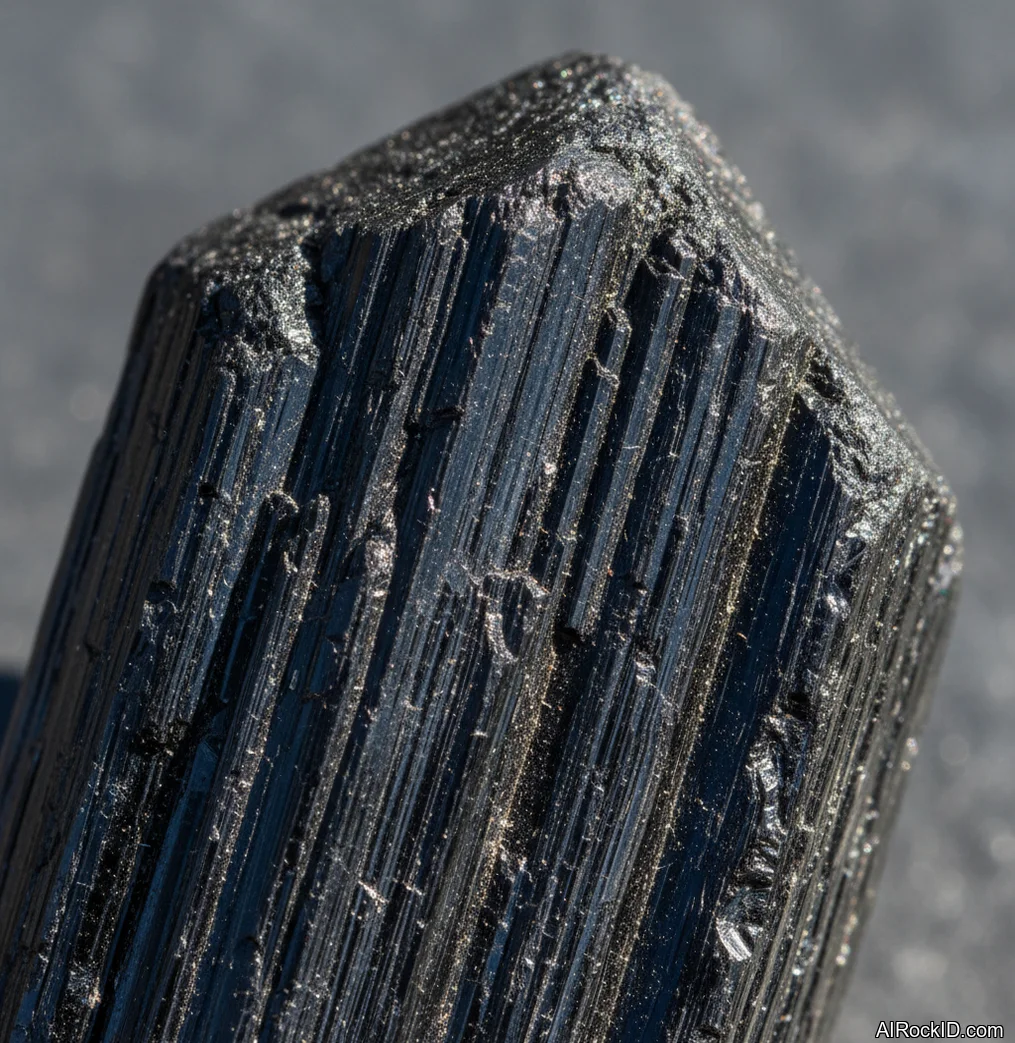
- Black Tourmaline: Black tourmaline commonly shows striated prismatic crystals, while shungite is massive, carved, or irregular rather than crystal-shaped.
Shungite vs. Similar Black Materials
| Material | Typical Look | Simple Difference |
|---|---|---|
| Shungite | Matte to semi-metallic black, sometimes sooty | Carbon-rich; higher-carbon pieces may show noticeable conductivity |
| Obsidian | Glassy black with sharp curved fractures | Volcanic glass, not carbon-rich |
| Jet | Lightweight black organic material | Usually lighter in hand and derived from fossilized wood |
| Black Tourmaline | Black striated crystal or crystal fragments | Often has lengthwise ridges and prismatic form |
| Hematite | Metallic dark gray to black | Much heavier and has a reddish-brown streak |
AI identification confidence
AI identification confidence for shungite is usually moderate from photos because many black rocks and minerals share similar color and luster. Clear images of the surface, fracture, streak mark, and any carved or raw edges improve the result, but conductivity and provenance are often needed for stronger confirmation.
When AI gets it wrong
- Polished black stones can hide texture, streak, and fracture details that help separate shungite from obsidian or dyed materials.
- Low-light photos may make glassy, metallic, and matte surfaces look alike.
- Black tourmaline fragments can be mistaken for rough shungite if crystal striations are not visible.
- Coal, jet, and other carbon-rich materials can resemble shungite without deposit information or simple physical tests.
How to Check Shungite Authenticity
Authentic shungite is commonly associated with deposits in Karelia, Russia, so reputable sellers should be able to state origin and material type. A basic conductivity test can support identification for higher-carbon pieces, but poor conductivity does not automatically disprove shungite because carbon content varies. A dark streak, black residue on unpolished surfaces, and a non-glassy appearance are useful clues, but they are not proof by themselves.
Elite Shungite vs. Common Shungite
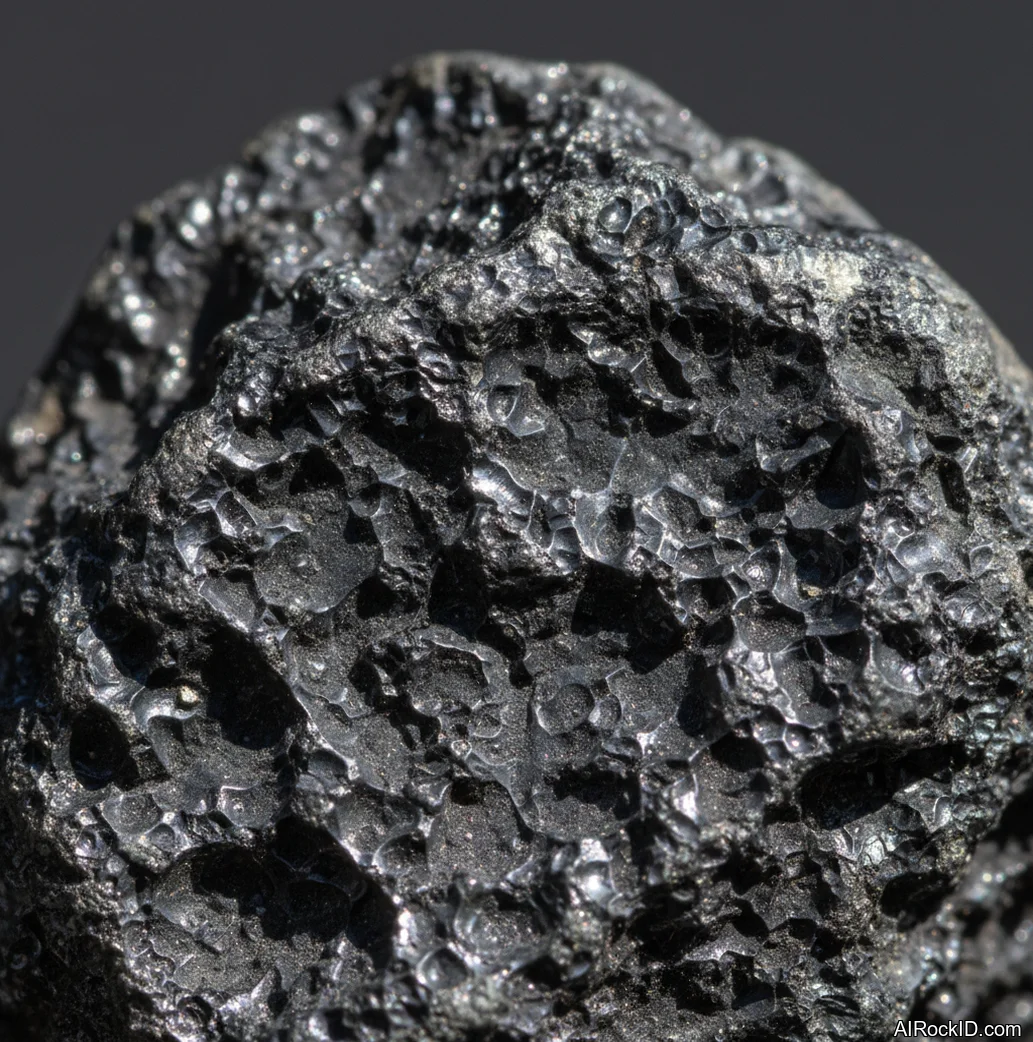
Elite shungite is a higher-carbon variety that often has a silvery metallic sheen and irregular, brittle shapes. Common shungite used for carvings and tumbled pieces is usually lower in carbon and more matte black. The terms are used commercially, so buyers should compare appearance, stated origin, and any available testing rather than relying on the label alone.
Photo Tips for Identifying Shungite
Use natural light and photograph shungite from several angles to show whether the surface is matte, metallic, glassy, or sooty. Include a close-up of a broken or unpolished edge, a streak mark on unglazed ceramic if available, and a size reference. Avoid filters or wetting the stone, because both can make shungite look more like obsidian or polished hematite.
What Is Shungite?
Shungite is a natural, carbon-rich mineraloid rock made mostly of non-crystalline carbon, and it’s best known from Karelia in northwest Russia.
Grab a palm-sized chunk and the first thing that hits you is the heft. It just sits there in your hand, heavier than you’d expect from something that basically looks like a plain black rock. Most pieces have this slightly greasy, sooty feel, and if you rub it with your thumb you’ll sometimes end up with a faint gray-black smudge on your skin (especially if your hands are even a little sweaty). At a quick glance it can pass for coal, but it doesn’t have that soft, crumbly “burnt wood” thing going on. It’s tougher. And the better material? Tilt it under a shop light and you’ll catch a quiet little metallic flash.
And yeah, it’s kind of messy in real life. Raw shungite can drop black dust in your pocket, and it’ll leave streaks on a white box at a show. That’s normal. What isn’t normal is a piece that feels warm and plastic-like, or one that’s perfectly uniform jet-black with some glossy coating. Those usually aren’t what they’re being sold as.
Origin & History
Karelia, Russia keeps popping up any time shungite comes up, and it’s not random. That’s where the classic deposits are, and it’s where the trade name really took hold.
The name “shungite” itself comes from the village of Shunga near Lake Onega. People around there were using the stuff locally long before anyone bothered shipping it out as an export. You can still picture it: dark, sooty-looking rock that leaves a faint black smear on your fingers if you handle it.
Russian researchers working in Karelia wrote about shungite in the 19th century, describing it in the scientific literature as a unique carbon-bearing rock. And in that region it’s had a practical reputation for ages, including being used as a pigment and for simple filtration. Modern interest really ramped up later, when sellers started leaning hard on its electrical conductivity and carbon chemistry.
Where Is Shungite Found?
Commercial shungite is overwhelmingly associated with Karelia in northwest Russia, especially the Lake Onega area near the village of Shunga.
Formation
Most collector-grade shungite is basically metamorphosed carbon sitting in ancient sedimentary rock. Think organic-rich mud and gunky sediment that got buried, cooked, and squeezed for a ridiculously long time, then ended up as a tough, carbon-heavy rock instead of staying soft and coal-like.
Look at a fresh break and it’s usually not perfectly uniform. Some chunks show faint banding, little quartz seams, or that mixed dull-to-shiny look where the carbon content shifts from one spot to the next. That’s the “rock” part. It isn’t some clean, single-mineral crystal, so it behaves more like a carbon-rich blend that’s been compacted and metamorphosed.
How to Identify Shungite
Color: Usually black to charcoal black, sometimes with a steel-gray cast on fresh breaks. Higher-carbon pieces can show a silvery sheen on flat areas.
Luster: Dull to satin, and occasionally sub-metallic on better material.
Pick up a raw piece and rub it on plain white paper. Real shungite often leaves a gray to black mark, kind of like a soft pencil, especially if the surface is fresh. If you scratch it with a copper coin, many pieces will take a mark because it’s relatively soft, and the scratch looks more like a smear than a crisp groove. The real test in hand is feel: it stays cool like stone, and it doesn’t feel like lightweight plastic or resin.
Common Look-Alikes
Shungite is sometimes confused with these materials:
- Anthracite coal
- Obsidian (black glass)
- Jet (lignite)
- Dyed black quartz
- Black tourmaline (schorl)
- Cheap resin or glass fakes
Market Cautions & Treatments
When AI Can Get This Wrong
AI often mixes up shungite with obsidian or jet in photos since all three go jet black and take a polish. Anthracite coal gets thrown in the mix too. Only shungite leaves that greasy smudge when you rub a raw piece—if you can't test that, photos alone aren't enough.
Properties of Shungite
Physical Properties
| Crystal System | Amorphous |
| Hardness (Mohs) | 3.5-4 (Soft (2-4)) |
| Density | 1.8-2.1 g/cm3 |
| Luster | Dull |
| Diaphaneity | Opaque |
| Fracture | Uneven |
| Streak | black to gray-black |
| Magnetism | Non-magnetic |
| Colors | black, charcoal, steel gray |
Chemical Properties
| Classification | Native elements (carbon; mineraloid rock) |
| Formula | C |
| Elements | C |
| Common Impurities | Si, O, Fe, S, Al, Ca, Mg |
Optical Properties
| Refractive Index | 2.42 |
| Birefringence | None |
| Pleochroism | None |
| Optical Character | Isotropic |
Shungite Health & Safety
Handling is usually safe. But if you’ve just snapped a piece or sanded it down, it can shed that black residue, the kind that smudges onto your fingertips and leaves little marks on whatever you touch next.
Safety Tips
If you’re drilling, sanding, or cutting it, put on a dust mask. That fine carbon dust gets everywhere (it sticks to your fingertips and leaves those little gray smudges), and it’s irritating to breathe. And wash your hands afterward.
Shungite Value & Price
Price Range
Rough/Tumbled: $5 - $60 per piece
Thing is, the price can jump around a lot, and it usually comes down to carbon content, the finish (raw vs polished vs carved), and whether the seller’s calling it “noble” shungite, the kind with that brighter, more metallic-looking sheen when you tilt it in the light.
Durability
Nondurable — Scratch resistance: Fair, Toughness: Fair
It’s stable as a rock, but it scuffs, sheds black residue, and can chip on sharp edges if you bang it around.
How to Care for Shungite
Use & Storage
Keep it in a pouch or a box if you don’t want black smudges on other stones. I don’t store it loose with white calcite or satin spar because it can dirty them up fast.
Cleaning
1) Rinse quickly under lukewarm water. 2) Use a soft toothbrush with a tiny drop of mild soap for crevices. 3) Pat dry and let it air-dry fully before putting it back in a bag.
Cleanse & Charge
If you do metaphysical cleansing, stick to gentle stuff like smoke, sound, or a quick rinse and dry. Long soaks can make the water look gray from surface residue.
Placement
I like it on a desk or near electronics because it doesn’t mind being handled and it won’t fade in sunlight. Just use a coaster or tray if you’ve got polished wood you care about.
Caution
Don’t count on a mirror polish staying spotless. It’ll grab fingerprints the second you touch it, and those tiny hairline scratches show up fast. And if the piece is raw, the edges can feel a bit grabby (almost like fine sandpaper), so it can scuff fabric and even leave marks on a wall if it rubs.
Works Well With
Shungite Meaning & Healing Properties
Most people grab shungite when they want something grounded and no-nonsense. In my own stash, it’s the piece I shove in a pocket when my brain’s pinging all over the place and I don’t want anything delicate or fussy. It’s got that heavy, quiet feel in your hand, like a smooth little weight that just sits there. And since it’s literally carbon-rich and conductive, a lot of folks connect it with “clearing” and “filtering” vibes.
But look, the market around it gets messy. A ton of online chatter turns shungite into a cure-all, and that’s where it goes off the rails fast. I treat the metaphysical side as a personal ritual thing, not a medical thing. If you’re buying it for “EMF shielding,” remember a chunk of rock on a table isn’t a lab-tested device, even if the material itself is conductive. So yeah, keep your expectations in check.
Put two pieces next to each other and you’ll see why people fight about what counts as “real.” The shinier, higher-carbon stuff feels slicker, almost oily (in that dry way), and it doesn’t leave as much crumbly black residue. The more common matte pieces? Rub them hard and you can end up with that dirty-pencil smudge on your fingers and maybe a little grit on the bottom of your palm. Either way, the energy people talk about is usually steady, protective, grounding. The kind of stone you keep around when life’s loud and you want something that won’t budge.
Common mistakes
- Assuming every black stone sold as shungite is from Karelia without checking seller details
- Confusing glassy black obsidian with shungite because both can be polished into similar shapes
- Expecting all shungite to conduct electricity equally, even though conductivity varies with carbon content
- Using color alone to identify shungite instead of checking streak, luster, texture, and weight
- Treating a shiny coating or polish as evidence of elite shungite
- Buying very cheap carved pieces without considering dyed stone, coal-like material, or vague origin claims
Identify Shungite from a photo
Compare Shungite traits, care tips, value clues, and common lookalikes with a clear photo.