Steatite Soapstone


Quick answer: Steatite soapstone is a very soft, talc-rich rock known for its smooth, waxy or soapy feel. It is often identified by its low hardness, muted gray-green to brown colors, and ability to be scratched easily with a fingernail.
AI Rock ID can help compare a photo of suspected steatite soapstone with visually similar soft rocks and carved materials. RockIdentifier.io provides reference details that are useful for checking texture, hardness, and likely lookalikes before labeling a specimen.
Good fit
- Collectors who want a soft, tactile rock specimen with a distinctive soapy feel
- Carvers and craft users seeking a material that can be shaped with simple tools
- Beginners practicing basic hardness and texture-based rock identification
- Buyers evaluating carved bowls, figurines, beads, or heat-resistant stone items
Not a good fit
- Jewelry pieces that need high scratch resistance or daily-wear durability
- Wet or abrasive settings where a very soft stone may wear quickly
- Anyone needing a precise mineral name, since soapstone is a rock made of multiple minerals
- Specimens that must remain free of surface marks from handling or testing
Most commonly confused with
- Serpentine: Serpentine is usually harder than steatite soapstone and may show a waxy green appearance without the same talc-soft scratch response.
- Alabaster: Alabaster is gypsum or calcite-based, often paler and more translucent, and does not usually have the same soapy talc feel.
- Jade: Jade is much tougher and harder, while steatite soapstone scratches easily and is commonly used as an inexpensive carving material.
- Chlorite: Chlorite-rich rocks can be green and soft, but they may feel more flaky or earthy rather than uniformly soapy.
Steatite Soapstone vs. Similar Materials
| Material | Typical Hardness | Key Difference | Common Use |
|---|---|---|---|
| Steatite soapstone | About Mohs 1 | Very soft with a smooth, soapy talc feel | Carving, counters, heat-resistant items |
| Serpentine | About Mohs 2.5–5 | Usually harder and more waxy than soapy | Carving, decorative stone |
| Alabaster | About Mohs 2–3 | Often pale, fine-grained, and slightly translucent | Sculpture, decorative objects |
| Jade | About Mohs 6–7 | Much tougher and harder to scratch | Jewelry, carvings |
| Chlorite-rich rock | Variable, often soft | May look green but can be flaky or earthy | Specimens, altered rock samples |
AI identification confidence
AI identification of steatite soapstone is usually more reliable when the photo is paired with simple tests such as fingernail scratch response and a description of the soapy feel. Image-only results can be uncertain because many green, gray, or carved stones share similar surface colors and shapes.
When AI gets it wrong
- Polished or oiled soapstone can look darker and resemble serpentine or jade in photos.
- Carved items may be mislabeled because shape and craftsmanship can hide natural texture.
- Low lighting can make gray, green, and brown stones appear similar.
- A photo cannot confirm talc content, asbestos risk, or exact mineral composition.
Final recommendation
For identification, combine visual inspection with a gentle hardness test and texture check rather than relying on color alone. For buying, ask whether the item is natural soapstone, treated or dyed, and intended for decorative, carving, or heat-resistant use.
How to Check Steatite Soapstone Before Buying
A genuine steatite soapstone item should feel smooth or slightly soapy and should scratch very easily compared with harder decorative stones. Ask sellers whether the piece is natural, dyed, waxed, or oiled, since surface treatments can change color and sheen. For cookware, counters, or stove-related items, confirm the product is sold for that specific use rather than assuming every soapstone object is heat-safe.
Natural vs. Dyed or Oiled Soapstone
Soapstone is often oiled or waxed to deepen its color and reduce a chalky surface appearance. Dyed pieces may show unusually even or intense color, especially in beads and small carvings. Surface treatment does not always mean the item is fake, but it should be disclosed when color, price, or intended use matters.
Simple Field Clues for Steatite Soapstone
Steatite soapstone can usually be marked by a fingernail or copper coin because of its high talc content. It often has a dense, fine-grained texture rather than visible crystals. A powdery scratch mark, dull luster, and slippery feel are useful clues, but laboratory testing is needed for exact mineral composition.
What Is Steatite Soapstone?
Steatite, the stuff people call soapstone, is a talc-rich metamorphic rock. It’s mostly massive talc, and you’ll often find chlorite, magnesite, plus amphiboles mixed in.
Grab a chunk and you instantly get the nickname. It’s slick, almost “greasy,” but not in a gross way, more like a bar of soap that’s been used a few times and still has that smooth slip to it. And it usually feels warmer in your hand than quartz or agate does, partly because it’s so soft and the surface doesn’t have that cold, glassy snap.
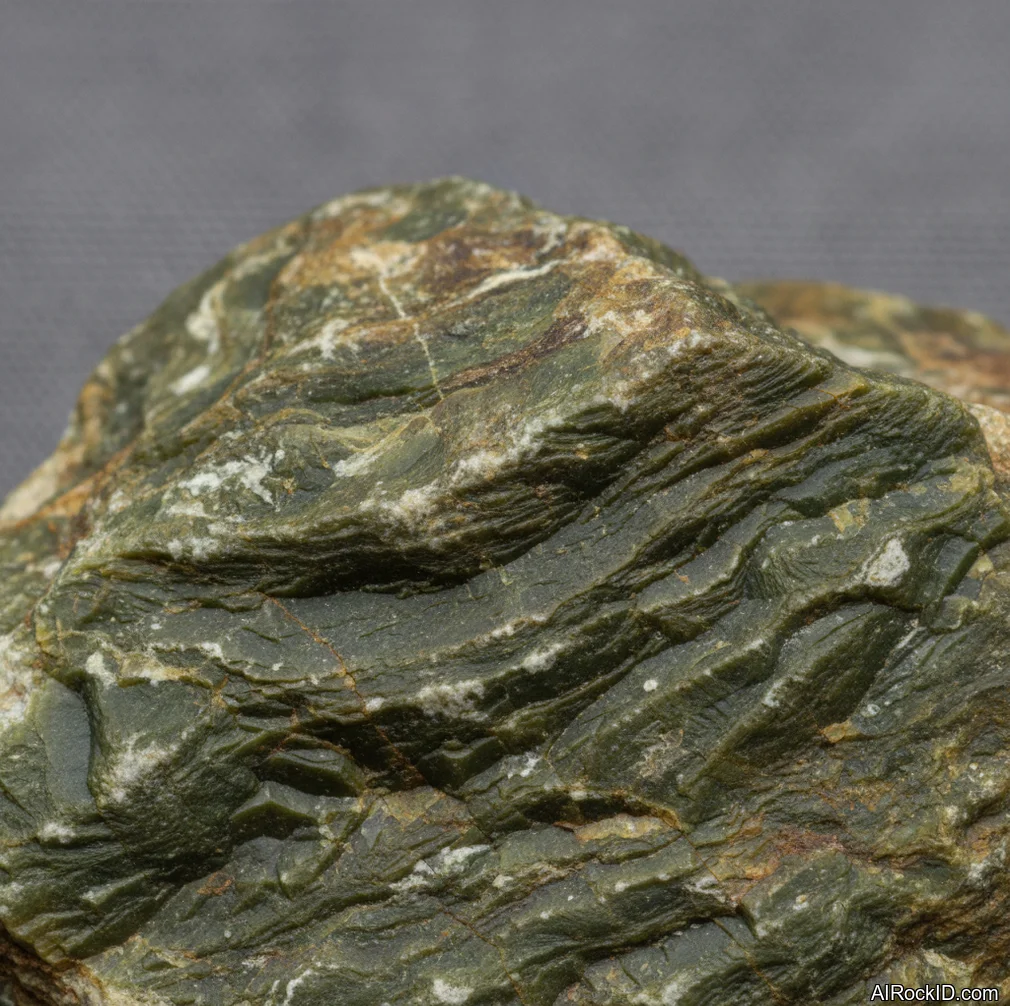
From across the room it just looks like a gray or greenish rock. But look closer and the little collector details pop out: faint white veining, color patches that drift from dove-gray to olive, and a quiet, waxy sheen that shows up after it’s been rubbed or handled a lot (you can almost tell where someone’s thumb kept worrying at the same spot). Thing is, “soapstone” gets tossed around for a bunch of soft, carvable rocks. True steatite is talc-dominant, and it behaves like it.
Origin & History
“Steatite” comes from the Greek “steatites,” which basically means “fat stone,” and yeah, that tracks the second you pick a piece up. It feels kind of slick and waxy under your fingers, like it’s got a built-in layer of soap. “Soapstone” is the trade name, and the stone business has leaned on that name forever because the feel sells it almost instantly.
Talc, the mineral, got its formal description in early modern mineralogy. But soapstone as something people actually used? That goes way further back. Folks carved it, cooked with it, built with it, long before anybody was talking about crystal systems. Walk through a museum gift shop and you’ll see soapstone animals and bowls from all over the place, and honestly they’re usually exactly what you’d expect: soft, workable talc rock that grabs detail fast, then picks up dents just as fast. Kind of the deal, right?
Where Is Steatite Soapstone Found?
Soapstone shows up in metamorphic belts where magnesium-rich rocks got altered, so you see it in places like the Alps, parts of Brazil, Russia, India, and pockets across the eastern and western USA.
Formation
Most soapstone shows up after magnesium-rich rocks have been cooked and squeezed, with reactive fluids sneaking through and nudging the chemistry toward talc. Think altered ultramafics like peridotite or serpentinite. Or dolomitic rocks that had a lot of silica-rich fluid moving through them.
But unlike a clean crystal species you can slap on a label, soapstone’s more like a recipe rock. Talc’s the main ingredient. Chlorite can push it green, magnesite gives it that faint chalky bite, and tremolite or anthophyllite can show up as little fibrous bits you can actually catch with a fingernail if you’re paying attention. So that’s why one chunk carves like butter and the next feels a little gritty under your thumb.
How to Identify Steatite Soapstone
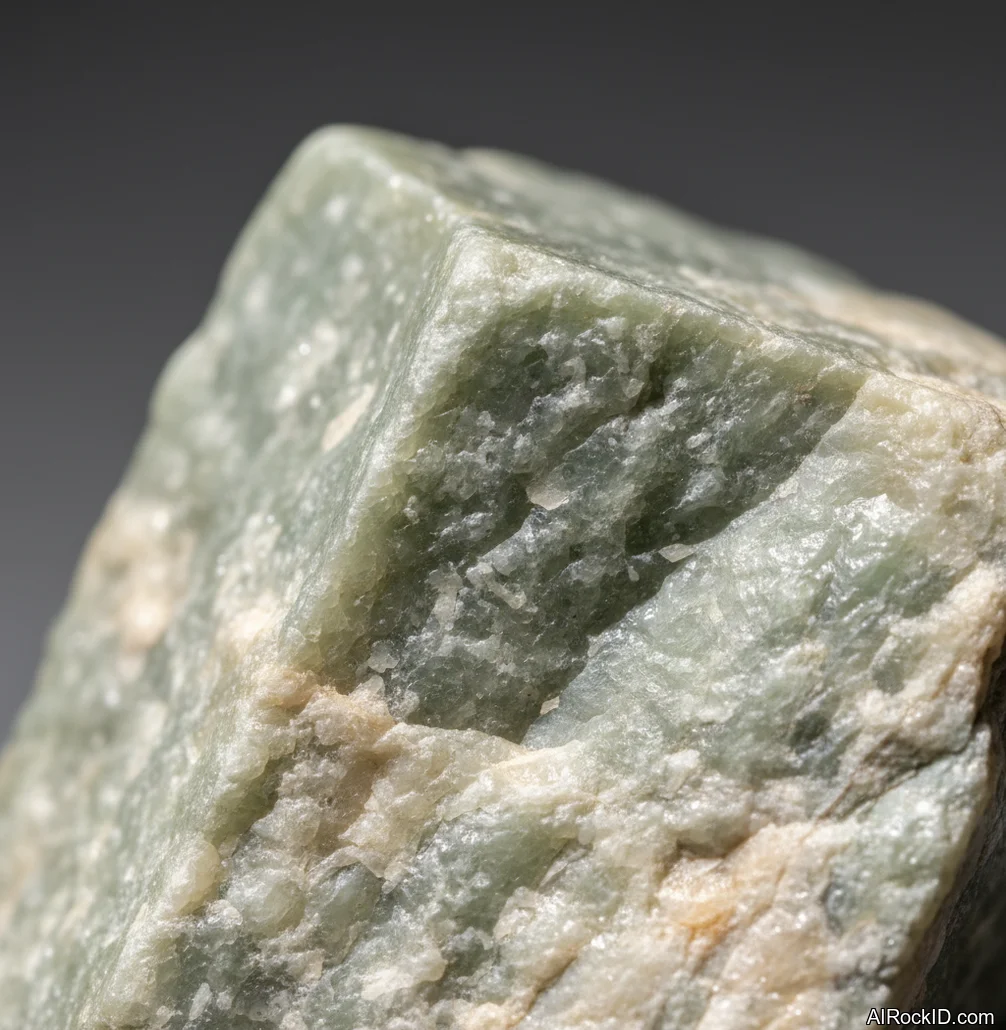
Color: Most steatite soapstone sits in the gray to gray-green range, sometimes with creamy white veining or darker green patches from chlorite. Weathered surfaces can look dull and pale compared to a fresh cut.
Luster: Luster is typically waxy to dull, and it can look slightly satiny on a worn or polished spot.
If you scratch it with a fingernail, it’ll mark easily, and a copper coin will cut a clear line. The real test is the feel: it’s slick, almost like talc powder got pressed into a solid bar. And if you rub it hard with your thumb, you can sometimes raise a faint pale streak on the surface, like you’re burnishing it.
Common Look-Alikes
Steatite Soapstone is sometimes confused with these materials:
- Talc (pure, massive form)
- Alabaster (especially dyed varieties)
- Dyed marble
- Serpentine
- Chalk (sometimes carved and sold as 'soft stone')
- Resin or ceramic imitations
Market Cautions & Treatments
When AI Can Get This Wrong
AI photo ID often mixes up steatite with serpentine and dyed alabaster, especially when carvings are involved. Photos can't show the greasy, soap-bar texture or the way a real piece scratches easy with a metal nail. A scratch test and feeling for that slippery warmth are hard to fake in a picture.
Properties of Steatite Soapstone
Physical Properties
| Crystal System | Monoclinic |
| Hardness (Mohs) | 1 (Very Soft (1-2)) |
| Density | 2.6-2.8 g/cm3 |
| Luster | Waxy |
| Diaphaneity | Opaque |
| Fracture | Uneven |
| Streak | White |
| Magnetism | Non-magnetic |
| Colors | Gray, Green, Blue-gray, White, Cream |
Chemical Properties
| Classification | Silicates (phyllosilicate) |
| Formula | Mg3Si4O10(OH)2 |
| Elements | Mg, Si, O, H |
| Common Impurities | Fe, Al, Ca, Ni, Cr |
Optical Properties
| Refractive Index | 1.539-1.550 |
| Birefringence | 0.010-0.013 |
| Pleochroism | Weak |
| Optical Character | Biaxial |
Steatite Soapstone Health & Safety
It’s safe to handle, and getting it wet is totally fine. The real issue only shows up when you start carving, sawing, or sanding it. That’s when you can kick up that super-fine dust (the kind that hangs in the air), and breathing that in is the main risk.
Safety Tips
Use wet sanding or set up local dust collection, and wear a properly fitted respirator when you’re cutting or carving. And if you’ve been working with it, go wash your hands before you eat. Dust sticks to your skin (and gets under your nails), even if you don’t notice it right away.
Steatite Soapstone Value & Price
Price Range
Rough/Tumbled: $3 - $30 per piece
Price mostly comes down to size, how even the color looks, and how clean it is when you actually put a tool to it. Big blocks and well-shaped preforms run higher, no surprise there. But those little tumbled stones you can roll around in your palm (smooth, almost waxy on the surface)? They usually stay cheap.
Durability
Fragile — Scratch resistance: Poor, Toughness: Fair
It’s chemically pretty stable in normal conditions, but it dents, scratches, and bruises incredibly easily because it’s talc-dominant.
How to Care for Steatite Soapstone
Use & Storage
Store it away from harder stones, because anything from quartz to a key in your pocket will scratch it. I keep soapstone in a soft pouch or wrapped in a cloth so it doesn’t pick up random scuffs.
Cleaning
1) Rinse with lukewarm water. 2) Use a tiny bit of mild soap and your fingers or a very soft cloth. 3) Pat dry and let it air-dry fully before putting it back in a bag or box.
Cleanse & Charge
If you do energetic cleansing, running water and smoke are both gentle options for soapstone. Skip salt scrubs since the grit can leave dull scratches.
Placement
Set it somewhere it won’t get knocked around, like a bedside table tray or a desk corner. It’s great as a “worry stone,” but expect it to polish and wear where your thumb hits it.
Caution
Don’t use ultrasonic or steam cleaners on it. And don’t just drop it into a bowl with harder tumbles where it’ll get knocked around and come out with fresh dings. If you carve it, take the dust seriously. Work wet (keep a little puddle going so the dust turns to sludge) or set yourself up with solid ventilation.
Works Well With
Steatite Soapstone Meaning & Healing Properties
In metaphysical circles, people talk about soapstone like it’s this calming, grounding material. And yeah, I see why. When you actually hold it, there’s no “sparkly” buzz to it, just this steady, quiet weight in your palm, like the smooth little rock you’d keep in a pocket on a rough day.
Grab one of those worn worry-stone versions and it’s obvious what people mean. It warms up fast, almost like it’s borrowing heat from your hand right away. And the surface? It kind of funnels your thumb into the same groove every time, like it’s been rehearsed. That little bit of physical feedback is a huge reason people reach for it when they’re stressed. It’s not “magic” to say repetitive touch can steady your breathing and pull your attention back to one spot. It’s a tactile anchor. Simple as that.
But look, here’s the honest part: if you want a stone you can carry daily without it getting chewed up, soapstone isn’t the one. It’ll collect scratches from coins and keys, and if you drop it on tile you can chip an edge. So I treat it more like a comfort object for home, meditation, or sitting on your desk. Not a medical tool. If you’re dealing with anxiety, sleep issues, or pain, crystals can be part of a routine, sure, but they don’t replace proper care.
Common mistakes
- Assuming every green carved stone is jade when many are softer soapstone or serpentine
- Identifying soapstone by color alone, even though it can be gray, green, brown, black, or mottled
- Using an aggressive scratch test on a finished carving or countertop surface
- Assuming all soapstone has the same heat resistance, density, or durability
- Ignoring surface oil, wax, or dye when judging natural color
- Treating soapstone as a single mineral instead of a talc-rich rock
Identify Steatite Soapstone from a photo
Compare Steatite Soapstone traits, care tips, value clues, and common lookalikes with a clear photo.