Uvarovite Garnet


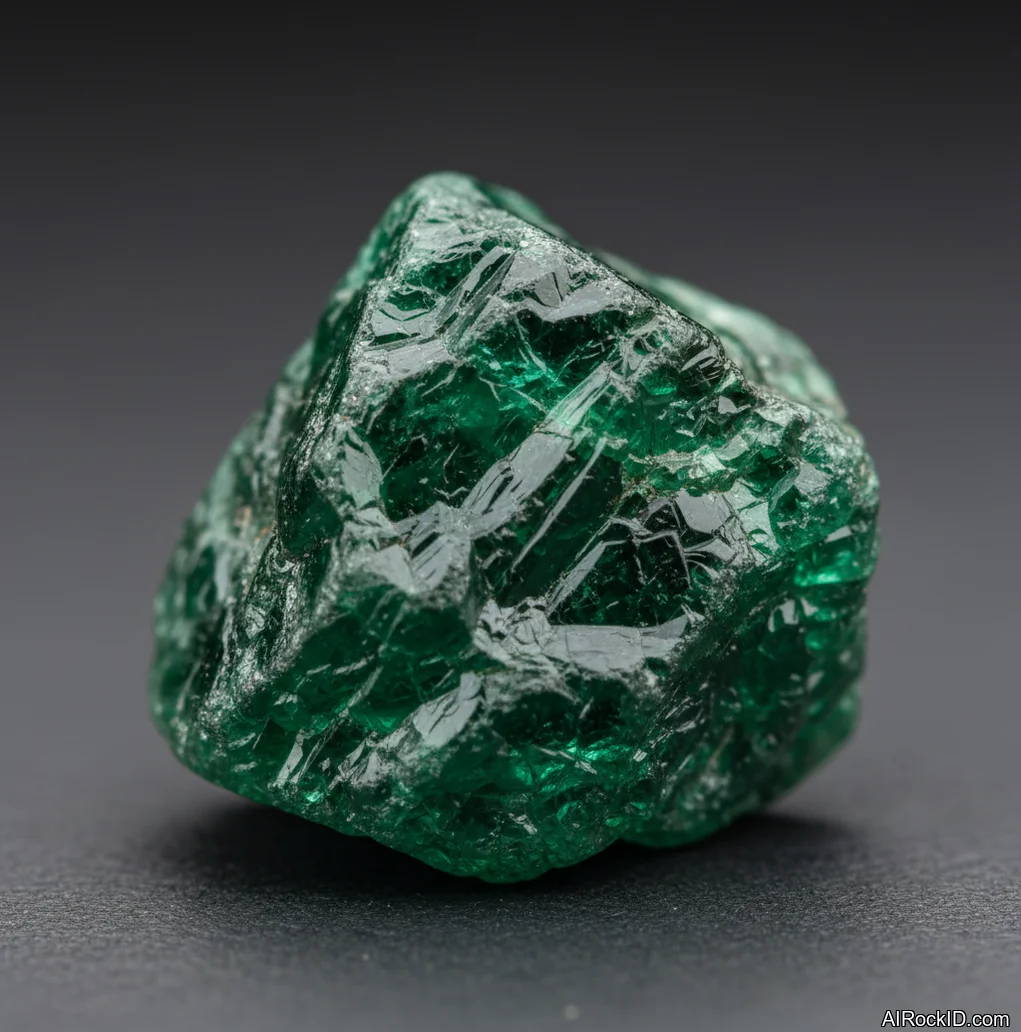
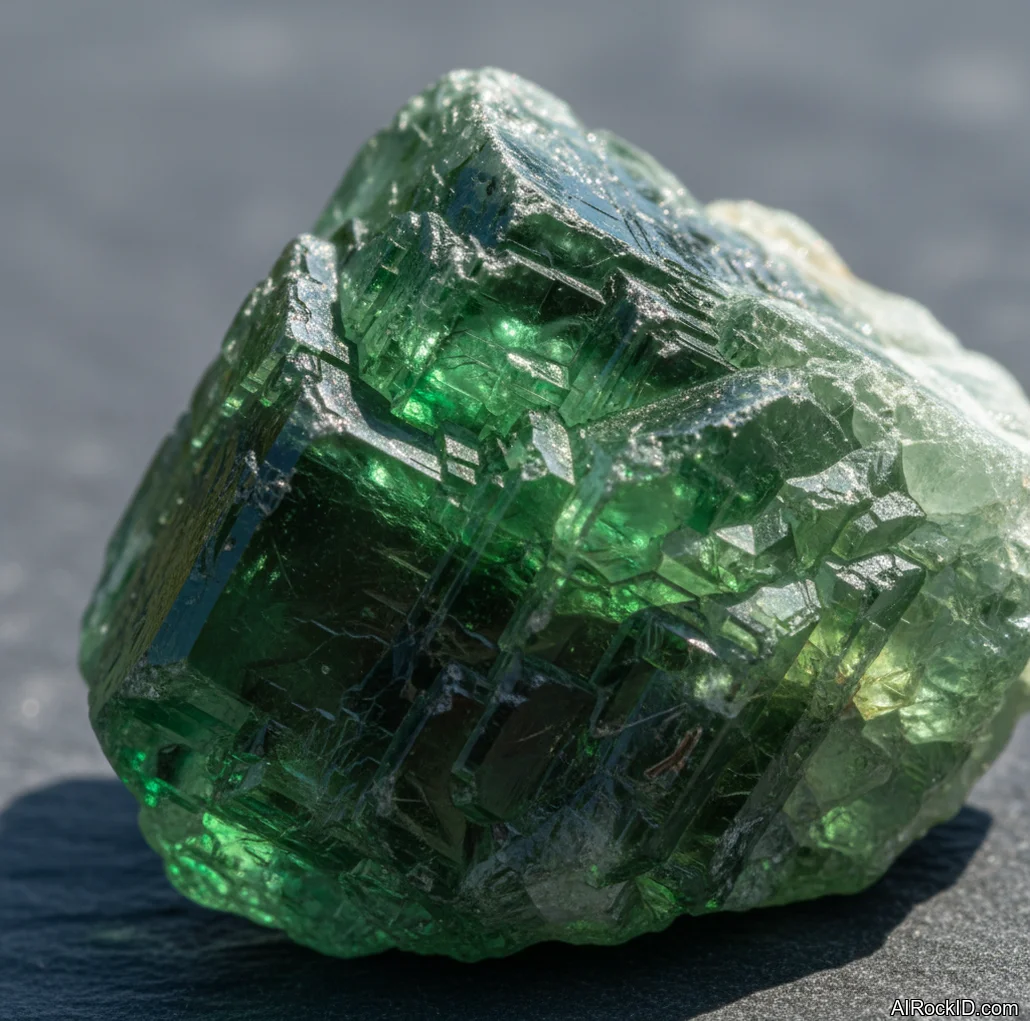
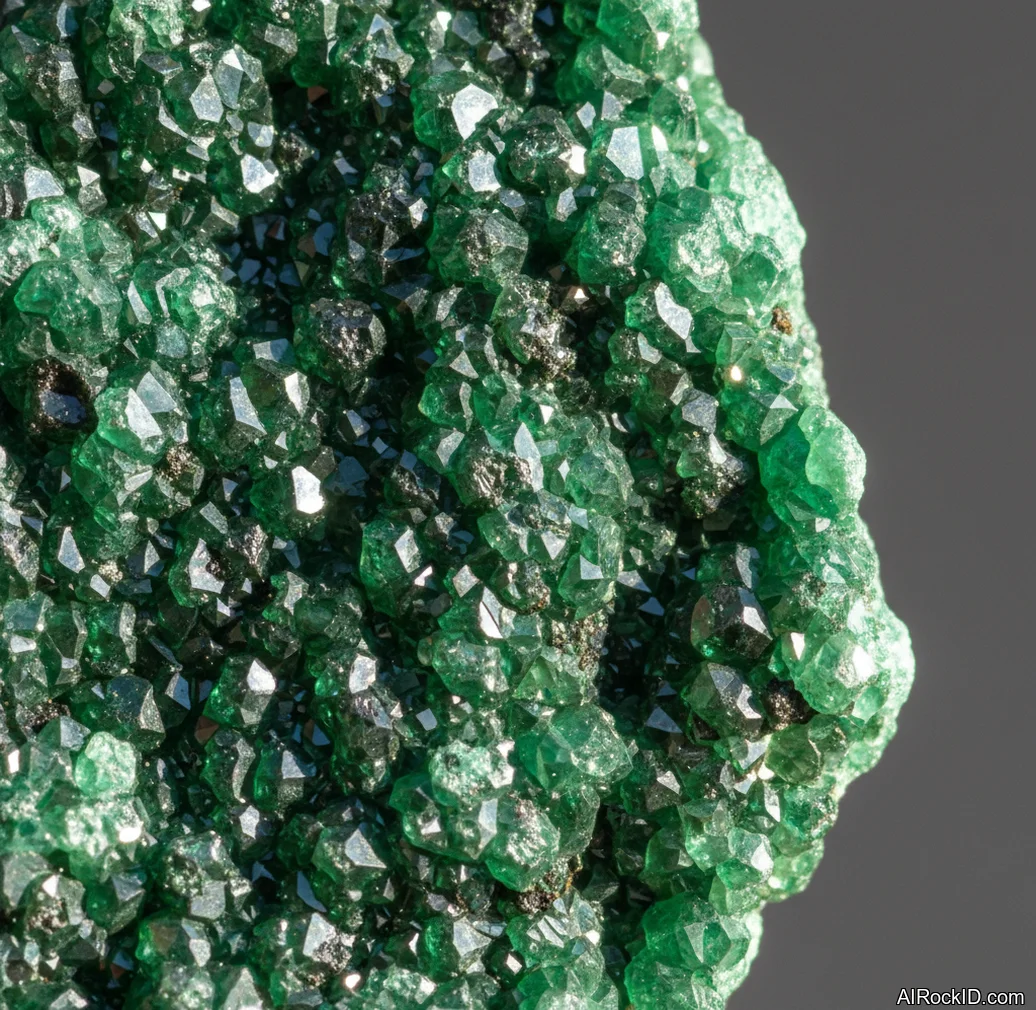
Quick answer: Uvarovite garnet is most often identified by its vivid emerald-green color, tiny druzy crystal habit, and occurrence on a rock matrix. Because it is rarely cut into large faceted gems, loose “uvarovite” stones should be checked carefully for identity and treatment claims.
AI Rock ID can help screen a suspected uvarovite garnet by comparing color, crystal habit, luster, and visible matrix features from a clear photo. RockIdentifier.io provides educational identification support, but rare garnets and lookalikes may still require gemological testing for confirmation.
Good fit
- Collectors who like bright green druzy crystal specimens
- People seeking a rare garnet variety rather than a common faceted stone
- Display pieces kept on matrix rather than jewelry for daily wear
- Specimens with documented locality or reputable seller information
Not a good fit
- Buyers looking for large transparent faceted green gems
- Rings or bracelets exposed to frequent knocks and abrasion
- Anyone needing a confirmed species without lab testing or seller documentation
- Collectors who prefer minerals that are easy to clean in water or ultrasonic devices
Most commonly confused with
- Tsavorite Garnet: Tsavorite is a green grossular garnet that is commonly faceted, while uvarovite usually forms tiny druzy crystals on matrix.
- Demantoid Garnet: Demantoid is a green andradite garnet with strong fire in faceted stones; uvarovite is chromium-rich and typically occurs as small surface crystals.
- Emerald: Emerald is beryl and often shows hexagonal crystal habits or faceted gem use, unlike the small isometric garnet crystals of uvarovite.
- Chrome Diopside: Chrome diopside can be a vivid green gem, but it has different cleavage and crystal habit and is not a garnet.
Uvarovite Garnet vs. Green Lookalikes
| Material | Typical Appearance | Key Difference |
|---|---|---|
| Uvarovite Garnet | Tiny emerald-green druzy crystals on matrix | Rare chromium garnet, usually not found as large faceted gems |
| Tsavorite Garnet | Transparent green faceted stones or crystals | Green grossular garnet; more common in cut jewelry |
| Demantoid Garnet | Yellow-green to green faceted stones | Andradite garnet noted for high dispersion |
| Emerald | Green hexagonal crystals or faceted gems | Beryl mineral with different crystal system and inclusions |
| Chrome Diopside | Deep green faceted stones | Softer pyroxene mineral with cleavage, not garnet |
AI identification confidence
Photo-based identification confidence is usually higher when uvarovite appears as bright green druzy crystals on a contrasting matrix. Confidence drops when the image shows only a green cabochon, a faceted stone, or a close-up without scale and matrix context.
When AI gets it wrong
- The photo is heavily saturated, filtered, or taken under colored lighting.
- Only a loose green gemstone is shown without crystal habit or matrix.
- The specimen is coated, dyed, or mislabeled as a rarer garnet variety.
- The crystals are too small or blurry to distinguish from green coatings or other druzy minerals.
Final recommendation
Choose uvarovite garnet when the goal is a rare green druzy specimen with visible crystal texture and credible provenance. For wearable green garnet jewelry, tsavorite or demantoid is usually more practical than fragile uvarovite on matrix.
How to Check Uvarovite Garnet Authenticity
Authentic uvarovite is typically sold as small, vivid green crystals attached to a host rock, not as large transparent cut stones. Look for natural crystal faces, uneven matrix contact, and seller details such as locality and mineral species. Be cautious with listings that use only broad terms like “green garnet” without specifying uvarovite or that show unusually large faceted gems at low prices.
Buying Uvarovite Garnet Specimens
Specimen value depends on color intensity, crystal coverage, sparkle, matrix stability, locality, and overall aesthetics. A well-composed small cabinet specimen may be more desirable than a larger piece with dull color, damaged crystals, or unstable matrix. Ask for photos in natural light and close-ups that show crystal texture rather than only distant display images.
Locality Clues for Uvarovite Garnet
Uvarovite is associated with chromium-rich geological environments and is often reported from metamorphic rocks, serpentinite-related settings, and chromite-bearing deposits. Known specimen sources include localities in Russia, Finland, Turkey, Italy, and other regions with chromium-bearing rocks. Locality information does not prove identity by itself, but it can support a more credible identification when combined with appearance and testing.
What Is Uvarovite Garnet?
Uvarovite garnet is the chromium-rich, emerald-green kind of garnet with the formula Ca3Cr2(SiO4)3. And most of the stuff you actually run into isn’t some big, clean crystal you can pinch between your fingers and hold up to a window. It’s more like a crust. A tight carpet of tiny dodecahedrons stuck to the matrix, like green sugar baked onto a chunk of darker rock.
Grab a solid plate in your hand and two things jump out fast. First, the sparkle isn’t that soft, glassy “quartz druzy” twinkle. It’s sharper. Pointier. You can tell you’re looking at little flat garnet faces, not a bunch of rounded bumps. Second, the green doesn’t read as dyed or fake. It’s that clean chromium green that stays green even when you tip it under warm indoor light, and the best pieces throw tiny flashes like somebody dusted the surface with glitter (you’ll see it along the crystal edges when you move it).
But here’s the collector reality: uvarovite is usually a display mineral, not a ring stone. Faceted stones do exist, sure, but they’re small and pricey for the size. So most dealers are really selling specimens, and the value comes down to crystal coverage, brightness, and how intact that drusy skin is around the edges.
Origin & History
In 1832, uvarovite got its first real description from Germain Henri Hess, working with material dug out of Russia’s Ural Mountains. He named it after Count Sergey Semenovich Uvarov, a Russian statesman who, back then, was a serious backer of science and mineral collecting.
Old Russian uvarovite has picked up a little legend at shows, mostly because that classic locality turned out those tight, even green druse crusts that look almost unreal in photos. But the name itself isn’t some ancient folklore label. It’s plain 19th century mineralogy, from that era when people were trying to get the garnet family organized into something that actually made sense.
Where Is Uvarovite Garnet Found?
Good uvarovite turns up in chromite-bearing metamorphic settings, especially in serpentinite zones. Russia and Finland are the classic sources, with smaller occurrences scattered worldwide.
Formation
Look at the kind of places uvarovite actually shows up and the whole thing starts to make sense. Like any garnet, it needs calcium and silica. But here’s the catch: you’ve also got to have chromium close by, and that usually points straight at rocks tied to ultramafics and chromite. A lot of uvarovite forms during metamorphism, when fluids push through serpentinite (or related rocks), and the chemistry just happens to line up in that narrow little sweet spot.
Most specimens come out drusy for a simple reason: uvarovite likes growing as tight, sparkly clusters on open surfaces and along fractures. Not the big, free-standing crystals people hope for. Those need room and the right chemistry, and in this situation? That combo doesn’t show up often. And the matrix is all over the place, from dark green serpentinite to chromite-rich rock that’s nearly black, with that dull, slightly metallic look you notice when you tilt it under a light.
How to Identify Uvarovite Garnet
Color: Bright emerald to grass green is the classic look, caused by chromium. The color is typically strongest in the tiny crystal faces and can look darker where crystals are thicker.
Luster: Vitreous to slightly resinous sparkle on clean crystal faces.
Pick up the specimen and tilt it under a single light source. Real uvarovite druse gives sharp, geometric flashes off lots of tiny faces, not the smoother shimmer you get from dyed quartz. The real test is a loupe: you should see little garnet shapes, usually dodecahedrons, packed together like a mosaic. But don’t expect a perfect, even lawn of crystals every time, edge damage and bald patches are normal and sellers sometimes hide them with angled photos.
Common Look-Alikes
Uvarovite Garnet is sometimes confused with these materials:
- Chrome diopside (especially small dark-green crystals on matrix that get called “uvarovite” in listings)
- Grossular garnet (tsavorite or green grossular; bigger, cleaner crystals can fool people who expect garnet = single crystals)
- Chrome mica (fuchsite) coatings on schist, which can look like a green glittery crust from a distance
- Green drusy quartz that’s been dyed (the “green sugar” look, but the crystals are quartz points instead of tiny garnet dodecahedrons)
- Green glass druse or “sugar glass” on matrix (too-perfect sparkle, too light in the hand, often glued on)
Market Cautions & Treatments
When AI Can Get This Wrong
At first glance, AI tends to tag uvarovite plates as dyed drusy quartz or “green druzy” because photos flatten the tiny dodecahedrons into a generic sparkle. Chrome diopside on matrix and fuchsite glitter are another trap in phone pics, especially when the crystals are small. The real test is a close macro shot or a loupe: uvarovite shows blocky dodecahedron faces and sharp edges, and it should scratch glass around the upper end of its 6.5 to 7.5 range while dyed quartz druse is still just quartz points with color sitting in seams.
Properties of Uvarovite Garnet
Physical Properties
| Crystal System | Cubic |
| Hardness (Mohs) | 6.5-7.5 (Hard (6-7.5)) |
| Density | 3.40-3.77 g/cm3 |
| Luster | Vitreous |
| Diaphaneity | Transparent to translucent |
| Fracture | Conchoidal |
| Streak | white |
| Magnetism | Non-magnetic |
| Colors | emerald green, grass green, dark green |
Chemical Properties
| Classification | Silicates (nesosilicates) |
| Formula | Ca3Cr2(SiO4)3 |
| Elements | Ca, Cr, Si, O |
| Common Impurities | Fe, Al, V |
Optical Properties
| Refractive Index | 1.83-1.86 |
| Birefringence | None |
| Pleochroism | None |
| Optical Character | Isotropic |
Uvarovite Garnet Health & Safety
Handling and rinsing are pretty low risk. But don’t grind or sand any garnet-bearing rock unless you’ve at least got basic dust protection in place. Some pieces have needle-sharp points, and the matrix can be crumbly enough to flake off in your hands (ask me how I know).
Safety Tips
If you’re cutting or trimming matrix, put on eye protection and a respirator rated for fine dust. That stuff turns into a gritty haze fast (you can feel it on your teeth), so do the cleanup wet to keep the dust down.
Uvarovite Garnet Value & Price
Price Range
Rough/Tumbled: $30 - $600 per specimen
Cut/Polished: $80 - $400 per carat
Price mostly follows color and how fully the crystals cover the piece, then it shifts to where it came from and how clean the druse surface looks. Big plates with an even blanket of bright crystals, plus little to no edge bruising (that chalky, chipped rim you notice right away when you run a finger along it), climb in price fast.
Durability
Moderate — Scratch resistance: Good, Toughness: Fair
The crystals are hard, but the drusy crust can chip or shed if it’s knocked or rubbed in a box.
How to Care for Uvarovite Garnet
Use & Storage
Store uvarovite plates in a padded box with the crystal side up so nothing scrapes the druse. If you stack flats, put a firm foam sheet between them.
Cleaning
1) Rinse briefly with lukewarm water to float off dust. 2) Use a very soft brush around the edges only, not a hard scrub on the crystal carpet. 3) Pat dry and let it air dry fully before boxing it back up.
Cleanse & Charge
For a metaphysical reset, I stick to smoke, sound, or a quick rest on a slab of selenite. Avoid salt bowls because grains can grind against the druse if you move it around.
Placement
A shelf at eye level is best because the sparkle shows when you can tilt it a little. Keep it out of high-traffic spots where sleeves, pets, or vacuum hoses can bump it.
Caution
Don’t throw it in a tumbler, and don’t just drop a drusy piece loose in your pocket. Yeah, the crystals themselves are hard. But the spot where they’re attached to the matrix? That’s the part that gives out first.
Works Well With
Uvarovite Garnet Meaning & Healing Properties
At first glance, uvarovite reads like a heart-stone to a lot of people just because of that color, and yeah, I get it. When I’ve got it in my hands at a table, it’s this clean green that says “fresh start” without tipping into sweet or sappy. It’s steadier than that. Think moss on shaded rock, the kind that looks almost damp even when it’s dry.
In my own practice, I use it more like a nudge to stay connected to what’s real and already working, not some magic fix. I’ll park a little plate of it where I can see it while I’m grinding through boring admin, because the tiny flashes catch my eye and pull me back in without getting me all spun up. And it’s not medical care. A mineral doesn’t replace therapy, sleep, or getting your iron checked if you’re feeling wiped.
But there’s a practical catch people gloss over. Most uvarovite is drusy on matrix, so it’s not exactly the easiest thing to carry around or shove under a pillow. (Those little crystals can snag, and the rough backside can feel like sandpaper.) If you want the vibe without the fragility, pair it with something tougher like green grossular, or even jade, and daily handling gets way less stressful.
Common mistakes
- Assuming every bright green garnet is uvarovite instead of tsavorite, demantoid, or another green garnet variety.
- Expecting uvarovite to occur commonly as large clean faceted gemstones.
- Judging color from oversaturated seller photos without asking for natural-light images.
- Cleaning druzy uvarovite with ultrasonic cleaners, steam, or harsh chemicals that may loosen matrix or damage delicate crystals.
- Ignoring the host rock and crystal habit, which are important clues for distinguishing uvarovite from green coatings or lookalike minerals.
Identify Uvarovite Garnet from a photo
Compare Uvarovite Garnet traits, care tips, value clues, and common lookalikes with a clear photo.