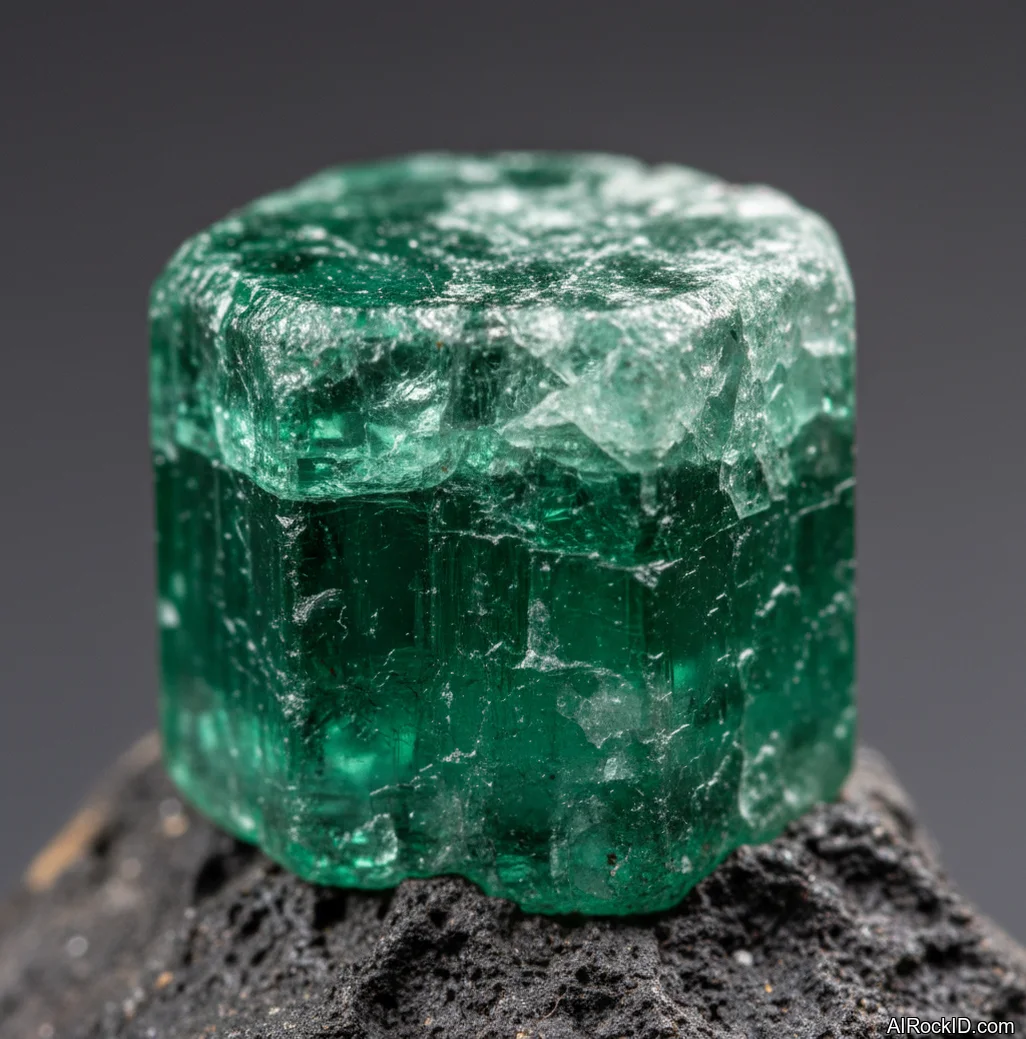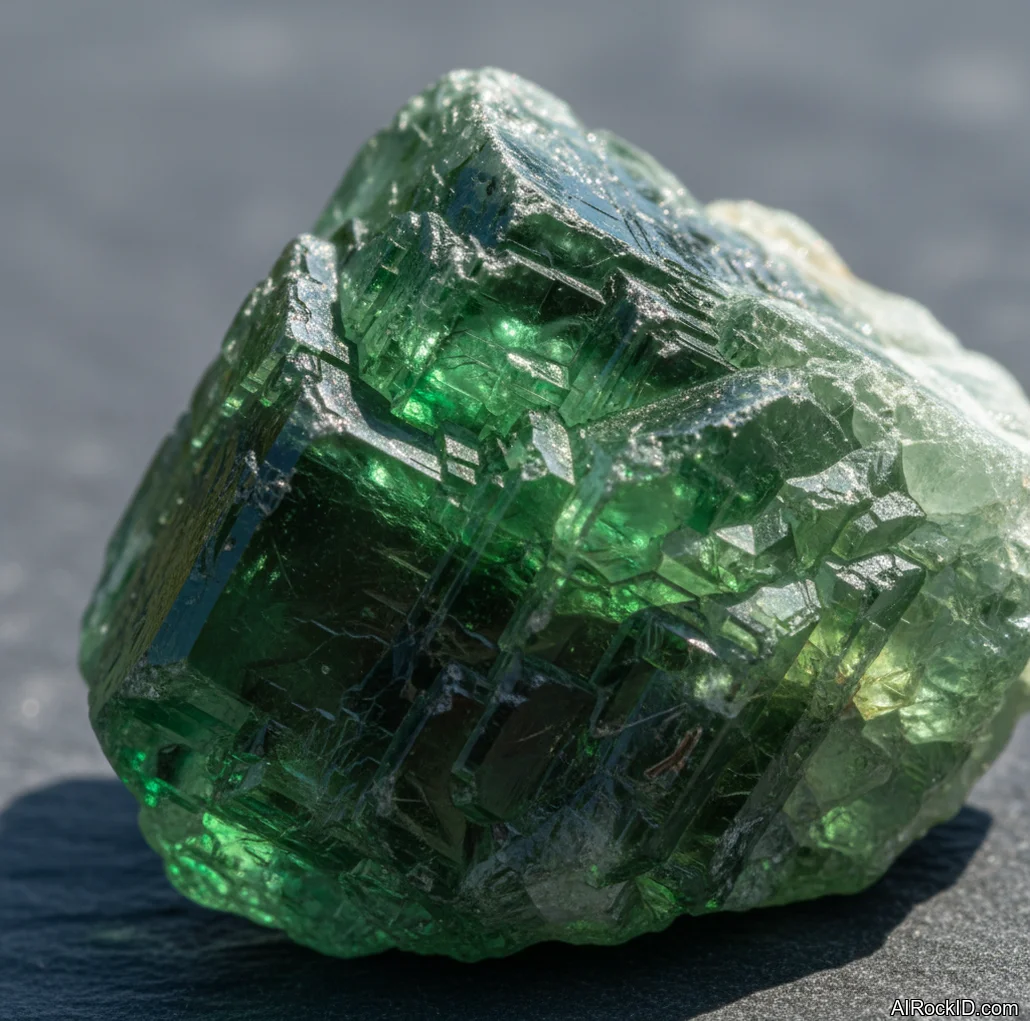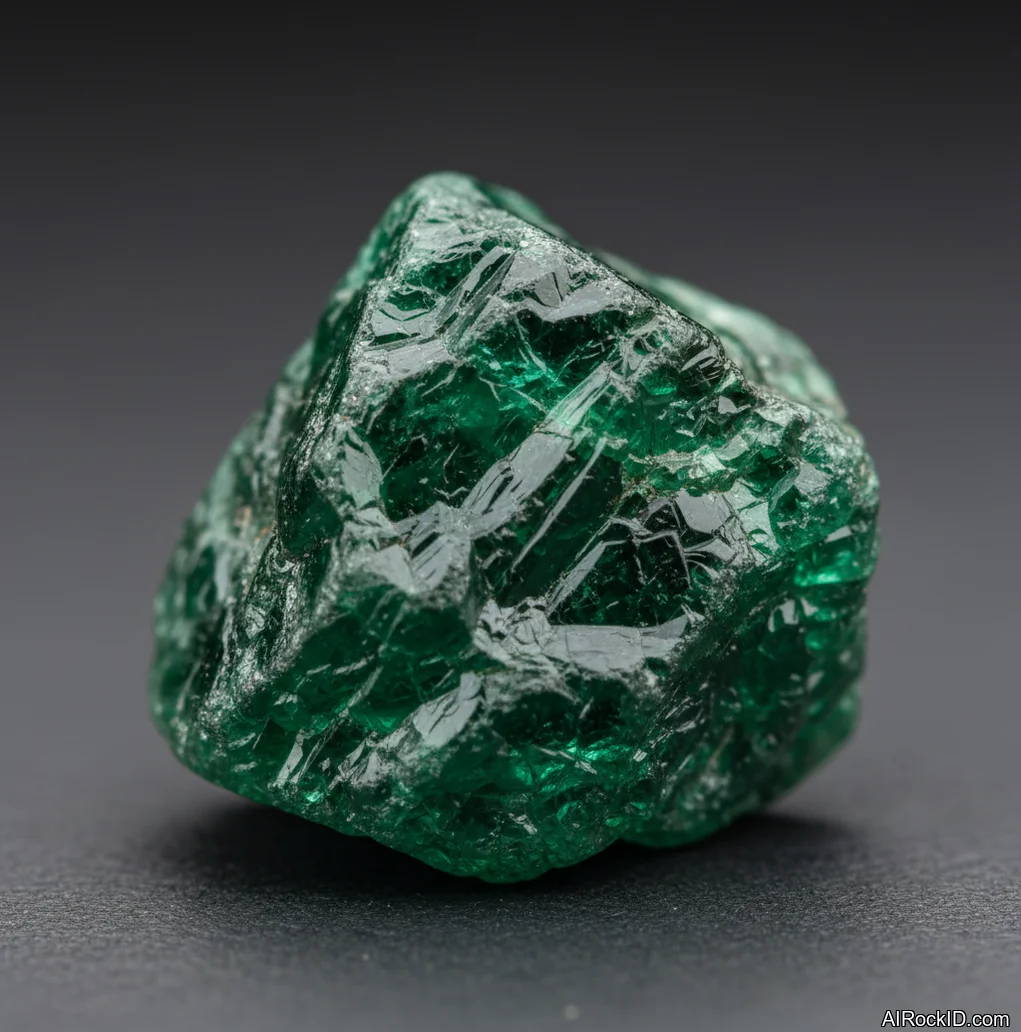
Tsavorite Garnet


Quick answer: Tsavorite garnet is a green variety of grossular garnet colored mainly by vanadium and chromium. It is often compared with emerald, chrome diopside, and demantoid garnet because these gems can share a vivid green appearance but differ in durability, optical traits, and typical inclusions.
AI Rock ID can help screen a green gemstone by comparing visible color, transparency, crystal habit, and surface features against known minerals. RockIdentifier.io provides identification support, but valuable tsavorite should still be confirmed by a qualified gemological lab or appraiser.
Good fit
- Collectors comparing rare green gemstones with high transparency
- Jewelry buyers who want a green stone with better everyday durability than softer alternatives
- Gem enthusiasts studying grossular garnet varieties
- People who prefer natural green color without routine oiling treatments
Not a good fit
- Anyone needing a guaranteed identification from a photo alone
- Buyers seeking a low-cost green gem in larger sizes
- Situations where lab documentation is unavailable for an expensive stone
- People expecting emerald-like inclusions as proof of identity
Most commonly confused with
- Emerald: Emerald is beryl, usually has lower brilliance, and is commonly included or clarity-treated; tsavorite is garnet and is typically untreated.
- Chrome Diopside: Chrome diopside can look richly green but is softer, usually around Mohs 5.5-6, and is less suitable for heavy-wear rings.
- Demantoid Garnet: Demantoid is an andradite garnet with higher dispersion and may show horsetail inclusions; tsavorite is grossular garnet.
- Peridot: Peridot is usually yellowish green to olive green, has a different refractive index range, and is softer than tsavorite.
Tsavorite Garnet vs Common Green Lookalikes
| Gem | Key Difference | Typical Durability |
|---|---|---|
| Tsavorite Garnet | Grossular garnet; usually untreated vivid green | Mohs 7-7.5 |
| Emerald | Beryl; often included and commonly oiled | Mohs 7.5-8 but fracture-sensitive |
| Chrome Diopside | Pyroxene; darker green and softer | Mohs 5.5-6 |
| Demantoid Garnet | Andradite garnet; stronger dispersion | Mohs 6.5-7 |
| Peridot | Olivine; more yellowish or olive green | Mohs 6.5-7 |
AI identification confidence
AI identification confidence for tsavorite is moderate from clear photos because several transparent green gemstones overlap in color and luster. Confidence improves when the image includes scale, lighting from multiple angles, visible inclusions, and any known test data such as refractive index or specific gravity.
When AI gets it wrong
- A faceted stone is shown without gemological measurements, making color the main clue.
- The photo has strong green color correction, backlighting, or reflections from nearby objects.
- The specimen is a loose crystal fragment rather than a polished gem with visible optical behavior.
- The stone is a simulant, synthetic material, or another green garnet variety sold under an incorrect name.
Final recommendation
For casual identification, compare tsavorite with emerald, chrome diopside, demantoid garnet, peridot, and green tourmaline before relying on color alone. For significant purchases, request an independent gem report that identifies the species, variety, natural origin, and any treatments.
How to Check Tsavorite Authenticity
Authentic tsavorite is a green grossular garnet, so gemological testing should show properties consistent with garnet rather than beryl, diopside, glass, or tourmaline. Useful checks include refractive index, specific gravity, magnification, and spectroscopy when available. High-value stones should be accompanied by a report from a recognized laboratory, especially when the seller makes claims about origin or exceptional quality.
Tsavorite Treatments and Disclosure
Tsavorite is generally valued because fine material is commonly sold without routine oiling, dyeing, or heat treatment. Any treatment claim should be supported by seller disclosure or laboratory documentation, since green color alone does not prove natural, untreated tsavorite. Be cautious with vague labels such as "green garnet" when species, variety, and treatment status are not stated.
Buying Tips for Tsavorite Jewelry
Color, clarity, cut, carat weight, and origin claims all influence tsavorite pricing, but documentation matters most for expensive stones. Look for secure settings that protect edges and corners, especially in rings. Compare prices against stones with similar size, saturation, clarity, and lab confirmation rather than judging by carat weight alone.
What Is Tsavorite Garnet?
Tsavorite garnet is a green type of grossular garnet, and that color mainly comes from vanadium, with chromium showing up sometimes too. If you’ve only seen it in photos, the first thing that hits you in real life is how sharp the sparkle is, even when the stone’s small. It isn’t that oily green you see in some glass fakes. It fires off clean, like someone’s flicking a light switch on and off.
Hold a rough piece and it stays cool in your palm, and it’s got that dense garnet weight for its size. Most of what you’ll see at shows is already cut stones, or little crystal bits sitting in matrix, not huge single crystals. And when somebody actually has a clean, bright rough chunk with strong color? Look, you can spot it from across the table because people start hovering around the case. Fast.
Compared to emerald, tsavorite usually reads a little more “electric” under spotlights, and you don’t have that constant stress about fissures and oils. But don’t buy the idea that it’s easy to find. Fine color in a decent size is still something you have to hunt for. Really hunt.
Origin & History
Raw stones out of Tanzania and Kenya are the whole reason tsavorite ended up on anyone’s radar. Back in the late 1960s, people started recognizing what it was, and gemologist Campbell R. Bridges gets the credit for getting it in front of a wider crowd after finds in Kenya’s Tsavo area and just over the border in northern Tanzania.
The name “tsavorite” is pulled straight from Tsavo National Park in Kenya. Tiffany & Co. leaned hard on that trade name in the 1970s, and it stuck, plain and simple. And in the gem world, that kind of naming matters because it pulled the stone out from under the older, catch-all “green grossular” tag and made buyers actually stop and look. Twice.
Where Is Tsavorite Garnet Found?
Most fine tsavorite comes from Kenya and Tanzania, with smaller amounts from Madagascar and Pakistan. Good stones tend to come from very specific belts and pockets rather than broad, easy mining areas.
Formation
At first glance, a lot of people assume tsavorite forms the way emerald does, but it doesn’t. Tsavorite is grossular garnet, and it grows during metamorphism, when calcium-rich rocks get cooked and squeezed and vanadium (and sometimes chromium) slips into the crystal structure and turns it green.
Look at what it sits in and you’ll usually find it tied to metamorphosed limestones and skarns. Think contact metamorphism, with fluids moving through those twitchy boundary zones where the chemistry changes fast (you can almost feel the rock go from chalky to gritty under your fingers). So the deposits come out patchy. You can dig forever and turn up nothing, then hit this small zone where the color just pops and suddenly every pebble looks like it might be the one.
How to Identify Tsavorite Garnet
Color: Tsavorite ranges from yellowish green to deep, saturated forest green, sometimes with a slightly bluish green cast in the best stones. The most valuable color is a strong, clean green without looking too dark.
Luster: Vitreous luster, often with very bright brilliance when cut.
Pick up the stone under two lights: daylight and warm indoor light. Some greens go dull or brownish under warm light, while good tsavorite stays convincingly green. The real test is the “snap” of the sparkle, it looks crisp and fast compared to most green glass or dyed quartz. And if you’ve got a loupe, check for typical garnet inclusions and clean facet junctions, because a lot of cheap lookalikes have rounded, mushy facet edges.
Common Look-Alikes
Tsavorite Garnet is sometimes confused with these materials:
- Chrome diopside
- Green tourmaline (verdelite)
- Demantoid garnet
- Dyed green grossular or quartz
- Green glass
- Peridot
Market Cautions & Treatments
When AI Can Get This Wrong
AI often confuses tsavorite with chrome diopside and green glass, since all three can hit that sharp emerald green in a photo. Demantoid garnet is another trip-up, but the horsetail inclusions in demantoid never show up in tsavorite. Real test is weight and refractive sparkle: tsavorite feels dense and sparkles hard, even in small stones.
Properties of Tsavorite Garnet
Physical Properties
| Crystal System | Cubic |
| Hardness (Mohs) | 7-7.5 (Hard (6-7.5)) |
| Density | 3.57-3.73 g/cm3 |
| Luster | Vitreous |
| Diaphaneity | Transparent to translucent |
| Fracture | Conchoidal |
| Streak | White |
| Magnetism | Non-magnetic |
| Colors | Yellow-green, Green, Deep green, Bluish green |
Chemical Properties
| Classification | Silicates (nesosilicates) |
| Formula | Ca3Al2(SiO4)3 |
| Elements | Ca, Al, Si, O |
| Common Impurities | V, Cr, Fe, Mn |
Optical Properties
| Refractive Index | 1.740-1.760 |
| Birefringence | None |
| Pleochroism | None |
| Optical Character | Isotropic |
Tsavorite Garnet Health & Safety
Tsavorite garnet’s usually fine to handle, and it’s fine around water too. But if you’re cutting or grinding it, treat it like any other lapidary job: watch the dust, wear a proper mask, and keep things wet so you’re not breathing that gritty green powder (it gets everywhere, even on your fingertips).
Safety Tips
Put on a respirator before you start. And when you’re grinding or sanding, run a little water on the surface (or mist it as you go) so the dust doesn’t get kicked up into the air.
Tsavorite Garnet Value & Price
Price Range
Rough/Tumbled: $20 - $400 per gram
Cut/Polished: $200 - $5000 per carat
Color is the whole game. Then you look at clarity. Size comes after that. Thing is, tsavorite gets pricey in a hurry once you’re talking fine color above about 2 carats. And if the stone runs dark, it can go kind of dead looking, unless the cutter really nailed it.
Durability
Durable — Scratch resistance: Good, Toughness: Good
Tsavorite is stable in normal wear, but it can chip on sharp edges if it takes a hard knock like any garnet.
How to Care for Tsavorite Garnet
Use & Storage
Store tsavorite separately from softer stones and from other gems that can scratch it, especially if you’ve got sharp facet edges. I keep mine in little gem jars or soft pouches because loose stones love to find each other and scuff.
Cleaning
1) Rinse with lukewarm water and a drop of mild soap. 2) Use a soft toothbrush to clean behind settings or along facet junctions. 3) Rinse well and pat dry with a soft cloth.
Cleanse & Charge
If you do energy-style care, a quick rinse and a few minutes on a windowsill with indirect light is plenty. Don’t bake it in harsh sun all day just to “charge” it.
Placement
In a display, tsavorite looks best under a small white spotlight or near a north-facing window where the green stays honest. For a pocket stone, it’s usually cut and small, so I’d rather carry it in a pouch than loose.
Caution
Skip ultrasonic cleaners and steamers when the stone’s already set in jewelry, because the setting can take a beating and any inclusions that are already there can get stressed out too. And don’t just chuck it into a mixed tumble bowl unless you’re fine with pulling it out later and finding mystery scratches you didn’t sign up for.
Works Well With
Tsavorite Garnet Meaning & Healing Properties
Next to a lot of green stones, tsavorite just hits different. It’s got this bright, switched-on look people clock immediately. When I’m standing at a gem show with a tray in my hands and those little paper packets rustling, tsavorite is one of the greens that never looks sleepy under the lights. It looks awake. That’s the vibe people keep reaching for, like motivation with a steady heartbeat, not some jittery caffeine buzz.
If you’re into crystal traditions, tsavorite usually gets linked to the heart space and growth themes. Getting unstuck. Letting yourself accept good stuff (even when you’re weirdly resistant to it). And having enough juice to actually follow through. Thing is, I’ve gotta say it plainly: it’s not medicine, and it’s not going to replace therapy, sleep, or real-world decisions. But as a reminder stone, it’s ridiculously easy to use because the color is so direct. You catch a glimpse of it and your brain snaps right back into that green, forward-moving headspace.
But here’s the honest collector downside. A lot of tsavorite out there is tiny. Like, blink and it’s gone tiny. Small stones are easy to lose and kind of hard to “bond with” if you’re the type who wants something palm-sized you can actually feel in your hand (warmth, edges, weight, the whole deal). I’ve watched people switch to a larger green grossular, or even a nice piece of chrome diopside, for daily handling. Then they keep tsavorite for jewelry or a small grid where it won’t vanish into the couch cushions. Because yes, that happens.
Common mistakes
- Identifying any vivid green transparent gemstone as tsavorite based only on color.
- Assuming a stone is emerald because it is green and highly valuable.
- Ignoring treatment disclosure when comparing tsavorite with emerald or other green gems.
- Buying a high-priced stone without an independent gemological report.
- Confusing demantoid garnet and tsavorite because both are green garnets.
- Using hardness alone to separate green gemstones, since several lookalikes have overlapping durability ranges.
Identify Tsavorite Garnet from a photo
Compare Tsavorite Garnet traits, care tips, value clues, and common lookalikes with a clear photo.