Yasato Unryu


Quick answer: Yasato Unryu is a plume-included quartz or agate material associated with Japan, recognized by white, cloudlike inclusions in a translucent to opaque chalcedony or quartz base. Its identification is usually visual, supported by hardness, translucency, and the absence of magnetic response.
AI Rock ID can help compare Yasato Unryu with visually similar plume agates, moss agates, and included quartz by analyzing pattern, luster, and transparency from a photo. RockIdentifier.io provides crystal identification support, but unusual locality names and trade names may still require seller documentation or expert review.
Good fit
- Collectors who like Japanese trade-name stones with soft plume or cloud patterns
- People comparing white plume inclusions in quartz, chalcedony, or agate
- Jewelry buyers who want a durable silica-based stone with moderate to high hardness
- Beginners learning to distinguish plume agate from moss agate and ordinary included quartz
Not a good fit
- Buyers who need a gemstone with standardized grading reports
- Anyone seeking a stone with a guaranteed single mine or locality without documentation
- Collectors who prefer transparent, faceted gems over patterned cabochon material
Most commonly confused with
- Plume Agate: Plume agate has branching or featherlike inclusions; Yasato Unryu is usually described by softer white cloudlike plumes.
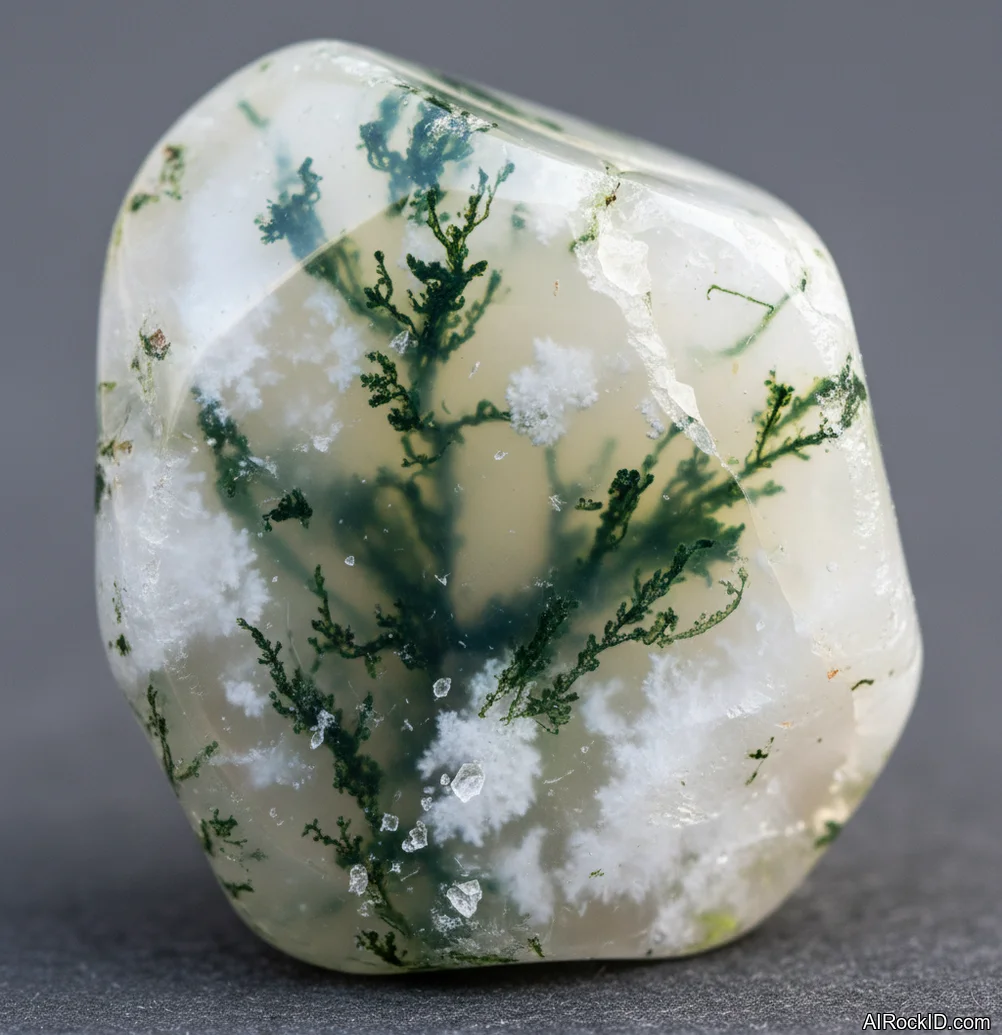
- Moss Agate: Moss agate typically shows green, brown, or black dendritic mosslike inclusions rather than pale white cloud forms.
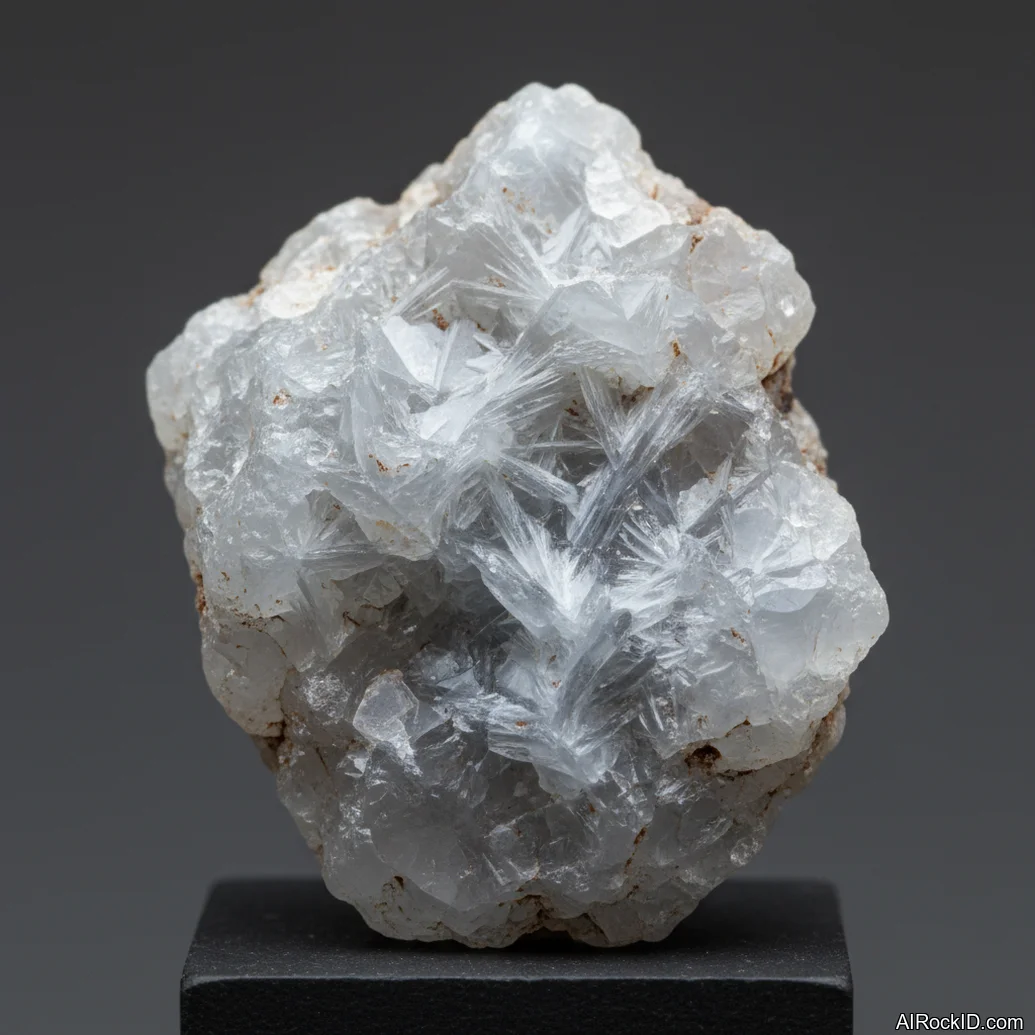
- Quartz: Common included quartz may contain veils, fractures, or mineral inclusions without agate banding or a named plume pattern.
- Dendritic Agate: Dendritic agate has tree- or fernlike manganese or iron oxide patterns, often sharper than the soft plumes of Yasato Unryu.
Yasato Unryu vs Similar Stones
| Stone | Typical Look | Key Difference | Common Check |
|---|---|---|---|
| Yasato Unryu | White cloudlike plumes in translucent to opaque silica | Japanese trade-name material with soft, floating inclusion patterns | Look for natural depth and irregular plume distribution |
| Plume Agate | Feathery, branching, or plume-shaped inclusions | Patterns are often more distinct and multicolored | Inspect inclusion shape and any agate banding |
| Moss Agate | Green, brown, or black mosslike growths | Color and dendritic texture differ from white cloud plumes | Check for mossy mineral inclusions rather than pale veils |
| Dendritic Agate | Tree, fern, or branchlike dark markings | Dendrites are usually sharper and more graphic | Use magnification to see branching oxide patterns |
| Milky Quartz | Uniform cloudy white quartz | Usually lacks separate plume inclusions or agate texture | Check whether the cloudiness is even or patterned |
AI identification confidence
AI identification confidence for Yasato Unryu is usually moderate because it is a trade-name material rather than a mineral species. Clear, close-up photos of the pattern, edge translucency, and surface luster improve results, but locality and authenticity claims still depend on provenance.
When AI gets it wrong
- Photos are overexposed, making white plumes blend into the background.
- The stone is tumbled or polished so heavily that banding and inclusion depth are hard to see.
- A seller uses Yasato Unryu as a broad trade label for any white plume agate.
- The sample is dyed, resin-filled, or photographed under colored lighting.
Final recommendation
Choose Yasato Unryu based on visible plume depth, natural-looking irregular patterns, and clear seller information rather than name alone. For higher-priced pieces, ask for origin details, untreated-status statements, or comparison photos in neutral daylight.
How to Check Yasato Unryu Authenticity
Authentic Yasato Unryu should show inclusions that appear suspended at different depths rather than printed or painted on the surface. Use a loupe to check whether white plumes follow natural fractures, cavities, or chalcedony textures. A hardness check should be consistent with quartz-family material, but destructive testing is not recommended for finished jewelry.
Buying Tips for Yasato Unryu
Because Yasato Unryu is a trade name, listings should ideally include clear photos, dimensions, treatment notes, and any available origin information. Be cautious with vague descriptions that use only poetic names without identifying the material as quartz, agate, or chalcedony. Matched cabochons, strong plume contrast, and documented provenance may affect price more than size alone.
Photo Tips for Identifying Yasato Unryu
Photograph Yasato Unryu in indirect daylight on a neutral background to show the white plume pattern accurately. Include one close-up, one edge or backlit view, and one full-stone view with scale. Avoid beauty filters and high contrast settings because they can make common milky quartz look like plume-included material.
What Is Yasato Unryu?
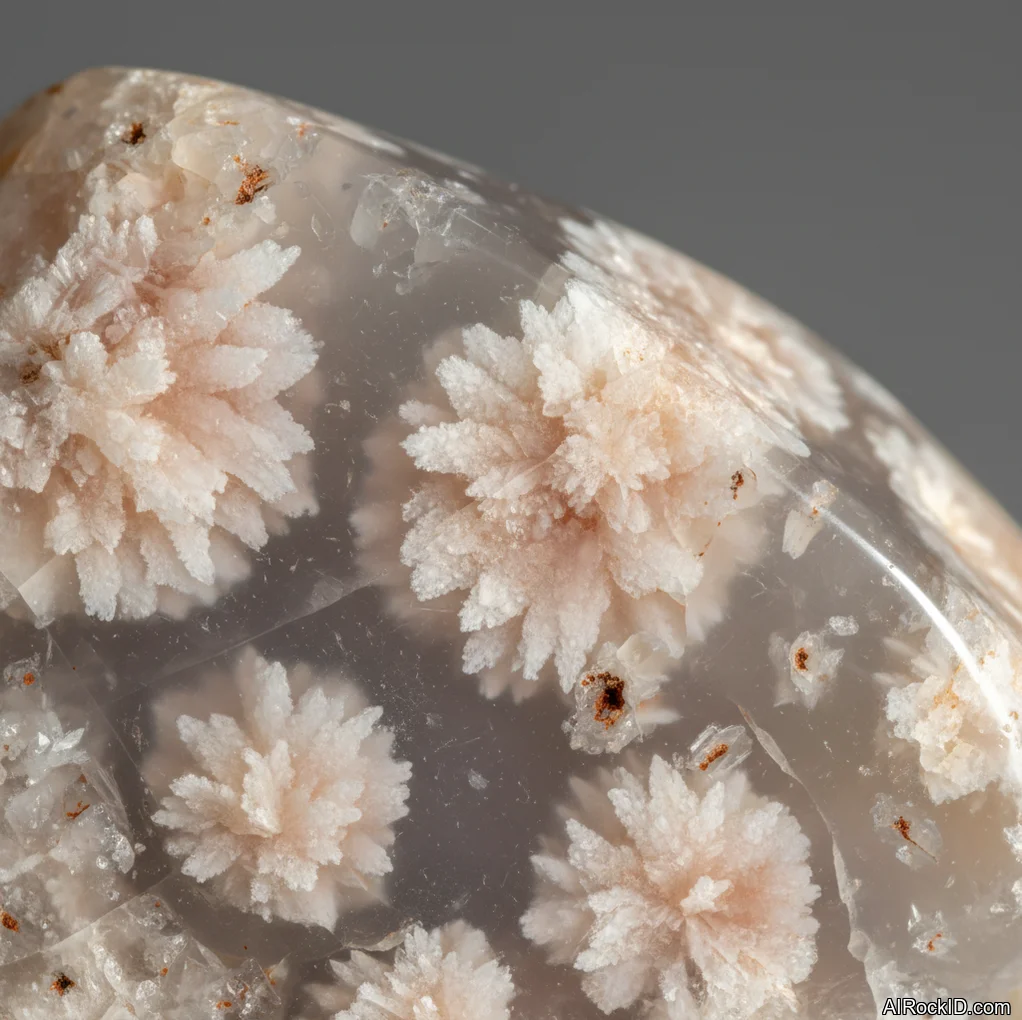
Yasato Unryu is a Japanese trade name for plume-included quartz, usually chalcedony or agate, from the Yasato area. What sets it apart is the white, cloudlike “unryu” patterns sitting inside gray to smoky, translucent silica.
Pick up a good piece and you’ll know fast. It’s cool in your palm, not slick or greasy, and it has that dense, stubborn heft plastic fakes never quite get right (they always feel a little hollow). The patterning is the whole reason people chase it: soft, feathery white plumes that curl and stack like steam caught in stone. Shine a bright desk lamp through it and the better pieces show real depth. Turn it a few degrees and the plumes seem to drift behind each other.
But not every chunk is a showstopper. A lot of it reads quieter, especially the smaller tumbles, and some sellers will slap “Unryu” on any cloudy agate they’ve got. Real Yasato material usually looks like calm storm clouds. Not sharp dendrites. Not that crisp “moss” look you see in moss agate.
Origin & History
Yasato Unryu is a name that bubbled up from Japan’s local lapidary and collector crowd, not something officially recognized as a separate mineral species. “Yasato” is basically a pointer to the old Yasato area in Ibaraki Prefecture (now folded into Ishioka), and “unryu” means “cloud dragon,” which is just describing the pattern, the same feel you get in Japanese ink paintings where the clouds curl around like a dragon.
You’ll run into it at Japanese mineral shows and in online shops, sold more like a locality tag than a strict mineral name. Think “Picture Jasper,” where the label is tied to certain deposits and a certain look. It’s still quartz, plain and simple, but the nickname lets dealers and collectors pin down a specific origin and appearance without cramming a whole paragraph onto a tiny label (and those little paper tags really don’t give you much room, do they?).
Where Is Yasato Unryu Found?
It’s associated with silica deposits in the Yasato area of Ibaraki, Japan, and most pieces on the market are cut from local chalcedony/agate nodules.
Formation
Most Yasato Unryu begins as silica-rich fluids pushing through volcanic or sedimentary host rocks, dropping off microcrystalline quartz in the form of chalcedony and agate. The “cloud” look comes from tiny mineral inclusions and little trapped micro-bubbles that get caught as the stone grows, then later pulses of silica that sheath the earlier stuff and build up those soft, layered swells.
Look at the edge of a slab and you can usually read the order things happened. The translucent gray chalcedony is the base layer, and the white plumes sit inside it like smoke paused halfway through a curl. Some pieces even show faint banding if you tilt it and catch the light just right, and that’s the giveaway you’re in agate territory, not staring at one big quartz crystal.
How to Identify Yasato Unryu
Color: Base color runs gray to smoky translucent, with milky white to cream plumes that look like fog or brushstrokes suspended inside. Some pieces show subtle brown or bluish tones depending on lighting.
Luster: Waxy to vitreous when polished, and more dull-waxy on a raw rind.
Pick up a piece and check temperature and heft. Real quartz-based material stays cool and feels dense; resin copies warm up fast and feel a little “light” for their size. If you scratch it with a steel blade, it shouldn’t take a scratch, but the blade may leave a faint metal streak you can wipe off. The real test is a hand lens: the plumes should look internal and layered, not printed on the surface or sitting in a clear coating.
Common Look-Alikes
Yasato Unryu is sometimes confused with these materials:
- Dendritic agate or dendritic chalcedony (manganese/iron “fern” inclusions that can read like unryu plumes in photos)
- Montana agate (milky plumes and smoky gray body color, often sold loose without locality)
- Plume agate from Mexico (white to cream plumes in gray chalcedony, very similar when polished)
- Dyed gray agate/chalcedony (black or smoke dye to imitate the Yasato gray base around white plumes)
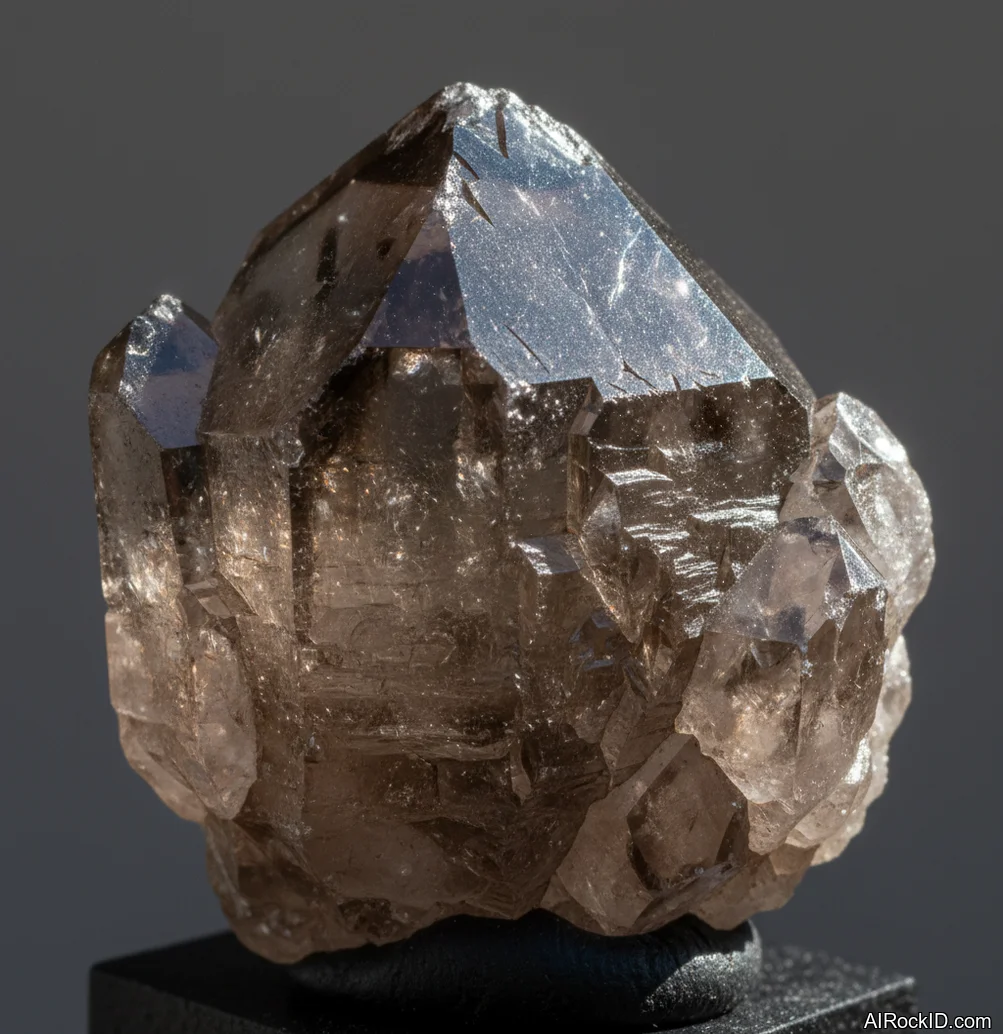
- Smoky quartz with white veils (macrocrystalline quartz, not chalcedony, but the white internal haze confuses buyers)
- Gray glass with white swirls (slag-style glass sold as “Japanese agate” or “unryu quartz”)
Market Cautions & Treatments
When AI Can Get This Wrong
At first glance in photos, AI mixes Yasato Unryu up with dendritic agate and any random plume agate because the white “clouds” read the same at thumbnail size. The real test is a close light check: shine a small flashlight through the edge and look for bubble trails (glass) or crisp fern-like branching (dendrites) instead of soft, cottony plumes. If you can handle it, scratch-test behavior helps too: chalcedony should bite glass cleanly around 6.5-7, while many glassy fakes scuff instead of cutting.
Properties of Yasato Unryu
Physical Properties
| Crystal System | Trigonal |
| Hardness (Mohs) | 6.5-7 (Hard (6-7.5)) |
| Density | 2.58-2.65 g/cm3 |
| Luster | Waxy |
| Diaphaneity | Translucent to opaque |
| Fracture | Conchoidal |
| Streak | White |
| Magnetism | Non-magnetic |
| Colors | gray, smoky gray, milky white, cream, pale brown |
Chemical Properties
| Classification | Silicates |
| Formula | SiO2 |
| Elements | Si, O |
| Common Impurities | Fe, Mn, Al, Ti |
Optical Properties
| Refractive Index | 1.530-1.543 |
| Birefringence | 0.009 |
| Pleochroism | None |
| Optical Character | Uniaxial |
Yasato Unryu Health & Safety
Solid pieces are fine to pick up, and getting them wet isn’t a problem. The real hazard shows up when you start cutting it, grinding it, or dry-sanding it, because that’s when you can kick up silica dust.
Safety Tips
So, when you’re cutting or grinding stone for lapidary work, keep it wet. Don’t do it dry. And put on a proper respirator that’s rated for fine silica dust (the kind that actually seals to your face, not a loose paper mask).
Yasato Unryu Value & Price
Price Range
Rough/Tumbled: $15 - $120 per piece
Cut/Polished: $2 - $12 per carat
Price usually follows what you actually see: how wild the plume pattern is, how see-through it looks when you hold it up to a window, and whether the surface has that slick, glassy polish you can feel when you rub it with your thumb. Bigger slabs with deep, layered “clouds” sell fast. But small tumbles can be inexpensive and still look good in hand.
Durability
Durable — Scratch resistance: Good, Toughness: Good
It’s stable like most quartz, but sharp impacts can chip polished edges because the fracture is conchoidal.
How to Care for Yasato Unryu
Use & Storage
Store it like you would any polished quartz: separate from softer stones so it doesn’t scuff them, and keep slabs in sleeves to protect the faces. If it’s a display piece, a little museum putty keeps it from taking a dive.
Cleaning
1) Rinse with lukewarm water to remove grit. 2) Wash with a drop of mild soap and a soft brush, then rinse well. 3) Dry with a microfiber cloth so you don’t leave water spots on a high polish.
Cleanse & Charge
If you do energetic cleaning, smoke cleansing or a quick rinse and dry is plenty. Long sunbaths aren’t needed, and strong heat can stress fractures in any quartz.
Placement
Bright, angled light shows the internal plumes best, especially from the side of a slab or tower. I like it on a shelf where you can walk past and catch the pattern shifting.
Caution
If the piece has fractures or a bunch of internal planes, skip the ultrasonic cleaner. It can shake those weak spots loose (you’ll sometimes see tiny flakes show up in the tank). And don’t touch it with bleach or harsh acids. For lapidary work, handle it like quartz. Keep a tight grip on silica dust control.
Works Well With
Yasato Unryu Meaning & Healing Properties
Yasato Unryu feels calm the second you look at it. That cloudy, layered pattern is why a lot of people reach for it for “quiet mind” stuff, kind of the same instinct as grabbing a soft-pattern agate instead of something sparkly and high-contrast that keeps yanking your eyes around.
Me, I keep a palm stone on my desk when I’m buried in paperwork. The surface is cool at first, then it warms up in your hand, and the pattern gives my eyes someplace gentle to settle (instead of bouncing between tabs and sticky notes all day). It’s weirdly helpful.
People who are into it usually describe the grounding as light. Not that heavy hematite feeling. More like steady, like you’re anchored but not weighed down. And if you’re touch-sensitive, this one’s nice because polished chalcedony has that smooth, almost silky feel. No sharp crystal points. Nothing poky to snag your attention.
But keep your head on straight about it. Any calming effect is personal and subjective, and it’s not medical care. Still, as a physical object, it does one thing really well: it slows you down. You catch yourself turning it under the light, tracking the “clouds,” and your breathing kind of falls into step. Why does that work? No clue. It just does.
Common mistakes
- Assuming every white included agate from Japan is Yasato Unryu without provenance.
- Confusing surface scratches or polishing haze with internal cloudlike inclusions.
- Relying only on trade names instead of checking whether the material is quartz, agate, or chalcedony.
- Mistaking dyed or enhanced stones for naturally white plume patterns.
- Judging authenticity from color alone rather than pattern depth, luster, hardness, and seller documentation.
Identify Yasato Unryu from a photo
Compare Yasato Unryu traits, care tips, value clues, and common lookalikes with a clear photo.