Flower Agate


Quick answer: Flower Agate is typically identified by its translucent pink to peach chalcedony base and soft, plume-like inclusions that resemble blossoms. It is commonly sold as tumbled stones, palm stones, beads, towers, and carvings, with durability similar to other agates.
AI Rock ID can help screen a Flower Agate specimen by checking color, translucency, banding, and plume-like inclusion patterns from a clear photo. RockIdentifier.io provides crystal identification support, but final confirmation may still require hardness, magnification, or seller documentation.
Good fit
- Collectors who like soft pink, peach, cream, or lavender-toned chalcedony
- People choosing a durable stone for pocket stones, beads, and decorative carvings
- Buyers comparing agates with visible plume, mossy, or dendritic inclusions
- Beginners who want a recognizable crystal with moderate price variation
Not a good fit
- Anyone needing a rare gemstone with formal grading standards
- Buyers who want a perfectly uniform pink stone without natural inclusions
- Uses involving acids, harsh cleaners, or prolonged direct sunlight exposure
- Situations where a transparent faceted gem is preferred
Most commonly confused with
- Cherry Blossom Agate: Often used as a trade name for similar pink agate with blossom-like plumes; naming may overlap with Flower Agate.
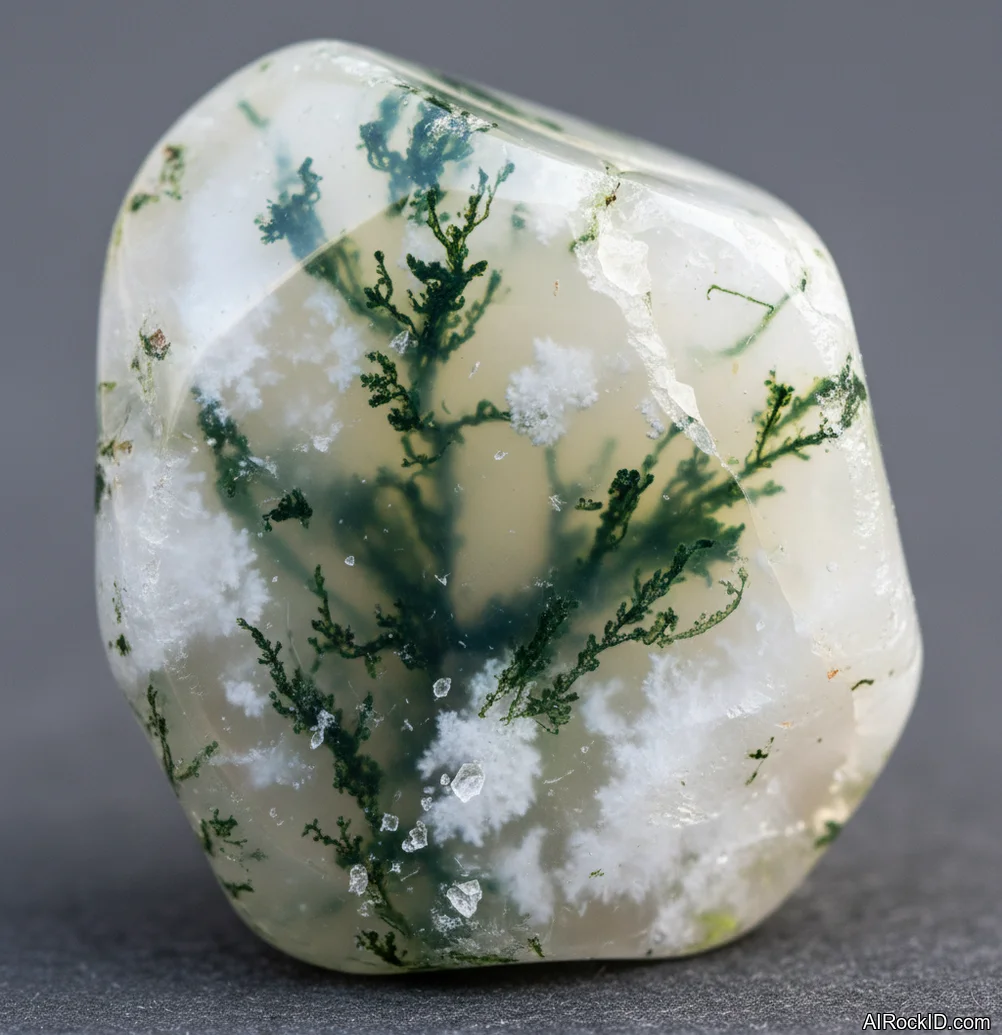
- Moss Agate: Usually has green, black, or brown moss-like inclusions rather than pink or cream flower-shaped plumes.
- Plume Agate: Has feather-like or cloud-like inclusions in many colors, while Flower Agate is usually pink to peach chalcedony.
- Pink Opal: Typically more opaque and waxy, with lower hardness and without agate-style chalcedony structure.
Flower Agate Lookalike Comparison
| Stone | Typical Look | Key Difference |
|---|---|---|
| Flower Agate | Translucent pink, peach, or cream chalcedony with plume-like blossoms | Flower-shaped inclusions are the main visual clue |
| Moss Agate | Clear to milky chalcedony with green, brown, or black branching inclusions | Inclusions look mossy or dendritic, not floral |
| Pink Opal | Opaque to slightly translucent pink with waxy luster | Softer and usually lacks layered agate texture |
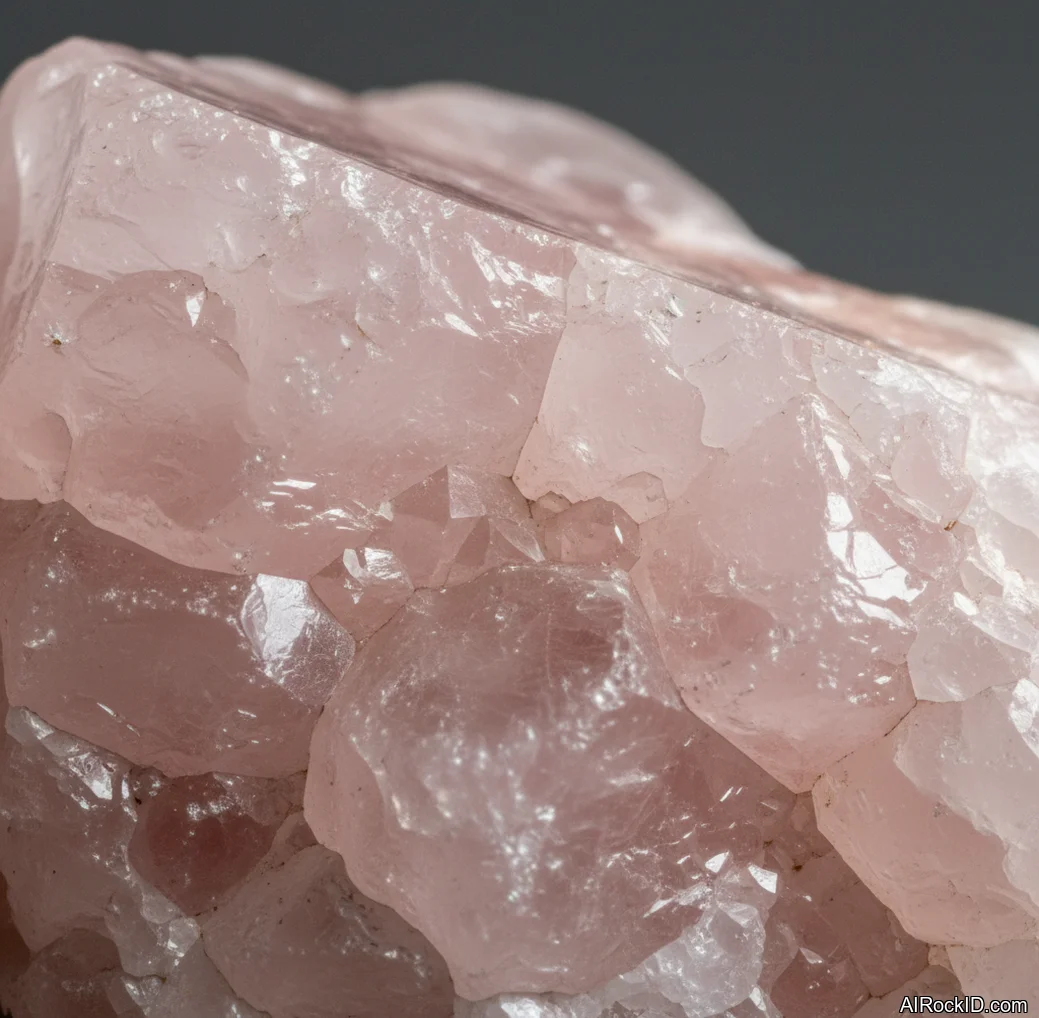
| Rose Quartz | Cloudy pink quartz, often massive and even-colored | Does not usually show internal plume clusters |
| Dyed Agate | Bright or unusually uniform pink, purple, or red tones | Color may concentrate in cracks, pores, or drilled holes |
AI identification confidence
AI identification confidence is usually moderate to high when the photo clearly shows translucent chalcedony with pink-to-peach color and rounded plume inclusions. Confidence drops when the specimen is heavily polished, carved, dyed, photographed under warm lighting, or shown without close-up detail.
When AI gets it wrong
- A close-up photo shows only pink color but not the plume-like inclusions.
- The stone is a bead or carving with a small visible surface area.
- Dyed agate has saturated color that resembles natural pink chalcedony in photos.
- Warm indoor lighting makes cream, gray, or beige agate appear pink.
How to Spot Real Flower Agate
Real Flower Agate usually has soft, uneven pink, peach, cream, or gray tones with inclusions that appear suspended inside the chalcedony. Natural pieces may show small pits, healed fractures, cloudy zones, or variation between one side and another. Be cautious with stones that are extremely neon, uniformly colored, or have dye concentrated around cracks, drill holes, or surface pits.
Buying Tips for Flower Agate
When buying Flower Agate, look for clear photos taken in neutral light, including close-ups of the plume inclusions and any surface flaws. Higher prices are often associated with strong floral patterns, pleasing color contrast, good polish, and larger intact carvings. Ask whether the stone has been dyed, stabilized, or color-enhanced if the listing does not state treatment information.
Where Flower Agate Is Commonly Found
Much of the Flower Agate in the crystal trade is reported from Madagascar, which is known for a wide variety of agate and chalcedony materials. Locality labels can be inconsistent in retail listings, so origin claims are most useful when supported by a trusted seller or supply-chain information. The appearance of the stone should not be used as the only proof of locality.
What Is Flower Agate?
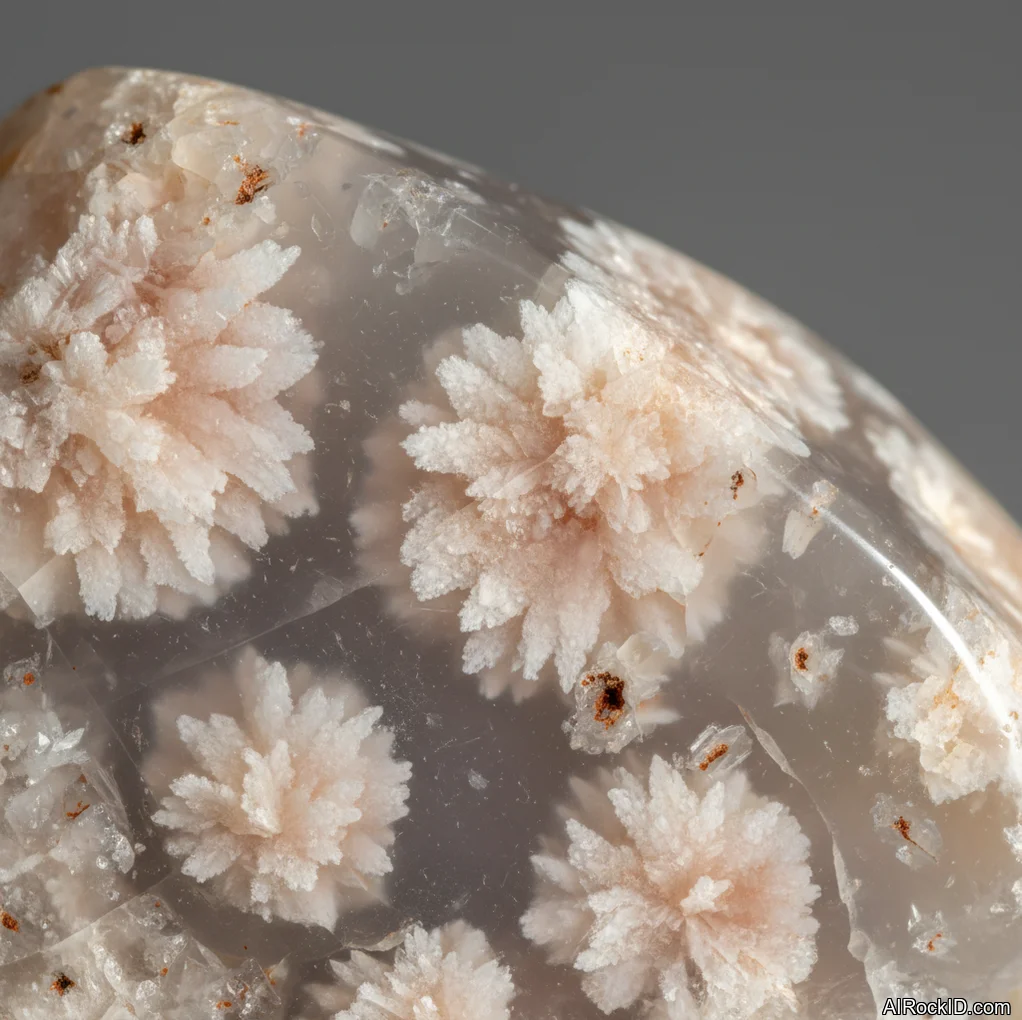
Flower Agate is just the trade name people use for a pink to peach chalcedony (microcrystalline quartz) with white, cream, or pale pink plume inclusions that look like tiny blossoms trapped inside the stone.
Hold a palm stone and you notice that familiar quartz weight right away. It’s cool when you first pick it up, then it takes its time warming against your skin. And the “flowers” aren’t printed on the outside or anything. They’re inside the chalcedony, so if you tilt it under a lamp the plumes shift and seem to hover at different depths, kind of like peering into a shallow pond.
A lot of folks take one look and assume it’s painted or dyed. But most of what’s out there is natural chalcedony with plume growth. Thing is, you won’t see it as sharp crystal points. It usually comes as nodules, slabs, or polished pieces, and the really good ones are the stones where the plumes stay crisp and separated instead of getting squished into a cloudy blur.
Origin & History
“Flower Agate” isn’t an official mineral species name. It’s a newer trade label that really caught on in the late 2010s, when pink chalcedony from Madagascar, packed with plume-like inclusions, started hitting shows and online shops in big quantities (the kind where you’d see table after table of the same stuff).
The “agate” part is a bit squishy, like it so often is in the gem world. Some pieces do have faint banding, so calling them agate isn’t much of a stretch. But a lot of material is closer to plume chalcedony, with barely any banding at all. “Cherry Blossom Agate” and “Sakura Agate” are basically just marketing names for the same visual, pulled from the way those plumes look like little clusters of petals.
Where Is Flower Agate Found?
Most Flower Agate in the market comes from Madagascar, typically as nodules that get cut into slabs, towers, and palm stones.
Formation
Look closely at a good slab and you can practically read the whole growth story in it. Chalcedony forms when silica-rich fluids push through little cavities or fractures in volcanic rock, then they gel up and slowly harden over time.
Those “flower” plumes? They’re basically inclusion structures that grew while the stone was filling in, usually when the chemistry shifted mid-deposit. You’ll spot plumes radiating outward, those cottony little bursts, and sometimes tiny orb-like starts that never quite finished (so they just sit there looking half-born). And since it’s chalcedony, the texture is microcrystalline. So it’ll take a high polish, but it still has that slightly waxy feel compared to clear macrocrystalline quartz, the kind that feels more glassy under your fingertip.
But here’s the rub: neat, high-contrast plumes don’t show up in every nodule. A lot of rough is just pale pink with faint ghost flowers, and that’s why the best display-grade pieces get cherry-picked fast.
How to Identify Flower Agate
Color: Usually soft pink, peach, or milky rose with white to cream plumes; some pieces lean beige or have a gray cast. The plumes often look like clustered petals or cauliflower-like blooms inside the chalcedony.
Luster: Polished surfaces show a vitreous to slightly waxy luster, typical of chalcedony.
Pick up a real piece and it stays cool to the touch longer than resin or glass, and it has that solid quartz weight for its size. The real test is depth: rotate it under a single light and the “flowers” should shift in parallax, not sit flat like a printed pattern. If you scratch it with a steel nail, it usually won’t take a mark, but it will scratch softer glass if you push it.
Common Look-Alikes
Flower Agate is sometimes confused with these materials:
- Moss Agate (especially pink or peach-dyed types)
- Pink Botswana Agate
- Dyed White Agate (with artificial plumes or color fills)
- Glass with embedded white wisps or swirls
- Cherry Blossom Agate (sometimes used interchangeably, but not always accurate)
- Pink Opal (especially lower-grade with cloudy inclusions)
Market Cautions & Treatments
When AI Can Get This Wrong
Photo IDs often mix up Flower Agate with Moss Agate or other plume agates, especially when the inclusions look leafy instead of floral. Glass fakes with internal swirls can fool both apps and people in photos. The real test is to check for quartz hardness—Flower Agate scratches glass easily, while glass fakes won't. The inclusions shouldn't feel raised; they're always inside the stone, never on top.
Properties of Flower Agate
Physical Properties
| Crystal System | Trigonal |
| Hardness (Mohs) | 6.5-7 (Hard (6-7.5)) |
| Density | 2.58-2.64 g/cm3 |
| Luster | Vitreous |
| Diaphaneity | Translucent |
| Fracture | Conchoidal |
| Streak | White |
| Magnetism | Non-magnetic |
| Colors | Pink, Peach, White, Cream, Beige, Gray |
Chemical Properties
| Classification | Silicates |
| Formula | SiO2 |
| Elements | Si, O |
| Common Impurities | Fe, Mn |
Optical Properties
| Refractive Index | 1.530-1.540 |
| Birefringence | None |
| Pleochroism | None |
| Optical Character | Uniaxial |
Flower Agate Health & Safety
Flower Agate is non-toxic, so it’s safe to handle. But it’s still a silica-based stone, and if you cut it or grind it, that fine dust you see hanging in the air (and settling as a gritty film on the table) shouldn’t be inhaled.
Safety Tips
If you need to shape it, keep it wet while you work (a little spray bottle helps) and wear a proper respirator that’s actually rated for fine silica dust.
Flower Agate Value & Price
Price Range
Rough/Tumbled: $10 - $120 per piece
Cut/Polished: $1 - $8 per carat
Prices jump when the plumes look crisp and evenly spaced, and the translucency is actually good, especially on bigger towers and those thick slabs you can feel the weight of in your hand. But the muddy, low-contrast stuff? It’s everywhere, and it usually ends up tossed in the bargain bins.
Durability
Durable — Scratch resistance: Good, Toughness: Good
It’s stable quartz, but polished pieces can chip on sharp edges if you knock them off a shelf.
How to Care for Flower Agate
Use & Storage
Store it so polished edges don’t bang into harder stones like quartz points or topaz. I keep mine in a tray with a soft liner, especially towers that like to tip over.
Cleaning
1) Rinse with lukewarm water and a drop of mild soap. 2) Use a soft toothbrush to get into carving grooves or around drilled holes. 3) Rinse well and pat dry, then let it air-dry before putting it back on fabric or wood.
Cleanse & Charge
If you do energy-style care, gentle options like smoke, sound, or a quick rinse work fine. Avoid long salt soaks mainly because it’s hard on finishes and metal stands, not because the stone can’t handle it.
Placement
Look closely at the plumes under a single warm lamp and you’ll see why shelves at eye level work best. Near a window is fine, but I wouldn’t bake it in direct sun all day if you want the color to stay soft and even.
Caution
Skip harsh cleaners and ultrasonic machines, especially if the piece is carved and you can see those tiny hairline fractures or little pits you can feel with a fingernail. And don’t drop it on tile. Chalcedony’s tough, sure, but it’ll still chip.
Works Well With
Flower Agate Meaning & Healing Properties
Next to the loud, flashy stones, Flower Agate feels… quiet. It’s the one people grab for steady, everyday goals, like when you’re trying to stick with a habit, not chase one huge breakthrough and call it done.
I’ve watched customers hover over a whole tray, sliding pieces around with their fingertips, and then land on the one where the plumes look like they’re “opening.” That’s always the word they use. And it tells you the appeal is mostly visual, almost like you’re picking a tiny scene.
On a stressful day, it’s the feel that wins people over. Smooth. Cool. Heavy enough in the palm that it kind of anchors you (literally). If you’re a fidgeter, a palm stone gets rubbed constantly, and after a week you start spotting little plume details you swear weren’t there at first. Funny how that works, right?
But keep your feet on the ground. Any “healing” talk is metaphysical, not medical. What Flower Agate is actually good at is being a focus object, something gentle to stare at while you journal or plan, or when you’re trying to come down after too much caffeine and not enough sleep.
Common mistakes
- Assuming every pink agate with inclusions is automatically Flower Agate
- Confusing trade names such as Flower Agate and Cherry Blossom Agate as strict mineral categories
- Judging authenticity from color alone instead of checking inclusions, translucency, and dye signs
- Using harsh chemical cleaners that may affect polish or treatments
- Expecting all specimens to show distinct blossom shapes on every side
Identify Flower Agate from a photo
Compare Flower Agate traits, care tips, value clues, and common lookalikes with a clear photo.