Blue Scheelite


Quick answer: Blue Scheelite is a calcium tungstate mineral known for its blue-to-gray-blue appearance and distinctive fluorescence under ultraviolet light. Because color alone can be misleading, identification is strongest when visual features are checked alongside density, crystal habit, and UV response.
AI Rock ID can help screen a suspected Blue Scheelite specimen by comparing visible color, texture, crystal habit, and fluorescence-related clues from photos. RockIdentifier.io provides crystal reference information that can support follow-up checks, but lab testing may be needed for high-value or uncertain pieces.
Good fit
- Collectors who want a fluorescent mineral with a documented chemical composition
- Buyers comparing blue-gray tumbled stones, cabochons, or rough pieces
- People who prefer mineral specimens with identifiable physical properties
- Crystal enthusiasts interested in tungsten-bearing minerals
Not a good fit
- Anyone who needs a gemstone identified by color alone
- Buyers who cannot inspect photos under both normal light and UV light
- Collectors seeking a very hard everyday jewelry stone
- Anyone expecting metaphysical use to replace medical care
Most commonly confused with
- Sodalite: Sodalite is usually darker royal blue with white veining and does not have Scheelite’s high density.
- Blue Calcite: Blue Calcite is softer, lighter in hand, and reacts differently to acid and UV compared with Scheelite.
- Angelite: Angelite is a pale blue anhydrite variety with a softer, more chalky appearance and lower density.
- Lapis Lazuli: Lapis Lazuli is typically deep blue with pyrite or calcite inclusions rather than a tungstate mineral structure.
Blue Scheelite vs. Similar Blue Minerals
| Mineral | Typical Visual Clue | Helpful ID Check | Main Difference |
|---|---|---|---|
| Blue Scheelite | Blue to gray-blue, sometimes massive or granular | Strong UV fluorescence and high density | Calcium tungstate mineral |
| Sodalite | Deep blue with white streaks or patches | Lower density; usually no Scheelite-type fluorescence | Sodium aluminum silicate |
| Blue Calcite | Soft pastel blue, often waxy | Very soft; reacts with acid | Calcium carbonate |
| Angelite | Pale powdery blue, commonly opaque | Soft and less dense | Anhydrite variety |
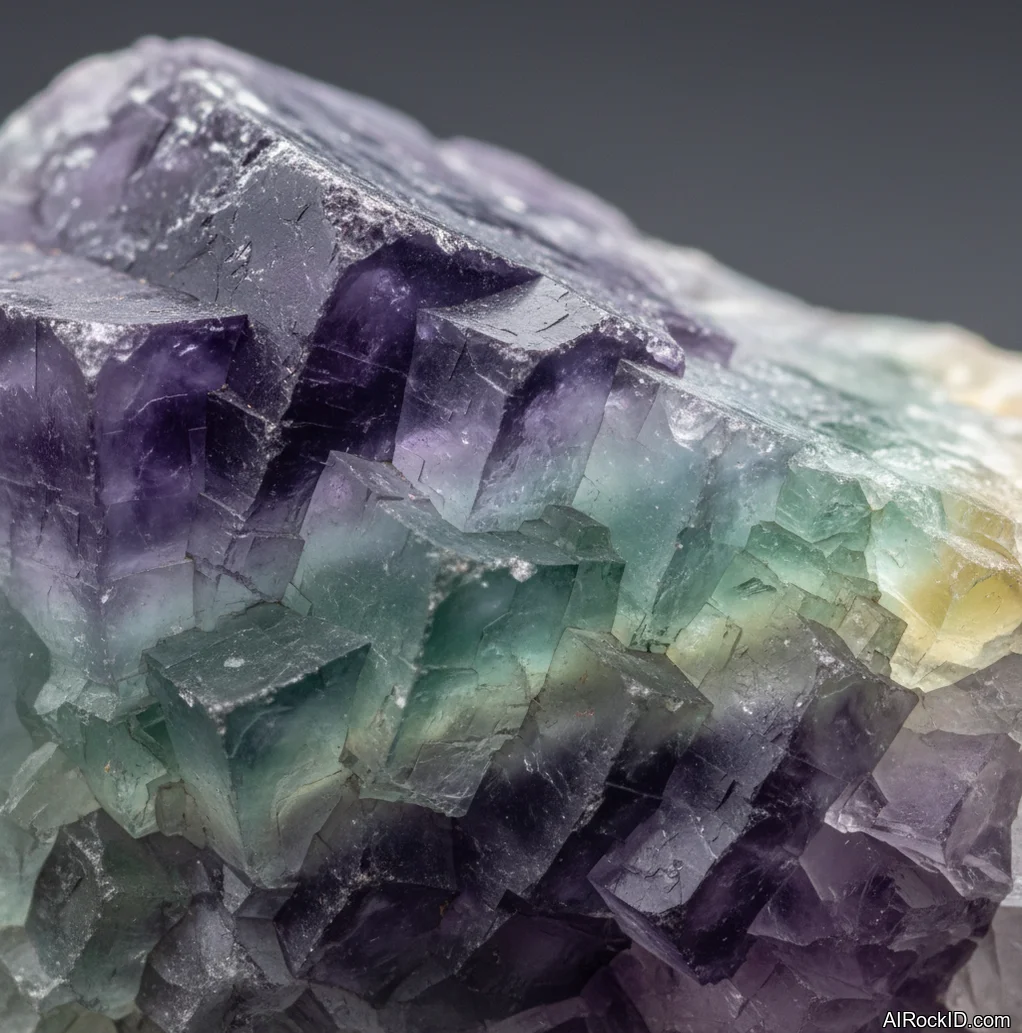
| Fluorite | Transparent to translucent blue or purple zones | Cubic cleavage; lower density | Calcium fluoride |
AI identification confidence
AI identification of Blue Scheelite is moderate when photos show color, texture, scale, and UV reaction. Confidence drops when the specimen is polished, dyed, poorly lit, or shown without density or fluorescence information.
When AI gets it wrong
- A blue stone is photographed under warm or saturated lighting that changes its apparent color
- A listing uses the name Blue Scheelite for mixed or trade-name material without composition data
- The specimen is tumbled or cabochon-cut, removing crystal habit and natural surface clues
- UV fluorescence is described but not shown, or the UV wavelength is not specified
Final recommendation
For buying or confirming Blue Scheelite, prioritize sellers who provide natural-light photos, UV photos, size, weight, and locality when available. If the piece is expensive or being sold as a rare mineral specimen, request testing details or purchase from a seller with a clear return policy.
How to Check Blue Scheelite Before Buying
Ask for photos in daylight and under UV light, since fluorescence is a useful supporting clue for Scheelite. Compare the stated weight with the size of the piece because Scheelite is relatively dense for its size. Be cautious with listings that rely only on a bright blue color or use vague trade names without mineral details.
Authenticity Clues in Photos
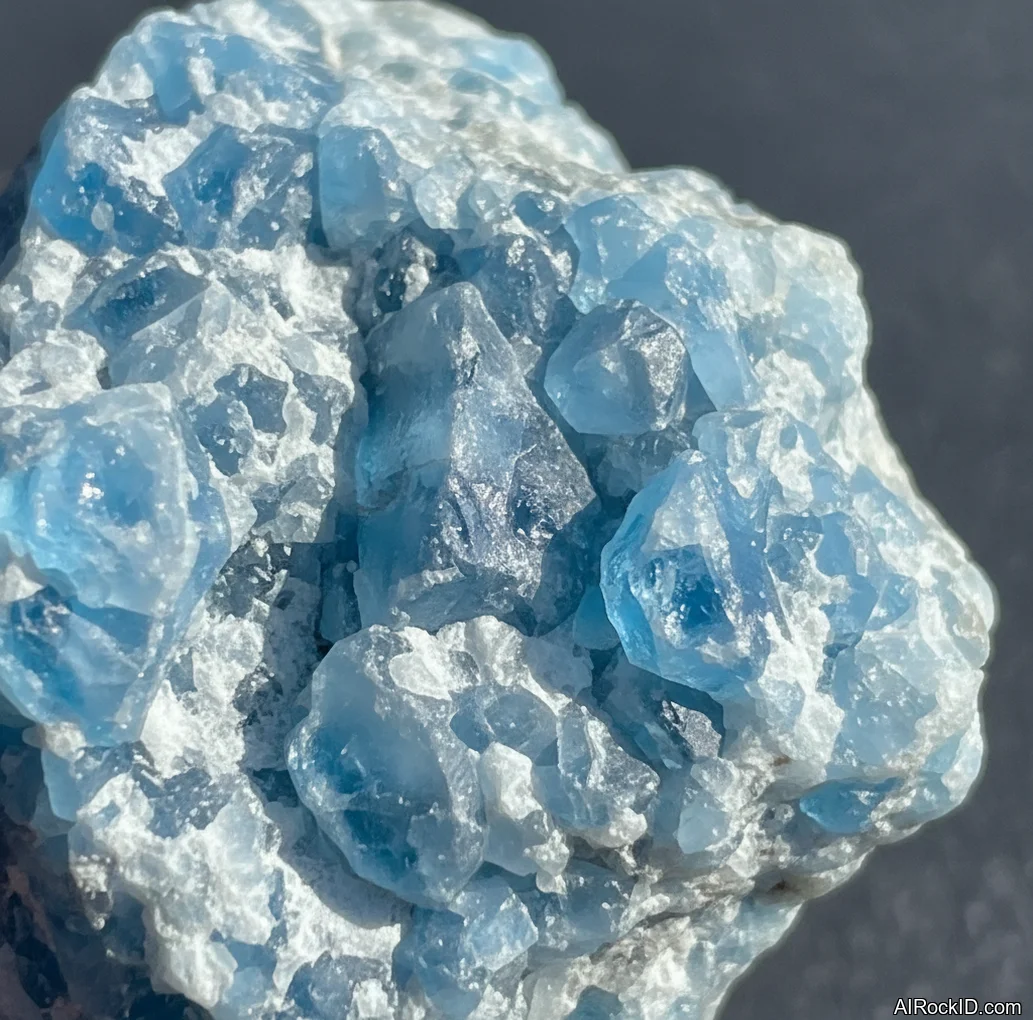
Natural Blue Scheelite may show uneven color, granular texture, matrix, or zoning rather than a perfectly uniform surface. Polished pieces can be harder to identify because tumbling removes crystal faces and surface texture. A UV image can help, but it should be interpreted with other observations rather than used as the only proof.
Locality and Label Information
A well-labeled Blue Scheelite specimen may include locality, mine, formation, or collection information. Locality data can improve confidence because Scheelite occurs in specific geologic settings, often associated with skarns, hydrothermal veins, or metamorphic environments. Missing locality information does not prove a specimen is fake, but it can reduce collectible value.
What Is Blue Scheelite?
Blue Scheelite is just scheelite (calcium tungstate, CaWO4) that happens to show up blue.
Thing is, the weight gives it away before anything else. You pick up a piece and it sits weirdly heavy in your palm for how small it is, like there’s a little lead shot tucked inside, and that dense, sinky feel is one of the fastest ways to tell you’ve got scheelite and not some random blue calcite.
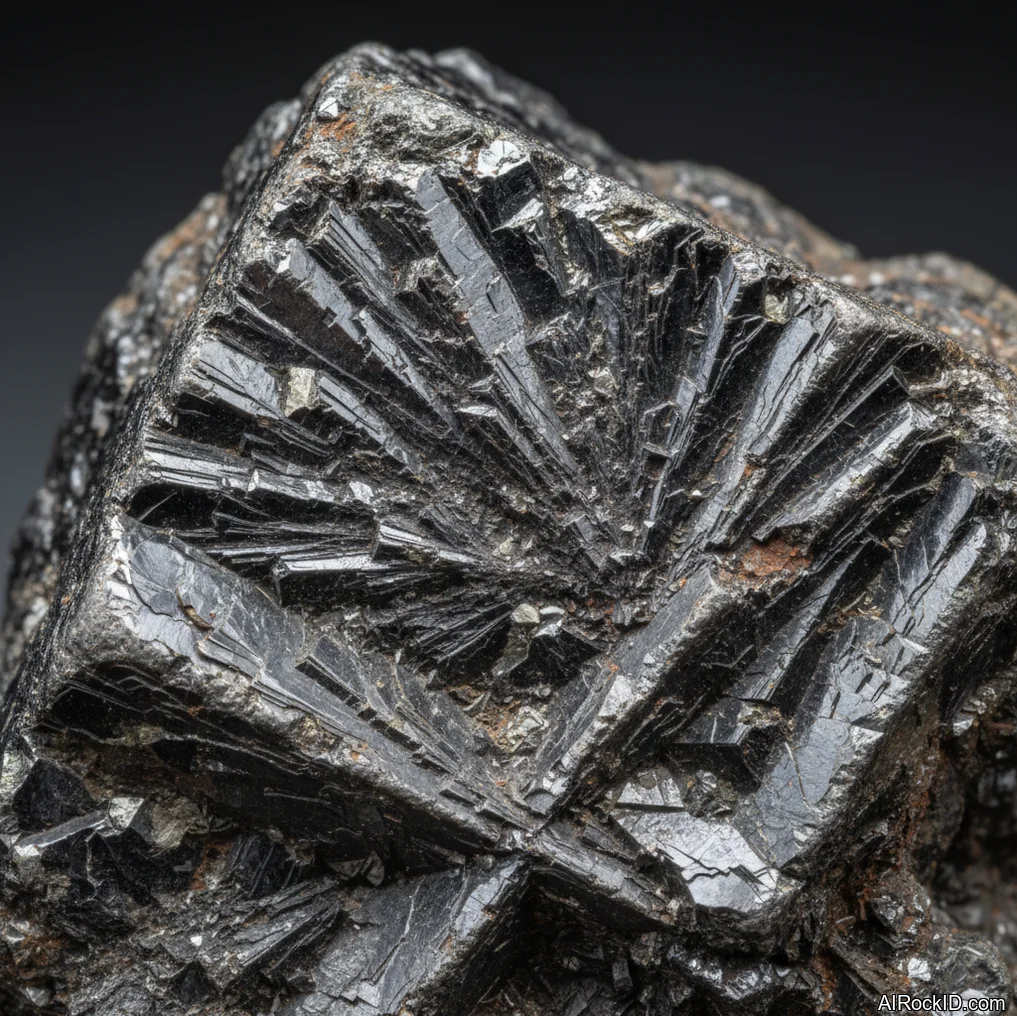
At first glance, the color isn’t always the bright candy-blue people expect from dyed material. It can read more smoky, even a little gray-blue. And the surface changes the whole vibe. A polished stone can look calm and glassy, but a rough chunk will show those flatter, cleavage-ish breaks and tiny flashes when you tilt it under a lamp (especially if the light’s hitting at a low angle).
So then you hit it with UV. Some pieces go from “meh” to “whoa” immediately. A decent shortwave lamp will make a lot of scheelite light up hard, and the blue-toned stuff often comes across icy or electric depending on the host rock and whatever impurities are in there.
Origin & History
Scheelite was first described in 1821 by the Swedish chemist Carl Wilhelm Scheele, and the mineral took his name as a pretty direct nod to his chemistry work. You’ll hear “scheelite” tossed around at mineral shows right alongside tungsten talk, because yeah, it’s one of the classic tungsten ores.
Thing is, the “blue” part isn’t some official separate species name. It’s more of a trade and collector label people use for pieces that have a blue body color or a bluish cast, and sometimes they also light up with strong fluorescence. And dealers will lean hard on that UV reaction in the tag, so ask the obvious question: is it actually blue in normal light, or is it mostly a fluorescent showpiece?
Where Is Blue Scheelite Found?
Scheelite shows up worldwide in tungsten districts, especially in skarns and hydrothermal veins. Blue material is reported from several of the same regions, but it’s usually seen as select pockets or specific parcels rather than a guaranteed “blue deposit.”
Formation
Most scheelite shows up when tungsten-rich fluids push their way through rocks that already have a lot of calcium in them. Out in the field, that usually translates to skarn right along the contact where an intrusion baked the nearby limestone or dolostone and then shoved in hot, metal-loaded fluids.
Look, if you actually study how the scheelite sits in the matrix, the whole sequence starts to click. A lot of specimens are riding with calcite and quartz, plus garnet from that grossular-andradite skarn material, and you’ll sometimes catch sulfides tucked in there too (especially down in the tighter seams). But in veins, it’s a different feel. There you’ll usually find it more tangled up with quartz and other tungstates.
And that blue color? It’s generally tied to tiny trace impurities or subtle structural effects in the crystal. It can even swing around inside the same piece, which is kind of wild. One side can read steel-blue, then you rotate it and the other side goes pale cream.
How to Identify Blue Scheelite
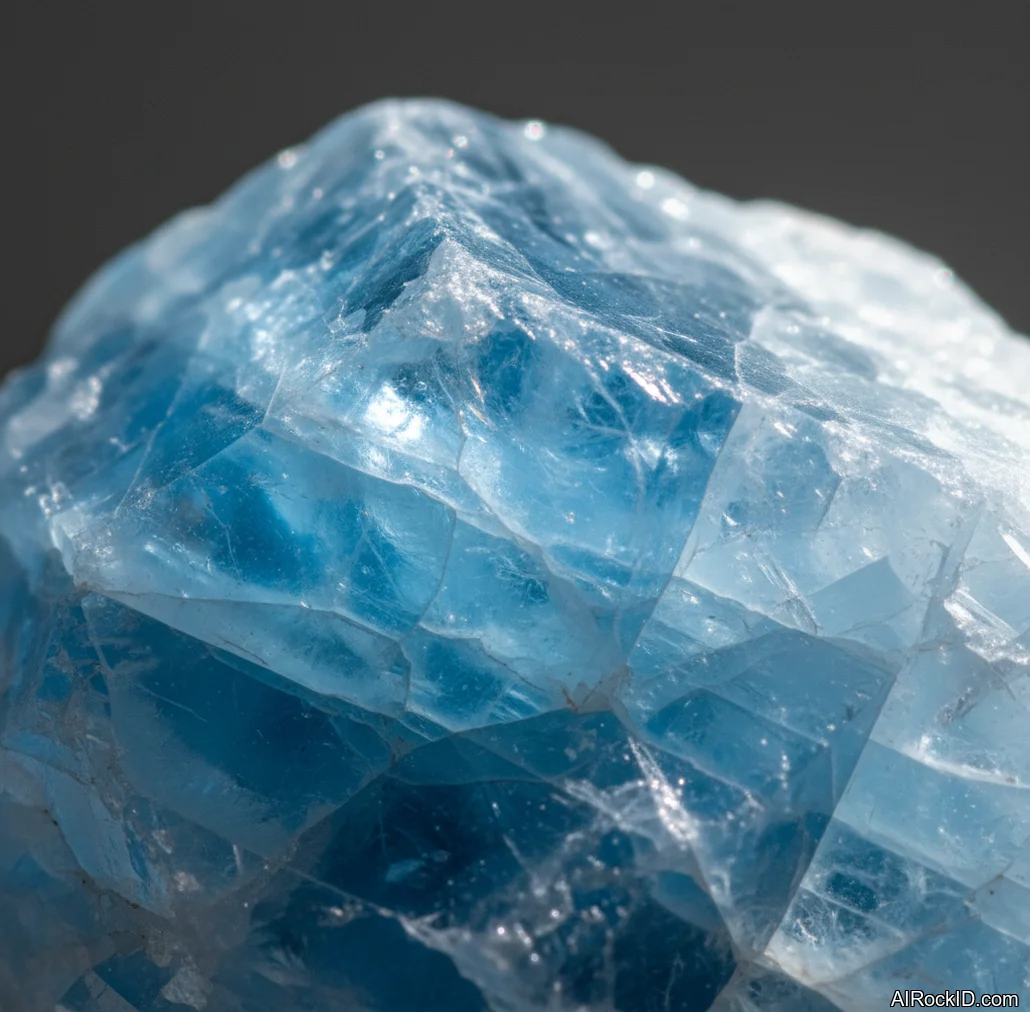
Color: Typically pale to medium gray-blue, sometimes with a smoky or steely cast. Color can look patchy, especially on rough surfaces or in mixed matrix.
Luster: Vitreous to adamantine on clean faces, with a glassy shine when freshly broken or well polished.
Under UV light is the real test. Many scheelites fluoresce strongly (often blue-white), and it’s hard to fake that exact look with a cheap rock unless you’ve seen a lot of UV material. If you scratch it with a knife, it shouldn’t be easy, but it also won’t laugh off a quartz point either. And that dense feel is huge, a palm-sized chunk feels surprisingly heavy compared to most blue stones people confuse it with.
Common Look-Alikes
Blue Scheelite is sometimes confused with these materials:
- Blue-dyed calcite
- Blue onyx (dyed marble)
- Blue aragonite
- Blue glass
- Angelite (anhydrite)
- Blue quartz
Market Cautions & Treatments
When AI Can Get This Wrong
Photo ID apps get tripped up by the blue color and often call Blue Scheelite 'blue calcite' or even glass. In pictures, it's almost impossible to see the true heft, so weight and coolness to the touch are your best physical checks. UV light helps: real scheelite glows bright blue-white under shortwave, while most fakes don't react.
Properties of Blue Scheelite
Physical Properties
| Crystal System | Tetragonal |
| Hardness (Mohs) | 4.5-5 (Medium (4-6)) |
| Density | 5.9-6.1 g/cm3 |
| Luster | Vitreous |
| Diaphaneity | Transparent to translucent |
| Fracture | Uneven |
| Streak | White |
| Magnetism | Non-magnetic |
| Colors | Blue, Gray-blue, White, Colorless, Cream |
Chemical Properties
| Classification | Tungstates |
| Formula | CaWO4 |
| Elements | Ca, W, O |
| Common Impurities | Mo, Fe, Mn, REE |
Optical Properties
| Refractive Index | 1.918-1.934 |
| Birefringence | 0.016 |
| Pleochroism | Weak |
| Optical Character | Uniaxial |
Blue Scheelite Health & Safety
Normal handling’s fine, and a quick splash of water usually isn’t a problem. But if you start grinding, sanding, or sawing it, that’s when the real trouble shows up, because you can kick up a bunch of fine dust.
Safety Tips
If you need to cut it or shape it, do it wet, keep the air moving with good ventilation, and wear a proper respirator that’s actually rated for fine particulates.
Blue Scheelite Value & Price
Price Range
Rough/Tumbled: $15 - $250 per specimen
Cut/Polished: $20 - $150 per carat
Prices climb fast when the crystal faces are clean, the UV reaction is strong, and the body color stays truly blue in normal light. Big chunks aren’t hard to find. But the real money goes to sharp crystals with no chips, no bruised edges (the kind you feel as a little snag when you run a fingernail along a corner), and that solid, good blue.
Durability
Moderate — Scratch resistance: Fair, Toughness: Fair
It’s stable in normal room conditions, but it can chip on edges and corners, especially if it has cleavage breaks or thin crystal plates.
How to Care for Blue Scheelite
Use & Storage
Store it in a padded box or wrap it, especially if it’s a crisp crystal on matrix. Don’t let it bang around with quartz points or anything harder.
Cleaning
1) Rinse quickly in lukewarm water with a drop of mild soap. 2) Use a soft toothbrush to get dust out of crevices. 3) Pat dry and let it air dry fully before putting it away.
Cleanse & Charge
If you do energy-style care, I’d keep it simple: smoke, sound, or a quick pass under cool running water, then let it rest. UV is fun for display, but I don’t leave any fluorescent pieces under strong lamps for long sessions.
Placement
A shelf is fine, but set it on something soft if it has sharp edges or sits point-down on a crystal tip. Under a UV flashlight it’s a killer “show and tell” piece, so keep it where you can grab it easily.
Caution
Skip ultrasonic cleaners and stay away from harsh acids. Don’t just chuck it in your pocket with harder stones either, because that’s how you end up with little scuffs you can actually feel with a fingernail when you tilt it under a lamp. And don’t assume every “blue scheelite” you see online is really scheelite unless you’ve checked it under UV and done a quick density feel in your hand. Why gamble on that?
Works Well With
Blue Scheelite Meaning & Healing Properties
Under a UV light, scheelite feels like someone hit a switch. One second it’s just sitting there, the next it’s lit up and you can’t unsee it. And honestly, that’s exactly how people talk about it in the metaphysical world too: a “lights on” stone for studying, spotting patterns, and getting unstuck. I’ve kept a chunky piece on my desk through long cataloging sessions, and it’s one of the only minerals I catch myself reaching for without thinking when I’m trying to do one task instead of ten.
But look, I’m not here to sell you a miracle rock. If you’re stressed out, you still need sleep, food, and whatever real-world support actually helps. In my experience, Blue Scheelite works best as a cue. Hold it for a minute, notice how oddly heavy it is in your palm, feel that cool, dense weight, take a quick breath reset, then go do the thing you’ve been dodging.
Collectors also call it a “truthy” stone because it doesn’t come off fluffy. It’s dense, cool to the touch, and kind of serious. In meditation, I’ve seen people pair it with grounding pieces so the mental energy doesn’t spiral into jittery overthinking. And if you’re sensitive to vibe shifts, that UV reaction turns into a literal little ritual: lights off, UV on, quick check-in, lights back on, back to life. Simple. Effective. Why fight it?
Common mistakes
- Identifying Blue Scheelite by blue color alone
- Assuming all fluorescent blue stones are Scheelite
- Ignoring density, even though Scheelite often feels heavy for its size
- Buying polished pieces without asking for UV and natural-light photos
- Confusing trade names with verified mineral species
- Treating metaphysical descriptions as proof of mineral identity
Identify Blue Scheelite from a photo
Compare Blue Scheelite traits, care tips, value clues, and common lookalikes with a clear photo.