Golden Tourmaline


Quick answer: Golden Tourmaline is a yellow to golden variety of tourmaline, typically identified by its vitreous luster, elongated crystal habit, and Mohs hardness of 7 to 7.5. It can resemble citrine, topaz, beryl, and yellow sapphire, so reliable identification often depends on a combination of optical properties, crystal form, and testing.
AI Rock ID can help screen a suspected Golden Tourmaline photo by comparing visible color, luster, transparency, and crystal shape with similar minerals. RockIdentifier.io provides educational identification support, but gemological testing is recommended for valuable faceted stones or major purchases.
Good fit
- Collectors looking for an uncommon yellow tourmaline variety
- Jewelry buyers who want a durable gemstone with a warm golden color
- People comparing yellow gemstones by appearance before purchase
- Specimen collectors interested in prismatic tourmaline crystals
- Anyone who wants a non-orange alternative to citrine-like colors
Not a good fit
- Buyers who need a guaranteed identification without gem testing
- People seeking a very inexpensive yellow gemstone
- Collectors who prefer opaque, rough display minerals over transparent gems
- Anyone expecting all yellow tourmaline to be naturally untreated
Most commonly confused with
- Citrine: Citrine is quartz, usually lower in density and lacks tourmaline’s strong pleochroism and typical striated prism habit.
- Yellow Topaz: Topaz has perfect basal cleavage and a higher Mohs hardness of 8, while tourmaline has no prominent cleavage.
- Heliodor: Heliodor is yellow beryl, usually showing a hexagonal habit rather than tourmaline’s trigonal, often striated prisms.
- Yellow Sapphire: Yellow sapphire is corundum with much higher hardness, higher density, and a different refractive index range.
Golden Tourmaline vs Similar Yellow Gems
| Material | Key Difference | Typical Clue |
|---|---|---|
| Golden Tourmaline | Trigonal tourmaline mineral | Striated prisms, vitreous luster, possible pleochroism |
| Citrine | Quartz rather than tourmaline | Often uniform yellow-orange color and lower density |
| Yellow Topaz | Harder and has perfect basal cleavage | Faceted stones may show cleavage-related risk |
| Heliodor | Yellow beryl | Hexagonal crystal habit and different optical constants |
| Yellow Sapphire | Corundum, much harder | High brilliance, high density, Mohs 9 |
AI identification confidence
AI identification confidence for Golden Tourmaline is usually moderate from photos because several yellow transparent gems share similar color and luster. Confidence improves when the image shows natural crystal shape, vertical striations, termination style, scale, and multiple angles under neutral lighting.
When AI gets it wrong
- A faceted stone is photographed without measurements, weight, or refractive-index data
- The gem has a generic yellow color similar to citrine, topaz, beryl, or glass
- Lighting makes a pale green, brown, or orange stone appear golden
- The specimen is polished or tumbled, removing crystal habit clues
Final recommendation
For casual collecting, Golden Tourmaline is best chosen by clear color, visible luster, and a trustworthy source. For jewelry or high-value stones, request gemological confirmation because lookalikes and treatments can affect identification and price.
How to Check Golden Tourmaline Before Buying
Ask whether the stone is natural, treated, or lab-reported, especially for faceted gems sold as fine jewelry. Useful purchase details include carat weight, dimensions, clarity description, origin if known, and whether the seller accepts independent verification. For rough crystals, look for natural longitudinal striations, a vitreous surface, and damage disclosure around terminations.
Natural, Treated, and Misrepresented Material
Some yellow tourmaline may be sold with incomplete treatment information, and color alone is not enough to confirm origin or natural status. Heat or irradiation disclosures are important when value depends on color stability, rarity, or collector interest. A reputable gem lab report is the clearest way to separate confirmed Golden Tourmaline from similar yellow gems.
Photo Tips for Golden Tourmaline Identification
Photograph the stone in daylight or neutral white light on a plain background, and include a scale reference. Capture the side, end, and any termination faces of rough crystals because tourmaline habit can be more diagnostic than color. For faceted stones, include close-ups, pavilion views, and any visible inclusions, but avoid using color filters or heavily saturated lighting.
What Is Golden Tourmaline?
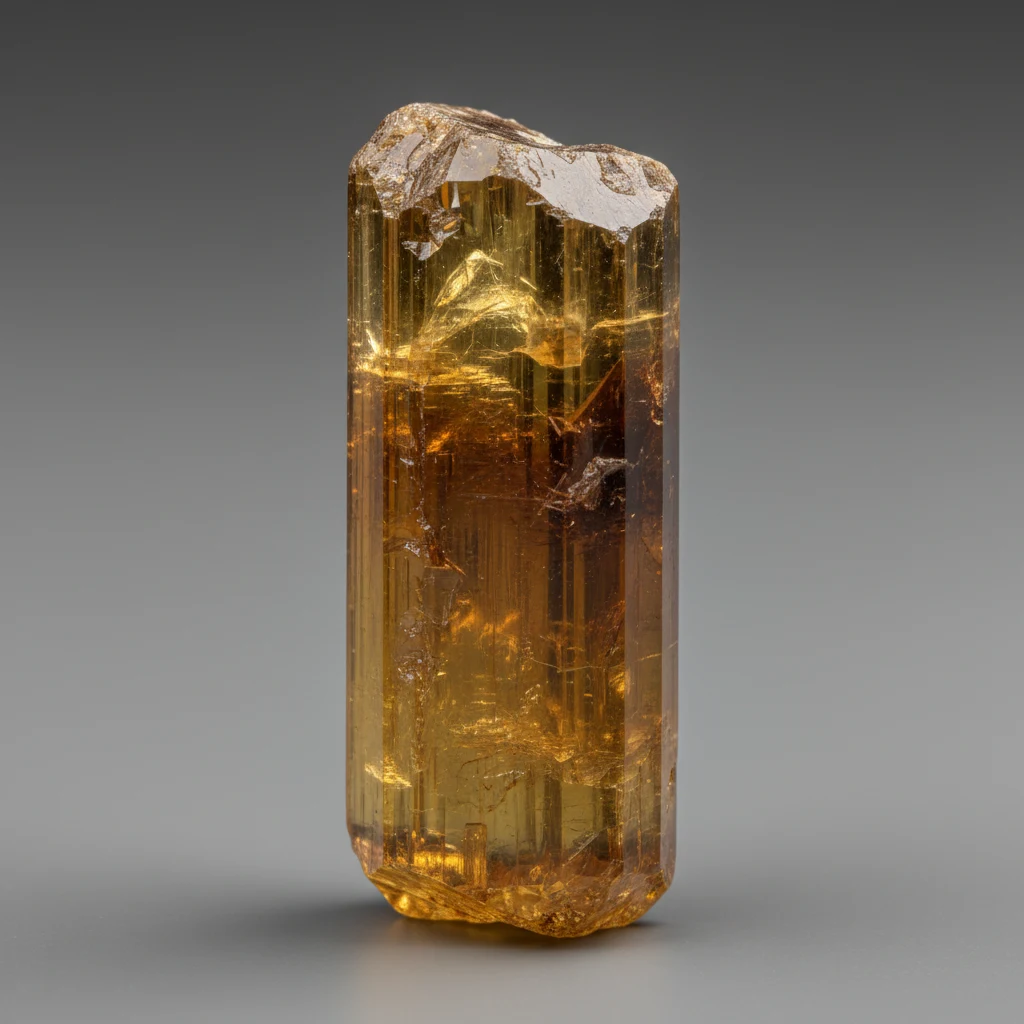
Golden Tourmaline is a yellow to golden variety of tourmaline, valued as a semi-precious gemstone for its bright color and transparency. In the hand, a good piece reads as clean, glassy, and sunlit, ranging from pale yellow through deep golden shades and sometimes brownish golden tones.
As a mineral specimen, Golden Tourmaline is uncommon rather than everyday material. It has a vitreous luster, transparent to translucent diaphaneity, and a hard Mohs range of 7-7.5, so it feels durable for careful collecting. Its borosilicate formula is Na(Li,Al,Mg)3Al6(BO3)3Si6O18(OH)4, with iron and manganese listed as common impurities.
Origin & History
The name tourmaline comes from the Sinhalese word “tura mali,” meaning “stone with mixed colors.” Golden Tourmaline sits within that broader tourmaline family, but its appeal is focused: yellow, golden, and occasionally brown tones with a clean vitreous flash when the crystal is turned in light.
Tourmaline was first described in the late 18th century, and Golden Tourmaline is collected today as an uncommon colored variety. For locality checking and mineral record comparison, collectors commonly consult mindat.org alongside specimen labels, especially when confirming pieces from Brazil, Nigeria, or Afghanistan.
Where Is Golden Tourmaline Found?
Golden Tourmaline is found in Brazil, Nigeria, and Afghanistan, with notable localities including Bahia in Brazil, Kogi in Nigeria, and Nuristan in Afghanistan. The supplied locality data notes that it is most commonly found in Brazil and parts of Africa.
Formation
Golden Tourmaline forms in igneous and metamorphic rocks through the crystallization of boron-rich minerals. That boron-rich setting is the key geological clue behind tourmaline’s identity as a borosilicate and explains why well-formed, transparent crystals are prized when they occur.
In specimen terms, formation shows up as a hard, glassy crystal with a trigonal crystal system, a white streak, and conchoidal fracture if broken. Golden Tourmaline is stable under normal conditions, but collectors should protect it from hard impacts, extreme heat, and sudden temperature changes.
How to Identify Golden Tourmaline
Identify Golden Tourmaline by its light yellow to deep golden color, vitreous luster, and transparent to translucent body. It is non-magnetic, gives a white streak, and has a Mohs hardness of 7-7.5, making it harder than many display minerals while still needing protection from sharp knocks.
For gem or lab confirmation, use its tourmaline optical properties: refractive index of 1.61-1.66, birefringence of 0.015, weak pleochroism, and uniaxial optical character. Density is listed at 3.06-3.20 g/cm3. Color and transparency are useful first clues, but a refractive index test can help separate it from lookalikes.
Properties of Golden Tourmaline
Physical Properties
| Crystal System | Trigonal |
| Hardness (Mohs) | 7-7.5 (Hard (6-7.5)) |
| Density | 3.06-3.20 g/cm3 |
| Luster | Vitreous |
| Diaphaneity | Transparent to translucent |
| Fracture | Conchoidal |
| Streak | White |
| Magnetism | Non-magnetic |
| Colors | Yellow, Golden, Brown |
Chemical Properties
| Classification | Borosilicate |
| Formula | Na(Li,Al,Mg)3Al6(BO3)3Si6O18(OH)4 |
| Elements | Na, Li, Al, Mg, B, Si, O |
| Common Impurities | Fe, Mn |
Optical Properties
| Refractive Index | 1.61-1.66 |
| Birefringence | 0.015 |
| Pleochroism | Weak |
| Optical Character | Uniaxial |
Golden Tourmaline Health & Safety
There are no known health risks associated with handling Golden Tourmaline.
Golden Tourmaline Value & Price
Price Range
Rough/Tumbled: $50 - $150 per specimen
Cut/Polished: $100 - $300 per carat
Price is influenced by color saturation and clarity.
Durability
Durable — Scratch resistance: Good, Toughness: Fair
It is stable under normal conditions but should be protected from hard impacts.
How to Care for Golden Tourmaline
Use & Storage
Store in a soft cloth or padded box to avoid scratches.
Cleaning
Clean with mild soap and water; avoid harsh chemicals. Rinse thoroughly and dry with a soft cloth.
Cleanse & Charge
To cleanse, place it under running water or use sound vibrations.
Placement
Keep it in a place where it can absorb sunlight for energy.
Caution
Avoid extreme heat or sudden temperature changes.
Works Well With
Golden Tourmaline Meaning & Healing Properties
In crystal healing practice, Golden Tourmaline is believed to promote joy, positivity, confidence, clarity, and inner peace. Its golden color makes it a natural choice for meditation layouts where the intention is focus, creativity, abundance, or a brighter emotional tone.
Golden Tourmaline is associated with the Solar Plexus and Crown chakras, and with Leo and Sagittarius. It is also linked with the Sun, Jupiter, Fire, and Earth. For care, cleanse it under running water or with sound vibrations, and store it in a soft cloth or padded box to avoid scratches.
Identify Golden Tourmaline from a photo
Compare Golden Tourmaline traits, care tips, value clues, and common lookalikes with a clear photo.
Common mistakes
- Assuming every transparent yellow gemstone is Golden Tourmaline
- Relying on color alone instead of checking hardness, density, habit, or optical properties
- Confusing heat-treated citrine or yellow glass with tourmaline in online listings
- Ignoring treatment disclosure when buying a high-value faceted stone
- Using a scratch test on finished jewelry, which can damage the stone or setting
- Expecting metaphysical descriptions to verify mineral identity