Hypersthene


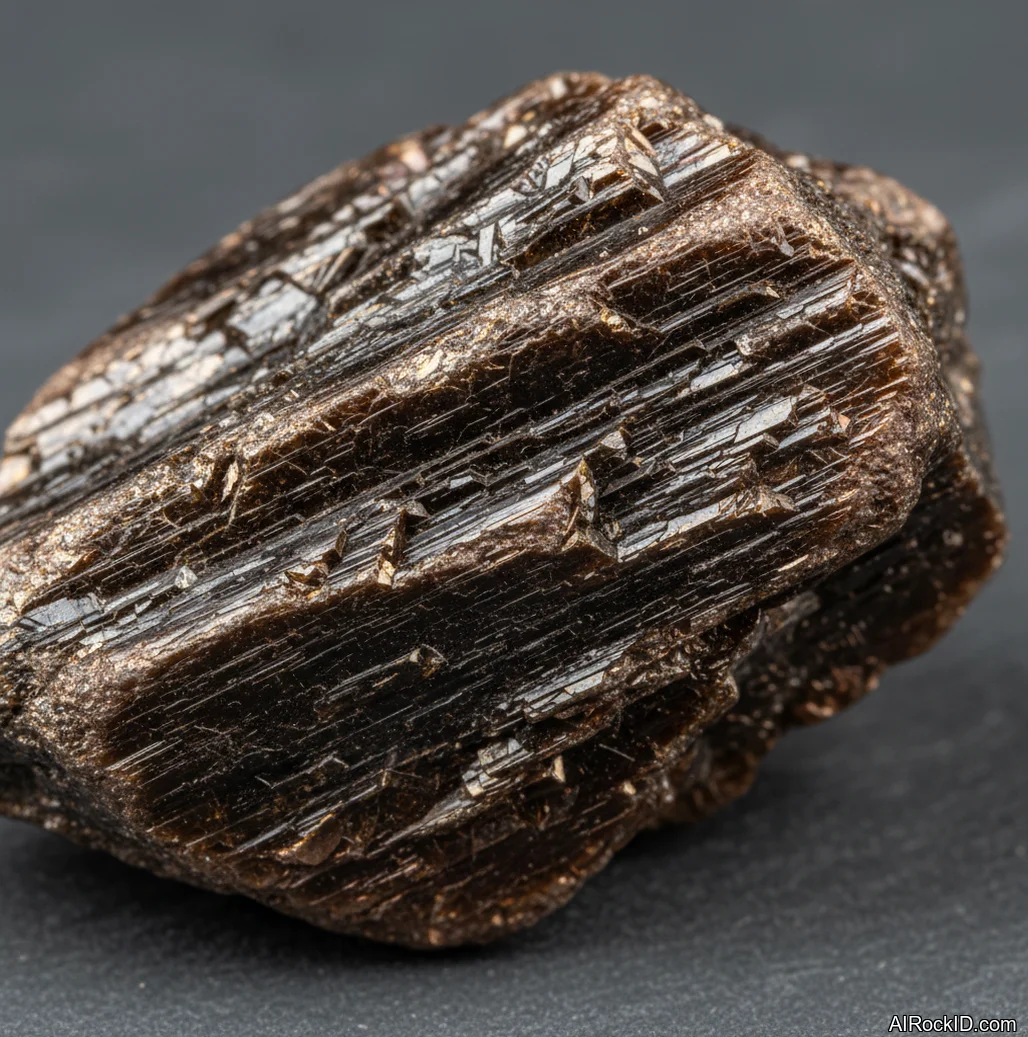
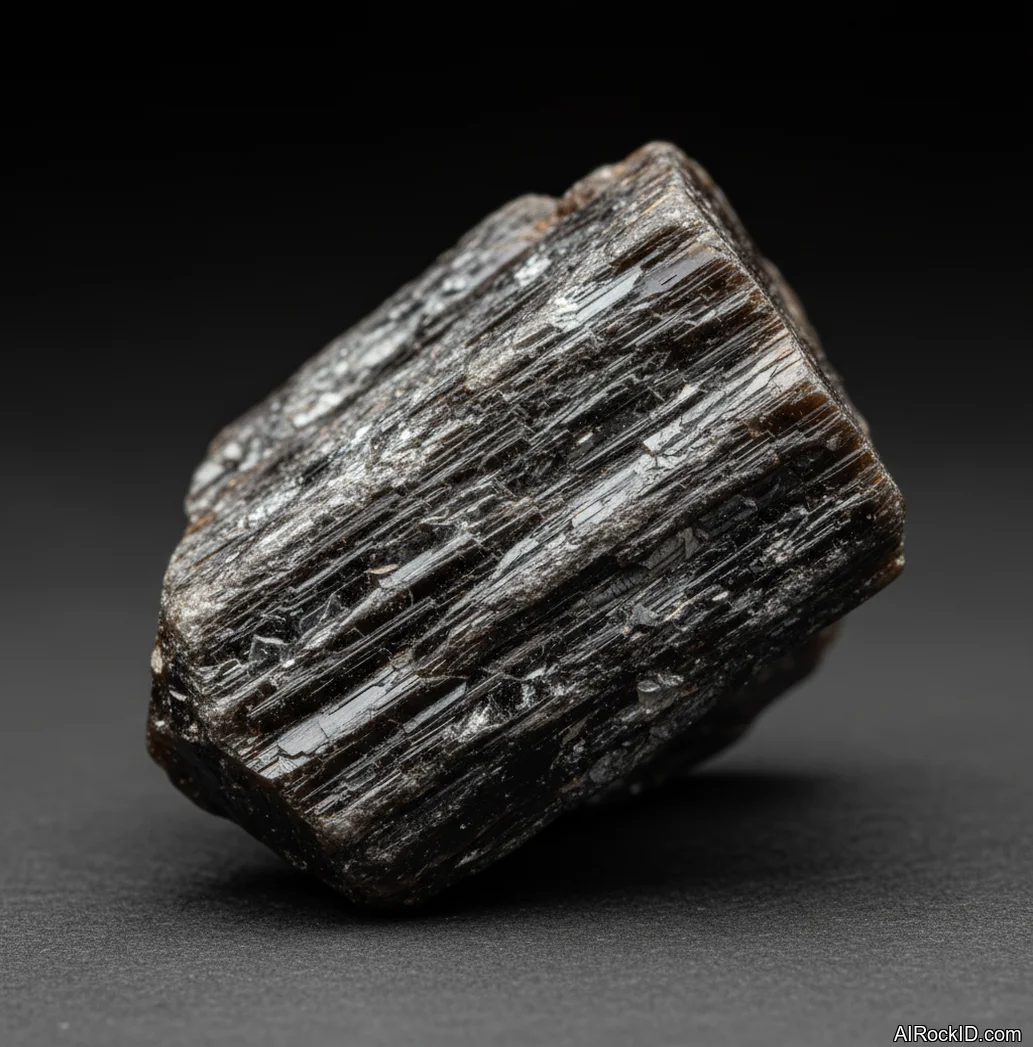
Quick answer: Hypersthene is a dark orthopyroxene mineral best recognized by its bronze-gray to greenish-black color and subtle silky or metallic-looking sheen. It is often confused with bronzite, labradorite, and other dark stones that show flash or shimmer.
AI Rock ID can help compare a suspected hypersthene sample against visually similar dark minerals by checking color, luster, texture, and visible flash patterns. RockIdentifier.io supports quick visual screening, but close lookalikes may still require hardness, density, or professional testing for confirmation.
Good fit
- Collectors who like dark minerals with a bronze or silvery sheen
- People comparing pyroxene minerals such as hypersthene, enstatite, and bronzite
- Jewelry buyers who want an understated stone rather than a bright flash stone
- Beginners learning to distinguish shimmer, schiller, and labradorescence
Not a good fit
- Anyone expecting strong rainbow flashes like labradorite
- Rings or high-impact jewelry worn daily without protective settings
- Buyers who need a lab-confirmed mineral species from photos alone
Most commonly confused with
- Bronzite: Bronzite is an iron-bearing enstatite variety with a warmer bronze sparkle, while hypersthene is usually darker and more gray-black.
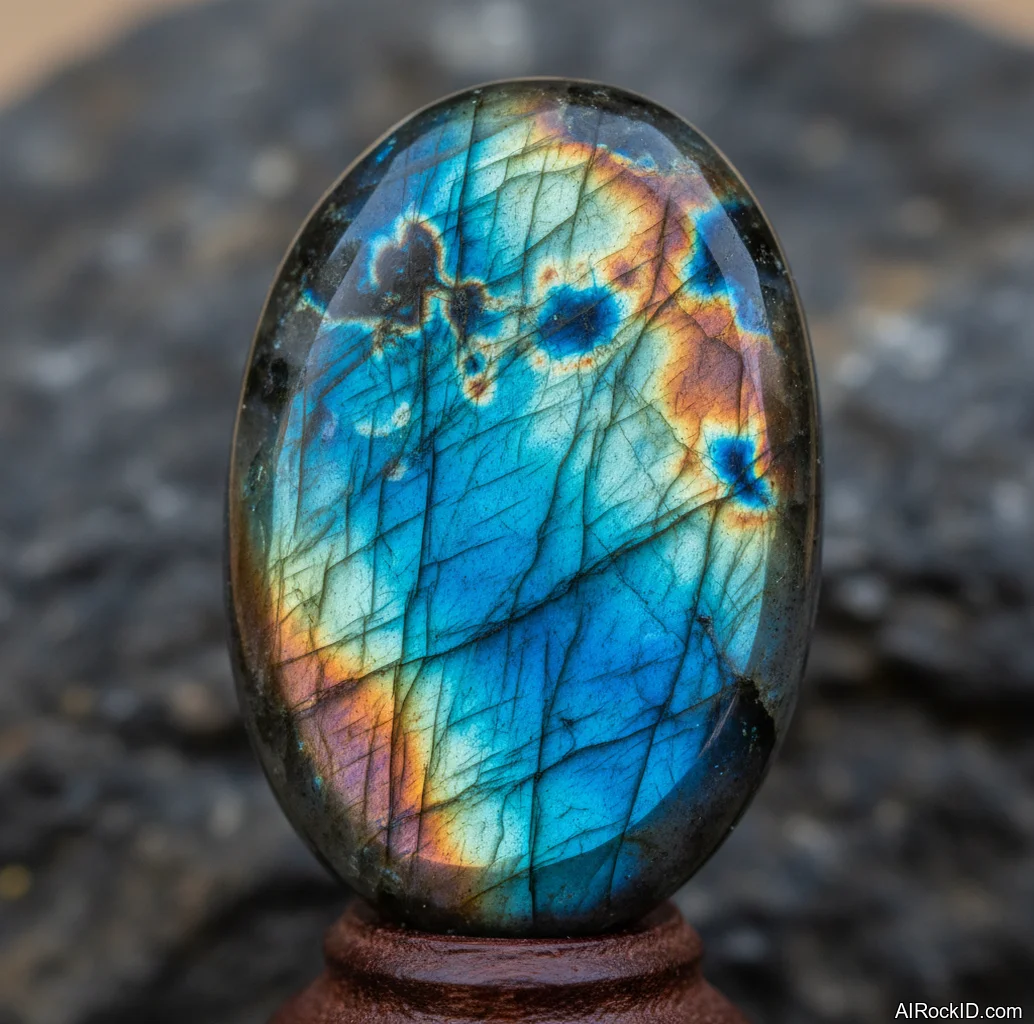
- Labradorite: Labradorite shows colorful labradorescence, while hypersthene usually has a softer silver, bronze, or silky sheen.
- Nuummite: Nuummite commonly shows elongated golden or blue-green flashes in an amphibole-rich rock, while hypersthene is a pyroxene mineral with a more uniform dark body color.
- Hornblende: Hornblende is generally black to dark green with prismatic cleavage and less of the bronze-gray silky sheen typical of polished hypersthene.
Hypersthene vs. Common Lookalikes
| Stone | Typical visual cue | Key difference |
|---|---|---|
| Hypersthene | Dark gray, green-black, or bronze-gray with silky sheen | Subtle schiller rather than bright color play |
| Bronzite | Brown to bronze with metallic flecks | Usually warmer brown and more bronze-speckled |
| Labradorite | Gray to dark base with blue, green, or rainbow flash | Flash is usually more colorful and directional |
| Nuummite | Black to dark base with golden or blue-green streaky flashes | Flash often appears as elongated fibers or streaks |
| Hornblende | Black to dark green, often blocky or prismatic | Typically lacks the same smooth bronze-gray sheen |
AI identification confidence
AI identification of hypersthene is usually moderate when the photo clearly shows a dark body color and silky bronze-gray sheen. Confidence drops when the stone is polished, poorly lit, or photographed at only one angle because bronzite, labradorite, and nuummite can look similar.
When AI gets it wrong
- A single photo does not show the sheen moving as the stone is tilted
- The surface is highly polished and hides crystal structure or cleavage
- Lighting creates artificial bronze or silver reflections
- The specimen is sold under a trade name rather than a verified mineral name
How to Check Hypersthene Before Buying
Ask for photos or video taken under neutral light from several angles, because hypersthene’s sheen can change with viewing direction. A reliable listing should avoid promising strong rainbow flash, which is more typical of labradorite than hypersthene. If the piece is expensive, request the seller’s basis for identification, such as mineral source, testing, or comparison with known orthopyroxene material.
Natural Hypersthene vs. Trade Names
Hypersthene may appear in listings as a mineral name, a rock component, or a descriptive trade name for dark shimmering material. Some stones sold as hypersthene may be bronzite, enstatite, or mixed pyroxene-bearing rock rather than a single confirmed mineral specimen. Trade names are not always fraudulent, but they should be treated as descriptive unless mineral identification is documented.
Best Photos for Identifying Hypersthene
Use one photo in daylight or neutral white light, one close-up of the surface, and one angled shot that shows the sheen. Avoid only using flash photography, because it can make many dark stones look metallic. A short tilt video is often more useful than a still image for separating subtle hypersthene schiller from labradorite color play.
What Is Hypersthene?
Hypersthene is a dark orthopyroxene mineral (pyroxene group) in the enstatite-ferrosilite series, and it’s usually loaded with iron and magnesium.
Pick up a polished piece and you notice it fast. Cool. Heavy for its size. And when you tilt it under a lamp, there’s this soft bronzy flash that looks like it’s tucked just under the surface, not painted on top. A lot of people run into it first as a palm stone or a cabochon, mostly because that shimmer behaves way better when the stone’s domed and lined up the right way.
At first glance it gets tossed into the “black stone” bucket, but it’s not truly jet black unless the lighting’s awful. In daylight, I usually see a smoky charcoal base with brown to coppery highlights, and sometimes a faint greenish cast along one edge if the polish is really clean (you can feel it too, kind of glassy-slick). But it’s finicky. Turn it the wrong direction and the sheen just drops out, and suddenly you’re holding a plain dark gray rock that refuses to photograph the way sellers want it to.
Origin & History
Hypersthene first got written up in 1808 by Paul Christian Wilhelm Beuth, who was working with material from the island of Labutscha (which older sources often fold into the Labrador region in Canada). The name’s straight out of Greek: “hyper” (over) plus “sthenos” (strength), basically a tip of the hat to how hard and tough it is compared with some other dark, similar-looking minerals people kept mixing it up with back then.
Thing is, older collections will sometimes list “hypersthene” like it’s a separate mineral species. Modern mineralogy mostly treats it as the iron-rich end of the enstatite-ferrosilite orthopyroxene series instead. But you’ll still spot “hypersthene” on tags at shows. It’s a familiar name, and that lapidary rough has that classic bronze sheen that flashes when you tilt it under the lights (you can see it from clear across a table).
Where Is Hypersthene Found?
It turns up in mafic and ultramafic igneous rocks and in high-grade metamorphic terrains. Collector pieces and lapidary rough are often marketed from Canadian and U.S. localities, with other occurrences worldwide.
Formation
Most hypersthene shows up in hot, high-temperature conditions, basically anywhere magnesium-iron silicates can hang on without breaking down. So think gabbro, norite, other dark igneous rocks, plus metamorphic rocks that got cooked and squeezed hard enough that orthopyroxene grows instead of the softer, water-bearing minerals.
But compared to something flashy like quartz, hypersthene usually isn’t the star of the show. It tends to be a host rock mineral. You’ll run into it as grains, chunky massive bits, or those bladed cleavage fragments, not big standalone crystals. I’ve busted open norite with a rock hammer and you can pick it out from that dull bronze glint on a fresh break (you see it right away), even before you bother grabbing a hand lens.
How to Identify Hypersthene
Color: Usually dark gray to black with brown, bronze, or coppery highlights; some pieces lean slightly greenish-gray in strong light. Polished material can show a silky, directional sheen.
Luster: Vitreous to silky, especially on polished surfaces that catch the light along fine internal alignment.
Look closely at the sheen: it’s directional, not a rainbow flash like labradorite, and it tends to look like brushed metal rather than glitter. The real test is rotation under a single light source, because the bronzy glow will turn on and off as you tilt it. If you scratch it with a steel knife, it’ll usually mark faintly or resist depending on the exact composition, but it shouldn’t behave like soft hematite or leave a red-brown streak.
Common Look-Alikes
Hypersthene is sometimes confused with these materials:
- Bronzite (enstatite with stronger, more even bronze schiller, often sold as hypersthene)
- Nuummite (anthophyllite-gedrite; bigger flashy patches and more color play than hypersthene’s softer sheen)
- Hematite or specular hematite (metallic gray-black; mirror-like sparkle instead of that under-the-surface bronze glow)
- Black labradorite / larvikite (dark feldspar with blue-silver flashes; the flash sits in broader planes than hypersthene)
- Dyed black chalcedony/onyx or dyed jasper (too uniform black; dye can pool in pits and fractures)
- Black glass or “obsidian” fakes (warm in the hand, lighter than expected, and the sheen looks like a surface gloss not a buried schiller)
Market Cautions & Treatments
When AI Can Get This Wrong
Phone photos love to call hypersthene “hematite” or “obsidian” because all three read as plain black until the angle hits just right. Nuummite and bronzite also trip AI up since the bronze flash can look identical in a still shot. The quick reality check is physical: hypersthene should feel cool and heavy, and the bronzy sheen should slide under the surface as you tilt it, not sit like a metallic paint layer.
Properties of Hypersthene
Physical Properties
| Crystal System | Orthorhombic |
| Hardness (Mohs) | 5-6 (Medium (4-6)) |
| Density | 3.3-3.9 g/cm3 |
| Luster | Vitreous |
| Diaphaneity | Opaque |
| Fracture | Uneven |
| Streak | grayish white |
| Magnetism | Non-magnetic |
| Colors | dark gray, black, bronze, brown, coppery gray |
Chemical Properties
| Classification | Silicates |
| Formula | (Mg,Fe)SiO3 |
| Elements | Mg, Fe, Si, O |
| Common Impurities | Ca, Al, Mn |
Optical Properties
| Refractive Index | 1.65-1.75 |
| Birefringence | 0.009-0.015 |
| Pleochroism | Moderate |
| Optical Character | Biaxial |
Hypersthene Health & Safety
Handling and rinsing won’t hurt normal specimens or polished stones. I’ve rinsed pieces under the tap and just patted them dry with a towel, no problem. But if you’re grinding or sanding it, treat it like any other silicate rock and don’t breathe the dust. Dust in your throat is nasty, and it’s not worth it, right?
Safety Tips
If you’re cutting or polishing, keep a little water running on the work so the dust doesn’t go everywhere. Wear eye protection (those tiny gritty bits love to bounce straight up), and don’t cheap out on the mask, either. Use a proper respirator rated for fine particulates.
Hypersthene Value & Price
Price Range
Rough/Tumbled: $5 - $60 per piece
Cut/Polished: $2 - $12 per carat
Price jumps around mostly because of how strong the sheen is and how evenly it lays across the surface, plus the polish quality and the size of the piece. Clean cab material with the right orientation costs more, since a lot of the rough just goes dead once you start cutting if you’re even a little off on direction.
Durability
Moderate — Scratch resistance: Fair, Toughness: Fair
It’s generally stable in normal household conditions, but the cleavage and mid-range hardness mean it can scuff and chip if you treat it like quartz.
How to Care for Hypersthene
Use & Storage
Store it in a pouch or a compartmented box so it doesn’t get rubbed by harder stones like quartz or corundum. And don’t toss palm stones together if you care about the polish.
Cleaning
1) Rinse with lukewarm water and a drop of mild soap. 2) Use a soft toothbrush to lift skin oils out of the polish. 3) Rinse and pat dry, then let it air-dry fully before putting it away.
Cleanse & Charge
For a non-fussy reset, I just use smoke, sound, or a quick pass on a selenite plate. If you like sunlight, keep it brief since the point here is the sheen, and harsh display light can dull a polish over time.
Placement
Angle it toward a single lamp on a shelf so the bronze flash actually shows. On a desk, it looks best a little off to the side of your monitor light, not straight under diffuse ceiling LEDs.
Caution
Skip ultrasonic cleaners and harsh chemicals. They can chip the edges, and once a hypersthene cab gets a little nick, it goes ugly fast because those broken spots wipe out that silky effect.
Works Well With
Hypersthene Meaning & Healing Properties
Most dealers pitch hypersthene as this quiet, steadying stone, and yeah, that lines up with what it feels like in your hand. It isn’t loud. You roll it between your fingers, it catches a bronze glow at one angle, then the moment you tilt it a hair, it goes dark again like someone turned the dimmer switch down.
When I’m sorting a tray at a show, it’s one of the only dark stones I can keep picking up without getting bored after ten seconds. It has that smooth, slightly weighty feel, cool at first touch, and the sheen is the kind you have to chase a little. Not a bad way to kill time while you’re waiting for someone to finish asking about prices (again).
In crystal lore, people tie it to grounding and focus, plus that “keep your head on straight” kind of energy. I can live with that wording if it stays as personal practice. It’s not medicine. It won’t replace sleep, therapy, or an actual plan you follow through on. But as a tactile reminder? It does the job, because it feels solid and calm, and that small bronze shift gives your eyes something to grab onto during a quick breathing break. Handy.
But here’s where things get weird. A lot of it gets sold under fuzzy trade names like velvet labradorite or black labradorite, so people go in expecting big color flash. Hypersthene doesn’t really do that. Its sheen is subtler and it’s directional, so if you’re buying it for “flash,” you might end up disappointed unless you’ve handled a good piece in person and you know exactly what you’re looking for. Who wants that surprise after the fact?
Common mistakes
- Calling any dark stone with a flash hypersthene without checking for labradorite or nuummite
- Assuming a strong rainbow effect is typical of hypersthene
- Using seller color descriptions alone instead of comparing luster, sheen, and structure
- Judging identity from one polished cabochon photo
- Confusing bronzite’s warmer bronze sparkle with hypersthene’s darker gray-bronze sheen
Identify Hypersthene from a photo
Compare Hypersthene traits, care tips, value clues, and common lookalikes with a clear photo.