Lizardite


Quick answer: Lizardite is a soft, usually green serpentine-group mineral found in serpentinite and altered ultramafic rocks. It can resemble jade, chrysotile serpentine, antigorite, or green soapstone, so visual identification should be treated as preliminary.
AI Rock ID can help screen lizardite by comparing color, texture, luster, and visible rock context from a photo. RockIdentifier.io should be used as an identification aid, with hardness, streak, locality, and professional testing used when an exact serpentine species matters.
Good fit
- Collectors interested in serpentine-group minerals and metamorphic rocks
- Educational specimens that show serpentinite textures or green massive material
- Display pieces kept away from frequent handling or abrasion
- Buyers who want an affordable green mineral but do not need true jade
Not a good fit
- Jewelry that must resist scratches, knocks, or daily wear
- Projects requiring a confirmed jadeite or nephrite identification
- Situations where asbestos-form serpentine may be disturbed, cut, drilled, or powdered
- Collectors who need species-level certainty from appearance alone
Why people search for this
People often search for lizardite to understand whether a green serpentine specimen is safe, valuable, or being confused with jade. Searches also focus on how to tell lizardite apart from other serpentine minerals that look very similar in hand samples.
Most commonly confused with
- Chrysotile: Chrysotile is the fibrous serpentine asbestos mineral, while lizardite is commonly platy or massive rather than silky-fibrous.
- Antigorite: Antigorite is another serpentine mineral that may form tougher, bladed, or foliated material, but it can overlap strongly in color with lizardite.
- Nephrite: Nephrite is a much tougher amphibole jade with higher durability and a generally waxy to greasy appearance.
- Jadeite: Jadeite is a pyroxene jade with greater hardness and density than lizardite.
Lizardite vs Similar Green Minerals
| Mineral | Typical hardness | Key difference | Common clue |
|---|---|---|---|
| Lizardite | 2.5–3.5 | Serpentine-group mineral, often massive or fine-grained | Soft green material in serpentinite |
| Chrysotile | 2.5–3 | Fibrous serpentine asbestos variety | Silky fibers or fibrous seams |
| Antigorite | 3.5–4 | Serpentine mineral often more platy, bladed, or foliated | Tough green masses or foliated pieces |
| Nephrite | 6–6.5 | Amphibole jade, much tougher than lizardite | Resists scratching and takes durable polish |
| Jadeite | 6.5–7 | Pyroxene jade with higher hardness and density | Granular texture and higher market value when gem quality |
AI identification confidence
AI identification confidence for lizardite is usually moderate at best because many serpentine minerals share green color, waxy luster, and massive textures. Confidence improves when the photo includes locality, host rock, close-up texture, scale, and simple tests such as hardness against a fingernail, copper coin, and steel point.
When AI gets it wrong
- A polished green stone is labeled lizardite when it is actually nephrite, jadeite, or dyed material.
- A fibrous serpentine sample is treated as non-fibrous lizardite without checking for chrysotile-like texture.
- Lighting makes gray, yellow-green, or dark green serpentinite appear like a different mineral.
- A mixed serpentinite rock is identified as a single pure mineral species.
Final recommendation
Choose lizardite when you want a representative serpentine-group specimen and the seller provides clear photos, locality, and any known testing. For jewelry, carving, or jade comparisons, request hardness or gemological confirmation because lizardite is softer and less durable than true jade.
How to Check Lizardite Authenticity
Authentic lizardite is usually sold as serpentine, serpentinite, or a serpentine-group specimen rather than as high-value jade. Useful checks include a soft hardness result, green to yellow-green color, waxy to dull luster, and a geological source associated with altered ultramafic rocks. Exact separation from antigorite or chrysotile may require microscopy, X-ray diffraction, Raman spectroscopy, or other laboratory methods.
Buying Lizardite Specimens
When buying lizardite, look for listings that state whether the piece is a mineral specimen, a rock made mostly of serpentine, or a polished decorative stone. Ask for untreated daylight photos, size, weight, locality, and whether the seller has ruled out fibrous asbestos-form material. Be cautious with vague labels such as “new jade,” “green jade,” or “serpentine jade,” which may describe appearance rather than mineral identity.
Field Clues for Lizardite
Lizardite is commonly associated with serpentinite, an altered ultramafic rock that may show green, mottled, veined, or slick-looking surfaces. It may occur with magnetite, chromite, brucite, talc, carbonate minerals, or other serpentine minerals. Field identification is provisional because lizardite, antigorite, and chrysotile can occur together in the same rock.
What Is Lizardite?
Lizardite is a magnesium-rich serpentine mineral with the formula Mg3Si2O5(OH)4. It forms as a sheet silicate when ultramafic rocks hydrate.
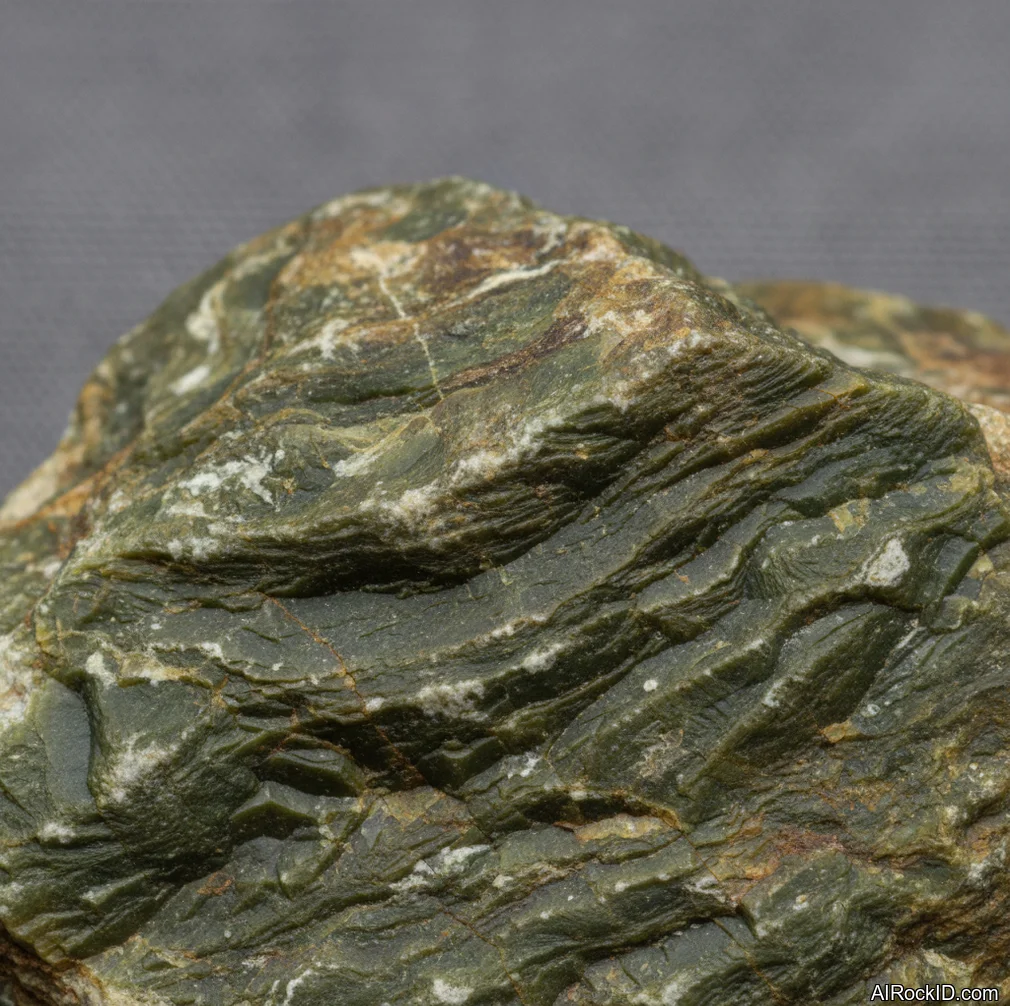
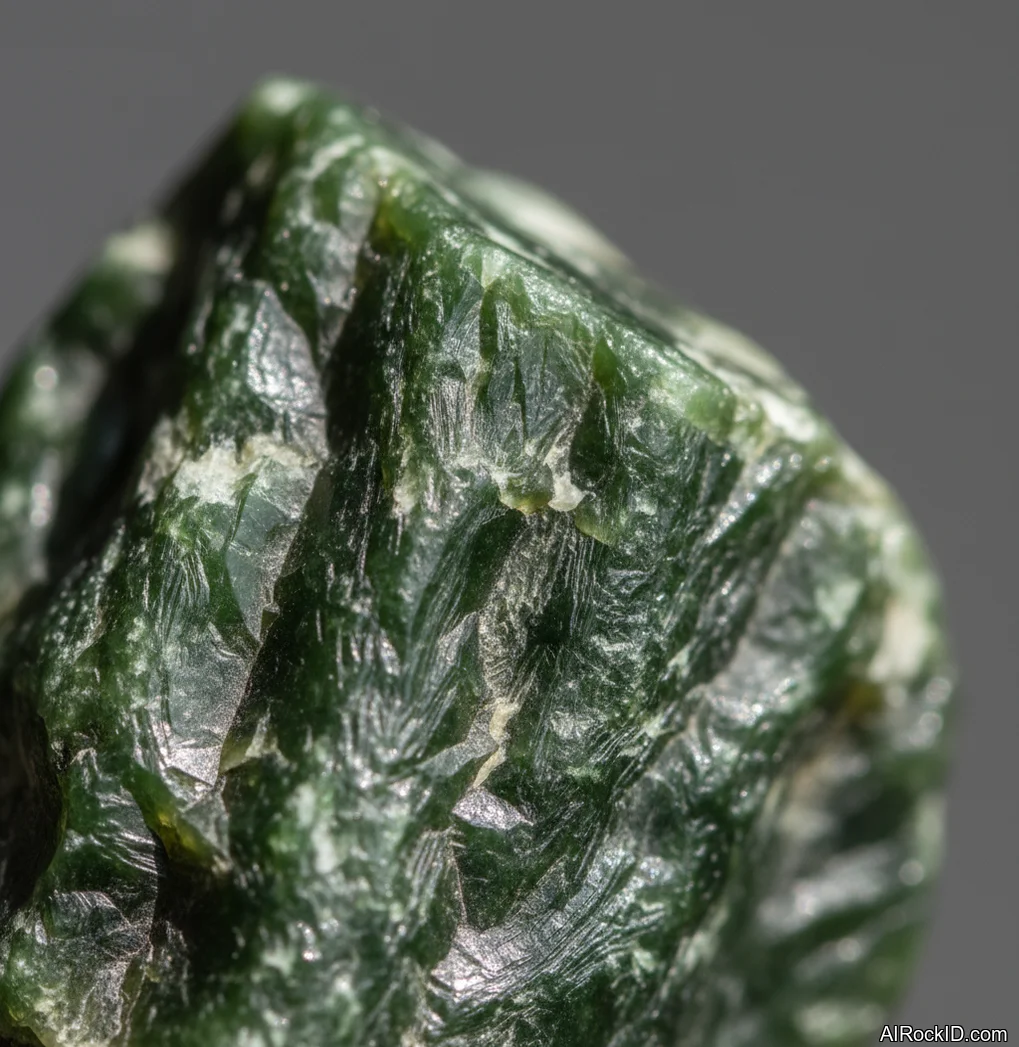
Pick up a chunky piece and you’ll notice it immediately. Slick. Almost soapy. Like that worn bar of soap you find by a creek, with the corners rounded off and a weird little sheen where it’s been rubbed. It also feels a bit lighter than you’d guess for something that looks dark green, and the surface usually reads waxy, not glassy.
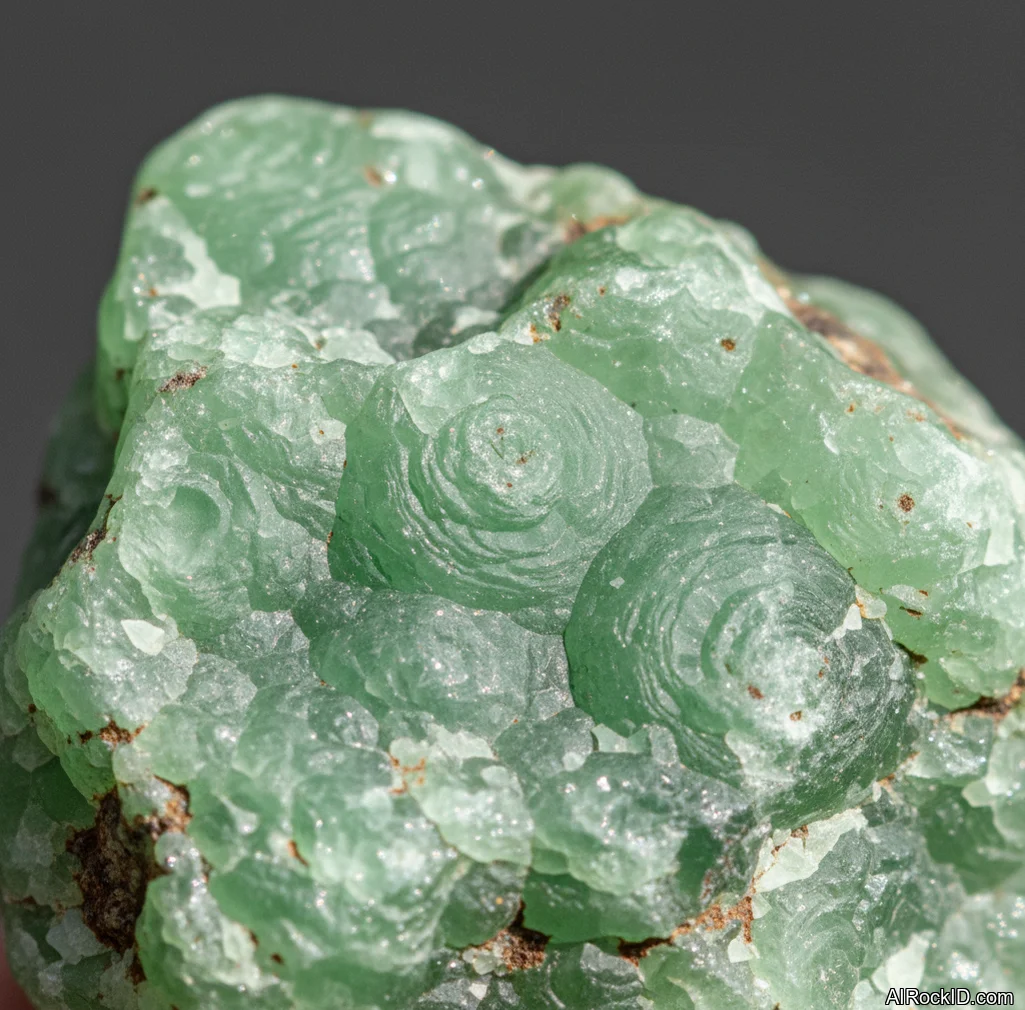
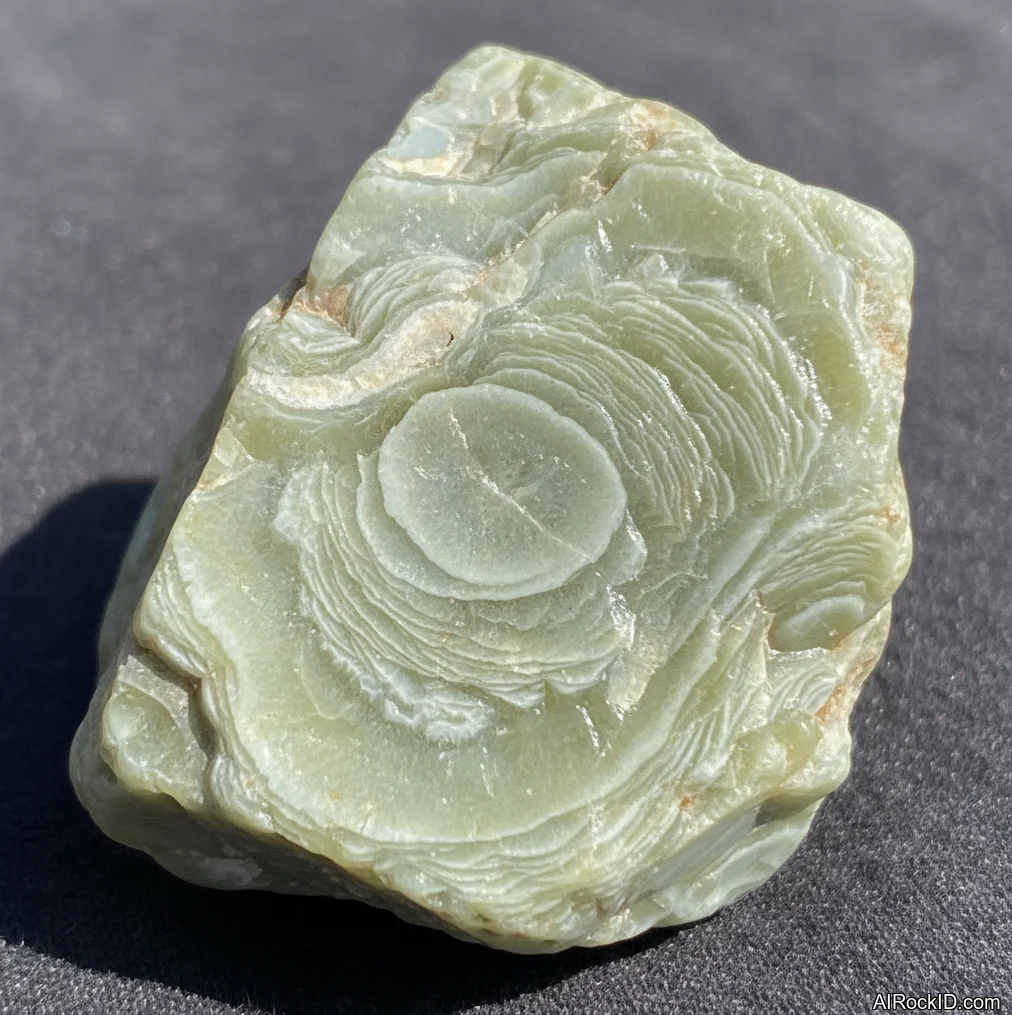
The color’s all over the place (and, honestly, most shop tags don’t bother saying that). You can see pale pistachio tones, or it can go into a deeper moss green, and it’s common to spot creamy veins where other serpentine minerals or carbonates cut through.
People mix it up with jade at first glance, and yeah, I get it, especially once it’s polished. But lizardite gives itself away pretty fast. It warms up in your hand quicker than true jade, a steel point bites into it more easily, and if you’ve carried a tumbled piece in your pocket for a month, the edges tend to dull and scuff instead of staying sharp. Why? It’s just softer in real life use.
Origin & History
“Lizardite” gets its name from the Lizard Peninsula in Cornwall, England. That’s the spot where serpentinized ultramafic rocks are famous and have been studied to death.
The mineral itself didn’t get separated out until the 20th century. And yeah, that was when mineralogists finally sorted the serpentine group into lizardite, antigorite, and chrysotile, using structure and habit to tell them apart.
Most older rock and gem books just shrug and print “serpentine,” full stop. You’ll still see that on plenty of dealer tags. But handle a few pieces side by side and the difference stops being academic. Lizardite is usually the smooth, platy, fine-grained material that takes a really nice polish (you can feel it get slick under your thumb), while antigorite tends to be tougher and can look more splintery.
Where Is Lizardite Found?
Lizardite shows up anywhere ultramafic rocks have been serpentinized, so you’ll see it in ophiolite belts, mountain belts, and old oceanic crust sections exposed on land.
Formation
Most lizardite forms when peridotite and dunite get invaded by water, usually during tectonic action that cracks the rock and keeps fluids moving. That hydration reaction swaps out olivine and pyroxene for serpentine minerals, and lizardite is a common end result when conditions favor its sheet-like structure.
Look, if you stare at a hand sample of serpentinite long enough, the whole process feels like it’s sitting there in plain sight. Green matrix. Pale veins. And those little slick planes that flash when you tilt the rock under a shop lamp. I’ve split field pieces where the inside popped out a brighter apple green than the weathered rind, and there was that faint earthy smell you only notice right after you crack open hydrated rock (kind of like damp soil, but sharper).
How to Identify Lizardite
Color: Usually medium to light green, sometimes yellow-green, with common white to cream veining; darker olive material happens too. Polished pieces can look more even in color, but raw material often shows mottling.
Luster: Waxy to slightly greasy, sometimes dull on rough surfaces and more satin-like when polished.
If you scratch it with a steel nail, it’ll usually mark, and that’s the quickest reality check when someone’s trying to sell it as “jade.” The real test is feel: lizardite often has that smooth, soapy glide on the fingers, especially on a worn surface. Compared to nephrite or jadeite, it bruises and scuffs easier, so a pocket stone will show little flat spots and dulling pretty fast.
Common Look-Alikes
Lizardite is sometimes confused with these materials:
- Antigorite (another serpentine, often confused when massive)
- Chrysotile (fibrous serpentine, sometimes labeled as Lizardite in rough form)
- Nephrite jade (especially low-grade, greenish material)
- Prehnite (paler green, sometimes waxy and sold as Lizardite at shows)
- Dyed serpentine or dyed onyx (color-enhanced to match Lizardite's yellow-green)
- Glass fakes (made to mimic the waxy luster and green shades)
Market Cautions & Treatments
When AI Can Get This Wrong
AI photo tools mix up Lizardite with nephrite and antigorite all the time, especially when the surface is polished. They also trip up on glass or dyed fakes when the color is even and the luster looks waxy. Scratching with a copper coin or steel nail helps—real Lizardite scratches easily while nephrite and glass won’t budge.
Properties of Lizardite
Physical Properties
| Crystal System | Trigonal |
| Hardness (Mohs) | 2.5-3.5 (Soft (2-4)) |
| Density | 2.55-2.65 |
| Luster | Waxy |
| Diaphaneity | Translucent to opaque |
| Fracture | Uneven |
| Streak | white |
| Magnetism | Non-magnetic |
| Colors | light green, yellow-green, olive green, gray-green, white, cream |
Chemical Properties
| Classification | Silicates |
| Formula | Mg3Si2O5(OH)4 |
| Elements | Mg, Si, O, H |
| Common Impurities | Fe, Ni, Cr, Al |
Optical Properties
| Refractive Index | 1.560-1.571 |
| Birefringence | 0.003-0.006 |
| Pleochroism | Weak |
| Optical Character | Uniaxial |
Lizardite Health & Safety
Handling it is usually safe, and a quick splash of water isn’t a big deal. Thing is, the real worry is the dust, especially if you’re cutting or sanding serpentine you can’t ID for sure (like when it’s a mixed-lot batch from a bunch of localities).
Safety Tips
If you’re going to do lapidary work on it, handle it like any other fine silicate dust hazard. Wet-cut it so you’re not kicking up a cloud, keep the airflow moving with decent ventilation, and wear a real particulate-rated respirator (not just a floppy dust mask).
Lizardite Value & Price
Price Range
Rough/Tumbled: $3 - $40 per piece
Cut/Polished: $1 - $8 per carat
Most of the price jumpiness comes down to color, how clean the material is, and whether it’s a well-cut cab that’s been polished properly (you can usually feel it with a fingernail if the finish is even a little off). Bright, even green with hardly any veining tends to move quicker. But those big display chunks with the wild, cool patterning can go for more anyway, just because they look great sitting on a shelf.
Durability
Nondurable — Scratch resistance: Poor, Toughness: Fair
It’s stable in normal room conditions, but it scratches and bruises easily, so it doesn’t hold up like tougher green stones.
How to Care for Lizardite
Use & Storage
Store it where it won’t rub against quartz, garnet, or even harder tumbled stones, because it’ll pick up scratches fast. A small pouch or separate box compartment keeps the waxy polish looking nice.
Cleaning
1) Rinse quickly in lukewarm water with a drop of mild soap. 2) Wipe with a soft cloth or a baby toothbrush for creases and veins. 3) Rinse and dry fully, and don’t leave it soaking for hours.
Cleanse & Charge
For a gentle reset, I stick it on a windowsill for indirect light or set it on a slab of selenite for a bit. Skip harsh salt soaks because there’s no upside and you can dull the surface over time.
Placement
It looks best where side light can hit the surface and bring out that oily sheen, like on a desk or a bookshelf. Keep it out of high-traffic spots if it’s polished, since one bump can leave a white scuff.
Caution
Skip ultrasonic cleaners and steam cleaning. And don’t toss it in a pocket with harder stones rattling around, because at 2.5 to 3.5 on the Mohs scale it’s going to get scratched, no question. If you pick up “jade” jewelry that’s cheap and you can mark it with a fingernail, just assume it’s serpentine. Treat it like the softer stone it is.
Works Well With
Lizardite Meaning & Healing Properties
In crystal circles, lizardite usually lands under the bigger “serpentine” umbrella. The vibe people put on it is calm, steady, very earth-forward. I don’t treat it like some rocket-fuel stone. It’s the kind of thing you park next to your keyboard when you’re tense and you want your shoulders to unclench.
Grab a polished palm stone and run your thumb over it for a minute. Seriously. That slightly slick, almost soapy feel is a huge part of why people like it, and it’s also why it shows up in meditation or grounding routines. But there’s a catch. It’s soft, so if you use it as a worry stone every day, it’ll start looking roughed up pretty quickly, with little scuffs where your thumb keeps circling. Some people call that “energy shifting.” I call it plain wear.
If you’re folding it into a self-care or spiritual routine, think of it as a supportive habit, not a fix for a medical issue. I’ve seen people get good results pairing it with breathwork or journaling because it’s quiet and doesn’t pull your attention all over the place. And if you’re picky about textures, you’ll probably notice lizardite feels more buttery in the hand than most green stones, which makes it more likely you’ll actually use it (instead of forgetting it in a drawer).
Common mistakes
- Assuming every green serpentine specimen is lizardite rather than a mixture of serpentine minerals.
- Calling lizardite “jade” without confirming jadeite or nephrite by hardness, density, or gemological testing.
- Grinding, drilling, or sawing unknown serpentine material without checking for fibrous asbestos-form minerals.
- Using color alone to separate lizardite from antigorite, chrysotile, or soapstone.
- Overvaluing common massive lizardite because it has a jade-like green color.
- Expecting lizardite to perform well in daily-wear rings despite its low hardness.
Identify Lizardite from a photo
Compare Lizardite traits, care tips, value clues, and common lookalikes with a clear photo.