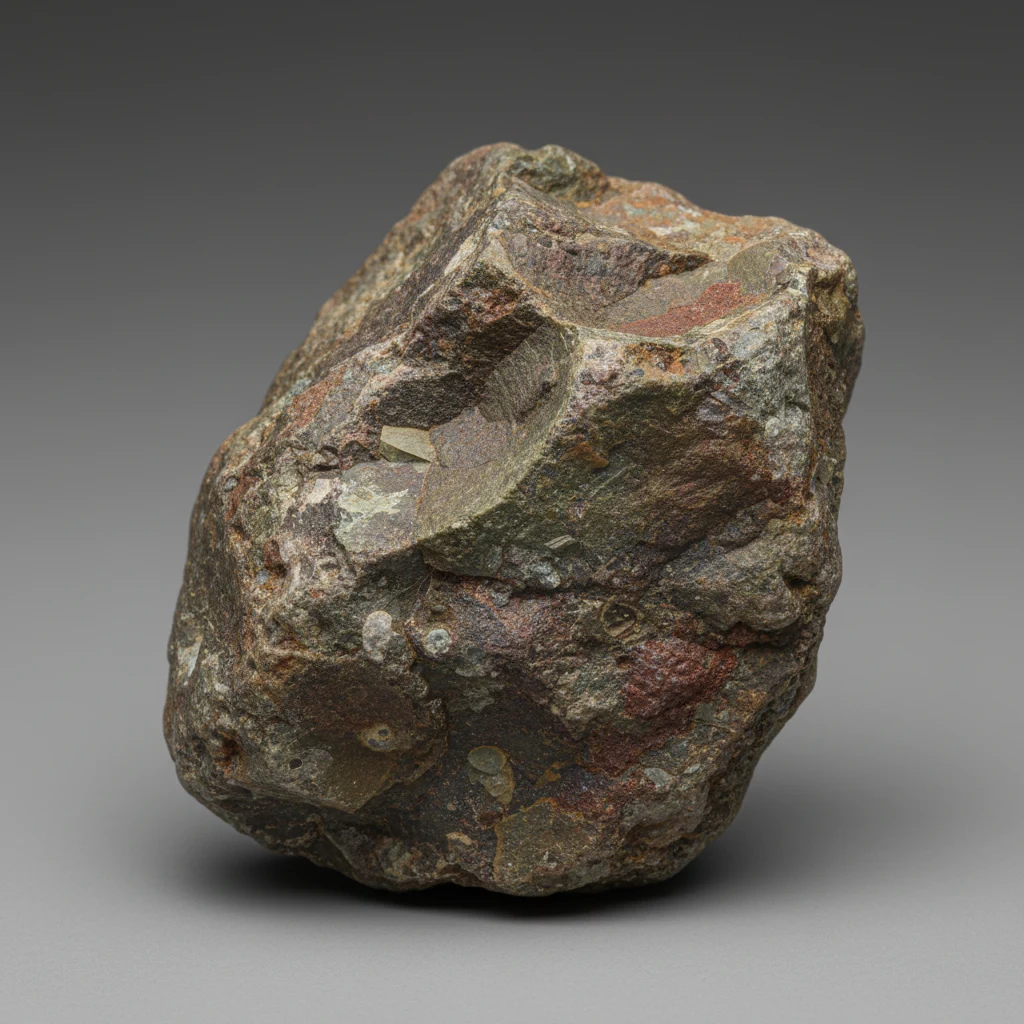
Mudstone


Quick answer: Mudstone is a fine-grained sedimentary rock made mostly of clay and silt-sized particles. It is usually identified by its dull appearance, earthy texture, lack of visible grains, and tendency to break into blocky pieces rather than thin sheets.
AI Rock ID can help compare a mudstone sample against similar fine-grained rocks by using visible texture, color, layering, and breakage patterns. RockIdentifier.io provides photo-based identification support, but field observations such as grain size, hardness, and reaction to water can improve accuracy.
Good fit
- Collectors who want a common sedimentary rock for comparison or teaching
- Students learning the difference between shale, siltstone, claystone, and mudstone
- Field users documenting local geology, outcrops, or construction cuts
- People interested in fossils, since some mudstones can preserve plant or animal traces
Not a good fit
- Anyone looking for a durable jewelry stone
- Collectors seeking bright color, transparency, or high polish
- Use in wet handling projects, since some mudstones soften or crumble when soaked
Most commonly confused with
- Shale: Shale is fissile and splits into thin sheets, while mudstone usually breaks into blocky fragments.
- Siltstone: Siltstone has a slightly gritty feel from silt-sized grains, while mudstone is generally smoother and more clay-rich.
- Claystone: Claystone is dominated by clay-sized particles, while mudstone can contain both clay and silt.
- Limestone: Limestone often reacts with dilute acid and may show shell fragments, while mudstone usually does not fizz strongly.
Mudstone vs. Similar Fine-Grained Rocks
| Rock | Typical Texture | Key Difference |
|---|---|---|
| Mudstone | Very fine, dull, earthy | Breaks blocky; mixed clay and silt |
| Shale | Very fine, layered | Splits into thin sheets |
| Siltstone | Fine, slightly gritty | Feels rougher due to silt grains |
| Claystone | Very smooth, clay-rich | More clay-dominant than mudstone |
| Slate | Fine, hard, cleaved | Metamorphic with slaty cleavage |
AI identification confidence
Photo-based identification of mudstone is usually moderate because many fine-grained sedimentary rocks look similar in images. Confidence improves when the photo shows fresh and weathered surfaces, scale, layering, breakage style, and nearby geologic context.
When AI gets it wrong
- A weathered shale surface may look blocky and be mistaken for mudstone.
- Dark mudstone can be confused with slate if cleavage and hardness are not checked.
- Fine limestone or dolostone may resemble mudstone unless acid reaction is tested.
- Wet or dusty surfaces can hide grain size, color, and natural breakage patterns.
Final recommendation
For reliable identification, combine visual inspection with simple checks such as hardness, grain feel, breakage style, and acid reaction when appropriate. If the specimen has thin splitting layers, strong cleavage, or visible gritty grains, compare it carefully with shale, slate, or siltstone before labeling it mudstone.
How to Tell If Mudstone Is Authentic
Mudstone is rarely imitated because it is common and usually inexpensive. Authentic pieces often show an earthy, dull surface, fine grain size, and natural irregular fractures rather than a glassy or resin-like texture. A very uniform color, molded-looking shape, or artificial coating may indicate a decorative composite rather than a natural rock.
Buying Mudstone Specimens
When buying mudstone, look for clear locality information, stable condition, and any visible sedimentary features such as bedding, ripple marks, or fossil traces. Avoid pieces that shed powder heavily, crumble during handling, or have been sealed without disclosure. Fossil-bearing mudstone may have higher value depending on preservation, legality, and collection locality.
Field Identification Tips
A hand lens can help confirm that mudstone has particles too small to distinguish easily. Rub a fresh surface gently to check for an earthy feel, and compare the breakage to shale, which tends to split into thin plates. If carbonate rock is possible, a small drop of dilute acid on an inconspicuous fresh surface can help separate limestone from mudstone.
What Is Mudstone?
Mudstone is a common fine-grained sedimentary rock made mainly of clay and silt. In the hand, it usually feels soft, compact, and earthy rather than glassy or crystalline, with a dull surface that suits its name. Its typical colors are gray, brown, and green, and its Mohs hardness of 2-4 makes it a soft to moderately soft collector specimen.
Collectors usually value mudstone for geology, texture, and sedimentary context rather than sparkle. It is opaque, non-magnetic, and commonly shows an uneven fracture. Because it can weather easily under harsh conditions, a good specimen is best kept dry, stable, and away from extreme outdoor exposure.
Origin & History
The name mudstone directly reflects what the rock is: stone formed from mud-rich material. It was first described in the 19th century, and the plain name still works well in the field because it points to the rock’s clay-rich, fine-grained character without needing a polished surface or gem treatment.
As a specimen, mudstone has a practical, grounded appeal. It is not rare or showy, but it records quiet sedimentary settings in a compact, touchable form. Reference: mindat.org.
Where Is Mudstone Found?
Mudstone is commonly found in sedimentary basins. Reported countries include the USA, China, and India, with notable localities including the Badlands of South Dakota, the Gobi Desert in Mongolia, and Bangalore, India.
Formation
Mudstone forms from the compaction of mud and silt over time. The process is commonly associated with quiet water environments, where fine particles can settle and later become pressed into a compact sedimentary rock.
That origin explains the feel of the specimen: fine grained, dull, and often soft compared with harder crystalline materials. Its amorphous structure, opaque appearance, and light gray to white streak all fit a rock built from very fine sediment rather than visible crystals.
How to Identify Mudstone
Identify mudstone by its soft, fine-grained texture and dull to earthy luster. Most pieces appear gray, brown, or green, and they lack the sparkle or transparency of many collectible minerals. A streak test can show a light gray to white streak.
Useful checks include Mohs hardness of 2-4, non-magnetic response, opaque diaphaneity, and uneven fracture. Density is listed at 1.8-2.5 g/cm3. In practice, a suspected mudstone should feel compact, matte, and sedimentary, with no obvious crystal faces.
Properties of Mudstone
Physical Properties
| Crystal System | Amorphous |
| Hardness (Mohs) | 2-4 (Soft (2-4)) |
| Density | 1.8-2.5 g/cm3 |
| Luster | Dull |
| Diaphaneity | Opaque |
| Fracture | Uneven |
| Streak | Light gray to white |
| Magnetism | Non-magnetic |
| Colors | Gray, Brown, Green |
Chemical Properties
| Classification | Tectosilicate |
| Formula | SiO2 · nH2O |
| Elements | Si, O |
| Common Impurities | Fe, Ca |
Optical Properties
| Refractive Index | None |
| Birefringence | None |
| Pleochroism | None |
| Optical Character | Isotropic |
Mudstone Health & Safety
Mudstone poses minimal health risks.
Mudstone Value & Price
Price Range
Rough/Tumbled: $5 - $20 per specimen
Cut/Polished:
Price is influenced by the size and quality of the specimen.
Durability
Moderate — Scratch resistance: Fair, Toughness: Fair
Mudstone can weather easily under harsh conditions.
How to Care for Mudstone
Use & Storage
Store in a cool, dry place away from direct sunlight.
Cleaning
Clean with a damp cloth, avoiding harsh chemicals. Let it air dry completely.
Cleanse & Charge
Place under running water or in sunlight for cleansing.
Placement
Keep in areas where calmness is desired.
Caution
Avoid exposing it to extreme weather conditions.
Works Well With
Mudstone Meaning & Healing Properties
Mudstone is thought to support grounding, stability, and calmness. In crystal-healing practice, it is associated with the Root chakra and the Earth element, making it a fitting stone for quiet spaces where steadiness is desired.
It is also linked with Taurus and Virgo, and with qualities such as nurturing, emotional healing, trust, insight, relaxation, self-discovery, and compassion. These uses are cultural and spiritual associations only; mudstone is not a substitute for medical treatment.
Identify Mudstone from a photo
Compare Mudstone traits, care tips, value clues, and common lookalikes with a clear photo.
Common mistakes
- Calling any dark fine-grained rock mudstone without checking for shale-like splitting
- Confusing slate with mudstone because both can be gray or black
- Using color alone for identification instead of texture, hardness, and breakage
- Assuming all mudstone contains fossils, even though many pieces are fossil-free
- Soaking a fragile sample in water, which may cause some mudstones to soften or break apart