Multi-Color Tourmaline


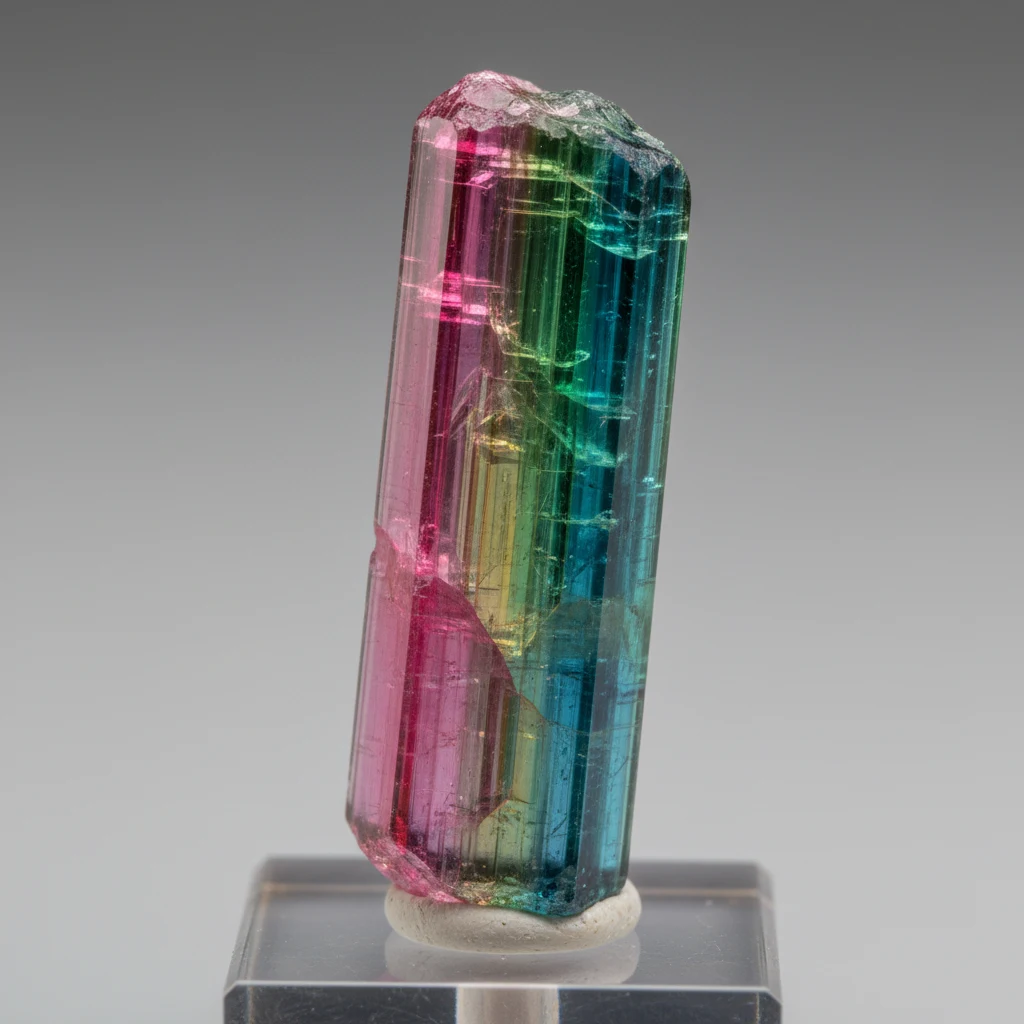
Quick answer: Multi-Color Tourmaline is a tourmaline crystal that shows two or more color zones within the same specimen, often in bands or gradients. Its color zoning, prismatic crystal habit, and strong durability help distinguish it from many softer or dyed lookalikes.
AI Rock ID can help compare a photo of Multi-Color Tourmaline against common lookalikes by checking visible clues such as color zoning, crystal shape, luster, and transparency. RockIdentifier.io provides educational identification support, but final confirmation may require gemological testing for valuable specimens.
Good fit
- Collectors who like natural color zoning in a single crystal
- Jewelry buyers looking for a durable gemstone with distinctive color patterns
- Beginners learning to identify prismatic crystals and banded gem material
- Specimen collectors comparing tourmaline varieties such as watermelon, bi-color, and parti-color stones
Not a good fit
- Buyers who need a perfectly uniform gemstone color
- Situations where untreated origin must be guaranteed without lab documentation
- People seeking a very low-cost crystal, since attractive zoning can increase price
- Anyone expecting a crystal to replace medical or professional care
Most commonly confused with
- Fluorite: Fluorite can be multi-colored but is much softer, has perfect cleavage, and often forms cubic or octahedral shapes rather than long striated prisms.
- Ametrine: Ametrine shows purple and yellow quartz color zones, while Multi-Color Tourmaline commonly shows more varied colors and a trigonal prismatic habit.
- Quartz: Quartz may be clear, smoky, or included, but it lacks tourmaline’s typical lengthwise striations and strongly zoned watermelon-like patterns.
- Dyed Agate: Dyed agate may show bright artificial bands, but its banding follows chalcedony layers rather than tourmaline’s internal crystal growth zones.
Multi-Color Tourmaline vs. Common Lookalikes
| Material | Typical Color Pattern | Key ID Clue | Hardness |
|---|---|---|---|
| Multi-Color Tourmaline | Distinct zones or bands in one crystal | Long striated prismatic habit; trigonal crystal system | 7–7.5 |
| Fluorite | Purple, green, blue, or rainbow zones | Cubic cleavage and lower scratch resistance | 4 |
| Ametrine | Purple and yellow quartz zones | Quartz habit; no tourmaline-style lengthwise striations | 7 |
| Dyed Agate | Strong bands, often very saturated | Waxy chalcedony luster and curved banding | 6.5–7 |
| Glass | Swirls or blended artificial colors | Possible bubbles and no natural crystal growth habit | About 5–6 |
AI identification confidence
AI photo identification is often moderately confident when a specimen shows clear tourmaline striations, natural color zoning, and a complete crystal shape. Confidence is lower for polished stones, cabochons, beads, or images with strong lighting glare because many colored materials can appear similar in photos.
When AI gets it wrong
- Polished beads or cabochons hide the original crystal habit and striations.
- Dyed agate, glass, or coated stones can mimic bright multi-color zoning in photos.
- Small chips may not show enough structure for reliable separation from quartz or fluorite.
- Overexposed images can make natural color boundaries look artificial or obscure inclusions.
Final recommendation
Choose Multi-Color Tourmaline when visible natural color zoning, tourmaline crystal habit, and reasonable durability matter more than uniform color. For expensive stones, ask for disclosure of treatments and consider a gemological report from a reputable lab.
How to Check Authenticity Before Buying
Look for natural-looking color transitions, lengthwise striations on crystal faces, and internal inclusions that are consistent with tourmaline. Be cautious with stones that have extremely vivid color with no visible inclusions, suspicious surface coating, or identical color patterns across many beads. For higher-value pieces, request treatment disclosure and a lab report rather than relying on appearance alone.
Natural Color Zoning vs. Dyed Material
Natural Multi-Color Tourmaline forms color zones during crystal growth, so boundaries may appear as bands, caps, or gradual changes along the crystal. Dyed materials often show color concentrated in cracks, pits, drill holes, or porous areas. Magnification can help reveal whether color follows the crystal structure or sits unevenly near the surface.
Photo Tips for More Accurate Identification
Photograph Multi-Color Tourmaline in indirect daylight on a neutral background, and include views from the side, end, and any broken or terminated faces. A close-up of striations, color boundaries, inclusions, and transparency improves identification quality. Avoid colored lighting and heavy filters because they can distort the stone’s true zoning.
What Is Multi-Color Tourmaline?
Multi-Color Tourmaline is a semi-precious tourmaline gemstone that shows more than one color inside a single crystal. In hand, the appeal is immediate: bands or zones of pink, green, blue, and yellow can sit together in one transparent to translucent piece, giving the specimen a lively, layered look rather than a single flat body color.
Collectors value it because the color zoning is easy to see and highly decorative, especially when paired with its vitreous luster. It is a durable stone with Mohs hardness 7-7.5, good scratch resistance, fair toughness, white streak, conchoidal fracture, and a density of 3.0-3.2 g/cm3.
Origin & History
The name tourmaline comes from the Sinhalese word “turmali,” a term used for various gemstones. Multi-Color Tourmaline belongs to the broader tourmaline mineral variety, and its scientific description dates to the late 18th century, when tourmaline began to be treated as a distinct mineral group in formal mineral study.
For collectors, the history is tied closely to the stone’s visible color complexity: one crystal can record changing growth conditions in a way the eye can read. Locality and mineral data for tourmaline specimens are commonly cross-checked through references such as mindat.org, especially when comparing pegmatite material from different regions.
Where Is Multi-Color Tourmaline Found?
Multi-Color Tourmaline is found in Brazil, Afghanistan, and Nigeria, with notable localities including Minas Gerais in Brazil, Kunar in Afghanistan, and Mali in West Africa. It is commonly associated with granitic pegmatites, the coarse igneous environments that can grow well-formed, colorful crystals.
Formation
Multi-Color Tourmaline forms in igneous rocks through the crystallization of boron-rich fluids. Its formula is Na(Li,Al,Mg)3Al6(BO3)3Si6O18(OH)4, and it is classified as a cyclo-silicate; boron, silicon, and oxygen are listed elements, with iron and manganese noted as common impurities.
The multi-color appearance comes from varying chemical environments during crystal growth. As conditions change, the crystal may develop zones of pink, green, blue, or yellow, so a polished gem or clean crystal section can look like a growth record captured in glassy, vitreous bands.
How to Identify Multi-Color Tourmaline
Identify Multi-Color Tourmaline first by its color zoning: look for two or more colors, commonly pink, green, blue, and yellow, within the same crystal. A fresh surface should show vitreous luster, and the material may range from transparent to translucent.
For a more technical check, use a refractometer: the refractive index should fall around 1.62-1.64, with birefringence listed as 0.008 and strong pleochroism. It is trigonal, non-magnetic, has a white streak, conchoidal fracture, and a Mohs hardness of 7-7.5.
Properties of Multi-Color Tourmaline
Physical Properties
| Crystal System | Trigonal |
| Hardness (Mohs) | 7-7.5 (Hard (6-7.5)) |
| Density | 3.0-3.2 g/cm3 |
| Luster | Vitreous |
| Diaphaneity | Transparent to translucent |
| Fracture | Conchoidal |
| Streak | White |
| Magnetism | Non-magnetic |
| Colors | Pink, Green, Blue, Yellow |
Chemical Properties
| Classification | Cyclo-silicate |
| Formula | Na(Li,Al,Mg)3Al6(BO3)3Si6O18(OH)4 |
| Elements | B, Si, O |
| Common Impurities | Fe, Mn |
Optical Properties
| Refractive Index | 1.62 - 1.64 |
| Birefringence | 0.008 |
| Pleochroism | Strong |
| Optical Character | Biaxial |
Multi-Color Tourmaline Health & Safety
There are no significant health risks associated with handling this mineral.
Multi-Color Tourmaline Value & Price
Price Range
Rough/Tumbled: $10 - $50 per specimen
Cut/Polished: $50 - $300 per carat
Price is affected by color quality, size, and clarity.
Durability
Durable — Scratch resistance: Good, Toughness: Fair
It is stable under normal conditions but should be protected from harsh chemicals.
How to Care for Multi-Color Tourmaline
Use & Storage
Store in a soft pouch away from other stones to avoid scratches.
Cleaning
Clean with mild soap and water using a soft cloth. Avoid ultrasonic cleaners.
Cleanse & Charge
To cleanse, place under running water for a few minutes.
Placement
Place in a location where it can catch sunlight for energy.
Caution
Avoid exposing it to high heat or harsh chemicals.
Works Well With
Multi-Color Tourmaline Meaning & Healing Properties
In crystal healing traditions, Multi-Color Tourmaline is believed to support emotional balance, protection, and the release of negative energy. Its associated qualities include balance, protection, and healing, with links to the Heart, Throat, and Root chakras.
Use it as a reflective or meditation stone rather than a medical tool; it is not a substitute for medical treatment. For care, clean it with mild soap and water and a soft cloth, avoid ultrasonic cleaners, harsh chemicals, and high heat, and store it in a soft pouch away from other stones to prevent scratches.
Identify Multi-Color Tourmaline from a photo
Compare Multi-Color Tourmaline traits, care tips, value clues, and common lookalikes with a clear photo.
Common mistakes
- Assuming every rainbow-colored stone is tourmaline without checking hardness, crystal habit, and luster.
- Mistaking dyed agate or glass beads for natural Multi-Color Tourmaline based only on color.
- Ignoring surface-reaching cracks where dye or coating may collect.
- Expecting all Multi-Color Tourmaline to show a classic watermelon pink-and-green pattern.
- Judging value only by size instead of color quality, clarity, cut, zoning, and treatment status.
- Using metaphysical labels as proof of identity instead of mineralogical features.