Multicolored Crystal Beads


Quick answer: Multicolored crystal beads are usually polished or drilled beads made from quartz-family materials, glass, dyed stone, or mixed mineral lots. Their identity is best confirmed by observing luster, transparency, hardness, drill-hole texture, and whether the color appears natural, dyed, coated, or heat-treated.
AI Rock ID can help compare multicolored crystal beads against common lookalikes by analyzing color zoning, luster, shape, and surface texture from a clear photo. RockIdentifier.io provides visual identification support, but bead strands with dyed, coated, or mixed materials may still require hands-on testing for confirmation.
Good fit
- Collectors who want colorful bead strands for display, jewelry, or craft projects
- Beginners learning to compare quartz, glass, agate, jasper, and dyed stone beads
- Buyers who prefer durable beads with moderate to high scratch resistance
- Projects where color variety matters more than a single confirmed mineral species
Not a good fit
- Buyers who need untreated, lab-verified natural gemstones
- High-wear designs if the beads have fragile coatings or metallic finishes
- Identification by color alone, because many bead materials can be dyed or imitated
Most commonly confused with
- Dyed Agate: Often shows very bright, uniform colors that concentrate in cracks or banding.
- Glass: Can have rounded bubbles, mold marks, or lower hardness than quartz-family beads.
- Jasper: Usually opaque with earthy patterns, though dyed jasper can appear unusually vivid.
- Quartz: Natural quartz is harder and may show internal fractures, veils, or color zoning rather than painted surface color.
Multicolored Bead Lookalike Comparison
| Material | Typical Clue | Common Buyer Note |
|---|---|---|
| Quartz-family bead | Vitreous luster, good hardness, internal fractures possible | May be natural, dyed, or heat-treated |
| Dyed agate | Color follows bands, cracks, or porous areas | Bright colors are often treatment-based |
| Glass bead | Air bubbles, swirls, or mold-like uniformity | Usually less scratch-resistant than quartz |
| Jasper bead | Opaque body with spotted or streaked patterns | Natural colors are often earthy; vivid colors may be dyed |
| Coated bead | Iridescent or metallic surface concentrated on the outside | Finish can wear at edges and drill holes |
AI identification confidence
AI identification is moderate for multicolored crystal beads because bead strands often contain mixed materials, treatments, or man-made substitutes. Confidence improves when photos show the drill holes, surface reflections, translucency, close-up texture, and several beads from the same strand.
When AI gets it wrong
- A dyed agate bead may be labeled as naturally colored quartz because both are silica-based.
- Glass beads can resemble polished quartz in photos when bubbles or mold marks are not visible.
- Coated or aura-finished beads may be misread as naturally iridescent minerals.
- Mixed strands may receive one mineral name even when different bead materials are present.
How to Check Authenticity Before Buying
Ask whether the beads are natural, dyed, heat-treated, coated, glass, or a mixed material strand. Check close-up photos of drill holes because dye, coating wear, glaze pooling, and rough inner edges often reveal treatments or non-stone materials. A seller should be able to state the base material rather than using only broad terms such as crystal, rainbow stone, or gemstone beads.
Photo Tips for Identifying Beads
Use daylight or neutral lighting and photograph several beads from multiple angles. Include a close-up of the drill hole, a side view against a white background, and one image showing translucency with light behind the bead. Avoid heavy filters because they can make dyed glass, agate, quartz, and coated beads look more similar.
Treatment Clues in Multicolored Beads
Very saturated pink, blue, purple, or neon green colors often indicate dye, coating, or glass rather than natural quartz coloration. Dye may collect in fractures, pits, or drill holes, while coatings may show rubbing on bead edges. Treatments are common in craft beads and are not automatically a problem if they are disclosed accurately.
What Is Multicolored Crystal Beads?
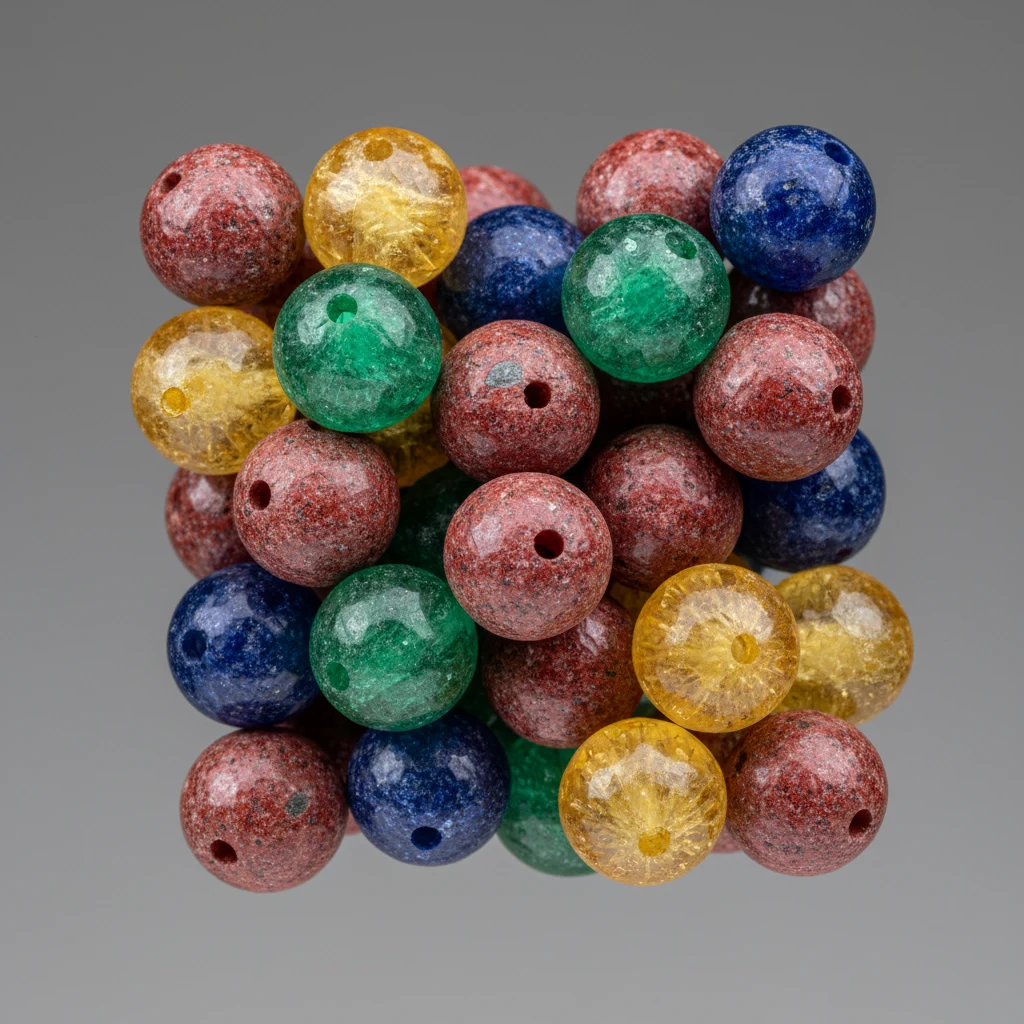
Multicolored Crystal Beads are decorative semi-precious gemstone beads made from various colored crystals, most often used in jewelry making and crafts. In the hand, they are valued less as a single rare mineral specimen and more as a colorful, workable material: red, blue, green, and yellow beads with a bright vitreous shine and transparent to translucent body.
Mineralogically, the provided classification places them in the silicate group, more specifically a tectosilicate with the formula SiO2. Their Mohs hardness range is 5-7, so they have good scratch resistance for beads, though their fair toughness means they can chip if dropped. They are non-magnetic, show a white streak, and commonly break with a conchoidal fracture.
Origin & History
The word crystal comes from the Greek word “kristallos,” meaning “frozen,” and Multicolored Crystal Beads carry that old association with clear, glassy-looking mineral material. These beads have been used for centuries in different cultures, especially as small, durable points of color for personal adornment, craftwork, and decorative arrangements.
For a collector, the appeal is immediate: a tray of mixed beads gives you color, luster, and usable size all at once. When checking mineral names, locality notes, or silicate terminology, many collectors compare labels with resources such as mindat.org, while still judging bead strands by eye for clarity, color pattern, polish, and overall condition.
Where Is Multicolored Crystal Beads Found?
Multicolored Crystal Beads are commonly associated with mineral-rich regions in India, Brazil, and China. Notable localities given for this material include Jaipur in Rajasthan, India; Minas Gerais, Brazil; and Yunnan, China. These are the names to look for when a seller provides locality information with a bead strand or specimen lot.
Formation
Multicolored Crystal Beads come from crystals that form through geological processes, often by cooling magma or by evaporating mineral-rich water. The material is classified as SiO2, a tectosilicate, and the color range may include red, blue, green, and yellow, with common impurities listed as iron and manganese.
As bead material, the geological story is carried into a small polished form. The vitreous luster, transparent to translucent body, and conchoidal fracture are all useful reminders that these beads began as mineral matter before being shaped for jewelry or craft use. Their moderate durability is suitable for wear, but hard knocks can still chip the edges.
How to Identify Multicolored Crystal Beads
Identify Multicolored Crystal Beads by their mixed red, blue, green, and yellow colors, shiny vitreous luster, and transparent to translucent appearance. Under close inspection, look for individual color patterns, clarity differences, and clean polish around the drill holes. A white streak, non-magnetic response, and conchoidal fracture are consistent with the listed physical properties.
Their reported hardness is Mohs 5-7, so a scratch test can help confirm hardness when done carefully and without damaging a finished bead. The density range is 2.5-3.0 g/cm3, the crystal system is listed as hexagonal, and the optical data include a refractive index of 1.54-1.55, weak pleochroism, uniaxial optical character, and no birefringence.
Properties of Multicolored Crystal Beads
Physical Properties
| Crystal System | Hexagonal |
| Hardness (Mohs) | 5-7 (Medium) |
| Density | 2.5-3.0 g/cm3 |
| Luster | Vitreous |
| Diaphaneity | Transparent to translucent |
| Fracture | Conchoidal |
| Streak | White |
| Magnetism | Non-magnetic |
| Colors | Red, Blue, Green, Yellow |
Chemical Properties
| Classification | Tectosilicate |
| Formula | SiO2 |
| Elements | Si, O |
| Common Impurities | Fe, Mn |
Optical Properties
| Refractive Index | 1.54-1.55 |
| Birefringence | None |
| Pleochroism | Weak |
| Optical Character | Uniaxial |
Multicolored Crystal Beads Health & Safety
There are no significant health risks associated with handling these beads.
Multicolored Crystal Beads Value & Price
Price Range
Rough/Tumbled: $10 - $50 per specimen
Cut/Polished: $2 - $10 per carat
Price is affected by color, clarity, and size of the beads.
Durability
Moderate — Scratch resistance: Good, Toughness: Fair
These beads are stable but can chip if dropped.
How to Care for Multicolored Crystal Beads
Use & Storage
Store in a cool, dry place to prevent damage.
Cleaning
Clean with a soft cloth and mild soap. Avoid harsh chemicals.
Cleanse & Charge
Place under moonlight or use sound to cleanse.
Placement
Ideal for use in jewelry or as decorative items.
Caution
Avoid exposing to extreme heat or harsh chemicals.
Works Well With
Multicolored Crystal Beads Meaning & Healing Properties
In crystal healing traditions, Multicolored Crystal Beads are believed to support creativity and emotional healing, especially when worn as jewelry or kept as bright decorative pieces. Their associated qualities are healing, creativity, and colorful expression, with property themes including joy, insight, transformation, self-discovery, calming, trust, focus, meditation, and emotional healing.
They are linked with the Throat and Heart chakras, Gemini and Libra, the planets Venus and Mercury, and the elements Earth and Water. These meanings are cultural and personal rather than medical; Multicolored Crystal Beads are not a substitute for medical treatment. For care, clean them with a soft cloth and mild soap, avoid harsh chemicals and extreme heat, and cleanse with moonlight or sound.
Identify Multicolored Crystal Beads from a photo
Compare Multicolored Crystal Beads traits, care tips, value clues, and common lookalikes with a clear photo.
Common mistakes
- Assuming every bead labeled crystal is natural quartz
- Identifying multicolored beads by color alone without checking luster, hardness, or drill-hole details
- Overlooking dye concentration in cracks, pores, and bead holes
- Confusing coated glass or aura-finished beads with naturally iridescent minerals
- Treating a mixed strand as one mineral species without examining individual beads
- Using metaphysical trade names as proof of mineral identity