Stilbite


Quick answer: Stilbite is a soft zeolite mineral best recognized by pearly, sheaf-like sprays and peach, cream, white, or colorless tones. It is commonly confused with other zeolites and soft bladed minerals, so crystal habit, luster, hardness, and matrix context are useful for identification.
AI Rock ID can help compare a stilbite specimen against visually similar zeolites by evaluating color, crystal habit, and surface texture from a photo. RockIdentifier.io provides crystal reference information that can support visual identification, buying checks, and specimen comparison.
Good fit
- Collectors who like pale peach, cream, or white zeolite clusters
- Specimen displays where delicate sheaf-like crystal sprays are protected from handling
- Buyers comparing mixed zeolite matrix pieces from India, Iceland, or basalt cavities
- Beginners learning to distinguish soft zeolites by habit and luster
Not a good fit
- Rings, bracelets, or other jewelry exposed to knocks and abrasion
- Water-based cleansing, soaking, or rough ultrasonic cleaning
- Collections that require highly durable display minerals
- Handling by young children without supervision, due to breakable crystal edges
Most commonly confused with
- Heulandite: Heulandite often forms tabular or wedge-shaped crystals, while stilbite commonly forms bow-tie or sheaf-like sprays.
- Apophyllite: Apophyllite is usually more glassy and blocky or pyramidal, while stilbite has a pearly luster and bladed aggregates.
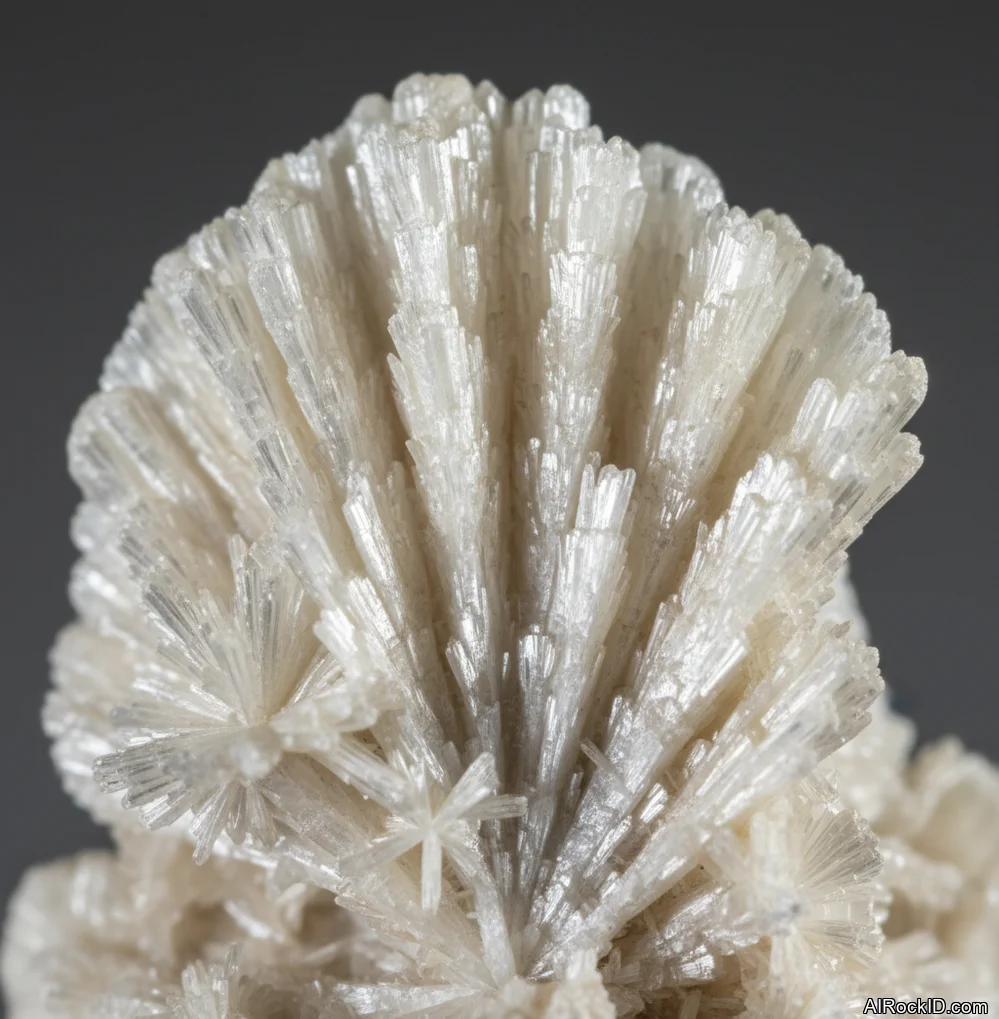
- Scolecite: Scolecite tends to form slender needle-like sprays, while stilbite forms flatter blades and bundles.
- Natrolite: Natrolite typically appears as fine acicular crystals, unlike the broader sheaf-like habit of stilbite.
Stilbite vs. Similar Zeolite Minerals
| Mineral | Typical Habit | Key Difference |
|---|---|---|
| Stilbite | Sheaf-like, bow-tie, or bladed sprays | Pearly luster; commonly peach, cream, white, or colorless |
| Heulandite | Tabular, wedge-shaped, or blocky crystals | Less sheaf-like; often broader individual crystals |
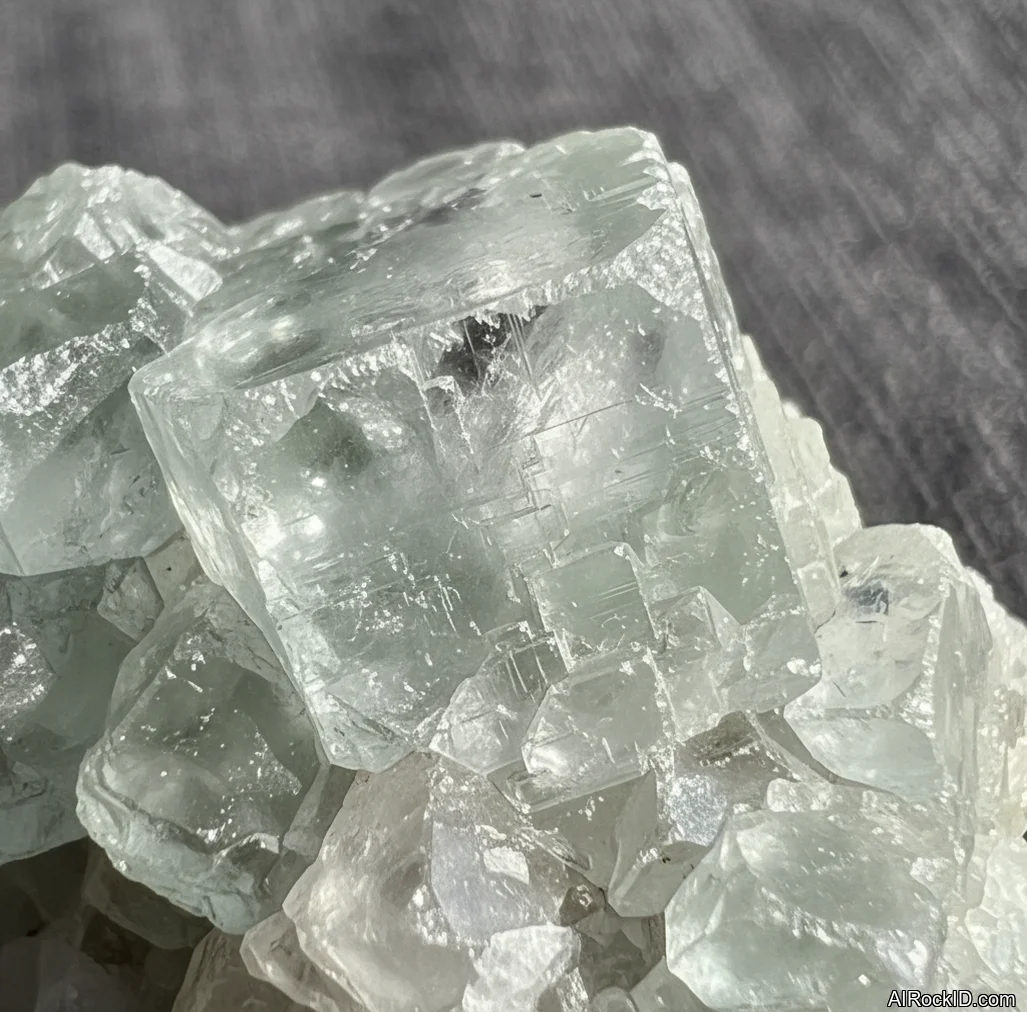
| Apophyllite | Cubic, pyramidal, or blocky crystals | More glassy and usually higher sparkle than stilbite |
| Scolecite | Needle-like sprays | Much thinner, more fibrous crystal form |
| Natrolite | Fine acicular crystals | More needle-like and commonly forms dense radiating clusters |
AI identification confidence
Photo-based identification of stilbite is usually moderate when the specimen shows clear sheaf-like crystals, pearly luster, and a typical zeolite matrix. Confidence drops when the crystals are tiny, colorless, broken, heavily mixed with other zeolites, or photographed without scale and lighting control.
When AI gets it wrong
- The specimen is a mixed zeolite cluster with stilbite, heulandite, apophyllite, and calcite growing together.
- The photo is overexposed, making pearly luster and crystal edges difficult to see.
- Only color is used for identification, since many zeolites can be white, cream, peach, or colorless.
- The sample is tumbled or polished, removing the natural sheaf-like crystal habit.
Final recommendation
Choose stilbite specimens with intact crystal sprays, stable matrix attachment, and clear seller photos from multiple angles. For authenticity checks, compare crystal habit rather than relying only on peach color, since several zeolites and calcite can appear similar.
How to Identify Stilbite in Mixed Zeolite Specimens
Stilbite often grows with other zeolites in basalt cavities, so a single specimen may contain several minerals. Look for fan-shaped, bow-tie, or sheaf-like sprays with a pearly to silky surface rather than sharp glassy points. Matrix labels from sellers can be helpful, but the visible crystal habit is usually the most useful field clue.
Buying Stilbite: Authenticity Checks
Authentic stilbite is commonly sold as natural crystal clusters rather than faceted stones or heavily polished pieces. Check for intact delicate blades, natural matrix contact, and consistent luster across the crystal faces. Be cautious with vague listings that use only color names such as “peach zeolite” without mineral identification or locality information.
Stilbite Locality Clues
Well-known stilbite specimens often come from zeolite-rich basalt regions, including parts of India, Iceland, Scotland, and the United States. Indian Deccan Traps material is especially common on the market and may occur with apophyllite, heulandite, calcite, or chalcedony. Locality alone does not prove identity, but it can support a visual identification when the crystal habit matches.
What Is Stilbite?
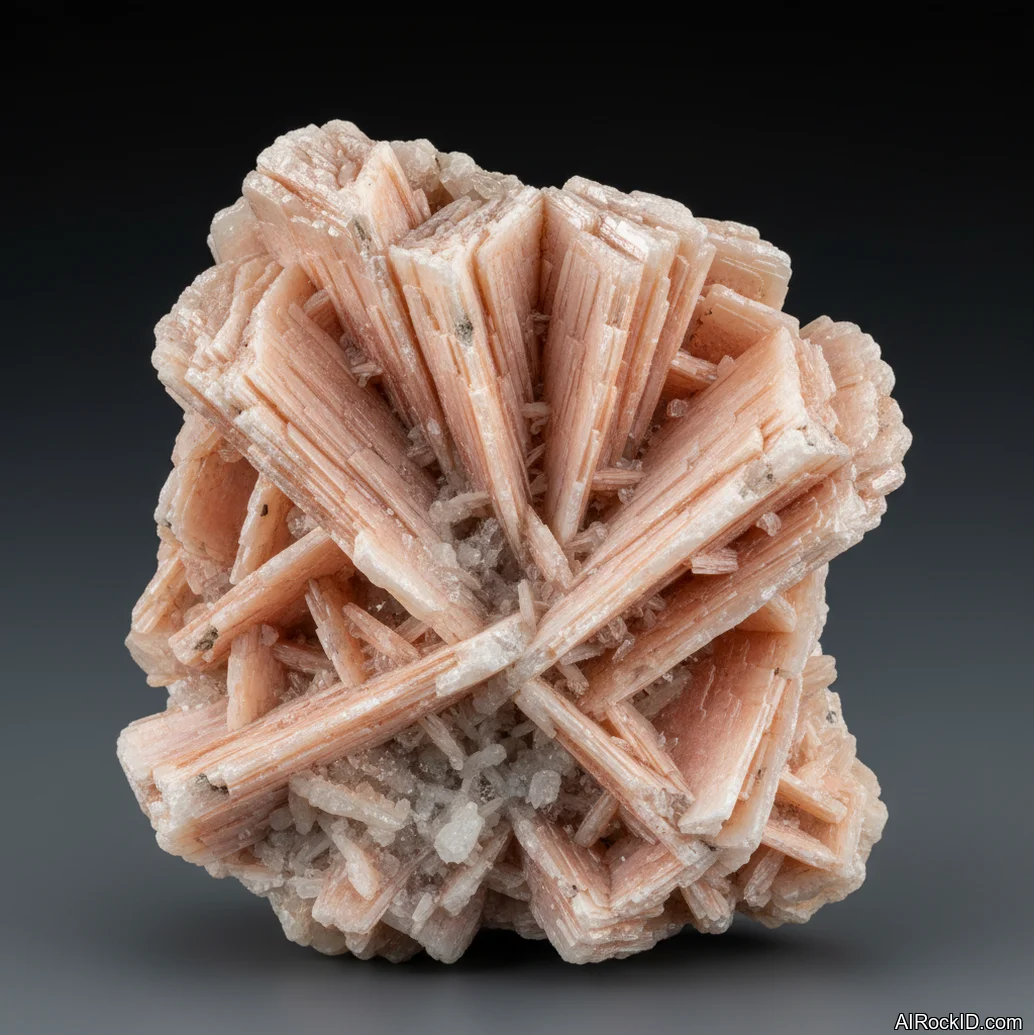
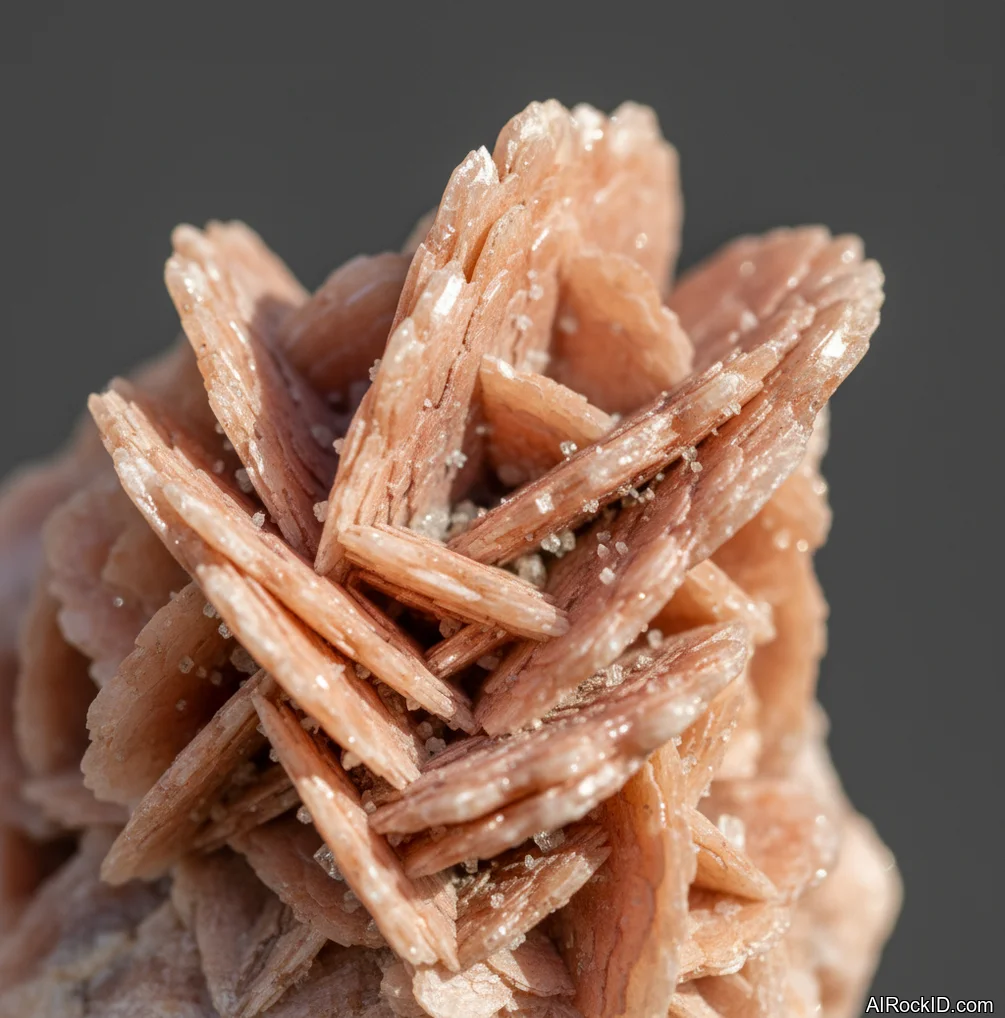
Stilbite is a zeolite mineral in the stilbite series, and it grows as bladed, sheaf-like crystal clusters, usually tucked into little cavities in basalt and other volcanic rocks.
Grab a solid cabinet specimen and the first thing you’ll notice is how weirdly light it feels for its size. Tip it under a desk lamp and the crystals kick back this soft, pearly flash, and those fan-shaped clusters really do look like stacked paper or tiny wheat sheaves. Most folks think of the peach-to-salmon material from India, but I’ve handled pieces that are snowy white, tan, and even a faint yellow that you almost miss until you turn it sideways.
At a quick glance, yeah, it can read as “just another zeolite.” Thing is, the growth habit gives it away. Stilbite likes those radiating sprays, and the individual blades often have faces that curve a little instead of staying perfectly flat. But it won’t take much punishment. If it’s rattling loose in a box at a show, you’ll often see the edges get bruised and a bit dusty from tiny chips. It’s for the shelf. Not your pocket.
Origin & History
Early mineralogy people got this sorted surprisingly fast. Stilbite was described back in 1797 by Jean-Claude Delamétherie, using European material that matches the same look collectors are still hunting for today.
The name comes from the Greek “stilbein,” meaning “to shine,” and yeah, you can feel how that fits the second you handle a decent piece. Tip a clean cleavage face toward a lamp and it kicks back this bright, silky, pearly flash that’s basically impossible to miss. And if you’ve ever flipped through older specimen labels, you’ve probably seen it tucked under “zeolite” plus a locality, since for ages the zeolite species were all mashed together until the chemistry and structure finally got straightened out.
Where Is Stilbite Found?
Stilbite turns up in basalt cavities and hydrothermal veins worldwide, with India and Iceland being two of the most consistent sources for showy crystal sprays.
Formation
Most stilbite you run into formed pretty late, after the lava had already cooled off. Hot, mineral-loaded water pushed through cracks and those old gas bubbles in basalt, and as the fluid cooled down and reacted with the rock, zeolites grew layer by layer right on the cavity walls.
And if you stare at a mixed zeolite piece long enough, you can usually tell what happened first. I’ve got one where a thin chalcedony crust lines the pocket (kind of waxy when you tilt it in the light), then the stilbite fans grew over that, and after that there are tiny apophyllite pyramids sitting on top like they arrived last and just took whatever space was left. That kind of zoning is common in Deccan Traps material, and it’s why those specimens feel “built” instead of random.
How to Identify Stilbite
Color: Most stilbite is white, cream, tan, or peach to salmon; some pieces show pale yellow or faint brown tones from iron staining. Color can be patchy across the fans, especially on basalt matrix.
Luster: Pearly to vitreous, often strongest on cleavage faces.
Pick up a spray and rotate it under a single light source. Real stilbite gives a pearly flash off flat faces, while lookalikes like some calcite clusters tend to sparkle differently and feel heavier. If you scratch it with a copper coin, it’ll mark pretty easily, and it won’t scratch glass. And if you’ve handled it before, you know the texture: the blades feel slightly “chalky slick,” not waxy like chalcedony.
Common Look-Alikes
Stilbite is sometimes confused with these materials:
- Heulandite
- Scolecite
- Apophyllite (especially peach or white)
- Gyrolite
- Dyed stilbite (usually bright pink or blue)
- Glass fakes
Market Cautions & Treatments
When AI Can Get This Wrong
AI often mistakes stilbite for heulandite or scolecite in photos, especially if the blades are thin or the color is more on the beige side. Apophyllite with a peach tint can also trip up image searches. The real test is weight (stilbite is always lighter than you'd expect) and the subtle pearly sheen you get when you move it under light. Bladed, wheat-sheaf clusters are a dead giveaway in person.
Properties of Stilbite
Physical Properties
| Crystal System | Monoclinic |
| Hardness (Mohs) | 3.5-4 (Soft (2-4)) |
| Density | 2.10-2.20 |
| Luster | Pearly |
| Diaphaneity | Transparent to translucent |
| Fracture | Uneven |
| Streak | White |
| Magnetism | Non-magnetic |
| Colors | White, Cream, Beige, Tan, Peach, Salmon, Pale yellow, Light brown |
Chemical Properties
| Classification | Silicates |
| Formula | NaCa4(Si27Al9)O72·28H2O |
| Elements | Na, Ca, Si, Al, O, H |
| Common Impurities | K, Mg, Fe |
Optical Properties
| Refractive Index | 1.486-1.500 |
| Birefringence | 0.014 |
| Pleochroism | Weak |
| Optical Character | Biaxial |
Stilbite Health & Safety
Stilbite’s usually safe to handle, and it isn’t considered toxic. But don’t grind or cut it. That stuff kicks up a super fine dust that’ll hang in the air and end up in your lungs, and breathing mineral dust is just a bad move.
Safety Tips
If you have to trim matrix, put on eye protection and a properly fitted respirator. And when you’re done, wipe the dust up with a damp wipe, not dry sweeping (that just kicks it back into the air).
Stilbite Value & Price
Price Range
Rough/Tumbled: $10 - $250 per specimen
Prices jump when the fan is clean and unbroken, the color looks good, and the piece has a balanced combo sitting on matrix, especially if there’s apophyllite tucked in there. But if the edges are bruised, there’s that chalky, powdery “handled too much” look you can see when you tilt it under a light, or there are glued repairs (yeah, you can usually spot the shine), the value drops fast.
Durability
Fragile — Scratch resistance: Poor, Toughness: Poor
Stilbite is stable on a shelf, but the crystals chip and crush easily under pressure or rough transport.
How to Care for Stilbite
Use & Storage
Store stilbite in a box with padding or on a stable shelf where nothing can bump it. I keep mine away from “grabby” drawers because the fans love to snag foam and chip.
Cleaning
1) Blow off loose dust with a hand bulb blower or very gentle canned air at a distance. 2) Use a soft makeup brush to lift dirt out of the crevices. 3) If it needs more, rinse quickly with lukewarm water and pat dry, then let it air dry fully before putting it back on display.
Cleanse & Charge
For a gentle reset, use brief water rinse or smoke cleansing and then let it sit somewhere quiet. Skip salt soaks since they can leave crust in all the little crystal gaps.
Placement
Put it somewhere it won’t get knocked, and where side lighting can hit the pearly faces. A low-angle lamp makes the fans look way better than overhead room light.
Caution
Don’t ultrasonic clean it. Don’t steam it. And seriously, don’t chuck it in a pouch with harder stones. It’ll come out looking like somebody took fine sandpaper to it, all scuffed up and dull.
Works Well With
Stilbite Meaning & Healing Properties
Compared to louder stones, stilbite feels soft and steady in a room. When I put a big peach fan-shaped piece on my desk, it doesn’t scream “go, go, go.” It’s more like, “slow down and finish one thing.” That’s about as straight as I can say it without getting all woo about it.
Most dealers in the metaphysical lane connect stilbite with calming the nervous system and clearing mental clutter. So I’ll put it this way: it’s a solid companion for journaling, breathing work, or just winding down at night, but it’s not a stand-in for therapy, sleep hygiene, or actual medical care. If you’re anxious, the rock isn’t a prescription. Period.
If you watch how people really use it, there’s a pattern. It ends up by the bed, on a meditation table, or sitting with other zeolites since that whole group has a “quiet room” reputation. But there’s also a practical angle. Stilbite’s fragile. You pick it up carefully, you don’t knock it around, you don’t toss it in a bag (ask me how I know). And that careful handling kind of becomes part of the ritual, even if nobody says it out loud.
Common mistakes
- Identifying any peach zeolite as stilbite without checking crystal shape
- Confusing glassy apophyllite points with pearly stilbite blades
- Assuming a mixed zeolite specimen contains only one mineral species
- Using hardness tests aggressively on delicate crystal sprays
- Buying polished pieces as diagnostic examples, even though polishing removes key crystal habits
- Cleaning stilbite with soaking or ultrasonic methods that may loosen fragile crystals
Identify Stilbite from a photo
Compare Stilbite traits, care tips, value clues, and common lookalikes with a clear photo.