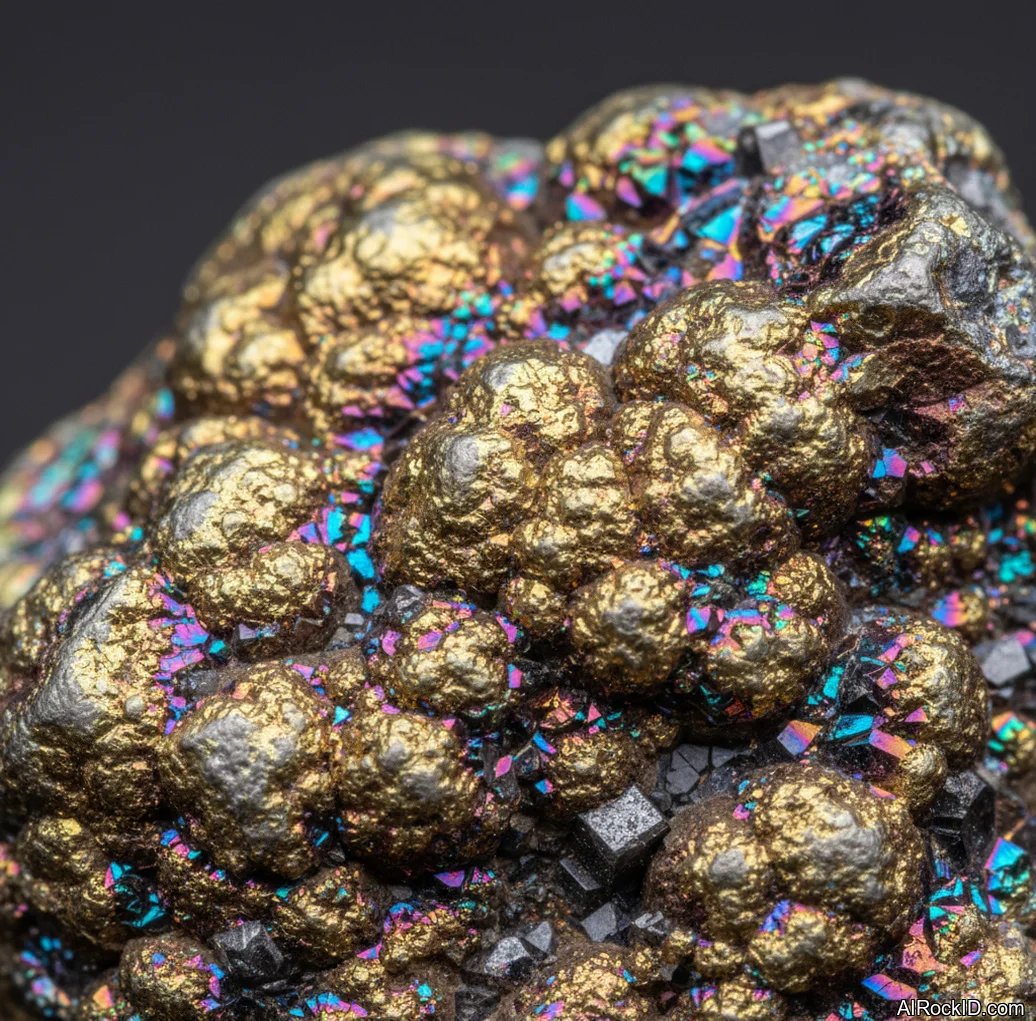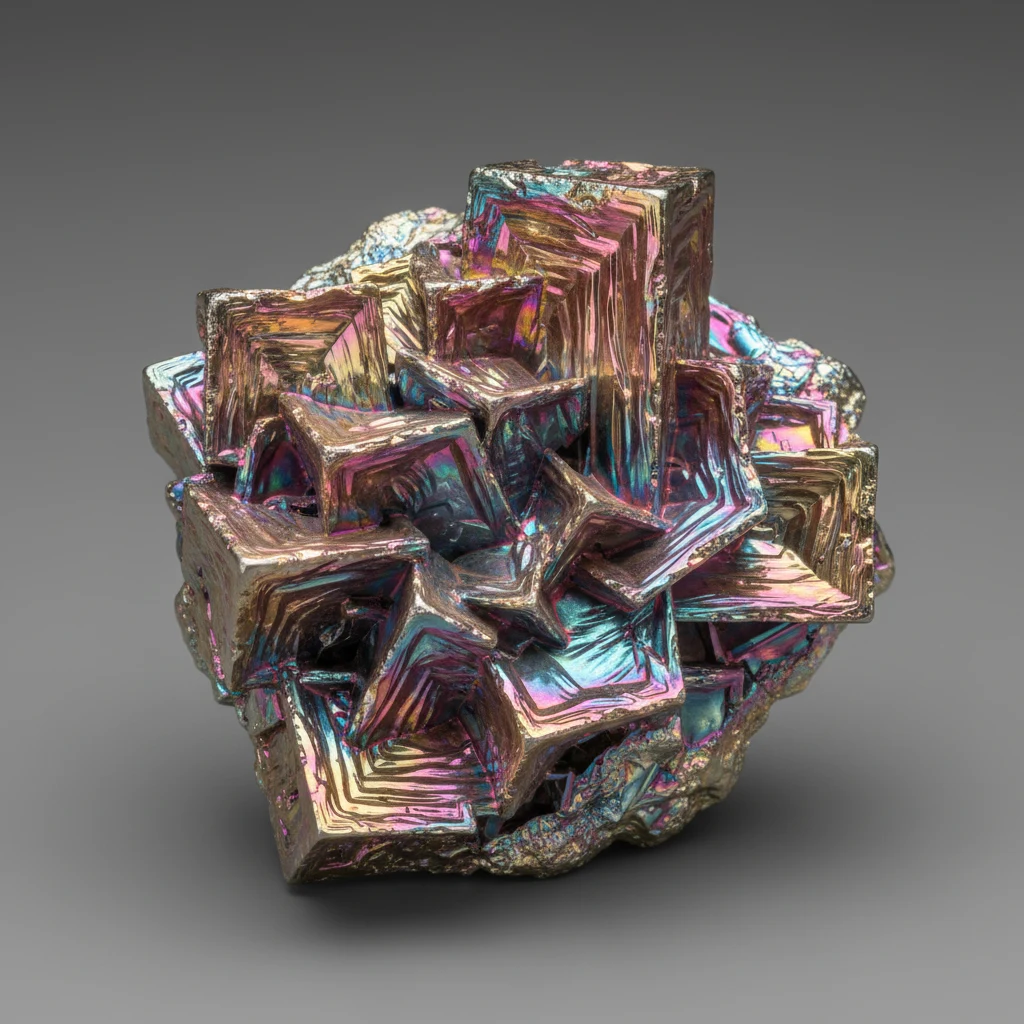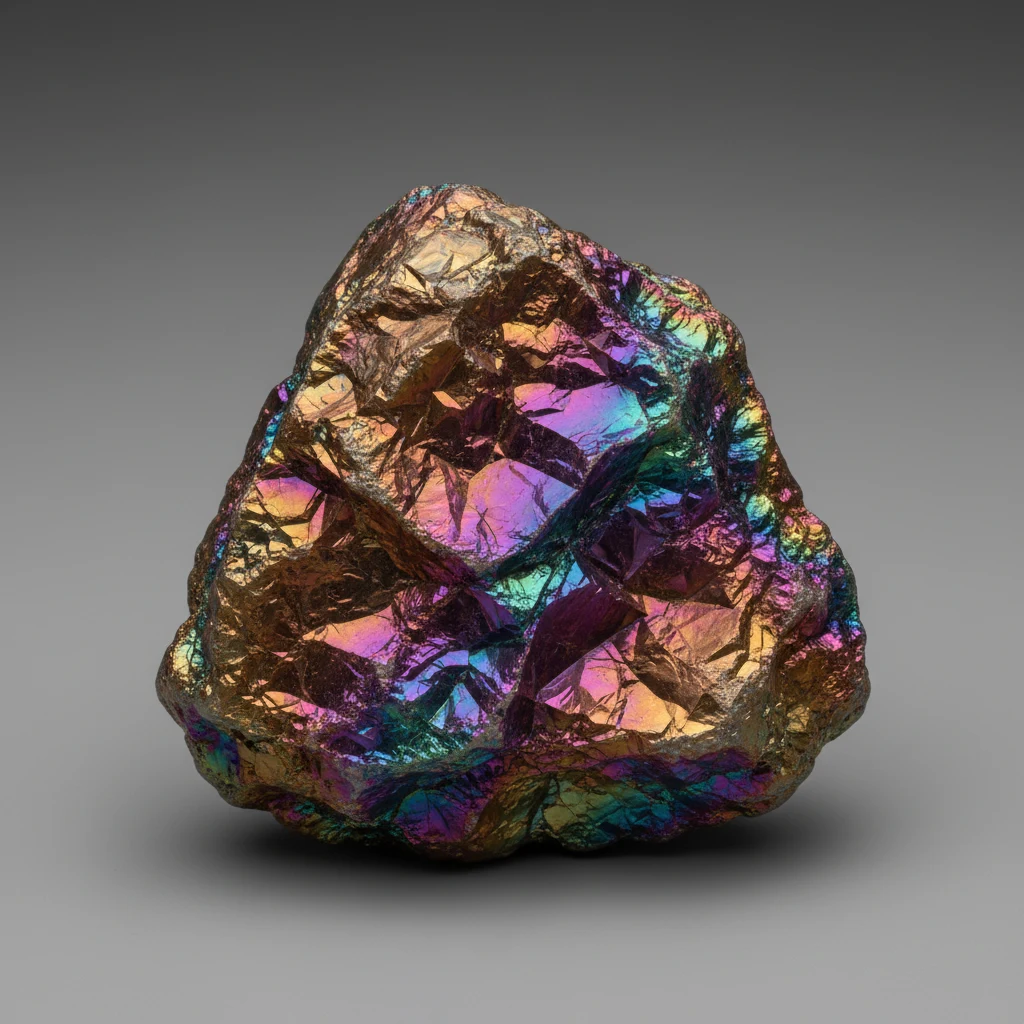
Peacock Ore (Bornite)


Quick answer: Peacock Ore is the trade name most often used for bornite specimens with a purple, blue, green, or gold tarnish. It is a copper iron sulfide with low hardness, so visual ID should be paired with streak, hardness, and source details when possible.
AI Rock ID can help compare Peacock Ore against visually similar copper minerals by analyzing color pattern, luster, and surface texture from a photo. RockIdentifier.io provides crystal and mineral reference information that can support, but not replace, physical tests or expert verification for valuable specimens.
Good fit
- Collectors who want a colorful copper mineral display specimen
- Beginners learning to compare sulfide minerals and tarnish colors
- People who prefer low-cost, visually distinctive mineral samples
- Educational collections that include common copper ores
Not a good fit
- Rings or daily-wear jewelry because bornite is soft and easily scratched
- Water-based crystal routines or long soaking
- Buyers seeking a naturally bright surface without checking for treatment
- Children’s collections without supervision due to copper sulfide dust concerns
Most commonly confused with
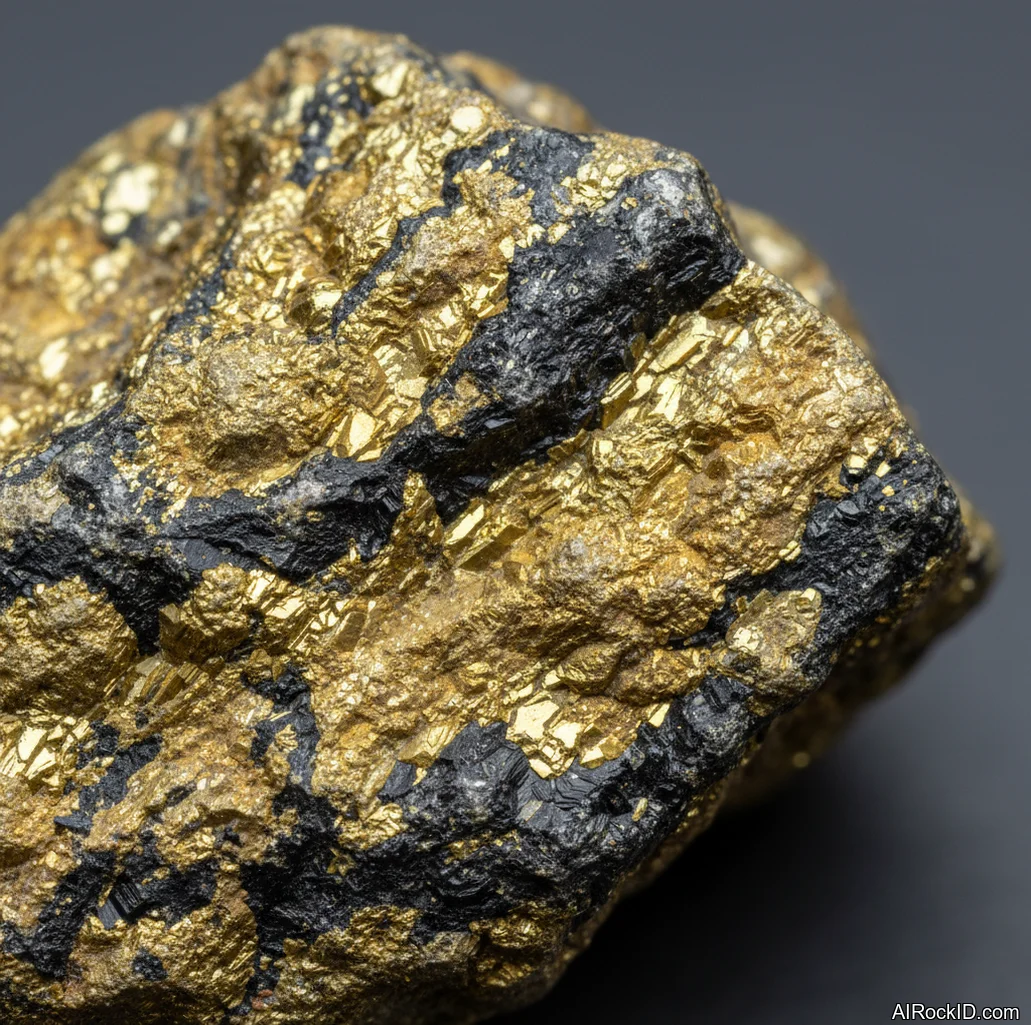
- Chalcopyrite: Chalcopyrite is brassier yellow when fresh and is often acid-treated to create rainbow colors sold as Peacock Ore.
- Covellite: Covellite can show deep blue to purple metallic color, but it is generally darker and has a different copper sulfide composition.
- Pyrite: Pyrite is harder, paler brassy gold, and usually lacks the same broad purple-green tarnish.
- Hematite: Hematite may appear metallic and iridescent, but it gives a red-brown streak rather than a gray-black sulfide streak.
Peacock Ore Lookalike Comparison
| Specimen | Typical Look | Key Difference | Mohs Hardness |
|---|---|---|---|
| Bornite | Brown-bronze fresh surface with purple-blue-green tarnish | Copper iron sulfide; common source of the Peacock Ore name | 3 |
| Chalcopyrite | Brassy yellow, sometimes artificially rainbow-treated | Harder and more yellow on fresh breaks | 3.5–4 |
| Covellite | Indigo-blue to purple metallic surface | Usually darker blue and more flaky or massive | 1.5–2 |
| Pyrite | Pale brassy gold cubes or massive grains | Much harder and not naturally rainbow in the same way | 6–6.5 |
| Hematite | Steel-gray, black, or iridescent metallic surface | Red-brown streak separates it from copper sulfides | 5–6.5 |
AI identification confidence
AI photo identification for Peacock Ore is usually moderate because color can be altered by lighting, tarnish, cleaning, or surface treatment. Confidence improves when the photo shows a fresh broken area, metallic luster, crystal habit, scale, and any label or locality information.
When AI gets it wrong
- Bright rainbow-treated chalcopyrite is mislabeled as bornite.
- A photo is overexposed, making brass-yellow minerals appear more blue or purple.
- Only a polished or coated surface is visible, with no fresh fracture or matrix.
- The specimen is a mixed copper ore containing more than one sulfide mineral.
Final recommendation
For collecting, choose Peacock Ore specimens with clear labeling, stable surfaces, and photos taken in natural or neutral light. If authenticity matters, ask whether the color is natural tarnish or chemically enhanced, especially when the specimen is sold as unusually vivid rainbow chalcopyrite.
Natural Bornite vs Treated Rainbow Chalcopyrite
The name Peacock Ore is used inconsistently in the mineral trade. Some specimens are true bornite with natural tarnish, while many bright rainbow pieces are chalcopyrite that has been chemically treated to produce intense color. A seller should be able to state whether the specimen is bornite, chalcopyrite, or a trade-name material.
Buying Checklist for Peacock Ore
Look for a mineral name, locality, clear lighting, and at least one photo showing the unpolished surface or matrix. Be cautious with vague listings that only say “rainbow crystal” or “peacock stone” without identifying the mineral. For higher-priced pieces, request the specimen’s size, weight, and whether any coating, acid treatment, or sealant was used.
Photo Tips for Identification
Photograph Peacock Ore in indirect daylight on a plain background to reduce color distortion. Include a close-up of the iridescent surface and a second image of a fresh edge, matrix, or less-tarnished area. Avoid flash glare because metallic minerals can reflect light strongly and hide diagnostic texture.
What Is Peacock Ore (Bornite)?
Peacock Ore is the collector name for bornite, a copper iron sulfide mineral with the formula Cu5FeS4. In the hand it feels heavy for its size, metallic, and opaque, with a softness around Mohs 3 that makes it more vulnerable than its bold colors suggest.
The famous peacock look is a surface tarnish, not the fresh internal color. Break or examine a fresh surface and true bornite is usually bronze-brown, copper-red, or reddish brown; with air and moisture, it develops purple, blue, green, violet, gold, and bronze iridescence. Collectors should know that some shop material sold as “peacock ore” is acid-treated chalcopyrite, so color alone is never enough.
Origin & History
Bornite was named in 1845 by Wilhelm Karl von Haidinger for Austrian mineralogist Ignaz von Born. Its older name, erubescite, comes from a Latin root meaning “to blush,” a good field description for the reddish-brown fresh mineral before the iridescent skin develops.
The nickname Peacock Ore came from collectors comparing the oxidized surface to peacock feathers. In practical collecting language, it is a visual name for bornite with colorful tarnish, though it is often used loosely in the trade. Locality and species references such as mindat.org are useful when checking whether a specimen is documented bornite or merely rainbow-colored chalcopyrite.
Where Is Peacock Ore (Bornite) Found?
Peacock Ore is common in copper deposits around the world. Bornite is reported from Chile, the United States, Peru, Mexico, Canada, Australia, Kazakhstan, Namibia, Morocco, and the United Kingdom, so it is not a single-locality curiosity.
Formation
Bornite forms in copper-rich sulfide environments. It occurs in hydrothermal ore veins, major porphyry copper systems, contact-metasomatic skarns, and secondary enrichment zones where copper minerals are altered and concentrated.
On matrix, bornite may appear with chalcopyrite, chalcocite, covellite, pyrite, quartz, calcite, malachite, or azurite. The peacock colors form after exposure to air and moisture as a thin oxidation film on the surface; they are not the mineral’s true body color. This is why careful collectors protect the tarnish and avoid acids, soaking, and harsh cleaning.
How to Identify Peacock Ore (Bornite)
Identify Peacock Ore by combining color with weight, streak, hardness, and fresh surface color. True bornite is a heavy metallic mineral, opaque, not magnetic, with a grayish black to black streak and Mohs hardness about 3.
A fresh bornite surface is typically bronze-brown, copper-red, or reddish brown beneath the iridescence. Chalcopyrite sold as peacock ore is usually brass-yellow when broken and is a little harder, about Mohs 3.5–4. Bright rainbow color by itself is a poor test because acid treatment can force vivid iridescence on chalcopyrite.
Properties of Peacock Ore (Bornite)
Physical Properties
| Crystal System | Orthorhombic, commonly pseudocubic; high-temperature bornite is cubic |
| Hardness (Mohs) | 3 (Soft) |
| Density | 4.9–5.3 g/cm³ |
| Luster | Metallic |
| Diaphaneity | Opaque |
| Fracture | Uneven to subconchoidal; brittle |
| Streak | Grayish black to black |
| Magnetism | Not magnetic |
| Colors | bronze-brown, copper-red, purple, blue, green, violet, gold, iridescent |
Chemical Properties
| Classification | Sulfide mineral |
| Formula | Cu5FeS4 |
| Elements | Copper, Iron, Sulfur |
| Common Impurities | Silver, Cobalt, Nickel |
Optical Properties
| Refractive Index | Not applicable; opaque |
| Birefringence | Not applicable; opaque |
| Pleochroism | Not observed in transmitted light; opaque |
| Optical Character | Opaque metallic mineral; optical character not determined in transmitted light |
Peacock Ore (Bornite) Health & Safety
Safe for normal dry handling, but dust from cutting, grinding, or drilling may irritate the lungs and introduce copper-bearing particles. Prolonged soaking can damage the mineral and may release small amounts of copper compounds.
Peacock Ore (Bornite) Value & Price
Price Range
Rough/Tumbled: Small common specimens usually sell for about $3–$20; attractive cabinet specimens commonly range from $20–$150; well-crystallized or locality-specific bornite specimens can be higher.
Cut/Polished:
Value depends on natural iridescence, specimen size, crystal form, association with other minerals, locality, freshness of color, and whether the material is true bornite or acid-treated chalcopyrite. Natural, well-documented bornite specimens are more desirable than artificially enhanced peacock ore.
Durability
Low to moderate — Scratch resistance: Poor; Mohs hardness 3 means it can be scratched by a copper coin, knife, and many household abrasives., Toughness: Brittle and prone to chipping if dropped or struck.
Bornite tarnishes readily and can alter with exposure to moisture, air, acids, and cleaning chemicals. The iridescent surface is delicate and may be dulled by handling, oils, or aggressive cleaning.
How to Care for Peacock Ore (Bornite)
Use & Storage
Store as a display or collection specimen in a dry place, ideally in a padded box or cabinet away from harder minerals that can scratch it.
Cleaning
Clean only with a soft dry brush or microfiber cloth. Avoid acids, ultrasonic cleaners, steam cleaners, detergents, and prolonged water exposure.
Cleanse & Charge
If used in metaphysical practice, use dry methods such as smoke, sound, or placing near clear quartz; avoid saltwater or soaking because the surface tarnish can be damaged.
Placement
Display away from humidity, direct sunlight, and frequent handling to preserve the iridescent surface.
Caution
Many brightly colored pieces sold as peacock ore are chalcopyrite treated with acid to force iridescence. Do not assume every rainbow specimen is natural bornite.
Works Well With
Peacock Ore (Bornite) Meaning & Healing Properties
In modern crystal healing traditions, Peacock Ore is used as a stone of joy, transformation, confidence, creativity, and positive energy. These meanings are cultural and spiritual associations, not scientifically verified effects, but many practitioners choose it when they want a visually energetic mineral for intention work.
Its common chakra associations are Solar Plexus, Third Eye, and Crown, with zodiac links to Cancer, Leo, and Sagittarius. For metaphysical use, keep the specimen dry: cleanse with smoke, sound, or by placing it near clear quartz rather than saltwater or soaking. The soft, brittle surface can dull from moisture, oils, and aggressive handling.
Identify Peacock Ore (Bornite) from a photo
Compare Peacock Ore (Bornite) traits, care tips, value clues, and common lookalikes with a clear photo.
Common mistakes
- Assuming every rainbow metallic specimen sold as Peacock Ore is bornite.
- Using color alone for identification without checking hardness, streak, or seller details.
- Buying very vivid rainbow pieces without asking whether they were acid-treated.
- Expecting Peacock Ore to hold up well in rings, bracelets, or pocket carry.
- Cleaning sulfide specimens with water, acids, or abrasive methods that can damage the surface.