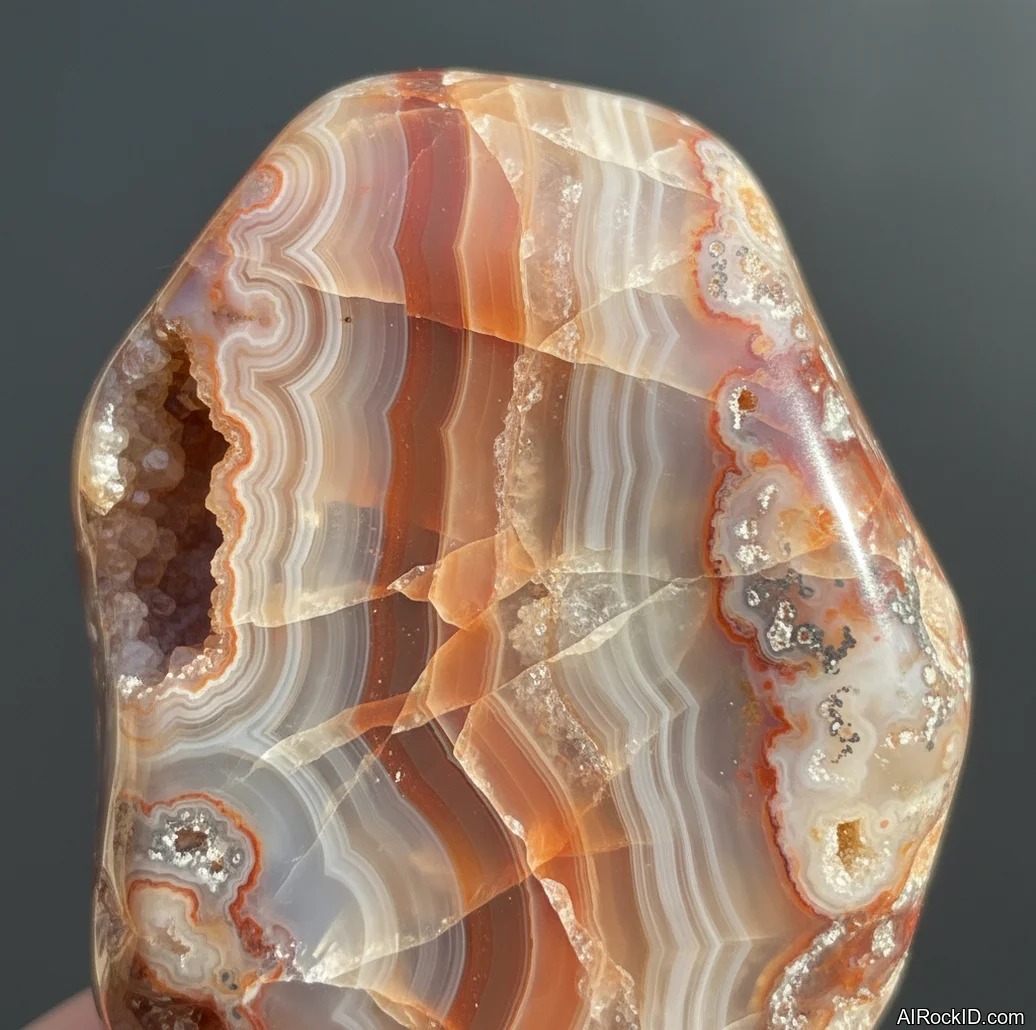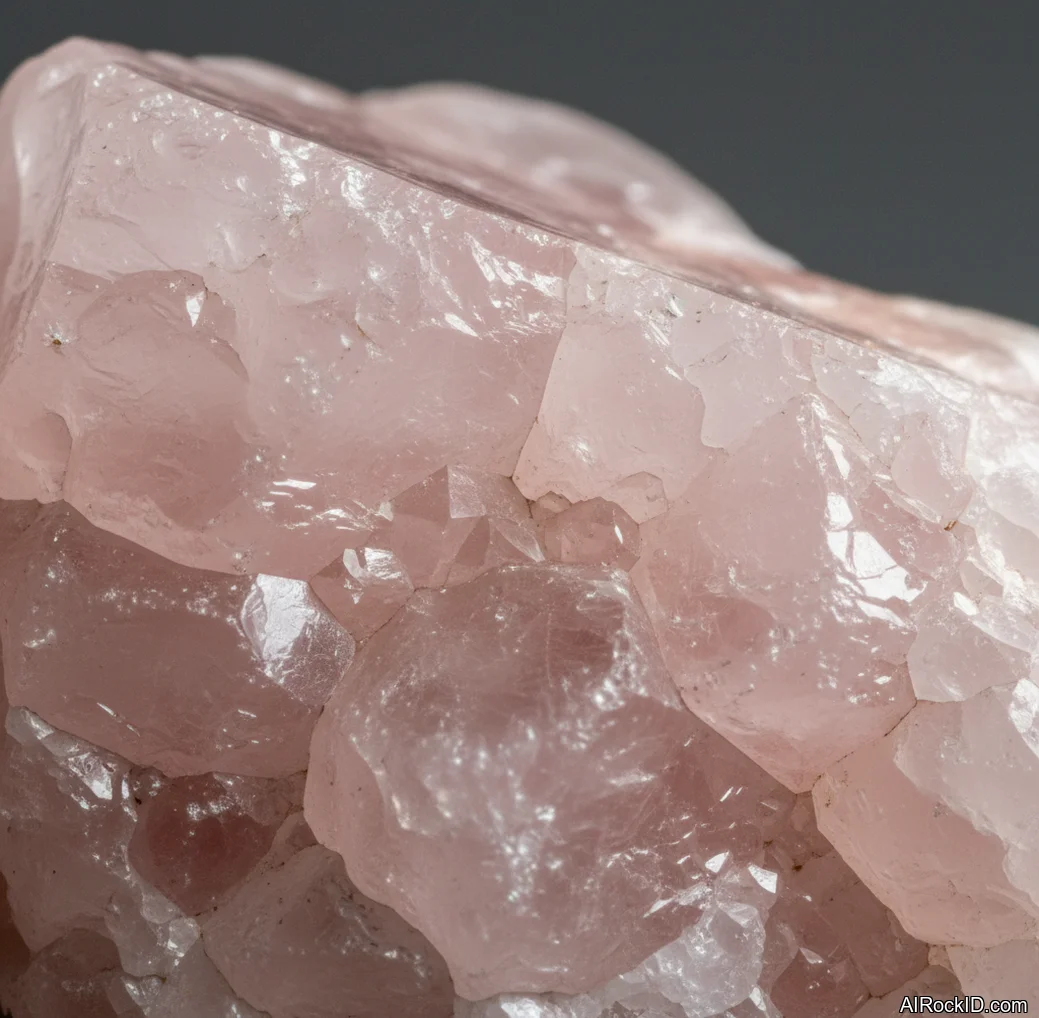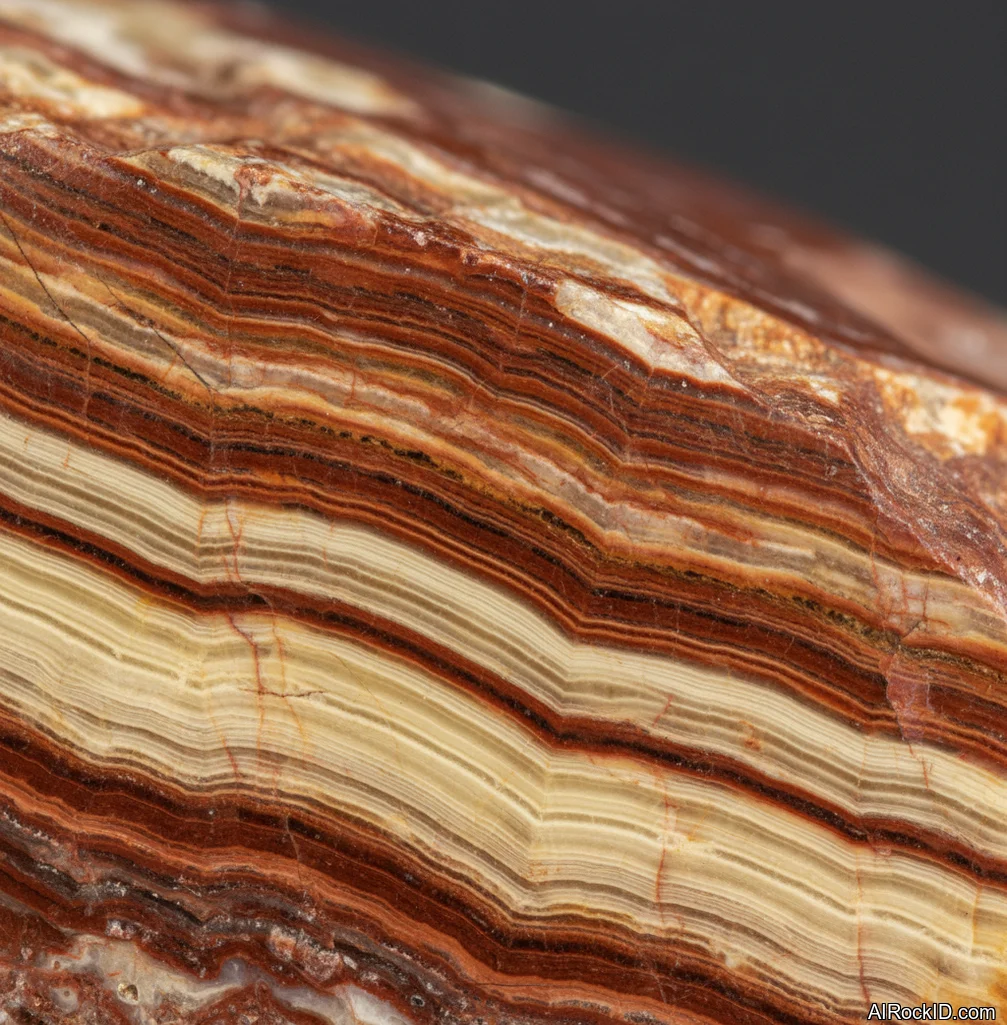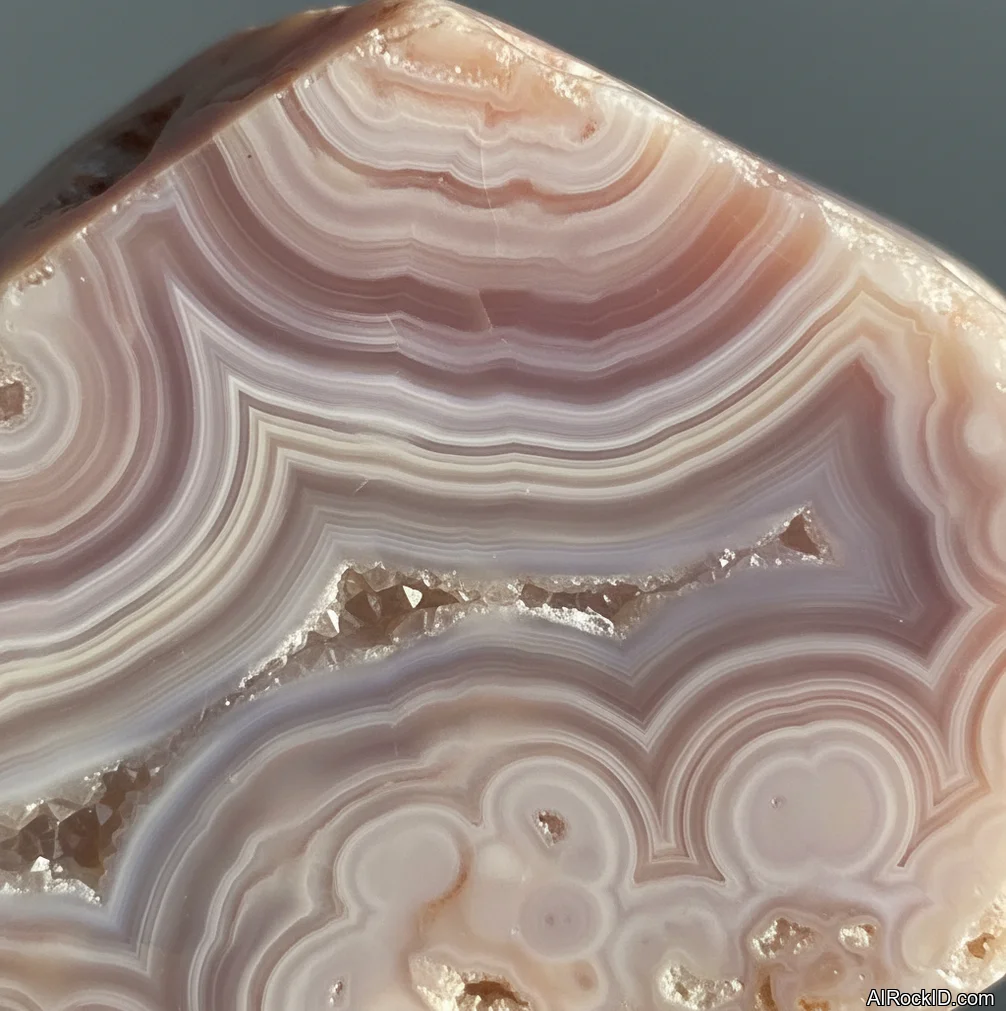
Pink Botswana Agate


Quick answer: Pink Botswana Agate is a pink to gray banded chalcedony, usually seen as cabochons, beads, and tumbled stones. Its fine, curved banding and waxy luster help separate it from many dyed agates and pink jaspers.
AI Rock ID can help screen Pink Botswana Agate by checking banding, color distribution, translucency, and surface texture from a clear photo. RockIdentifier.io provides visual identification support, but final confirmation may require hardness testing, magnification, or a gemologist’s opinion for valuable pieces.
Good fit
- Collectors who like soft pink, gray, and white banded chalcedony
- Jewelry makers looking for durable beads or cabochons
- Beginners who want a recognizable agate with visible patterns
- Buyers who prefer natural-looking colors over bright dyed stones
Not a good fit
- Anyone expecting transparent pink gemstone material
- Collectors who want a rare faceted gem rather than common lapidary agate
- Buyers who dislike natural variation between beads or slabs
- People seeking a stone to diagnose, treat, or prevent medical conditions
Why people search for this
People often search for Pink Botswana Agate to confirm whether a pink-gray banded stone is natural agate, dyed agate, or a similar-looking jasper. It is also commonly searched by buyers comparing beads, cabochons, and tumbled stones for authenticity.
Most commonly confused with
- Botswana Agate: Often gray, brown, or white; pink varieties are a color range within the same general agate material.
- Dyed Agate: May show unusually bright or even color, dye concentrations in cracks, and color pooling around drill holes.
- Pink Jasper: Usually more opaque and less finely banded than Pink Botswana Agate.
- Rose Quartz: Typically lacks agate-style banding and has a glassier quartz look with cloudy pink translucency.
Pink Botswana Agate vs Similar Pink Stones
| Stone | Key Look | Main Difference | Mohs Hardness |
|---|---|---|---|
| Pink Botswana Agate | Soft pink-gray curved bands | Fine chalcedony banding with waxy luster | 6.5–7 |
| Dyed Agate | Bright or unusually uniform pink | Dye may collect in cracks or drill holes | 6.5–7 |
| Pink Jasper | Opaque pink to reddish mass | Less translucent and usually less finely banded | 6.5–7 |
| Rose Quartz | Cloudy pale pink quartz | No agate bands; more glassy appearance | 7 |
| Rhodochrosite | Pink with white bands or patches | Softer carbonate mineral, can react to acid if powdered | 3.5–4 |
AI identification confidence
AI identification confidence is usually moderate when the photo clearly shows natural curved banding, pink-gray color zones, and a polished chalcedony surface. Confidence drops for single-color beads, overexposed photos, or pieces with heavy dye treatment.
When AI gets it wrong
- The stone is photographed under strong pink or warm lighting
- Only one bead or a small cropped area is visible
- Dye makes ordinary agate look like Pink Botswana Agate
- The piece is opaque enough to resemble jasper
Final recommendation
Choose Pink Botswana Agate when you want a durable banded chalcedony with subdued pink and gray tones. For the most reliable purchase, look for fine natural banding, consistent seller disclosure, and no obvious dye pooling in cracks or drill holes.
How to Spot Authentic Pink Botswana Agate
Authentic Pink Botswana Agate usually shows fine, curved or parallel bands in soft pink, gray, white, and sometimes tan. Natural color is often gentle rather than neon-bright. Under magnification, dyed material may show color concentrated in fractures, pits, or around bead holes.
Buying Pink Botswana Agate Beads and Cabochons
For beads, check that the drill holes are clean and that the color does not appear much darker around openings. For cabochons, look for pleasing band placement, a smooth polish, and no large pits or cracks across the dome. Matched strands can cost more when the banding and color are consistent.
Photo Tips for Identifying Pink Botswana Agate
Use bright indirect daylight and photograph the stone on a neutral background. Include close-up images of the banding, any drill holes, and the side profile of cabochons or beads. Avoid color filters because they can make gray agate, dyed agate, or rose quartz appear misleadingly similar.
What Is Pink Botswana Agate?
Pink Botswana Agate is a pink-to-gray, banded type of agate, and agate is microcrystalline quartz (chalcedony).
Grab a decent piece in your hand and, honestly, the first thing you clock is the density. It’s not “metal heavy,” no. But it’s got that quartz heft for its size, and when it’s polished it feels smooth with this slightly waxy, slick finish under your thumb (especially along the curved edge).
And the color? It’s not cotton-candy pink. The real material usually lives in that dusty rose to mauve range, sometimes drifting into peachy-beige, with smoky gray bands running through it. The nicest pieces have tight, even striping you can literally trace all the way around the stone without losing the line.
People see the word “pink” and expect something loud, and that’s where the mix-ups start. If it’s screaming bubblegum and the tone is perfectly uniform, you’re probably holding dyed agate. Natural Pink Botswana looks softer and layered, with bands that flip from translucent to opaque as you turn it under a lamp. Why does that matter? Because that shifting, stacked look is exactly what gives it away.
Origin & History
Botswana agate really started showing up in the wider gem and collector world in the mid to late 20th century, once rough coming out of Botswana’s volcanic ground began filtering into the lapidary trade. It wasn’t “discovered” the way a single crystal species might be, with some named type specimen tucked in a museum drawer. It’s basically a trade name for agate from Botswana. And that pinkish look people associate with it? That’s only one of the color styles that deposit can turn out.
The name itself is pretty literal. “Agate” traces back to the Achates River (now called the Dirillo) in Sicily, where banded chalcedony was written about in classical times. “Botswana” is just the locality label. But, honestly, a lot of dealers treat it like a quiet quality cue too, because Botswana material often shows super fine banding compared with plenty of other banded agates.
Where Is Pink Botswana Agate Found?
Most Pink Botswana Agate on the market comes from Botswana, where banded chalcedony forms in volcanic host rocks and is mined and exported for lapidary use.
Formation
Look at the banding for a second and you’re basically staring at a timeline: silica-rich fluids seeped into little cavities in volcanic rock in pulses, not all at once. Each pulse laid down a skinny layer of microcrystalline кварц, and the chemistry nudged a bit from one round to the next, so the translucency and color shift band by band.
But it’s not some tidy one-shot fill. Agate usually builds in stages, coating the cavity walls first and then creeping inward over time. So you’ll sometimes see a pale center, a tighter, more sharply banded outer zone, or even a small drusy quartz pocket when the last fluid phase had a little space left to crystallize (you know that sparkly “sugar” look when you tilt it?). In Botswana material, the bands can get absurdly fine. Hold a cab under a bright desk lamp and you can pick out dozens of hairline layers, stacked so close together they almost blur.
How to Identify Pink Botswana Agate
Color: Soft pink, dusty rose, mauve, peach-beige, and gray are common, usually in parallel bands. Edges can be slightly translucent with a smoky look.
Luster: Waxy to vitreous, especially when polished.
Pick up the stone and feel the temperature. Real chalcedony stays cool in your hand longer than glass or plastic fakes. If you scratch it with a steel nail, it shouldn’t take the scratch, but it will scratch ordinary window glass because it’s basically quartz. The real test is the banding: natural bands look like layered smoke or thin ribbons, not blotchy dye pools around cracks or drill holes.
Common Look-Alikes
Pink Botswana Agate is sometimes confused with these materials:
- Dyed gray/white banded agate sold as “pink agate” (often Brazilian agate that’s been dyed)
- Pink chalcedony (more even color, usually less obvious banding than Botswana agate)
- Rhodochrosite (pink banding too, but it’s softer and has that sugary cleavagey look instead of agate’s tight waxy polish)
- Pink opal (more opaque and chalky, doesn’t show crisp fortification-style bands)
- Rose quartz (cloudy, massive pink with no fine parallel bands)
- Pink glass or resin “agate” (fake banding, lighter feel, warms up fast in the hand)
Market Cautions & Treatments
When AI Can Get This Wrong
In photos, AI mixes Pink Botswana Agate up with rose quartz and pink opal all the time because the dusty rose reads as one flat color and the fine bands vanish under soft lighting. Rhodochrosite is another trap when the bands are wide, but a quick hardness check helps: agate at 6.5 to 7 will scratch glass cleanly, while rhodochrosite won’t and it’ll show easier scuffs on edges. The real tell in-hand is the surface feel: polished Botswana agate has that cool, slick, slightly waxy quartz finish, not the chalky drag you get from pink opal or the plasticky warmth of glass.
Properties of Pink Botswana Agate
Physical Properties
| Crystal System | Trigonal |
| Hardness (Mohs) | 6.5-7 (Hard (6-7.5)) |
| Density | 2.58-2.64 |
| Luster | Waxy |
| Diaphaneity | Translucent to opaque |
| Fracture | Conchoidal |
| Streak | White |
| Magnetism | Non-magnetic |
| Colors | Pink, Dusty rose, Mauve, Gray, Peach, Beige, White |
Chemical Properties
| Classification | Silicates |
| Formula | SiO2 |
| Elements | Si, O |
| Common Impurities | Fe, Mn, Al |
Optical Properties
| Refractive Index | 1.530-1.540 |
| Birefringence | 0.004 |
| Pleochroism | None |
| Optical Character | Uniaxial |
Pink Botswana Agate Health & Safety
Pink Botswana Agate is non-toxic and safe to handle, and it’s generally fine around water too. The real issue is just the physical stuff. Drop it on a hard floor and you might knock a chip off, or if a piece breaks, the edges can get surprisingly sharp (the kind that’ll snag a fingertip if you’re not paying attention).
Safety Tips
If you’re going to cut it or grind it, handle it the same way you’d handle quartz. That means keep the silica dust down with water, and don’t skip proper respiratory protection.
Pink Botswana Agate Value & Price
Price Range
Rough/Tumbled: $3 - $25 per tumbled stone (about 20–40 mm) or $20 - $120 per palm stone
Cut/Polished: $1.50 - $10 per carat
Tight, high-contrast banding and a clean polish can jack the price up in a hurry. Bigger pieces with a consistent pink tone usually run higher too, but if that pink is almost neon-bright, I start wondering if it’s been dyed (it’s a real red flag).
Durability
Durable — Scratch resistance: Good, Toughness: Good
It’s stable in normal household conditions, but like most polished agate it can take a nasty chip if you drop it on tile.
How to Care for Pink Botswana Agate
Use & Storage
Keep it in a pouch or a separate compartment if it’s riding around with softer stones. Agate can scuff things like fluorite, and it can get scuffed by corundum or diamond.
Cleaning
1) Rinse with lukewarm water and a drop of mild soap. 2) Use a soft toothbrush to clean around drill holes or grooves. 3) Rinse again and pat dry with a microfiber cloth.
Cleanse & Charge
If you do energetic cleansing, running water or a quick smoke cleanse works fine, and moonlight won’t hurt it. I skip harsh salt baths mostly because they can dull a polish over time, not because the stone can’t take it.
Placement
On a desk it’s great because you can actually see the banding under a lamp, and the colors don’t fight with anything. If it’s a display piece, set it where you can pick it up and rotate it, because the layers look different from every angle.
Caution
Don’t use an ultrasonic cleaner if the piece has fractures or if it was dyed. And don’t just toss it loose in a bag where it can rattle around and get knocked by harder gems.
Works Well With
Pink Botswana Agate Meaning & Healing Properties
Next to the loud, flashy stuff, Pink Botswana Agate is basically a whisper. Folks who reach for it usually want something steady, the kind of stone you toss in a pocket and then forget it’s there until your thumb finds that slick, rounded polish. I’ve carried a palm stone at shows on days when I’m standing for hours, feet aching on concrete. It doesn’t “zap” you. It just sits in your hand, cool at first and sort of steadying.
And if you stare at the bands for a minute, you can see why people connect it with calming and getting your emotions in order. It’s literally layers stacked on layers. When I’m picking pieces for the shop, I watch customers drift toward the ones where the color shifts gently, not the harsh stripey ones that look like someone drew lines with a marker. That’s partly a vibe, sure. But it’s also just how our eyes work. Soft gradients feel easier.
But I want to keep this grounded: none of this is medical. If you’re dealing with anxiety or grief, a stone can be a tactile anchor, like worry beads, and that’s real in a practical, hands-on way. The issue with crystal talk online is how it turns absolute and weirdly specific. So with Pink Botswana Agate, I’d just call it a steady companion stone. Nice for routines, journaling, sleep-prep, especially if you like holding something cool and smooth while you breathe (and yeah, sometimes that simple thing helps).
Common mistakes
- Assuming every pink banded agate is specifically from Botswana
- Mistaking bright dyed agate for natural Pink Botswana Agate
- Identifying a stone from color alone without checking banding and translucency
- Confusing opaque pink jasper with chalcedony-based agate
- Expecting all beads in a natural strand to have identical band patterns
- Using metaphysical labels as proof of mineral identity
Identify Pink Botswana Agate from a photo
Compare Pink Botswana Agate traits, care tips, value clues, and common lookalikes with a clear photo.