Rainbow Fluorite


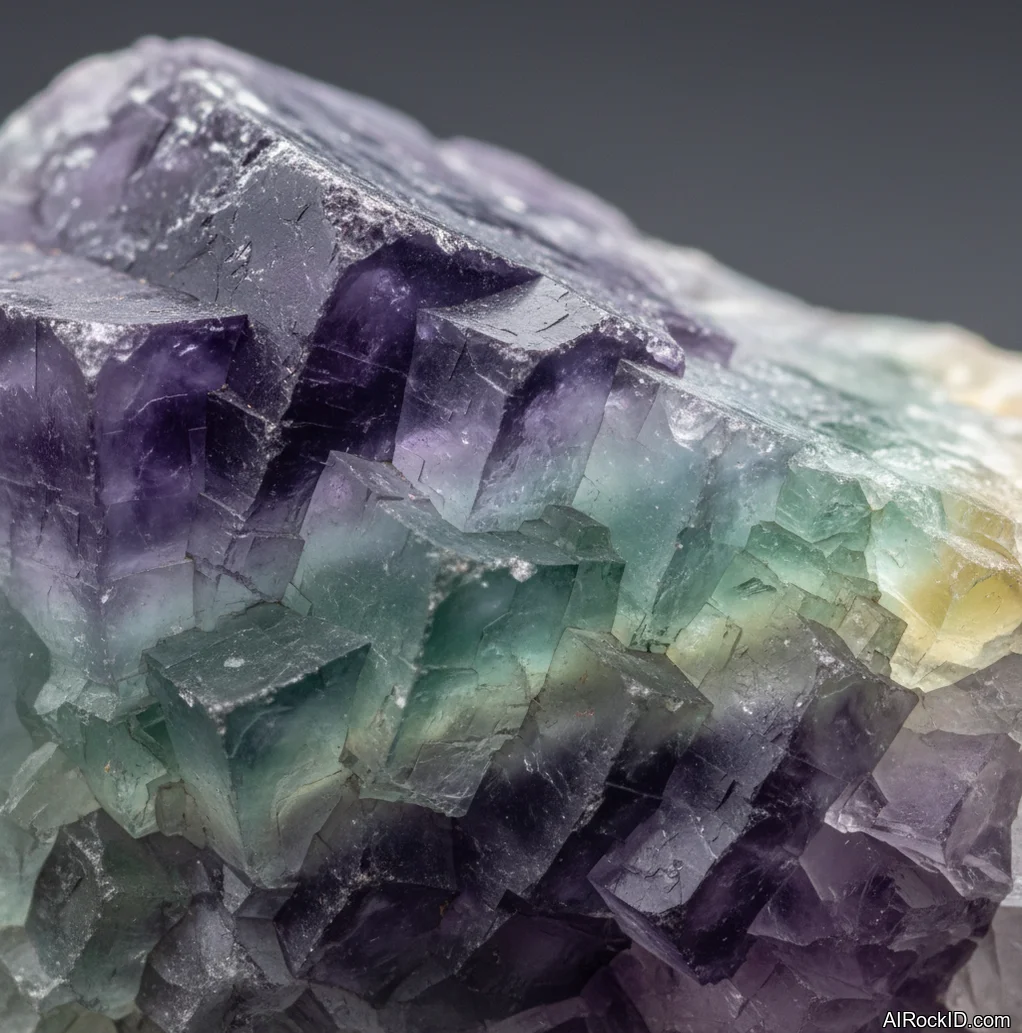
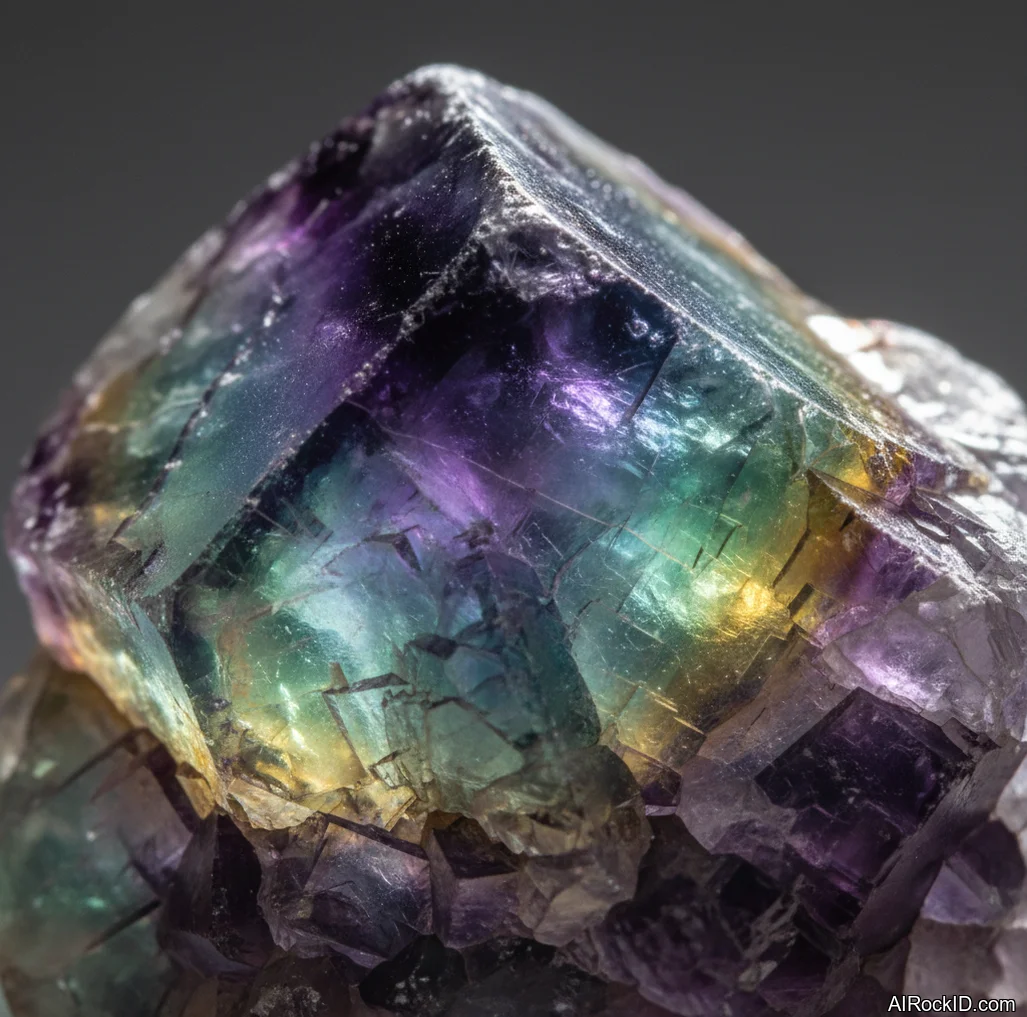
Quick answer: Rainbow Fluorite is a color-zoned variety of fluorite recognized by bands or patches of purple, green, blue, and colorless material. Its moderate softness, glassy luster, and perfect cleavage help separate it from harder banded stones and glass imitations.
AI Rock ID can help screen Rainbow Fluorite by evaluating visible color zoning, luster, translucency, and crystal habit from a photo. RockIdentifier.io can support identification, but hardness, cleavage, and seller documentation are useful checks for higher-confidence results.
Good fit
- Collectors who want a colorful, recognizable mineral specimen
- Beginners learning to identify banding, cleavage, and fluorite crystal forms
- People seeking decorative stones for display rather than daily-wear jewelry
- Buyers comparing natural banded fluorite with dyed or mislabeled lookalikes
Not a good fit
- Rings, bracelets, or other jewelry exposed to frequent knocks
- Ultrasonic cleaners, steam cleaning, or harsh chemical cleaning
- Outdoor placement in strong sunlight for long periods
- Anyone needing a durable stone for high-impact use
Most commonly confused with
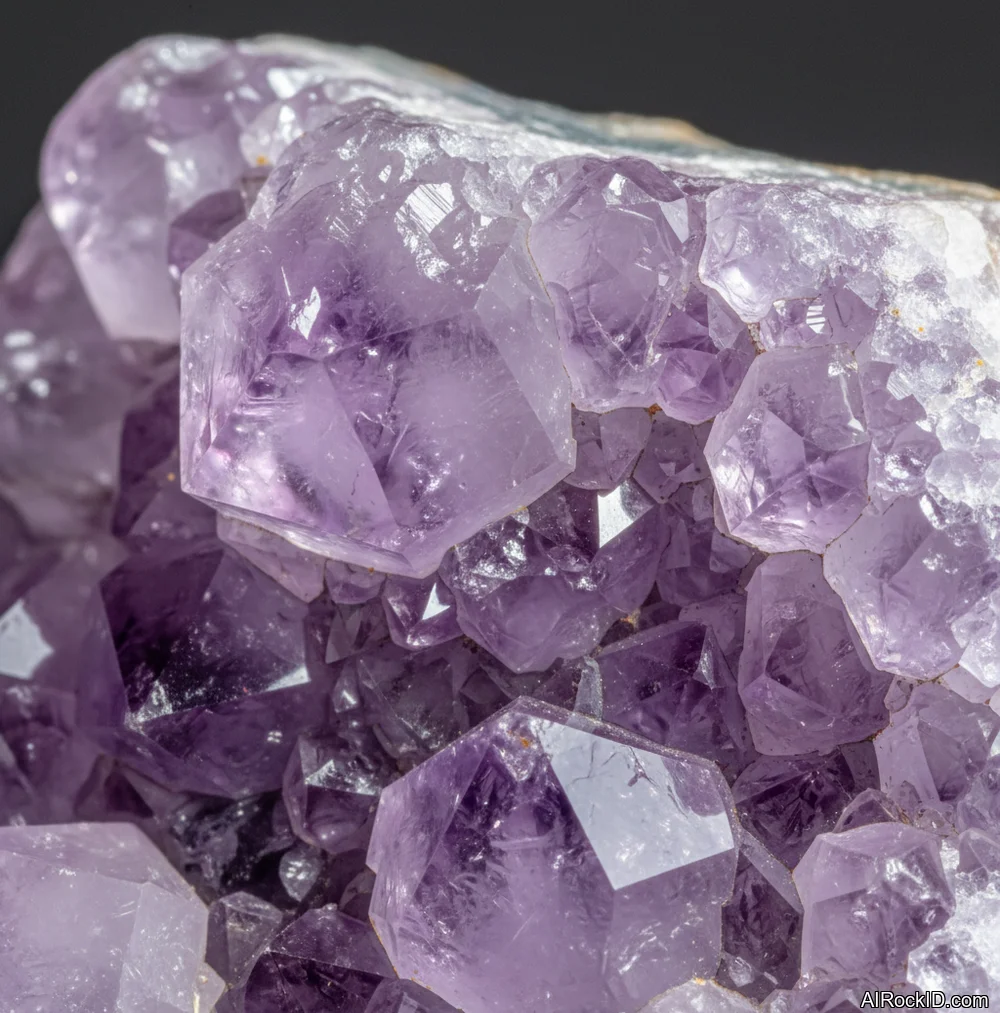
- Amethyst: Amethyst is quartz with Mohs 7 hardness and no perfect cleavage; Rainbow Fluorite is softer and often shows multiple color zones.
- Purple Fluorite: Purple Fluorite may be mostly one color, while Rainbow Fluorite typically shows distinct bands or zones of several colors.
- Banded Calcite: Calcite is softer at Mohs 3 and reacts readily with dilute acid; fluorite does not fizz under normal dilute acid testing.
- Glass: Glass may show bubbles, molded shapes, or uniform color, while natural fluorite often has cleavage planes, internal zoning, and mineral inclusions.
Rainbow Fluorite vs. Common Lookalikes
| Stone | Key Difference | Quick Check |
|---|---|---|
| Rainbow Fluorite | Purple, green, blue, or clear zones with perfect cleavage | Mohs 4; scratches more easily than quartz |
| Amethyst | Usually purple quartz without green-blue fluorite bands | Mohs 7; no perfect cleavage |
| Banded Calcite | Often cream, honey, or pastel banded carbonate | Fizzes with dilute acid; Mohs 3 |
| Glass | Can be artificially colored or molded | Look for bubbles, seams, or overly uniform color |
| Chevron Amethyst | Purple and white quartz V-banding | Harder than steel knife; no fluorite cleavage |
AI identification confidence
AI photo identification for Rainbow Fluorite is often moderate to high when the image clearly shows multicolor banding, vitreous luster, and a natural specimen shape. Confidence drops when the stone is polished, strongly backlit, dyed, or photographed without scale and surface detail.
When AI gets it wrong
- Polished palm stones may hide cleavage and make fluorite look like glass or quartz.
- Strong purple lighting can make amethyst, dyed agate, or glass appear fluorite-like.
- Close-up photos without scale can obscure hardness clues and crystal habit.
- Highly saturated colors may indicate dye, editing, or artificial lighting rather than natural zoning.
Final recommendation
Choose Rainbow Fluorite when you want a visually banded collector stone and can protect it from scratches, drops, and heat. For jewelry or daily carry, a harder stone such as quartz is usually more practical.
How to Check Rainbow Fluorite Before Buying
Look for natural color zoning rather than perfectly uniform stripes, and inspect polished pieces for chips along edges or cleavage planes. Ask sellers whether the stone has been dyed, resin-stabilized, or treated, especially when colors appear unusually neon or evenly distributed. For online purchases, request photos in natural light and at least one close-up image of the surface.
Natural, Treated, and Imitation Rainbow Fluorite
Natural Rainbow Fluorite forms with color zoning caused by trace elements, radiation effects, and growth conditions. Some low-cost decorative pieces may be dyed, coated, or sold under broad trade names that do not describe treatment. Imitation pieces may be glass or resin, especially when shapes are identical, colors are extremely uniform, or internal bubbles are visible.
Photography Tips for Identification
Photograph Rainbow Fluorite in indirect daylight on a neutral background to show true color zoning. Include a scale object and take one image of the whole specimen plus one close-up of edges, cleavage surfaces, or inclusions. Avoid colored LEDs and heavy backlighting because they can distort purple, green, and blue tones.
What Is Rainbow Fluorite?
Rainbow Fluorite is a banded color variety of fluorite (calcium fluoride, CaF2) where you’ll see two or more color zones running through the same piece.
Pick up a chunk and you notice it right away: that slick, glassy shine. Then, almost as fast, you notice how it wants to split along flat planes if you tap it wrong (the break lines are weirdly clean). The bands might show up as sharp stripes, smoky swirls, or those hard color stops that look like somebody stacked thin sheets of grape and mint candy. Under bright shop LEDs some pieces can look almost neon, but set the same stone on a desk in normal room light and it calms down a lot.
Thing is, here’s the collector reality. It’s gorgeous, but it’s soft. I’ve literally seen a polished freeform pick up a fresh ding just from clinking against another stone in a display tray. So treat it like a showpiece, not a pocket stone.
Origin & History
Fluorite got its formal write-up in 1530, when Georgius Agricola described it as a flux, the stuff you toss in to help ores melt during smelting. The name tracks, too. It comes from the Latin “fluere,” meaning “to flow,” because that’s basically what it did in the furnace, it helped everything move along for the metalworkers.
And “rainbow fluorite” isn’t some separate species or anything. It’s just a trade name dealers and collectors use for the banded, multicolor pieces (the kind with those stripey layers you can see even before you cut it). Back in the day, lapidaries and miners didn’t bother with the marketing. They sorted it by color and clarity, plain and simple, and the really clean purple or green cubes were the ones they set aside.
Where Is Rainbow Fluorite Found?
Rainbow Fluorite shows up anywhere fluorite forms, but the banded purple-green material most shops sell is commonly sourced from China, Mexico, and parts of the USA and UK.
Formation
Most fluorite comes out of hot, mineral-loaded water pushing through cracks and little open pockets in the rock, and it drops CaF2 when the temperature and chemistry swing. You’ll find it crusting the walls of vugs, plugging up veins, and sometimes tucked in the same pocket with quartz, calcite, barite, galena, and pyrite.
Look, if you stare at the banding for a minute, you’re basically looking at a timestamp. Frozen growth. One surge of fluid throws purple, the next one shifts green, and then suddenly there’s a clearer band (why the clean break? chemistry changed, that’s why). In some deposits, the zoning tracks the cube faces, like stacked panes of glass you can almost trace with a fingernail. But in other places it goes swirly and messy, like the fluid couldn’t make up its mind halfway through the crystal growing.
How to Identify Rainbow Fluorite
Color: Typically purple and green banding, often with blue, teal, yellow, or clear zones in between. Color can be patchy or sharply layered depending on the piece.
Luster: Vitreous, with bright reflections on fresh cleavage faces.
Pick up a raw piece and tilt it under a single overhead light. You’ll catch flat flashes from perfect cleavage, and the angles feel “planar,” not curved like quartz. If you scratch it with a steel nail, it’ll mark more easily than you expect, and it won’t have the gritty resistance you get with harder stones. The problem with photos online is saturation, so ask for a quick video in normal indoor light if you’re buying a high-priced specimen.
Common Look-Alikes
Rainbow Fluorite is sometimes confused with these materials:
- Dyed banded calcite (Mexican Onyx)
- Dyed quartz
- Synthetic rainbow glass (opalite or 'unicorn stone')
- Color-zoned amethyst
- Heat-treated fluorite (artificially enhanced bands)
- Banded obsidian glass
Market Cautions & Treatments
When AI Can Get This Wrong
AI photo ID often gets tripped up by dyed calcite and rainbow glass, especially under bad lighting. The glass fakes come out too glossy and the bands look swirled instead of stacked. In hand, a real piece will scratch easily and you’ll spot those textbook cleavage planes—no way to see that in a photo.
Properties of Rainbow Fluorite
Physical Properties
| Crystal System | Cubic |
| Hardness (Mohs) | 4 (Soft (2-4)) |
| Density | 3.18 g/cm3 |
| Luster | Vitreous |
| Diaphaneity | Transparent to translucent |
| Fracture | Uneven |
| Streak | White |
| Magnetism | Non-magnetic |
| Colors | Purple, Green, Blue, Teal, Yellow, Clear, White |
Chemical Properties
| Classification | Halides |
| Formula | CaF2 |
| Elements | Ca, F |
| Common Impurities | Y, Ce, Fe, Mn, Eu, Sm |
Optical Properties
| Refractive Index | 1.433-1.435 |
| Birefringence | None |
| Pleochroism | None |
| Optical Character | Isotropic |
Rainbow Fluorite Health & Safety
Normal handling is pretty low risk. The bigger concern is that the piece is physically fragile, so it can chip if you knock it on a hard edge. And if you’re doing lapidary work, you’ll want to avoid breathing in the dust.
Safety Tips
If you’re shaping it, keep a little water going, make sure there’s decent airflow, and wear a proper respirator (not just a flimsy dust mask). Then wash your hands afterward. For display pieces, set it somewhere it won’t get knocked or bumped.
Rainbow Fluorite Value & Price
Price Range
Rough/Tumbled: $5 - $120 per piece
Cut/Polished: $2 - $20 per carat
Prices shoot up fast when the color zones look clean, the piece is larger, and the faces don’t have chips or bruises along the edges (you can feel those little bites with a fingernail). Sharp cubes and pieces with good fluorescence usually cost more than the same weight in tumbled stones.
Durability
Nondurable — Scratch resistance: Fair, Toughness: Poor
It chips and cleaves easily, and prolonged sun exposure can fade color in some pieces.
How to Care for Rainbow Fluorite
Use & Storage
Store it separately in a soft pouch or a compartmented box so it can’t smack into harder stones. If you stack it with quartz, you’ll see new chips sooner than later.
Cleaning
1) Rinse quickly in lukewarm water with a drop of mild soap. 2) Use a very soft brush or your fingers to lift dirt from crevices. 3) Pat dry and let it air-dry fully before putting it back in a closed box.
Cleanse & Charge
For gentle cleansing, use smoke, sound, or a short rinse and dry. If you use moonlight, keep it away from harsh sun afterward since some color zones can fade over time.
Placement
Put it on a stable shelf or in a cabinet where it won’t get knocked over. I like it under a small LED spotlight, but not where it heats up.
Caution
Don’t use ultrasonic cleaners or a steamer on fluorite, and don’t get rough with it. Thing is, fluorite has perfect cleavage, so it can chip way easier than you’d expect from just a small bump. I’ve seen a corner flake off from a light tap on a hard sink edge. And if you want the color to stay strong, keep it out of prolonged direct sunlight. Why risk fading it?
Works Well With
Rainbow Fluorite Meaning & Healing Properties
A lot of folks grab rainbow fluorite when their brain feels like a browser with 40 tabs open. And yeah, I get why. You pick up this cool, banded chunk and it’s instantly chilly against your skin, almost slick in that glassy way fluorite has, and when you roll it in your palm you catch those flat cleavage flashes that blink on and off. Suddenly your focus shrinks down to color and light. That kind of simple sensory anchor can calm you down.
In crystal-shop language, rainbow fluorite gets tied to mental clarity, study vibes, and “organizing the mind.” I’ve kept a piece on my desk during long sorting sessions, and it does one practical thing really well: it nudges me to slow down and finish one task before I jump to the next. But look, it’s not medicine. It won’t replace sleep, food, or actual planning.
If you meditate, the banding helps, too. Your eyes can track the layers like a little trail, and it’s easier to stay present than staring at a stone that’s just one flat color. But don’t fuss with it nonstop. Thing is, if you fidget with it every day, the edges start looking tired and a bit worn (you’ll notice it first on the sharper corners).
Common mistakes
- Assuming all purple banded stones are Rainbow Fluorite without checking hardness.
- Using scratch tests on visible faces instead of an inconspicuous area.
- Confusing natural color zoning with dye concentration in cracks or surface pits.
- Wearing Rainbow Fluorite in high-contact jewelry and expecting quartz-like durability.
- Cleaning fluorite with ultrasonic, steam, or acidic methods.
- Judging authenticity from color alone without considering cleavage, luster, and seller disclosure.
Identify Rainbow Fluorite from a photo
Compare Rainbow Fluorite traits, care tips, value clues, and common lookalikes with a clear photo.