Tourmalinated Quartz


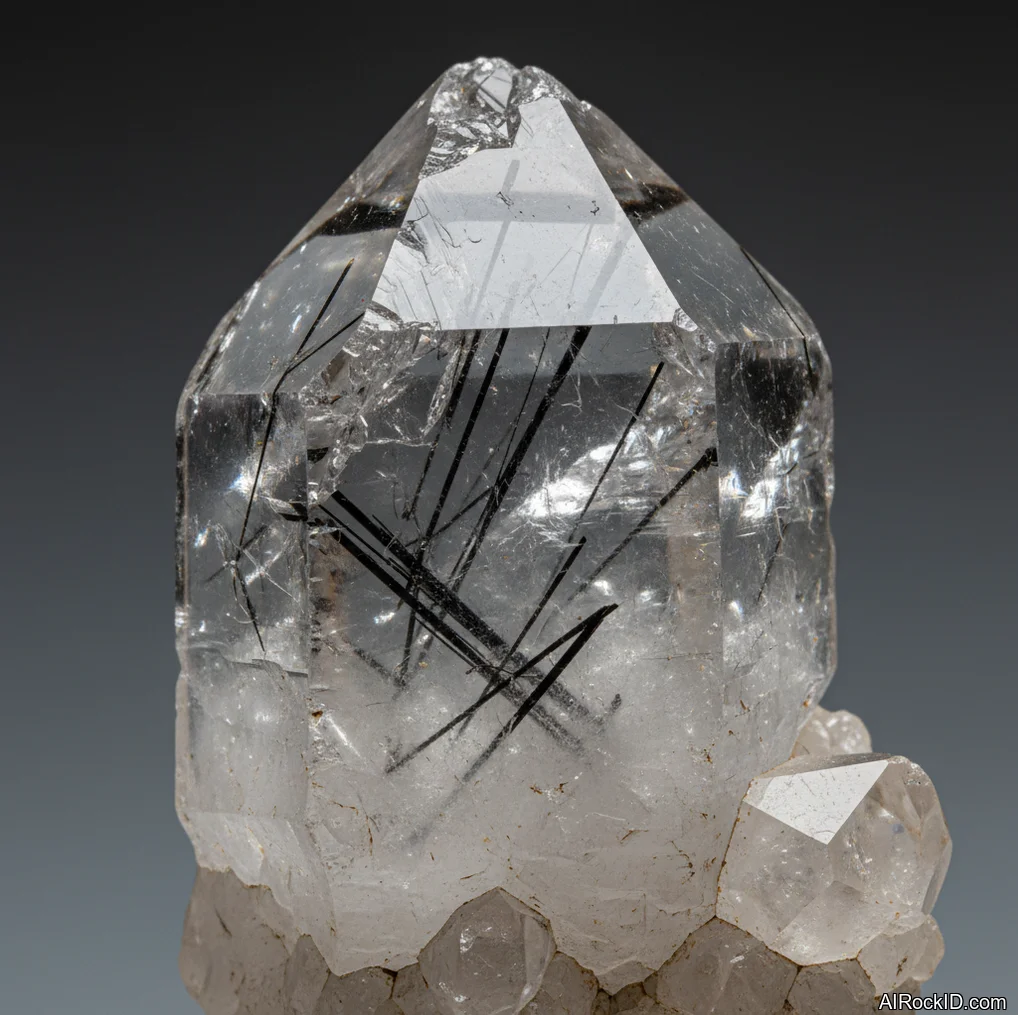
Quick answer: Tourmalinated quartz is quartz that contains visible black tourmaline needles or rods, usually schorl. It is identified mainly by the contrast between the quartz host and the dark, needle-like inclusions, but similar-looking included quartz and glass imitations can cause confusion.
AI Rock ID can help screen a photo of tourmalinated quartz by checking for quartz transparency, inclusion shape, and visual patterns. RockIdentifier.io provides crystal identification support, but results are most reliable when paired with basic observations such as hardness, heft, and whether the inclusions are internal rather than painted or glued on.
Good fit
- Collectors who like visible mineral inclusions inside quartz
- Lapidary users looking for cabochons, beads, or decorative carvings
- Beginners who want a recognizable included quartz variety
- Buyers who prefer black-and-clear contrast over brightly colored stones
Not a good fit
- Anyone seeking a rare mineral species rather than a quartz variety
- Buyers who need a flawless transparent gemstone
- Jewelry designs that require delicate points or thin exposed edges
- People who dislike visible fractures, veils, or internal inclusions
Most commonly confused with
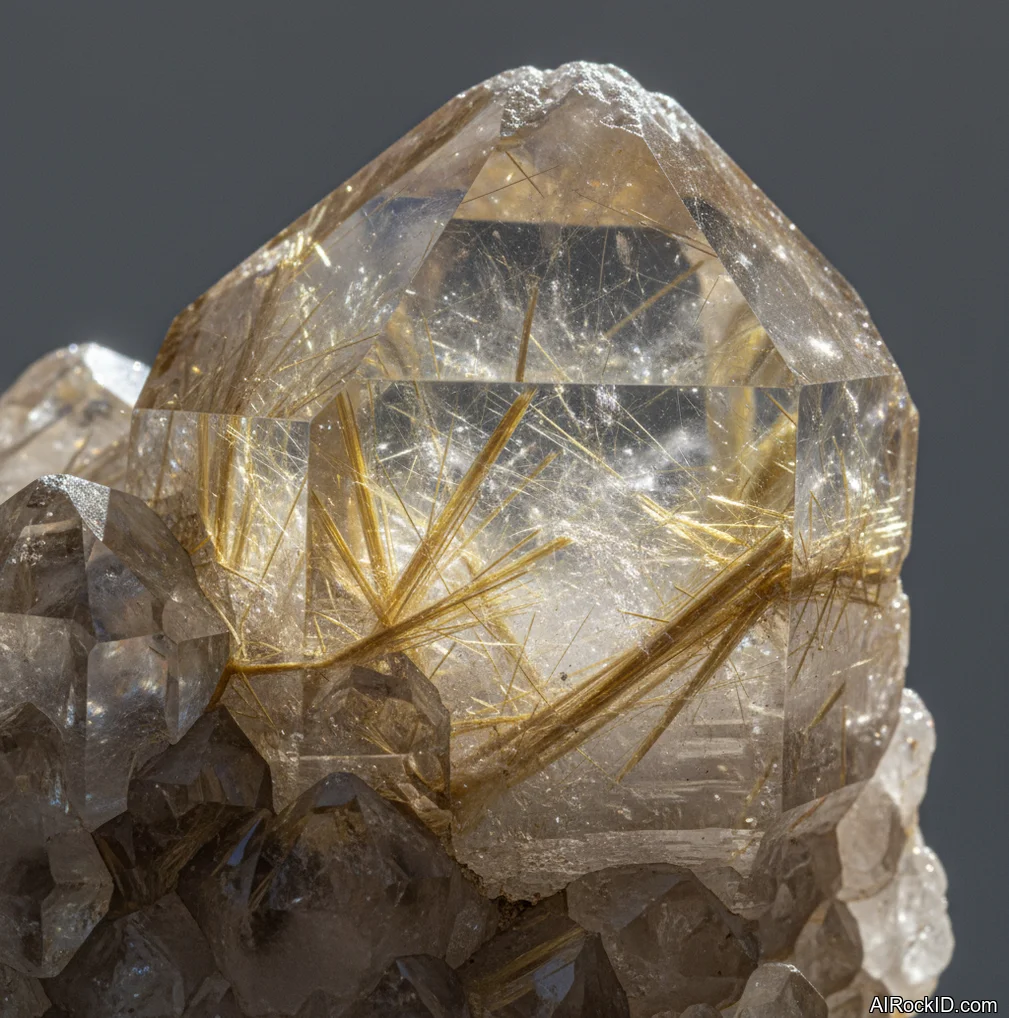
- Rutilated Quartz: Usually has golden, coppery, reddish, or silvery rutile needles rather than black tourmaline rods.
- Actinolite in Quartz: Green to dark green actinolite inclusions can look needle-like, but the color is typically less jet black.
- Hematite Quartz: Hematite inclusions are commonly red, brown, metallic, or plate-like rather than long black needles.
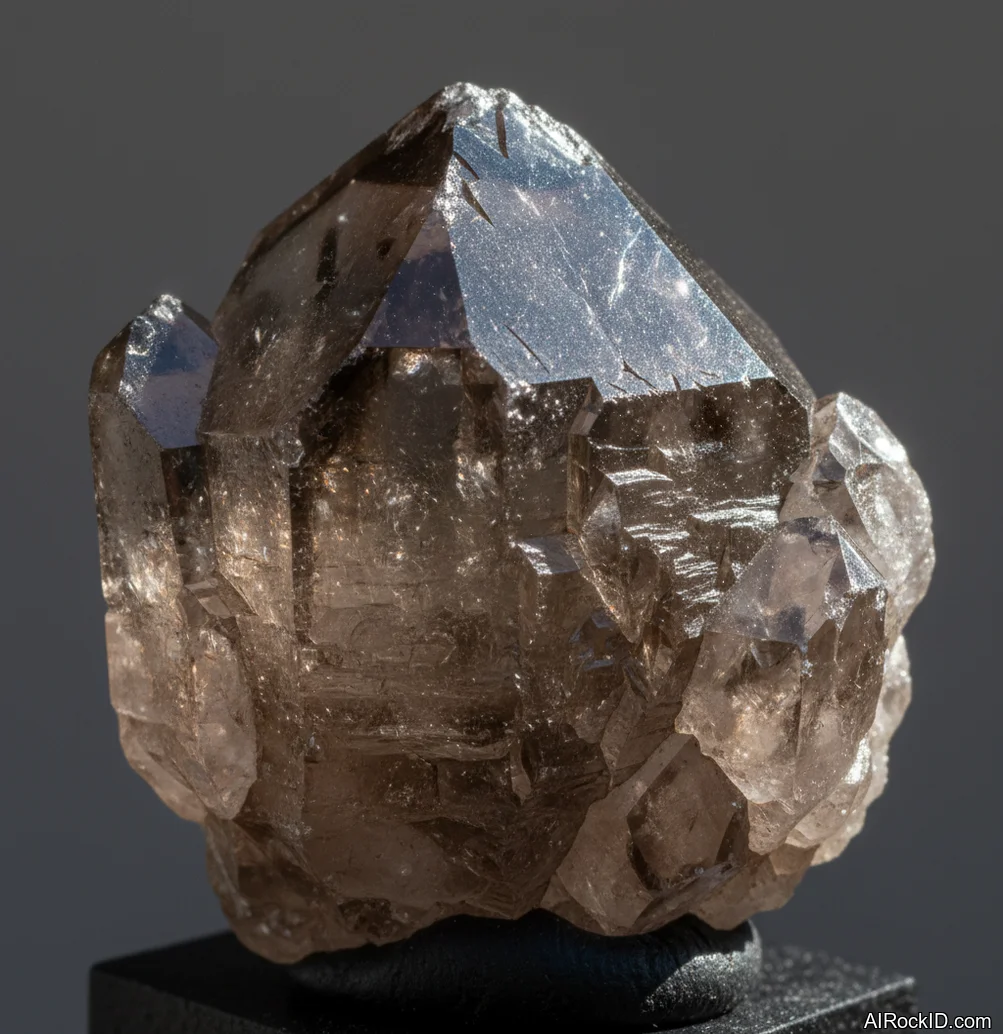
- Smoky Quartz: Smoky quartz has body color from natural or treated irradiation and does not need black needle inclusions.
Tourmalinated Quartz vs. Similar Included Stones
| Material | Typical Inclusion Look | Key Difference |
|---|---|---|
| Tourmalinated quartz | Black needles or rods in clear to milky quartz | Dark tourmaline inclusions are usually internal and irregular |
| Rutilated quartz | Gold, copper, red, or silver fine needles | Rutile is commonly lighter or metallic rather than opaque black |
| Actinolite in quartz | Green to dark green fibers or needles | Green cast is usually visible under good light |
| Smoky quartz | Gray to brown transparent quartz body | Color is throughout the quartz, not separate black needles |
| Included glass imitation | Bubbles, repeated streaks, or artificial-looking lines | May lack quartz hardness and natural growth features |
AI identification confidence
AI identification confidence is usually moderate to high when a sharp photo shows black needle-like inclusions clearly enclosed in quartz. Confidence drops when the specimen is highly polished, very dark, photographed in low light, or shown without scale and multiple angles.
When AI gets it wrong
- The inclusions are surface scratches, paint, or glue-filled cracks instead of minerals inside quartz
- The photo shows dark smoky quartz with no clear needle inclusions
- The specimen is glass or resin with artificial black lines or bubbles
- The image is too overexposed to separate clear quartz from pale background
Final recommendation
Choose tourmalinated quartz with clearly internal black inclusions, a quartz-like glassy luster, and no obvious signs of dye, paint, or glued-on material. For jewelry, inspect the setting and edges because fractures around inclusions can affect durability even though quartz itself is relatively hard.
How to Check Authenticity Before Buying
Look for black needles that pass through the quartz rather than sitting only on the surface. Natural inclusions often vary in thickness, direction, and density, while artificial lines may look too uniform or stop abruptly at the surface. A loupe can help reveal bubbles, glue, coatings, or filled fractures that suggest glass, resin, or assembled material.
Photo Tips for Identifying Tourmalinated Quartz
Photograph the stone under bright indirect light against a plain background. Include close-up images from several angles so the black needles can be seen inside the quartz, not just on the surface. A photo next to a ruler or coin can also help distinguish fine natural needles from large cracks or surface markings.
What Affects Appearance in Cut Stones
Tourmalinated quartz can look very different depending on cut orientation, inclusion density, and quartz clarity. Cabochons and beads often show the black needles clearly, while faceted stones may emphasize reflections and internal fractures. Milky quartz hosts create a softer contrast, while clear quartz hosts make individual tourmaline needles easier to see.
What Is Tourmalinated Quartz?
Tourmalinated Quartz is just quartz (SiO2) with visible tourmaline trapped inside it, usually black schorl that shows up as needles or thin, threadlike lines.
Hold a decent piece and it’s the same old quartz feel in your palm: cool, hard, kind of slick like glass. But your eyes keep catching on those black streaks running through it. Some chunks honestly look like somebody dripped ink into water and then hit pause. Others have sharp, straight needles that crisscross like tiny pick-up sticks, locked in place. And when you get a really nice one, it’s that clean “window” quartz, where the tourmaline looks like it’s hanging in midair.
People glance at it and assume the black stuff is dirt or cracks. It’s not. It’s real tourmaline that actually grew in there, and on a specimen that’s only lightly polished you can usually spot the needles dipping into the surface and popping back out (like little stitches). But don’t count on every piece being gem-clear. Most of what turns up at shows is milky to smoky quartz packed with inclusions, because that’s what comes out of the ground in volume.
Origin & History
Quartz has been written up and picked out of the ground since antiquity. But “tourmalinated quartz” is really a trade name, and it didn’t become common until dealers started selling inclusion quartz as its own category instead of labeling it “quartz with schorl.” Tourmaline itself showed up in European mineralogy in the early 1700s after Dutch traders brought stones over from Sri Lanka, and the name “tourmaline” comes from the Sinhalese word “turmali.”
In most mineral books, the tourmaline in these pieces is identified as schorl, the black, iron-rich endmember. And I’ve handled a few chunks where the inclusions are so fine and hairlike they look like someone dragged a pin through wet ink, so sellers call it “black rutile.” Thing is, rutile needles usually read more brassy to reddish-brown, and under a loupe they’ve got a different vibe, a different sheen. So the label hangs around because it’s easy. Dealers like easy. Why complicate it?
Where Is Tourmalinated Quartz Found?
Most market material comes out of pegmatite districts in Brazil and Madagascar, with smaller amounts from Pakistan, the western USA, and alpine pockets in Switzerland.
Formation
Raw pegmatite chunks kind of spell it out. Silica-heavy fluids cool off, quartz starts growing, and right there in the same pocket tourmaline is crystallizing too. If the tourmaline kicks off first, it can wind up trapped when the quartz grows around it. But if they’re growing at the same time, you end up with those needle inclusions that look like someone literally stitched them through the crystal.
Next to “garden quartz” with chlorite inclusions, this is usually way crisper and more straight-line. Schorl likes to grow as prismatic crystals and skinny needles, so the inclusions don’t just sit there, they point somewhere. That direction is the giveaway.
Thing is, there’s a catch. Some specimens look almost brecciated, like the quartz cracked, then healed back up, and the tourmaline used those seams as a growth path. Under a light, you can sometimes catch it: the dark threads line up right on a healed crack plane instead of just floating around wherever. Kinda makes you rethink what you’re looking at, doesn’t it?
How to Identify Tourmalinated Quartz
Color: Quartz ranges from clear to milky white, smoky gray, or lightly yellowish, with black to very dark brown tourmaline needles, threads, or splinters inside.
Luster: Vitreous on quartz surfaces, with a dull to sub-vitreous look on exposed tourmaline inclusions.
Look closely at the black material with a loupe. Schorl inclusions usually look like straight needles or tiny prismatic slivers, not fuzzy dendrites. Pick up the piece and tilt it under a single point light; real inclusions sit at different depths and don’t move, while surface scratches and dirt flash in a single plane. The real test is hardness: the host quartz will scratch glass easily, and the tourmaline won’t smear like paint or marker.
Common Look-Alikes
Tourmalinated Quartz is sometimes confused with these materials:
- Needle-included glass (especially clear resin with black threads)
- Rutilated Quartz (with dark rutile)
- Dyed quartz with painted black lines
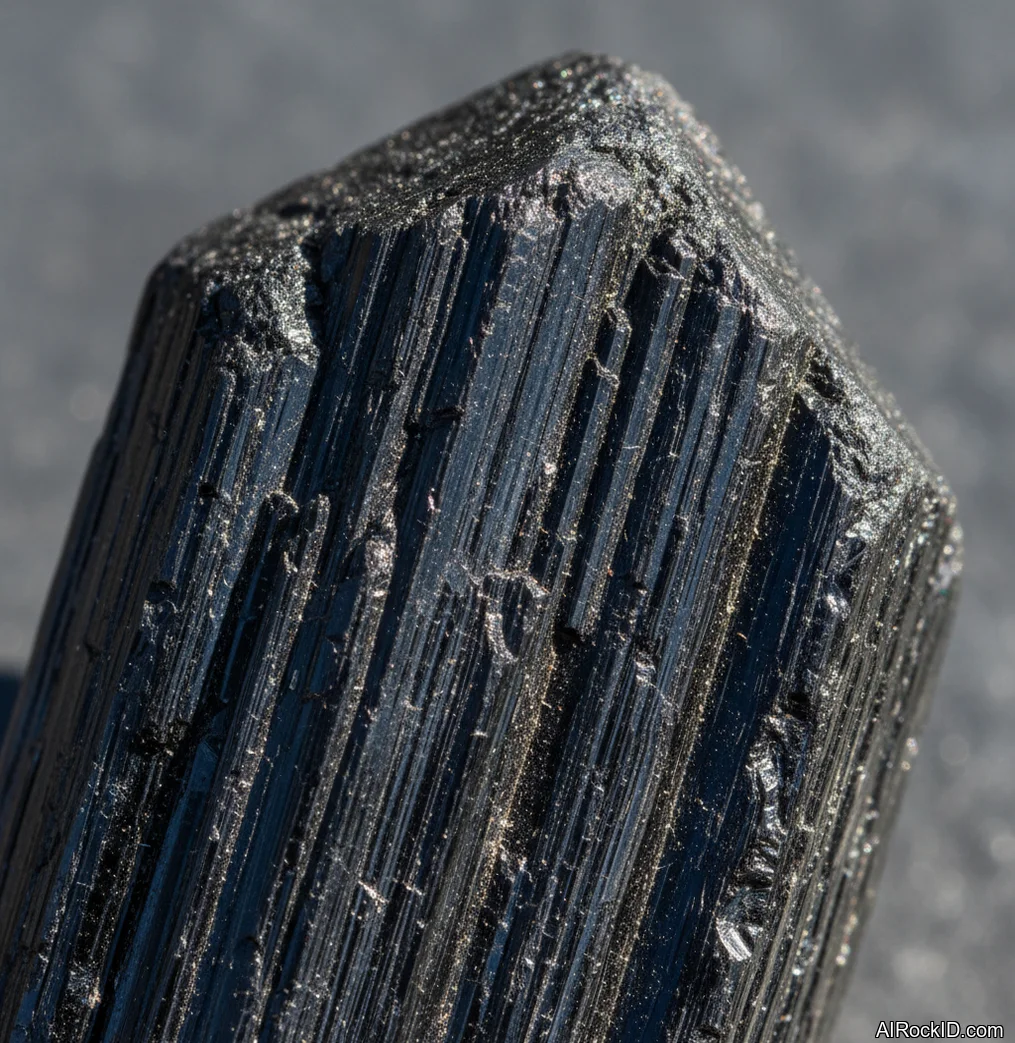
- Black Tourmaline embedded in quartz matrix (but not trapped inside)
- Actinolite-included Quartz
- Hematite-included Quartz
Market Cautions & Treatments
When AI Can Get This Wrong
Photo ID tools mix it up with rutilated quartz way too often, especially when the needles are thicker or brownish. Glass fakes with black threads trip up the algorithms because the inclusions look sharp but never branch or taper. A real collector will scratch-test for quartz hardness and check the inclusions under magnification—tourmaline is brittle and sometimes even pokes out of the surface.
Properties of Tourmalinated Quartz
Physical Properties
| Crystal System | Trigonal |
| Hardness (Mohs) | 7 (Hard (6-7.5)) |
| Density | 2.65 g/cm3 |
| Luster | Vitreous |
| Diaphaneity | Transparent to translucent |
| Fracture | Conchoidal |
| Streak | White |
| Magnetism | Non-magnetic |
| Colors | Clear, White, Smoky gray, Black |
Chemical Properties
| Classification | Silicates |
| Formula | SiO2 (quartz) with inclusions of schorl tourmaline (NaFe3Al6(BO3)3Si6O18(OH)4) |
| Elements | Si, O, Na, Fe, Al, B, H |
| Common Impurities | Fe, Al, Ti, Mn |
Optical Properties
| Refractive Index | 1.544-1.553 |
| Birefringence | 0.009 |
| Pleochroism | None |
| Optical Character | Uniaxial |
Tourmalinated Quartz Health & Safety
It’s usually safe to pick up and put on display. Just use basic common sense if you’re cutting or grinding it, because the fine silica dust (the stuff that hangs in the air and ends up on your fingertips) is a lung hazard.
Safety Tips
If you’re going to do lapidary work, do it wet. Use water, make sure you’ve got decent ventilation (you should actually feel air moving), and wear a proper respirator that’s rated for fine particulates. Why risk it?
Tourmalinated Quartz Value & Price
Price Range
Rough/Tumbled: $5 - $120 per piece
Cut/Polished: $3 - $25 per carat
Prices jump when the clarity’s there, the contrast is strong (those inky black needles sitting in clear quartz), and the surface is actually polished nicely or the point ends in a clean natural termination. Bigger, cleaner, showy display pieces run higher because most of what you see is milky and kind of busy-looking.
Durability
Durable — Scratch resistance: Excellent, Toughness: Good
It’s stable in normal indoor conditions, but sharp blows can chip quartz edges and exposed tourmaline can snag or pop out on rough specimens.
How to Care for Tourmalinated Quartz
Use & Storage
Store it like you’d store any quartz: separate from softer stones so it doesn’t scratch them, and pad sharp points so they don’t chip. If it has natural terminations, don’t let it rattle around in a drawer.
Cleaning
1) Rinse with lukewarm water and a drop of mild dish soap. 2) Use a soft toothbrush to get into little pits and around exposed tourmaline. 3) Rinse well and pat dry; avoid blasting it with very hot water if the piece has lots of internal fractures.
Cleanse & Charge
A quick rinse and a wipe is usually all it needs. If you do ritual cleansing, smoke, sound, or leaving it on a shelf overnight are low-risk options.
Placement
Look closely at the lighting where you put it. Side light shows the needles way better than flat overhead light, and a dark background makes the quartz look clearer.
Caution
Don’t reach for harsh acids or bleach. They won’t fix anything, and over time they can actually rough up a polished surface (you’ll start to feel it go a little grabby under your fingertips instead of slick). And skip the ultrasonic cleaner if the specimen is heavily fractured or full of healed cracks. Why risk it? That buzzing can work its way into those tiny lines and make things worse.
Works Well With
Tourmalinated Quartz Meaning & Healing Properties
A lot of dealers and collectors talk about tourmalinated quartz like it’s a two-for-one deal: quartz for “clarity,” black tourmaline for “grounding.” And honestly, the way people describe it matches what you see. Your eyes follow those dark needle streaks, then snap back into the clear quartz. It’s weirdly hard to space out while you’re looking at it.
Grab a palm stone and you’ll notice the quartz feels slick from the polish, almost glassy, but the tourmaline lines give your brain something to grab onto, like a little road map under the surface. I’ve kept one on my desk on long paperwork days because it’s visually busy in a way that stops me from picking up and putting down ten other things. But look, I’m going to say this straight: none of that is medical care. If you’ve got anxiety, sleep problems, or anything serious going on, crystals are a comfort object at best, maybe a routine anchor. Not treatment.
The annoying part about tourmalinated quartz in the metaphysical market is the “it blocks everything negative” hype. Real life doesn’t work like that, does it? Thing is, what it can do, if you’re someone who uses objects as reminders, is nudge you to slow down and check in with your thoughts. And if you’re sensitive to sensory stuff, the cool feel of quartz in your hand can be calming all by itself (even before you attach any meaning to it).
Common mistakes
- Assuming every black line in quartz is tourmaline without checking whether it is internal
- Confusing golden or copper rutilated quartz with tourmalinated quartz
- Ignoring bubbles or mold-like shapes that may indicate glass or resin
- Expecting all natural pieces to be perfectly clear and free of fractures
- Using color alone to identify the stone instead of checking inclusion shape and host material
Identify Tourmalinated Quartz from a photo
Compare Tourmalinated Quartz traits, care tips, value clues, and common lookalikes with a clear photo.