Rutile


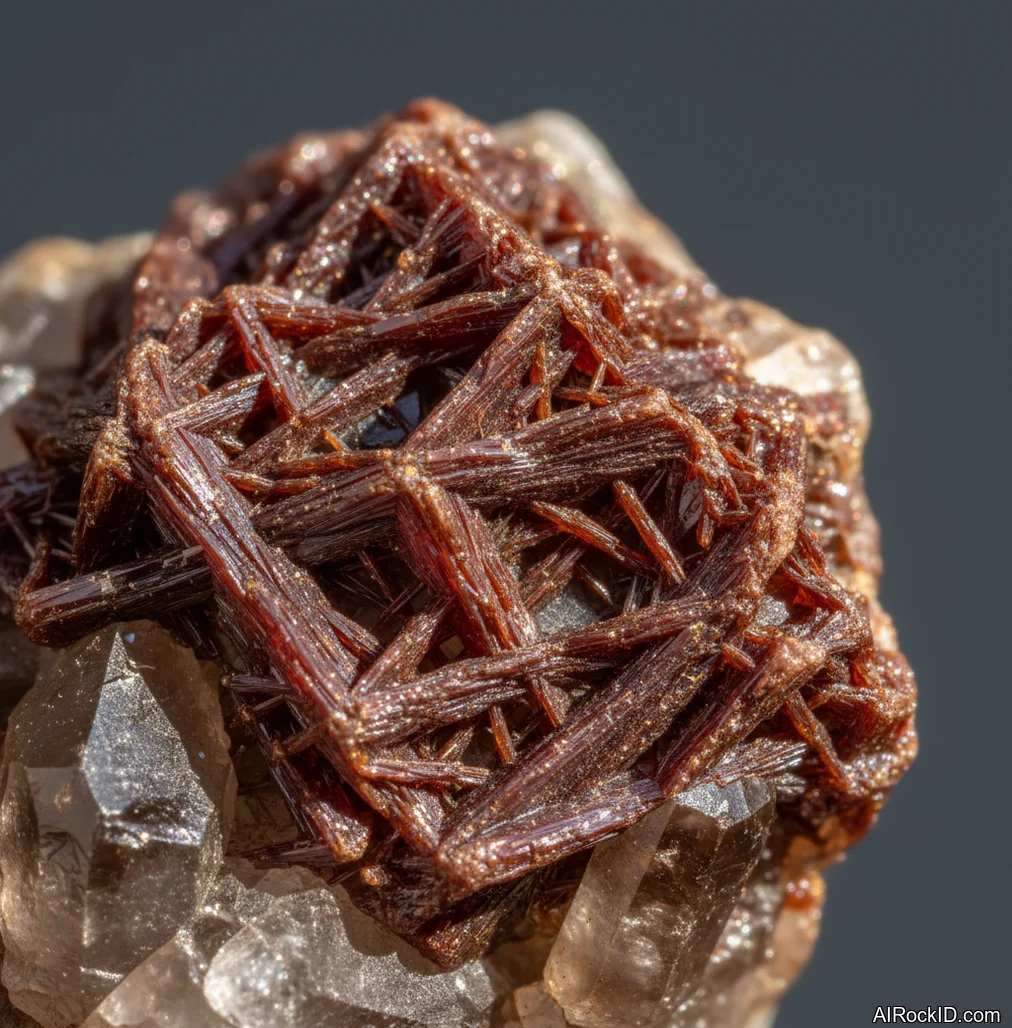
Quick answer: Rutile is a titanium dioxide mineral that commonly appears as reddish-brown, golden, or black needles, prisms, or hairlike inclusions in other minerals. It is often recognized by its very high luster, dense feel for its size, and distinctive needle-shaped crystal habit.
AI Rock ID can help compare rutile-like needles, dark prismatic crystals, and rutile inclusions against visual reference patterns. RockIdentifier.io provides identification support, but final confirmation may require hardness checks, streak, crystal habit, or professional testing when the specimen is valuable.
Good fit
- Collectors interested in needle crystals, twinned crystals, or inclusions in quartz
- People comparing dark metallic-looking minerals with similar habits
- Buyers checking whether golden needles in quartz are natural rutile or another inclusion
- Students learning titanium minerals and common accessory minerals in rocks
Not a good fit
- Anyone who needs a guaranteed lab identification from photos alone
- Buyers seeking only transparent faceted gemstones, since most rutile is collected as crystals or inclusions
- People who want a soft mineral for carving or frequent handling
Most commonly confused with
- Tourmaline: Tourmaline forms striated prismatic crystals and is usually less metallic-looking than rutile.
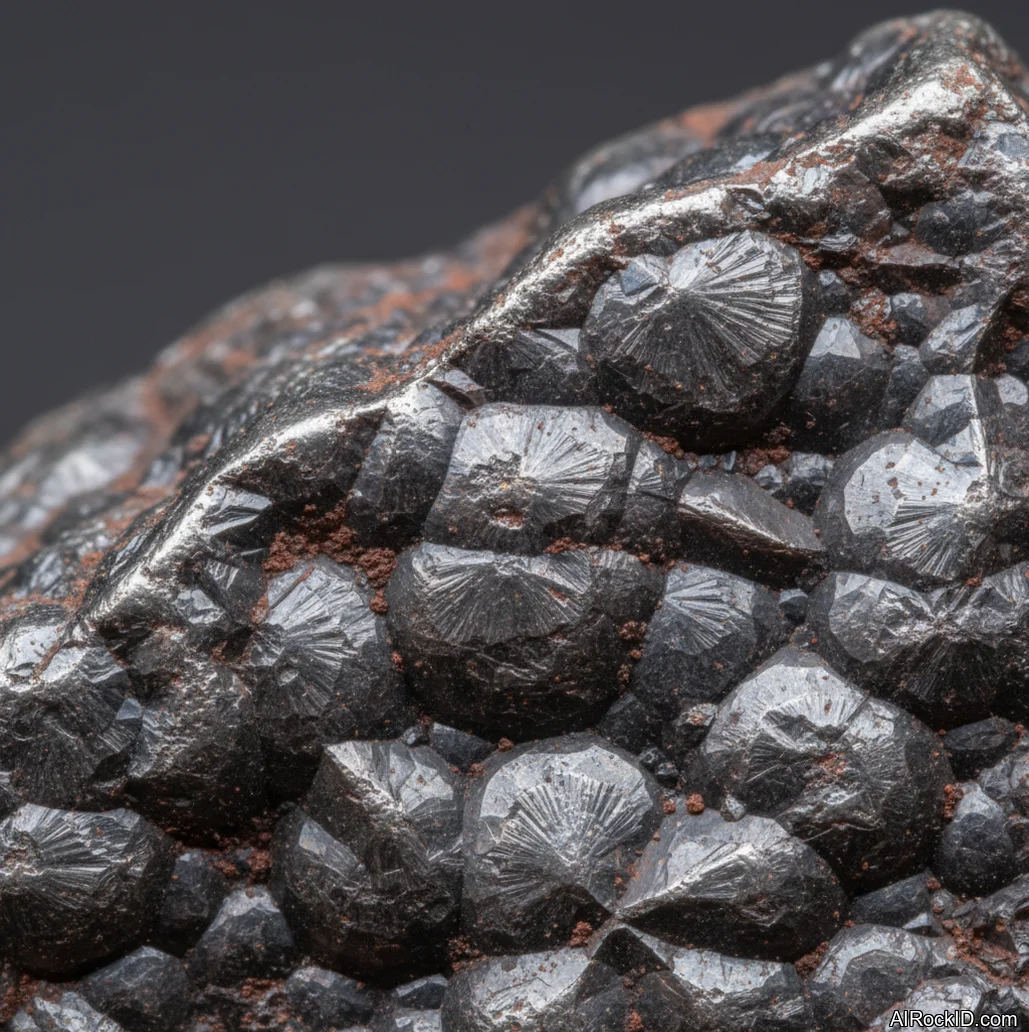
- Hematite: Hematite is typically steel-gray to black with a red-brown streak, while rutile often forms slender needles or prisms.
- Brookite: Brookite is also titanium dioxide but commonly forms tabular or plate-like crystals rather than classic rutile needles.
- Goethite: Goethite may appear as dark needles or sprays, but it is an iron oxide-hydroxide and usually has a yellow-brown to brown streak.
Rutile vs. Common Lookalikes
| Mineral | Typical clue | Key difference |
|---|---|---|
| Rutile | Reddish-brown, golden, or black needles; high luster | Titanium dioxide with a classic needle or prismatic habit |
| Tourmaline | Long striated prisms in many colors | Usually shows stronger lengthwise striations and less metallic luster |
| Hematite | Steel-gray to black masses or crystals | Red-brown streak is a strong distinguishing sign |
| Brookite | Thin tabular crystals, often brownish | Same chemical formula as rutile but different crystal structure and habit |
| Goethite | Brown to black sprays, fibers, or botryoidal forms | Iron-based mineral with a yellow-brown to brown streak |
AI identification confidence
AI identification of rutile is strongest when the specimen shows clear needle-like crystals, visible inclusions in quartz, or reddish-brown to black prismatic forms. Confidence is lower for dark massive pieces, tiny inclusions, or photos without scale, luster, and streak information.
When AI gets it wrong
- Black tourmaline needles in quartz may be mistaken for rutile if the photo does not show striations clearly.
- Hematite or goethite can resemble dark rutile when only color and shine are visible.
- Synthetic or treated quartz with metallic-looking filaments may be mislabeled as natural rutilated quartz.
- Very small rutile inclusions may be difficult to distinguish from actinolite, tourmaline, or other needle-like inclusions.
Final recommendation
For buying rutile, look for clear photos that show crystal habit, luster, and any host mineral rather than relying on color alone. For higher-value rutilated quartz or unusual crystal clusters, request locality details, treatment disclosure, and return options before purchase.
How to Check Rutile Authenticity Before Buying
Natural rutile commonly appears as fine needles, slender prisms, or inclusions that follow irregular growth patterns rather than perfectly uniform spacing. In rutilated quartz, rutile needles should appear enclosed within the quartz, not painted, glued, or resting only on the surface. Ask sellers for untreated, well-lit photos from multiple angles, especially when the specimen is sold as natural golden rutile in quartz.
Rutile Inclusions in Quartz
Rutile is one of the best-known needle-like inclusions in quartz, where it can appear golden, coppery, reddish, brown, or black. These inclusions may be sparse, densely packed, randomly arranged, or aligned in sprays. The host mineral remains quartz, while the internal needles are rutile when correctly identified.
Field Clues for Rutile Identification
Rutile has a relatively high specific gravity, so a compact crystal may feel heavier than expected for its size. Many crystals show a strong adamantine to submetallic luster and may appear red-brown along thin edges or under bright light. A streak test, when safe for the specimen, can help separate rutile from iron oxides and other dark lookalikes.
What Is Rutile?
Rutile is a titanium dioxide mineral (TiO2), and it usually grows as skinny, prismatic crystals with a shine that runs from adamantine to straight-up metallic.
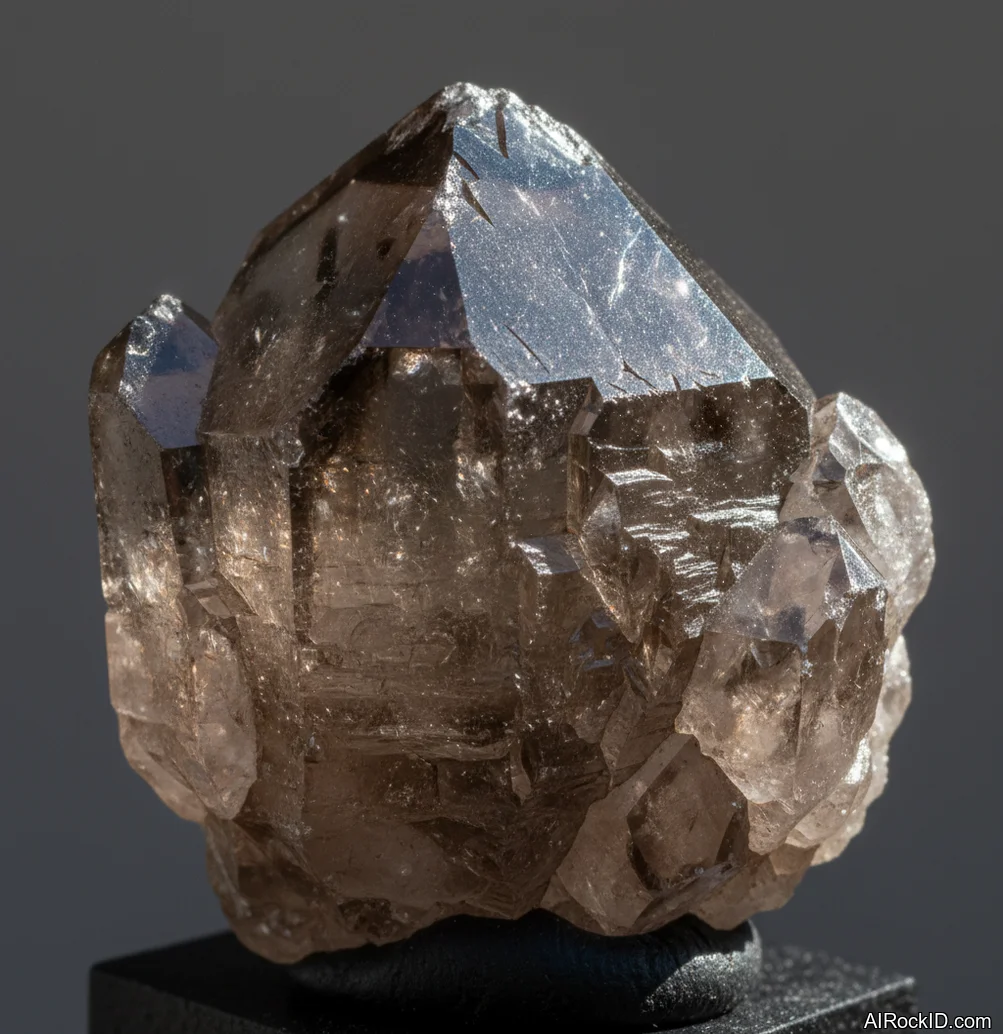
Hold a rutile crystal for a second and two things hit you right away. It’s heavier than your brain expects. And the crystal faces kick back light like tiny mirrors when you tilt it under a lamp. Most folks first run into rutile as those golden needles trapped inside quartz, but the free-standing crystals are a whole different deal. They might be deep red-brown, almost garnet-ish around the edges, or they can be jet black and totally opaque.
From across the table it can pass for tourmaline, or even a short, chunky bit of hornblende. But when the surface is clean, rutile’s luster gives it away instantly. The shape does too. Long and sharp, sometimes a little bent, sometimes packed into tight sprays. I’ve fished pieces out of a dealer’s flat where the crystals were so heavily striated they felt like tiny nail files when you dragged a fingernail over them (kind of weirdly satisfying, honestly).
Origin & History
In 1803, Abraham Gottlob Werner pinned rutile down as its own mineral species, and the name never really went away. It comes from the Latin “rutilus,” meaning red or reddish, which tracks if you’ve actually held those transparent red-brown crystals from alpine-type pockets up to the light and watched them glow a little at the edges.
Collectors latched on for a couple reasons. One is simple: the crystals can be razor-sharp and genuinely pretty sitting on matrix, like they were placed there on purpose. The other is that rutile turns up everywhere as inclusions, and chasing those inclusions turned into its own mini-obsession. “Rutilated quartz” is basically a gateway drug at gem shows. Dealers know exactly what they’re doing, too, and they’ll park the best needle-filled pieces right at eye level so you can’t not stop and look.
Where Is Rutile Found?
Rutile turns up worldwide in igneous and metamorphic rocks, plus placer sands. Collector-grade crystals often come from alpine pockets, pegmatites, and high-grade metamorphic terrains.
Formation
Look at where rutile turns up and a pretty clear theme pops out. It’s a titanium mineral that’s happiest at high temperatures, so you find it in igneous rocks and in metamorphic rocks that have basically been heat-cooked. In metamorphic terrain, it’ll show up as little grains or skinny needles in schist and gneiss, and you’ll sometimes catch it sitting right alongside kyanite, sillimanite, and garnet.
But it doesn’t stop there. In igneous rocks, rutile can hang around as an accessory mineral, and in pegmatites it can grow into those flashier, well-formed crystals that actually look like crystals instead of just specks.
And then there’s the weathering route. Rutile’s chemically stubborn, so when rocks break down it can survive the whole mess and get concentrated into heavy mineral sands with ilmenite and zircon. If you’ve ever had one of those little vials of black beach-concentrate sand in your hand, you know the feel. Heavy, almost like it wants to settle instantly. That little glint you see when you tilt it in the light? Yeah, there’s a decent chance some of that is rutile hiding in there.
How to Identify Rutile
Color: Most rutile is reddish-brown, brownish-black, or black; thinner edges can look red-brown when backlit. Inclusions in quartz are often golden to coppery, but color depends on thickness and lighting.
Luster: Clean faces have an adamantine to metallic luster that flashes sharply under point light.
If you scratch it with quartz, rutile should resist pretty well, but it won’t touch topaz or corundum. Pick up a crystal and feel the heft; it’s noticeably heavy for its size compared to tourmaline. The real test is a loupe: rutile crystals commonly show strong lengthwise striations and crisp prism faces, and rutilated quartz needles look like solid rods rather than flaky, mica-like shimmer.
Common Look-Alikes
Rutile is sometimes confused with these materials:
- Brookite
- Hematite (especially dark, metallic specimens)
- Titanite (Sphene)
- Ilmenite
- Tourmaline (schorl, when it's in thin black prismatic crystals)
- Dyed quartz with rutile-like inclusions
Market Cautions & Treatments
When AI Can Get This Wrong
Photo ID mixes up rutile with hematite or black tourmaline all the time, especially when you're dealing with prismatic black crystals. AI can't weigh a sample, so it misses the telltale heft. Scratching glass is a quick check, but real rutile's adamantine shine and sharp crystal faces are hard to fake in person.
Properties of Rutile
Physical Properties
| Crystal System | Tetragonal |
| Hardness (Mohs) | 6.0-6.5 (Hard (6-7.5)) |
| Density | 4.2-4.3 g/cm3 |
| Luster | Adamantine |
| Diaphaneity | Transparent to translucent |
| Fracture | Uneven |
| Streak | pale brown to light yellowish-brown |
| Magnetism | Non-magnetic |
| Colors | reddish-brown, brown, brownish-black, black, golden (as inclusions) |
Chemical Properties
| Classification | Oxides |
| Formula | TiO2 |
| Elements | Ti, O |
| Common Impurities | Fe, Nb, Ta, V, Cr |
Optical Properties
| Refractive Index | 2.616-2.903 |
| Birefringence | 0.287 |
| Pleochroism | Strong |
| Optical Character | Uniaxial |
Rutile Health & Safety
Handling specimens is pretty low risk. The real worry is breathing in mineral dust if you’re cutting, grinding, or sanding rutile-bearing material (that fine powder that hangs in the air and settles on your fingers).
Safety Tips
If you’re cutting, shaping, or drilling, do it wet and wear a proper respirator. Don’t dry-sweep the dust. Clean up the slurry instead (it’s messy, but it keeps the fine stuff out of the air).
Rutile Value & Price
Price Range
Rough/Tumbled: $5 - $300 per specimen
Cut/Polished: $10 - $150 per carat
Prices jump all over the place depending on how the rutile shows up. Those sharp, glassy crystals sitting on matrix, the kind that catch light when you tilt them in your hand, go for a lot more than beach-sand grains or the dull, heavy massive chunks. And yes, transparent red-brown faceting rough is out there, but truly clean stones are scarce. Thing is, rutile’s high refractive index makes it a pain to cut, so even when you’ve got decent rough, getting a nice finished stone isn’t exactly straightforward.
Durability
Moderate — Scratch resistance: Good, Toughness: Fair
Rutile is chemically stable, but slender crystals chip easily and sharp terminations don’t love being rattled around in a pocket.
How to Care for Rutile
Use & Storage
Store rutile crystals in a box with padding or a perky box, because the tips chip faster than you’d think. If it’s rutilated quartz, treat it like quartz but still keep it from knocking into harder stones.
Cleaning
1) Rinse briefly in lukewarm water with a drop of mild soap. 2) Use a soft toothbrush around the base and matrix, not across sharp terminations. 3) Rinse well and air-dry on a towel; avoid heat-drying that can pop fragile attachments.
Cleanse & Charge
If you do energetic cleaning, stick to smoke, sound, or a quick rinse and dry. I don’t leave rutile clusters sitting in saltwater because it’s not worth the risk to the matrix.
Placement
Put it where a single light source can hit it, like on a shelf with a small lamp, since rutile’s flash is half the fun. Keep it out of the edge-of-shelf danger zone.
Caution
Don’t tumble raw rutile crystals. And don’t toss fragile matrix pieces in an ultrasonic cleaner either, because the vibration can chip edges fast (you’ll hear that nasty rattling). Thing is, if you’re cutting or sanding, put on a respirator every time. Mineral dust is the real hazard here, not the crystal itself.
Works Well With
Rutile Meaning & Healing Properties
Against the softer, cushier stones, rutile just feels… pointy. Not in a “it’ll cut you” way, but in that sharp, no-nonsense way you notice the second it hits your palm. And I mean that both literally and energetically. Those needle crystals really do look like tiny antennas, and when I’m sorting a tray of mixed minerals, rutile’s the one that makes me straighten up like, okay, focus.
Grab a rutilated quartz palm stone and tilt it under a window. Do it slow. The needles flash in these little spark-bursts when the light catches just right, and it’s weirdly easy to lock your eyes on that and use it as a visual hook for meditation or breath counting. But here’s the part people don’t always say out loud: a lot of the “rutile magic” is honestly the quartz doing quartz things, and the rutile is basically the loud visual sign that tells your brain to pay attention. Want the rutile feel without the quartz buffer? Pick up a standalone rutile crystal and you’ll get it immediately.
And no, it’s not a miracle tool. It’s not medical care either. I treat it like a blunt little reminder to cut through the clutter, make the call, write the list, stop doom-scrolling (yes, that one). On days when my thoughts are everywhere, I’ll park a rutile specimen right by my notebook where I can’t ignore it. Thing is, the habit matters more than the rock, and rutile just keeps that habit right in my face.
Common mistakes
- Assuming every golden needle in quartz is rutile without checking for tourmaline, actinolite, or other inclusions.
- Identifying rutile by black color alone, which can lead to confusion with tourmaline, hematite, or goethite.
- Overlooking the host mineral when buying rutilated quartz, since the specimen is primarily quartz with rutile inclusions.
- Expecting all rutile to be golden; natural rutile is often reddish-brown, dark brown, or black.
- Using only a single photo for identification when luster, crystal habit, and scale are not visible.
Identify Rutile from a photo
Compare Rutile traits, care tips, value clues, and common lookalikes with a clear photo.