Golden Rutile Quartz


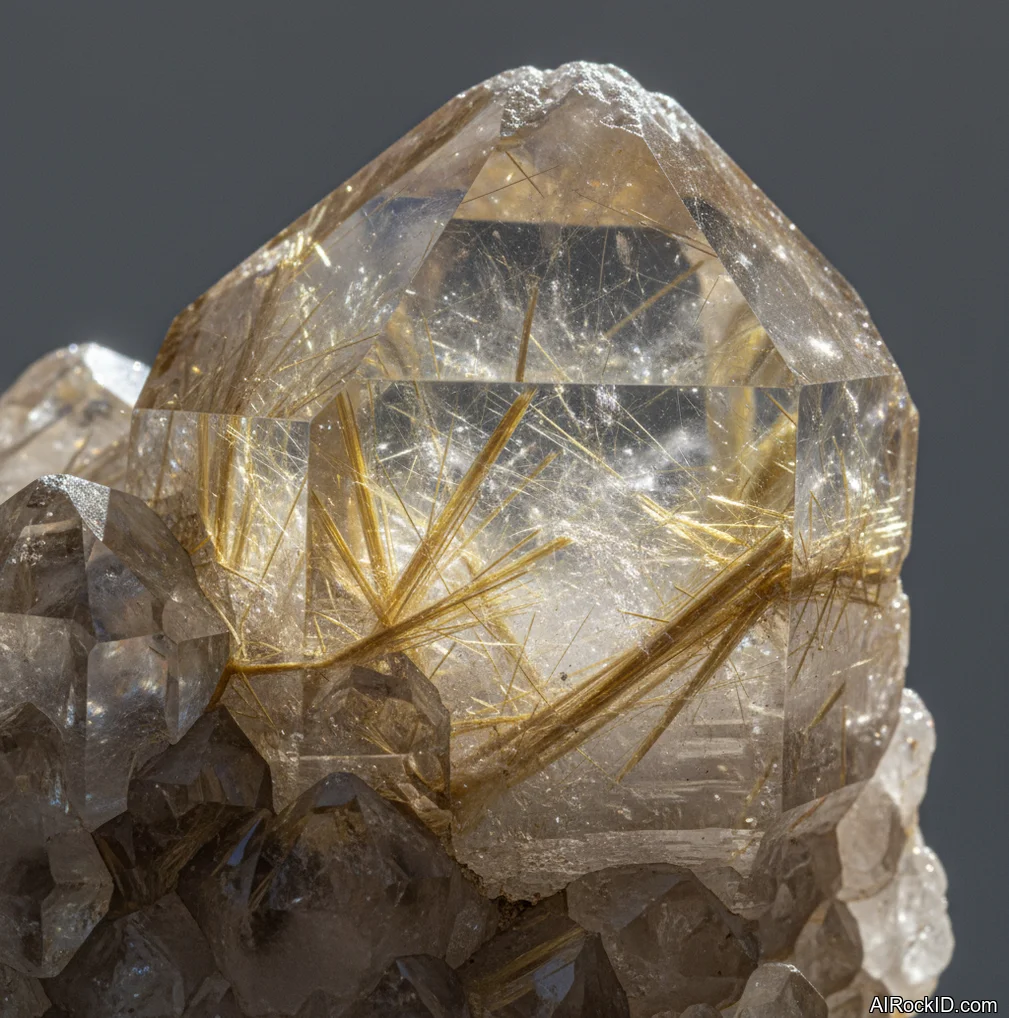
Quick answer: Golden Rutile Quartz is transparent to translucent quartz containing fine golden rutile needles. It is best identified by its quartz hardness, glassy luster, and internal needle-like inclusions rather than by color alone.
AI Rock ID can help compare a photo of Golden Rutile Quartz against visually similar quartz varieties and included stones. RockIdentifier.io provides crystal identification support, reference details, and comparison context for checking likely matches.
Good fit
- Collectors who like visible internal inclusions in clear quartz
- Jewelry buyers who want a durable quartz-based stone
- Beginners learning to distinguish natural inclusions from cracks or bubbles
- People comparing rutilated quartz with tourmalinated quartz or included glass
Not a good fit
- Buyers who want a perfectly clear, inclusion-free quartz
- Situations requiring a rare gemstone with consistently high resale value
- Anyone relying on a crystal for medical treatment or health outcomes
Most commonly confused with
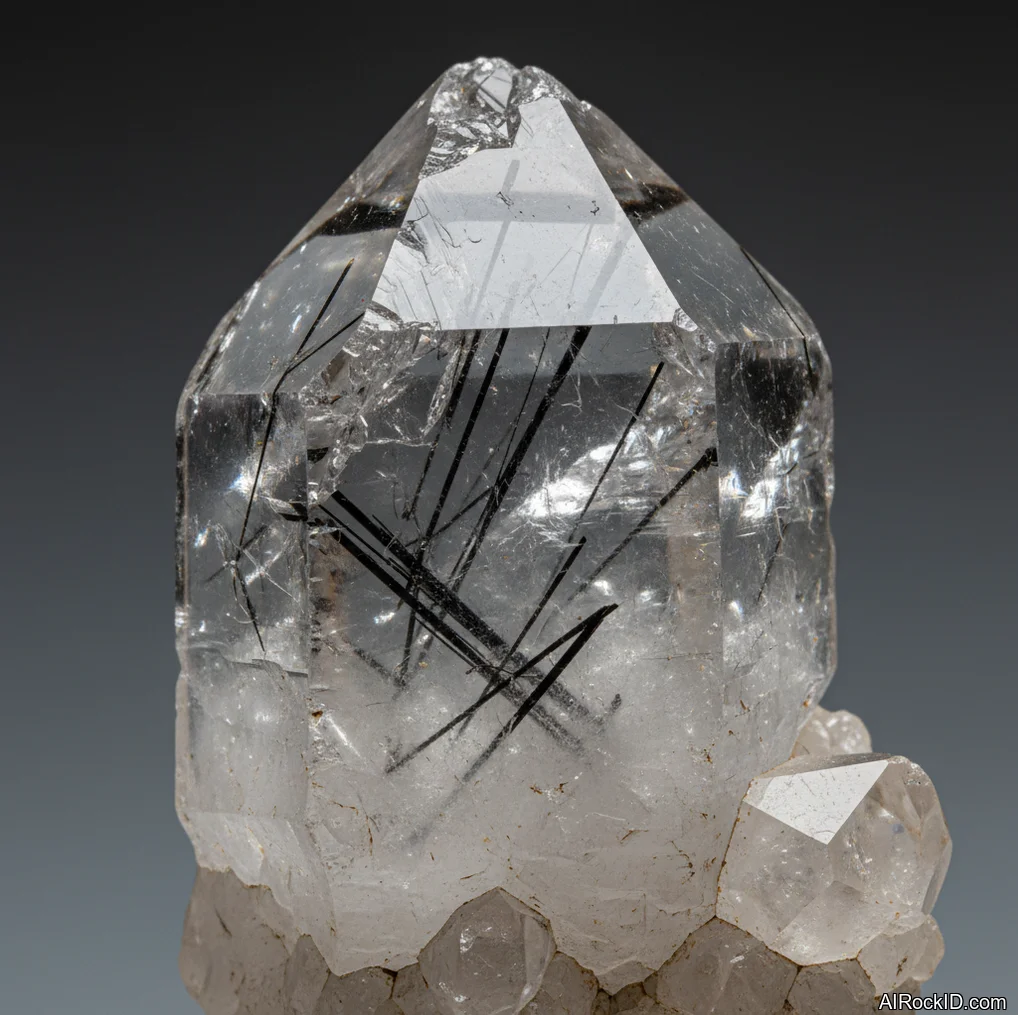
- Tourmalinated Quartz: Usually contains black tourmaline needles rather than golden rutile threads.
- Clear Quartz: May be transparent but lacks the distinct golden needle inclusions.
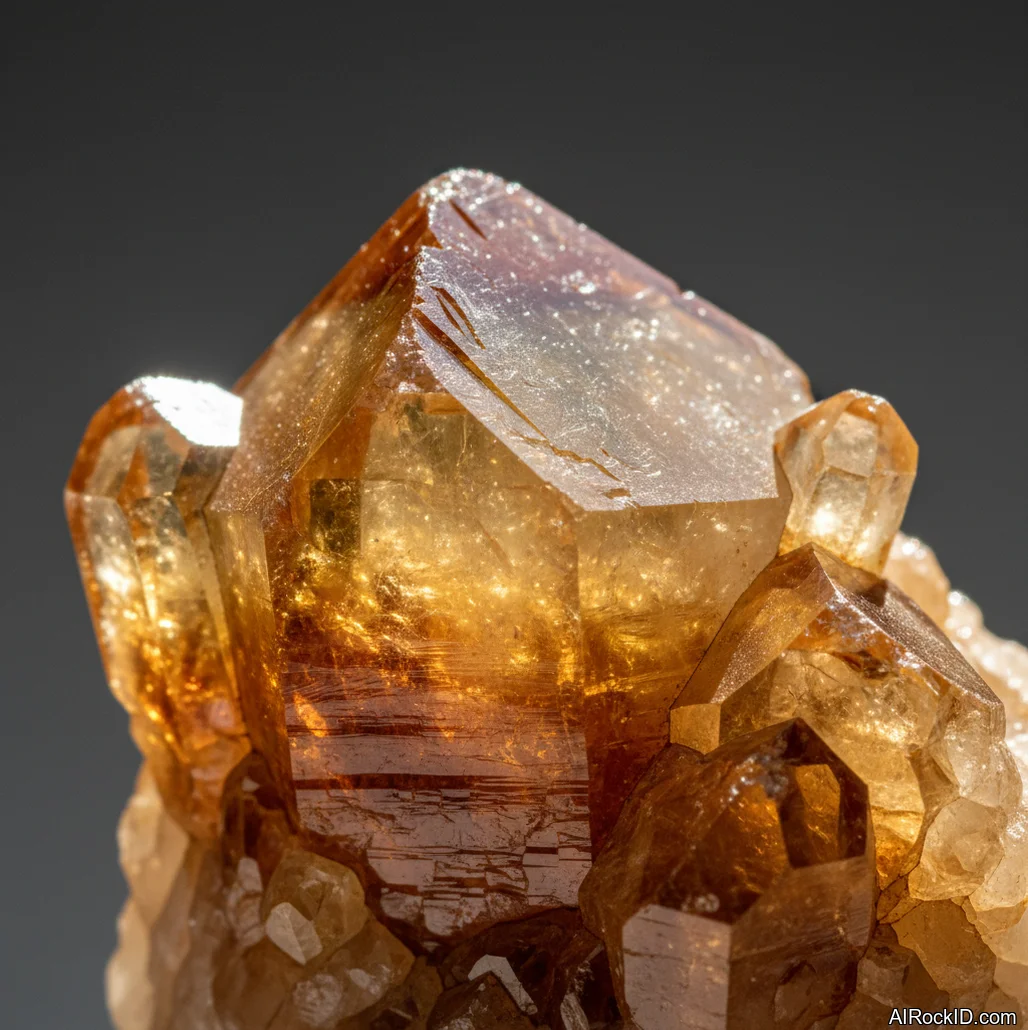
- Golden Healer Quartz: Typically shows yellow to iron-stained zones or coatings instead of sharp rutile needles.
- Synthetic or Imitation Glass: May show bubbles, molded shapes, or artificial-looking fibers rather than natural mineral inclusions.
Golden Rutile Quartz vs Similar Stones
| Stone | Main Visual Clue | Key Difference |
|---|---|---|
| Golden Rutile Quartz | Clear quartz with golden needle inclusions | Needles are rutile inside quartz |
| Tourmalinated Quartz | Clear quartz with dark needle inclusions | Inclusions are usually black tourmaline |
| Clear Quartz | Transparent to milky quartz | No consistent golden needle pattern |
| Golden Healer Quartz | Yellow, orange, or iron-stained quartz | Color often comes from iron oxides, not rutile needles |
| Imitation Glass | Clear body with possible bubbles or added fibers | Lower hardness and may show manufactured features |
AI identification confidence
AI identification is usually more reliable when the photo clearly shows the internal golden needles, crystal transparency, and surface luster. Confidence may be lower for polished beads, heavily included pieces, or photos taken under warm lighting that changes the apparent color.
When AI gets it wrong
- Golden-colored cracks or iron staining may be mistaken for rutile needles
- Black or dark inclusions can lead to confusion with tourmalinated quartz
- Polished glass with fibers or bubbles may resemble included quartz in photos
- Close-up images without scale can make ordinary inclusions look like rutile
Final recommendation
Choose Golden Rutile Quartz by looking for natural-looking golden needles enclosed within quartz, not surface paint or loose metallic fibers. For higher-value pieces, ask for clear photos, origin details when available, and disclosure of any treatments or assembled materials.
How to Check Golden Rutile Quartz Authenticity
Authentic Golden Rutile Quartz should show rutile needles enclosed within the quartz rather than sitting on the surface. Natural inclusions usually vary in thickness, direction, and density, while imitations may show uniform fibers, bubbles, or a molded appearance. Quartz should resist scratching from steel more than softer glass imitations, but scratch testing is not recommended on finished jewelry.
Buying Tips for Golden Rutile Quartz
Look for clear seller photos that show the stone from multiple angles, especially if the rutile pattern is important to you. Fine jewelry pieces should identify the metal setting and disclose whether the quartz is natural, treated, dyed, assembled, or synthetic. Dense rutile coverage can be attractive, but it may reduce transparency and change the overall look of the stone.
Photo Tips for Identifying Golden Rutile Quartz
Photograph Golden Rutile Quartz in bright, indirect light so the golden needles can be seen without glare. A white or gray background helps separate true inclusions from reflections. Include one close-up image and one full-stone image with scale for better visual comparison.
What Is Golden Rutile Quartz?
Golden Rutile Quartz is just quartz (SiO2), but with golden rutile (TiO2) needles locked inside it.
Thing is, when you pick up a piece, your eye doesn’t stay on the quartz for long. It shoots straight into those needles. Some are so thin they look like fine hair. Others are more like sewing pins. And the really good ones? They’ve got that chaotic, tangled look, like somebody shook a wad of gold thread inside the crystal and it never settled.
But in your hand it still reads as quartz. Cool to the touch. Glassy on the surface. Harder than most stuff sitting on a table, too.
At first glance, a lot of people assume the “gold” is metallic flakes. It isn’t. It’s rutile crystals that got trapped while the quartz was growing. And the needles don’t always show up in a neat, even spread either. You’ll get a clear window, then a dense brush of needles, then a slightly cloudy patch where the quartz healed fractures around them (you can almost see the shift when you tilt it). So yeah, that unevenness is part of the charm. It also means two stones with the same size can look totally different.
Origin & History
Quartz has been talked about since antiquity. Rutile, though, didn’t get formally described as a mineral until 1803, when Abraham Gottlob Werner did it. The name comes from the Latin “rutilus,” meaning red, a nod to that common reddish-brown color rutile shows in a lot of finds.
Collectors started calling it “rutilated quartz” as a trade term once clear quartz with those visible rutile needles became a regular lapidary and cabinet staple. And you’ll hear “Venus hair stone,” too, which is that old-school jewelry phrase for the hair-like look of the inclusions. Dealers still toss it around when they’re selling the romance, but in a mineral box I just call it rutilated quartz and move on.
Where Is Golden Rutile Quartz Found?
Good golden material shows up a lot in Brazil, with other steady sources in Madagascar and Pakistan. Alpine-type pieces exist too, but they’re usually collector curiosities, not the bulk of what you see at shows.
Formation
Look, if you stare at those little needles for a second, you’re basically looking at timing frozen in place. Rutile is titanium dioxide crystallized out into these skinny prisms, and when the conditions line up, those needles form first or right alongside the quartz. Then the quartz keeps stacking on, layer by layer, and the rutile gets sealed in like it’s been laminated.
Most of what gets sold as Golden Rutile Quartz is coming out of hydrothermal settings or pegmatite-related zones, where silica-rich fluids have the chance to grow really clean quartz. Sometimes the rutile needles are already there and the quartz grows around them. Sometimes the rutile grows while the quartz is still forming. Either way, that “gold thread” look is just those rutile prisms grabbing the light through a transparent host. But when the quartz isn’t actually transparent, the whole effect kind of falls apart, doesn’t it? You just get beige quartz with fuzzy stuff trapped inside. Happens all the time.
How to Identify Golden Rutile Quartz
Color: The host ranges from colorless to smoky or slightly milky, while the inclusions are yellow-gold to brassy gold needles that can look hair-thin or pin-thick. Some pieces show a faint greenish-gold cast in certain lighting when the rutile is very fine.
Luster: Vitreous luster on the quartz surfaces, with bright internal flashes off the rutile needles.
Pick up a few and tilt them under a single overhead light. Real rutile needles will throw sharp, bright lines that shift as you rotate, while printed or foil “inclusions” look flat and don’t have depth. The real test is the feel and hardness of quartz: it should stay cool in your hand and it’ll scratch ordinary window glass without trying. But watch for assembled pieces too, like a clear cab with a golden film under it. From the side, the “needles” sit on one plane instead of floating through the stone.
Common Look-Alikes
Golden Rutile Quartz is sometimes confused with these materials:
- Tourmalinated quartz (black schorl needles in quartz, sometimes sold as “rutilated” in bad listings)
- Golden hair rutilated glass (man-made glass with metallic-looking fibers, often too uniform and “perfect”)
- Quartz with goethite/limonite needles or sprays (brown to honey needles that get mislabeled as rutile)
- Quartz with epidote needles (greenish needles can read “gold” under warm lighting and phone filters)
- Heat-treated or coated “rutilated” quartz (golden look boosted by surface films or aggressive photo editing)
Market Cautions & Treatments
When AI Can Get This Wrong
At first glance, phone cameras and AI love to call anything with internal lines “rutilated,” so tourmalinated quartz and even goethite-in-quartz get mixed in a lot. The real test is rotation: rutile needles stay crisp and metallic-gold from multiple angles, while many iron-oxide needles go dull brown and “disappear” when you turn the stone. If you can, do a quick hardness sanity check on an unpolished edge (quartz should bite glass), and use a loupe to confirm the needles are inside the quartz, not sitting on the surface like a film.
Properties of Golden Rutile Quartz
Physical Properties
| Crystal System | Trigonal |
| Hardness (Mohs) | 7 (Hard (6-7.5)) |
| Density | 2.65 g/cm3 (quartz host; higher locally where rutile is dense) |
| Luster | Vitreous |
| Diaphaneity | Transparent to translucent |
| Fracture | Conchoidal |
| Streak | White |
| Magnetism | Non-magnetic |
| Colors | Colorless, White, Smoky brown, Golden yellow, Brassy gold |
Chemical Properties
| Classification | Silicates |
| Formula | SiO2 (quartz) with TiO2 (rutile) inclusions |
| Elements | Si, O, Ti |
| Common Impurities | Al, Fe, Li |
Optical Properties
| Refractive Index | 1.544-1.553 |
| Birefringence | 0.009 |
| Pleochroism | None |
| Optical Character | Uniaxial |
Golden Rutile Quartz Health & Safety
It’s safe to handle and rinse, same as most quartz. But if you’re grinding or sanding it, don’t breathe the dust. (That fine, powdery stuff gets everywhere, right?)
Safety Tips
If you have to cut it or drill into it, keep it wet and wear the right respirator so you’re not kicking silica dust up into the air. Seriously, you don’t want to be breathing that stuff.
Golden Rutile Quartz Value & Price
Price Range
Rough/Tumbled: $10 - $250 per piece
Cut/Polished: $5 - $60 per carat
Price mostly comes down to how clear the quartz is, what the rutile looks like (color and density), and if the piece has clean, natural faces or a really well-done polish you can feel when you run a thumb over it. Big, super-clear specimens with thick golden needles get expensive in a hurry. But those average tumbled stones? They usually stay cheap.
Durability
Durable — Scratch resistance: Excellent, Toughness: Good
It’s basically quartz for wear and handling, but it can chip on sharp edges and internal fractures can make some pieces more fragile than they look.
How to Care for Golden Rutile Quartz
Use & Storage
Store it like you’d store any quartz point: wrapped or separated so it doesn’t clack against harder stones and chip an edge. If it has a lot of internal fractures, don’t toss it loose in a pocket.
Cleaning
1) Rinse with lukewarm water and a drop of mild soap. 2) Use a soft toothbrush to get grit out of creases and around terminations. 3) Rinse well and pat dry; skip harsh chemicals and avoid boiling or rapid temperature changes.
Cleanse & Charge
If you do the metaphysical side, a quick rinse and a dry wipe works fine, or set it on a windowsill for gentle light for a short time. Don’t bake it in full sun for days if the host is smoky or has coatings you care about.
Placement
On a desk, angle it so a single lamp hits the needles, because that’s when it really pops. In a display case, keep it away from stuff that sheds dust, since dust kills the internal sparkle.
Caution
Don’t toss it in an ultrasonic cleaner if there are internal fractures or those little healed cracks you can sometimes catch when you tilt it under a lamp, because the vibration can pry them back open. And don’t mix up “golden rutile” with gold-bearing quartz either, they’re not the same thing.
Works Well With
Golden Rutile Quartz Meaning & Healing Properties
Next to plain clear quartz, Golden Rutile Quartz tends to feel mentally louder for a lot of people. Not spooky. It’s more like your attention gets yanked toward whatever you already had running through your head, like someone turned the volume knob up a notch. I’ve watched folks at my local show pick one up, go dead quiet, then start sorting through pieces like they’re suddenly very sure they need to choose the “right” one. Decision energy. That’s the vibe.
Grab a palm stone and just rub your thumb over the polish for a minute. It’s slick, almost glassy, and you’ll catch that little squeak your skin sometimes makes on a really smooth surface (you know the one). You can’t feel the needles, obviously, but you can see them shift as you tilt it under the lights, and that tiny bit of visual motion makes it weirdly easy to stay present. If you use stones for meditation, this one’s more “focus and organize” than “float away.” But look, it can be too stimulating right before bed, especially when the rutile is dense and flashy.
And I’ve gotta say the boring part out loud: none of this is medical care. If you’re using it as a reminder to keep your head clear, cool. But if you’re trying to treat anxiety or anything physical, get real support, and let the crystal be a personal object, not the plan.
Common mistakes
- Assuming every golden line inside quartz is rutile
- Confusing surface scratches with internal needle inclusions
- Identifying a stone from warm lighting instead of the actual inclusion color
- Overlooking bubbles that may suggest glass imitation
- Treating all rutilated quartz as equally valuable regardless of clarity, cut, and inclusion pattern
Identify Golden Rutile Quartz from a photo
Compare Golden Rutile Quartz traits, care tips, value clues, and common lookalikes with a clear photo.