Chinese Writing Stone


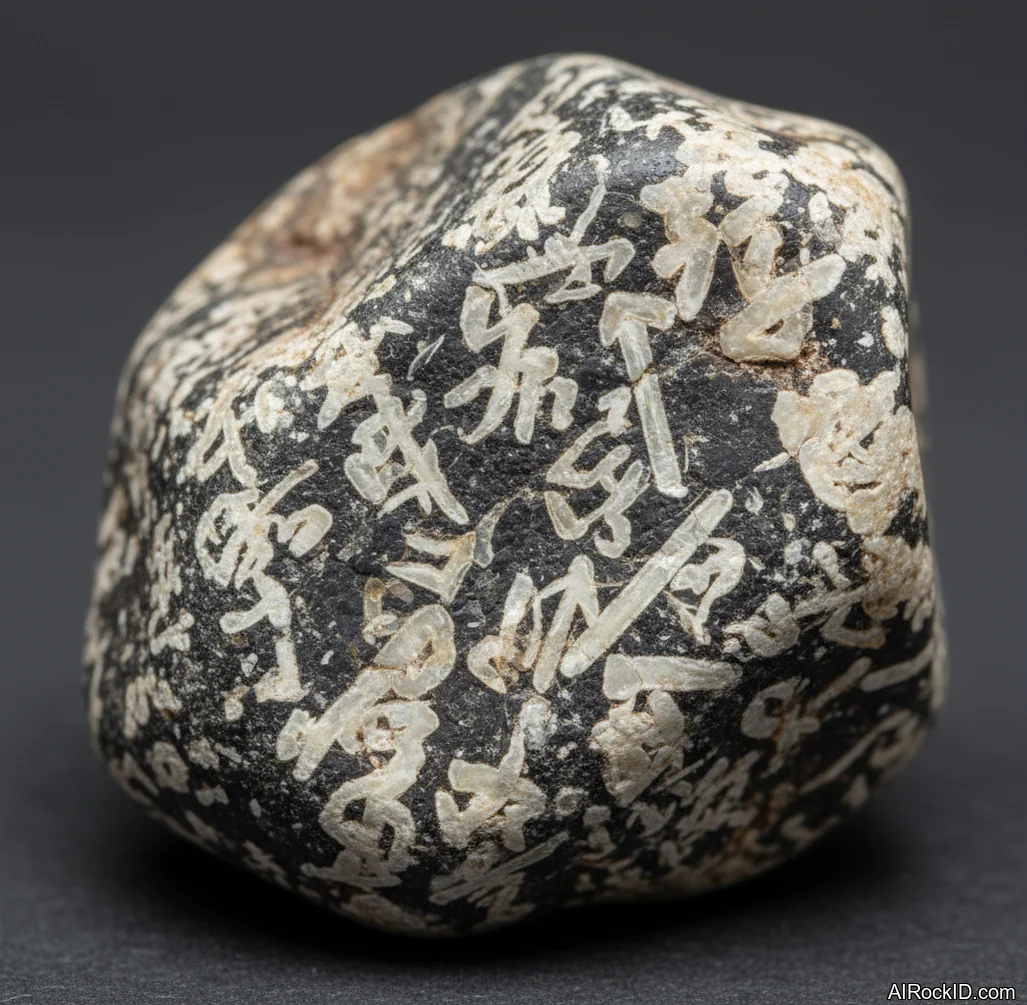
Quick answer: Chinese Writing Stone is a patterned ornamental rock best recognized by dark, brushstroke-like markings that resemble handwritten characters. It is commonly cut as cabochons, beads, palm stones, and display pieces, with identification based mainly on pattern, host rock texture, and absence of dye or printed surface designs.
AI Rock ID can help compare Chinese Writing Stone with visually similar patterned rocks by analyzing color contrast, pattern shape, and surface texture from a clear photo. RockIdentifier.io provides a quick reference point, but uncertain results should be checked against physical traits such as hardness, luster, and whether the markings continue below the surface.
Good fit
- Collectors who like naturally patterned stones with calligraphy-like markings
- Beginners seeking a visually distinctive rock that is usually easy to recognize
- Jewelry makers using cabochons, beads, or pendants with high-contrast patterns
- People who prefer neutral black, gray, cream, or greenish tones
- Specimen buyers who value pattern placement more than rarity
Not a good fit
- Buyers looking for a transparent or faceted gemstone
- Collectors who need a single, consistent mineral species rather than a patterned rock
- Jewelry settings exposed to heavy abrasion or impact
- Anyone expecting two pieces to have identical markings
Most commonly confused with
- Picasso Stone: Picasso Stone usually shows angular, abstract line networks rather than character-like dark crystals in a lighter host.
- Zebra Jasper: Zebra Jasper has broader, banded black-and-white striping instead of isolated calligraphy-like marks.
- Dalmatian Jasper: Dalmatian Jasper is typically cream with rounded black spots, not elongated writing-like forms.
- Snowflake Obsidian: Snowflake Obsidian is glassy black with gray-white snowflake clusters rather than a matte or waxy patterned rock.
Chinese Writing Stone vs Similar Patterned Stones
| Stone | Typical Pattern | Key Difference | Common Use |
|---|---|---|---|
| Chinese Writing Stone | Dark writing-like marks on lighter matrix | Markings often resemble brushstrokes or characters | Cabochons, beads, display stones |
| Picasso Stone | Gray, tan, or black angular lines | More fractured or abstract linework | Cabochons, slabs, carvings |
| Zebra Jasper | Bold black-and-white bands | Striped rather than script-like | Tumbled stones, beads |
| Dalmatian Jasper | Cream base with black spots | Spotted rather than linear | Tumbled stones, carvings |
| Snowflake Obsidian | Gray-white clusters in black glass | Glassy luster and volcanic texture | Tumbled stones, spheres |
AI identification confidence
AI identification is often moderately reliable when a photo clearly shows the stone’s writing-like pattern, natural surface texture, and overall color contrast. Confidence drops when the piece is highly polished, photographed under glare, dyed, or cropped so tightly that the matrix is not visible.
When AI gets it wrong
- A printed or resin item has a surface pattern that imitates natural markings
- Strong reflections hide the stone’s texture and make it look glassy
- The photo shows only one small marking instead of the whole pattern field
- The specimen is mislabeled as jasper, marble, chiastolite, or Picasso Stone by a seller
Final recommendation
Choose Chinese Writing Stone by pattern clarity, natural-looking contrast, polish quality, and whether the markings appear within the rock rather than only on the surface. For jewelry, inspect edges and drill holes for chips, dye residue, or filler before buying.
How to Check Authenticity Before Buying
Authentic Chinese Writing Stone should show irregular markings that vary in thickness, direction, and depth rather than repeated printed shapes. Examine drill holes, chipped edges, and the back of the piece to see whether the pattern continues naturally through the material. Be cautious with items that have identical-looking designs, overly glossy resin surfaces, or color that rubs off on a damp cloth.
Photo Tips for Identifying Chinese Writing Stone
Use diffuse daylight or soft indoor lighting to reduce glare on polished pieces. Photograph the entire stone, a close-up of the markings, and an edge or back view so the matrix and pattern depth can be evaluated. A coin or ruler in the image helps show scale, which is useful when comparing cabochons, beads, and rough specimens.
What Affects Pattern Appeal
Collectors often prefer pieces with strong contrast, balanced spacing, and markings that resemble natural calligraphy without looking artificial. Large uninterrupted patterns can be desirable in cabochons and display slabs, while smaller repeated marks are common in beads. Pattern appeal is subjective, so two stones of the same size and material can be valued differently.
What Is Chinese Writing Stone?
Chinese Writing Stone is a patterned metamorphic rock, and it’s famous because it contains chiastolite (a variety of andalusite) that makes natural, ink-like “writing” shapes in a dark matrix.
Pick up a palm stone and you feel it right away. Solid. Honest weight for its size. It’s not heavy like hematite, but it’s not airy either, and the surface usually has that slick, almost glassy drag from the polish that you can feel on your thumb.
But the look is what grabs most people. Tan to caramel patches with sharp, dark strokes that really do read like brush marks once the piece is cut and polished. At first glance, folks assume it’s painted on. Then you tilt it under a light and you can see the markings are inside the stone, not sitting on top (that’s the giveaway).
Most of what you’ll see for sale is polished, sometimes as worry stones or flat ovals. Raw chunks exist. They’re usually dull and dusty, and the “writing” doesn’t pop until a face is cut. And yeah, some sellers call a bunch of different patterned rocks “writing stone,” but the classic material is chiastolite-bearing rock.
Origin & History
“Chinese Writing Stone” is just a trade label that grew out of the lapidary and souvenir world, not an official mineral species name. It comes from the way chiastolite’s dark inclusions can look like brush-written characters once the stone’s been sliced and you’re staring at the fresh face under a decent light.
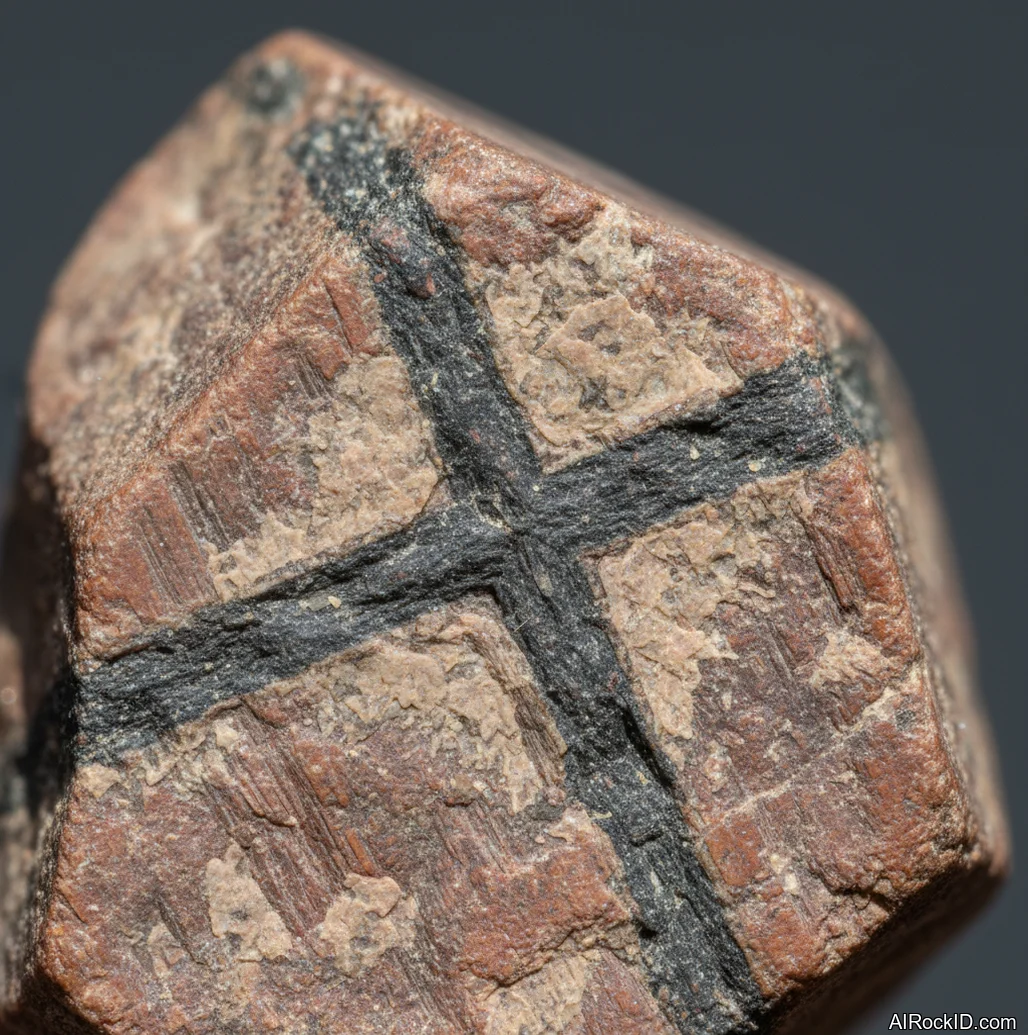
Chiastolite itself was described as a variety of andalusite in early mineralogy, especially in 18th to 19th century European literature. And people have been talking about that cross pattern in chiastolite for ages, because when you cut a clean section the cross shows up so crisp it almost looks printed. So the “writing” effect is really the same inclusion behavior, just stretched into longer strokes depending on how the crystal sits and where the cut runs (ever notice how a tiny change in angle can turn a tidy mark into a whole line?).
Where Is Chinese Writing Stone Found?
Most commercial “Chinese Writing Stone” is sold as Chinese material, but chiastolite-bearing rocks show up in several metamorphic belts worldwide, including parts of Spain, France, and the USA.
Formation
Chiastolite starts out as aluminum-rich clay sediment, then it gets “cooked” by contact or regional metamorphism, usually right in the andalusite stability field. Hot enough for andalusite to grow, sure. But not such high pressure that it switches over to kyanite.
That cross-like “writing” is just inclusions, most often carbonaceous stuff plus other tiny impurities, getting shoved into certain zones while the crystal grows. It’s basically the growth pattern, locked in place. And if you’ve ever actually sliced one open, you know the look can change a lot from piece to piece. Some cuts come out with sharp, clean strokes you can feel with a fingernail when the surface is fresh, and others turn out kind of murky and smeared. Not your polishing job. That’s just the rock being picky (why does it always do that on the one you’re excited about?).
How to Identify Chinese Writing Stone
Color: Typically tan to yellow-brown chiastolite “letters” in a dark gray to black matrix, sometimes with rusty brown staining from iron oxides. The contrast is the whole point, and the best pieces have sharp, inky-looking lines.
Luster: Polished surfaces look waxy to vitreous; raw surfaces are dull to earthy.
Look closely at the markings under a bright light and a loupe: real patterns sit under the polish and don’t smear or scratch like surface ink. If you scratch it with a steel nail, it should resist pretty well, but quartz will still bite it. The real test is a fresh chip or an unpolished edge: you’ll often spot the blocky, prismatic andalusite/chiastolite grains in the matrix if you know what you’re looking for.
Common Look-Alikes
Chinese Writing Stone is sometimes confused with these materials:
- Picasso Jasper (often sold as "Picasso marble")
- Calligraphy Jasper (a trade name used for a few different patterned jaspers)
- Dendritic opal or dendritic limestone (manganese dendrites that look like ink branches)
- Tourmalinated quartz (black needles in light quartz, sometimes marketed as "writing" patterns)
- Dyed jasper/agate palm stones with black dye pushed into natural fractures to fake "ink" lines
- Black-and-tan patterned glass or resin palm stones (printed or swirled to mimic script)
Market Cautions & Treatments
When AI Can Get This Wrong
At first glance, phone AI loves to call it “jasper” or “Picasso jasper” because it keys off the tan base with black scribbles and doesn’t understand chiastolite patterns. Photos also confuse it with dendritic stones since both read as ink on a lighter ground, especially when the chiastolite crosses are small. The real test is touch and a quick scratch: Chinese Writing Stone should bite glass or at least skate hard at the edge, and the “writing” won’t smear or rub off like a dyed surface line can.
Properties of Chinese Writing Stone
Physical Properties
| Crystal System | Orthorhombic |
| Hardness (Mohs) | 6.5-7.5 (Hard (6-7.5)) |
| Density | 3.10-3.20 |
| Luster | Vitreous |
| Diaphaneity | Opaque |
| Fracture | Uneven |
| Streak | White |
| Magnetism | Non-magnetic |
| Colors | tan, yellow-brown, dark gray, black, rust-brown |
Chemical Properties
| Classification | Silicates (nesosilicate) |
| Formula | Al2SiO5 |
| Elements | Al, Si, O |
| Common Impurities | C, Fe, Mn |
Optical Properties
| Refractive Index | 1.629-1.650 |
| Birefringence | 0.021 |
| Pleochroism | Strong |
| Optical Character | Biaxial |
Chinese Writing Stone Health & Safety
You can usually handle it without worry, and it’s fine around water since it’s a hard silicate rock. But like any stone, if you’re cutting or sanding it and that dry, gritty dust starts hanging in the air (you can feel it on your tongue), don’t breathe it in.
Safety Tips
If you’re doing lapidary work, run water through the tools and wear a real respirator. Don’t sweep the dust up dry. Just wipe the slurry while it’s still wet (it’s that gray, gritty mud that sticks to everything).
Chinese Writing Stone Value & Price
Price Range
Rough/Tumbled: $5 - $60 per piece
Prices bounce around based on the contrast, how easy the pattern is to read at a glance, and how clean the polish comes out. A big slab with sharp, graphic markings will run you more than a bucket of small ovals (the kind that tend to blur together once they’re wet).
Durability
Durable — Scratch resistance: Good, Toughness: Fair
It holds up fine in normal handling, but sharp impacts can chip edges, especially on thin polished pieces.
How to Care for Chinese Writing Stone
Use & Storage
Keep polished pieces in a pouch or a divided box so they don’t bang into quartz points and get edge chips. Raw chunks can live on a shelf, but they shed grit if the matrix is soft and weathered.
Cleaning
1) Rinse with lukewarm water and a drop of mild soap. 2) Use a soft toothbrush to get into pits or saw marks. 3) Rinse again and dry with a towel so water spots don’t dull the polish.
Cleanse & Charge
A quick rinse, smoke cleansing, or a night on a windowsill away from harsh midday sun is fine. If you use salt, keep it dry and don’t grind it into the polish.
Placement
Looks best where side light hits it, like a desk corner lamp or a bookshelf with a small spotlight. And if you actually use it as a worry stone, keep it out of the same pocket as your keys.
Caution
Don’t just take a listing at face value because it says “writing stone.” A lot of the time it’s not chiastolite at all, just a patterned jasper or some dyed material with a fake look once you’ve got it in your hand. And skip the ultrasonic cleaner if you see any fractures, even those tiny hairline ones that only show up when you tilt it under a lamp. Same goes if the surface has that thin, resin-filled polish, the kind that can feel a little plasticky and grabby instead of smooth. Why risk it?
Works Well With
Chinese Writing Stone Meaning & Healing Properties
Most dealers sell this as a “knowledge” or “study” stone, and yeah, I see the logic. You’re staring at tiny strokes and lines, so your mind jumps straight to handwriting, notes, memory. When I keep one on my desk, it quietly pushes me to stay organized, mostly because that graphic pattern is hard to ignore when your hand’s hunting for a pen.
Grab a smooth palm stone and run your thumb over the polish for a minute. It’s grounding in a really practical, no-magic way, like a paperweight that actually earns its spot. And you can feel the slick surface warm up under your skin (especially if you’ve been typing and your hands are a little cold). But I’m not going to pretend it fixes anything medical. If you’re anxious, it can work as a tactile anchor, the same way a worry coin does, and that’s a real effect even if it isn’t “energy” in a lab sense.
But here’s the catch: people expect every piece to look like crisp calligraphy. A lot of them don’t. Some are blotchy. Some read more like lightning cracks. And some only show the good pattern on one side (annoying, right?). If you’re buying online, ask for photos of both faces and the edges. It saves disappointment.
Common mistakes
- Assuming every black-and-cream patterned stone is Chinese Writing Stone
- Judging authenticity from the front only without checking edges or the back
- Confusing printed designs or resin imitations with natural mineral patterns
- Expecting all pieces to contain readable character-like markings
- Using harsh scratch tests on polished jewelry or finished cabochons
- Relying on seller names alone, since similar stones may be sold under overlapping trade names
Identify Chinese Writing Stone from a photo
Compare Chinese Writing Stone traits, care tips, value clues, and common lookalikes with a clear photo.